The Dublin government is to appeal the European Court of Human Right’s
finding that 14 Irishmen were not tortured by the British Army in 1971.
The announcement of the appeal to the ECHR’s Grand Chamber of a ruling
made last March comes the day after a daughter of one of the men brought
legal proceedings against the 26 County State.
Mary McKenna’s late father Sean McKenna was one of the detainees known
as “the Hooded Nen”. Along with others, he was subjected to various
torture techniques and sensory deprivation practices by the British Army
during their ‘interrogation’. He was released into a psychiatric
hospital and died in 1975.
Supported by medical evidence, Ms McKenna believes her fathers’ death
was directly attributable to the treatment he suffered while imprisoned.
Ms McKenna sought an order from the High Court forcing the Dublin
government to tell her if it intended to appeal the ECHR’s
finding to the ‘Grand Chamber’ of the court as the deadline neared.
On Tuesday, her lawyer Michael Halleron said the decision was
“significant”.
“A referral to the Grand Chamber allows Ms McKenna on behalf of her
father, as well as the other applicants, another opportunity for the
judgement made in 1978 to be revised, insofar as the five techniques on
persons interned in Northern Ireland in 1971 constituted inhuman and
degrading treatment but not torture,” he added.
The ECHR in 1978 found the men’s treatment, while inhuman and degrading,
did not constitute torture.
In 2014, after new information was disclosed that showed that British
authorities knew of the long-term effects the torture techniques used on
the men would have, the Dublin government requested a revision of the
1978 decision. Last March the ECHR refused that request. The Dublin
government had until June 20th to seek to have the ECHR’s refusal
referred to the Grand Chamber, which is the ultimate court of the
European Court of Human Rights.
Ms McKenna was forced to bring High Court proceedings after being
informed by the Minister for Justice that any decision by to appeal the
decision would be made on June 19th, the day before the deadline. Ms
McKenna said this was insufficient time to allow her to consider and if
necessary challenge any decision not to pursue an appeal.
She said she was “absolutely delighted and relieved at this decision as
it is another step forward on the long road in order to get justice for
my father, and for the other men who suffered such terrible
mistreatment.”
Kevin Hannaway, one of those interned, said: “Today’s ruling is not only
a mammoth step for us, but for many other torture survivors all around
the world.
“We always knew the judgment was flawed, and that we had strong grounds
of appeal, we are delighted the Irish Government has accepted our
submissions and an appeal will now be lodged.
“We all intend on fighting this case to the very end on behalf of
ourselves and those who have passed away since the treatment we
underwent.”
Mr Hannaway’s lawyer Darragh Mackin also welcomed the position adopted by
the Dublin government.
“From the day on which the judgment was handed down, we have engaged
with the Irish Government in calling for an urgent appeal to be lodged.
“The international significance of this case is duly reflected by the
fact that this case will now be referred to the highest court in Europe.
The grounds were self-evident. We now look forward to an expeditious
hearing in the Grand Chamber.”
The following is the full text of the keynote speech by Sinn Fein
Deputy Leader Michelle O’Neill to the Sinn Fein Ard Fheis 2018.
Dia daoibh agus failte go dti Beal Feirste.
Thank you for the warm welcome.
I’m very honoured to be welcomed onto the stage by a formidable Belfast
woman, the first female Sinn Fein Mayor of this great city, Deirdre
Hargey.
Deirdre will be a champion of this city in her year ahead and we wish
her well.
I think it’s poignant – that in the year that marks 100 years since
partial suffrage – that a woman is at the helm of this city.
Belfast has that long tradition of female activism from Winnie Carney to
Mairead Farrell and now today to Deirdre Hargey.
We’ve a packed weekend ahead of us as we discuss and debate how we will
advance our ideas and vision for a New Ireland.
Sinn Fein is working the length and breadth of the country – in London,
Europe and North America – to bring about and influence much needed
change across Irish society.
Rooted in the communities from which we come, it is through our
organising, campaigning and leadership within the institutions, and most
importantly, on the ground, that we are delivering real change.
I want to take this opportunity to thank all of our activists, our
public representatives and your families for your passion, hard work and
dedication to this party, to those who we represent and the New Ireland
you are helping build.
SINN FEIN MOVEMENT
We are a party on the move.
We’re bringing people and generations together from all backgrounds in
common cause.
We are fortunate to have a wealth of experience from representatives and
activists who, over many years, have helped build the party to where we
are today.
A huge welcome to all of you.
I want, in particular, to welcome the families of our Patriot Dead to
this year’s Ard Fheis.
There is a place for everyone in the Sinn Fein movement.
We are a modern, progressive, Republican Party who stands with the
people in defending and advancing Irish national interests.
And Sinn Fein stands ready.
We stand ready to;
* Be in Government North and South;
* To assert and deliver rights for all;
* To continue the fight against Brexit;
* To oppose austerity at every turn.
* To deliver high quality public services.
* To take on the vested interests, putting an end to cronyism and
making Government accountable to the people and the law,
* To deliver real prosperity, encourage entrepreneurship, decent
jobs, and fair pay for a fair day’s work!
WOMEN
Sinn Fein stands with women.
The recent repeal result was for all women.
For the forgotten women of the mother and baby homes.
For the women that were being failed in crisis.
For the mothers forced to give their babies up against their will.
It was a vote for compassion.
It was a vote to say loud and clear… women will never be left behind
again.
Women’s position has improved in Irish society; glass ceilings have been
shattered but there is still plenty to do.
We now need to;
* Close the gender pay gap;
* Bring new laws to provide access to healthcare North and South;
* Live free from violence;
* Provide affordable childcare;
* End economic inequality;
* Bring more women into public life and politics.
A chairde, surely you agree, it’s time for a woman Taoiseach to lead the
next Government.
Surely, that woman is, Mary Lou McDonald
YOUTH
I am so proud of the huge numbers of young people who are active in this
party.
A whole new generation of young Shinners!
A whole new generation of emerging young leaders – new voices, with big
ideas – who symbolise a bright and hopeful future.
You are the future leaders and you will achieve, make your mark, and
make a difference in shaping a prosperous Ireland of the future.
Thig leat agus beidh leat. Mol an oige agus tiocfaidh si.
BREXIT
You join this movement at a truly defining period in Irish history, not
least in the context of Brexit.
Brexit represents the greatest economic threat to the island of Ireland
in a generation.
And I fully respect the right of the British people to leave the EU and
I wish them well.
However, I am absolutely opposed to the British Government dragging us
out of the EU against our will.
Sinn Fein wants the whole of Ireland to remain within the EU just like
the people voted.
We have influenced and made our case to the EU27 in the Dail and the
European Parliament.
We will continue to make our voices heard and to build a progressive
coalition around our national interest.
Myself and the leaders of the SDLP, Alliance and Greens presented two
joint statements in recent weeks where we made clear that:
* Human Rights and equality provisions must be protected.
* We cannot withstand exclusion from the single market or customs
union;
* We must protect the Good Friday Agreement in all of its parts,
* The backstop agreed by both the British Government and the EU27
is the bottom line in order to safeguard our political and economic
stability now and for the future.
The four party leaders speak for the majority of the people in the
north.
The DUP do not speak for all of the people of the North.
They are putting their self-serving pact with the Tory party at
Westminster before people’s interests here.
They’re living in a fool’s paradise.
They blindly prop up Theresa May who is preoccupied with negotiating
with her own cabinet rather than the EU.
Britain is divided! But in Ireland We are united!
We will not be collateral damage as a result of the reckless Tory/DUP
Brexit agenda.
There will be no border in Ireland.
Sin e!
PEACE & RECONCILIATION
In April we marked the 20th anniversary of the Good Friday Agreement.
This gave us all space to reflect on how far we have come, and reminded
us that nothing can be taken for granted.
And despite our ongoing political challenges, the island of Ireland has
been transformed as a result of the peace process.
The Good Friday Agreement is the centrepiece of a more prosperous,
peaceful and democratic society
The agreement defines the new relationships that now exist within, and
between Ireland and Britain.
And yesterday evening both Mary Lou and I met with Prince Charles in the
rebel county, Cork, where we talked about the necessary work of
reconciliation.
Much pain and hurt has been caused over the years to many people.
We must attempt to heal that pain, to recognise each other’s loss and to
find ways to trust each other.
We must build bridges that we can cross.
We must rid our society of sectarianism.
We must choose to live together.
We must continue to build on the reconciliation work of Martin
McGuinness over many years and we will do so because it is the right
thing to do.
So instead of refighting the battles of the past we all – unionists and
nationalists – need to have the humility to accept that we have
conflicting narratives, conflicting histories and conflicting
allegiances.
We must reach a sustainable compromise through dialogue and agreement.
Create a future where everyone feels they belong.
Where our culture and identity is respected.
Where we recognise each other’s right to express being Irish, British,
both, or neither.
TALKS PROCESS
The abandonment of those principles by both the British Government and
the DUP has led to a situation in which for the last 18 months, the
people of the North have had no Government.
That is not acceptable.
It is not tolerable.
It is not good enough.
No Assembly and no Executive is the price of the Tory/DUP pact.
We set out to restore the Executive on the basis of equality, rights and
respect.
In February, we reached an agreement that created the conditions for the
Executive to be re-stablished
However, the DUP walked away.
The issues which require resolution are not going away.And all roads
will lead back to the negotiating table.
In the meantime, there can be no justifiable excuse for refusing to
afford citizens here their civil, social and cultural rights.
Whether that be Irish language rights;
Access to Coroner’s inquests;
Equal marriage rights or,
Women’s right to healthcare;
Fifty years after the civil rights campaign, rights will not be denied.
There is a clear requirement under the Good Friday Agreement on the part
of both governments, to ensure the equivalent standards of protection of
rights which exist in all other parts of these islands, must be
delivered here too.
Over recent months I have met with all sections of our business
community and trade unions including the CBI, the Chamber of Commerce,
local industry leaders, and Intertrade Ireland.
They all want local institutions to deliver economic progress.
So do I!
For a successful, competitive economy we need a skilled workforce and a
new Economic Strategy.
But we also need political certainty and stability.
None of this can be delivered if the institutions do not command the
confidence of local people.
It is not an either/or situation.
We need both.
And so the message from this Ard Fheis to both governments is loud and
clear;
You must convene the British-Irish Intergovernmental Conference without
delay, and determine how you, as the joint stewards of the peace
process, will remove the obstacles to power-sharing.
Mary-Lou and I will be in London on Wednesday and this is the message
that we will be delivering directly to Theresa May.
IRISH UNITY
The Good Friday Agreement provides a peaceful democratic pathway to
Irish Unity.
The issue of Irish Unity has taken on a new dynamic because of Brexit.
Demographics are changing and so too is the political landscape.
This cannot be ignored.
Peter Robinson’s recent remarks at Queen’ University acknowledge this.
The Good Friday Agreement gives people the opportunity and choice to
decide our future together.
How we live together.
How we work together.
How we share this island together.
The political momentum of change is moving in that direction.
Sinn Fein wants a New Ireland, a fairer Ireland, and a united Ireland.
But we do not own the debate.
I have absolutely no doubt that there are many, many within the unionist
community who look at Brexit with the same fear and trepidation as
nationalists and republicans.
A Unity Referendum is coming and we need to be prepared for it.
There is no contradiction in declaring and delivering on our firm
commitment to power sharing with unionism and a functioning Assembly,
while also initiating a mature and inclusive debate about new political
arrangements which better serve all of us who share this island.
Similarly, there is no contradiction in unionism working the existing
constitutional arrangements while taking its rightful place in the
conversation about what a New Ireland would look like.
CONCLUSION
This is a defining period in our history.
The opportunities for real change are within our grasp.
It is a time to hear all voices within this debate.
We must continue our journey of dialogue, of listening, of sharing ideas
because in the New Ireland, there can only be a victory for us all.
It is our task to persuade people why it’s in their economic, cultural
and political interests to share power not only at Stormont – but on an
All-Ireland basis together.
To assure people that all identities will be protected.
That there will be guaranteed rights and entitlements for all in the New
Ireland.
As republicans, we are about transforming and uniting our country for
everyone, not ourselves alone.
Let’s push ourselves, challenge ourselves, be confident in ourselves.
Let’s lead the change, let’s bring people with us.
Let’s shape our future together.
As Margaret Mead said:
“Never doubt that a small group of thoughtful, committed citizens can
change the world.
Indeed, it is the only thing that ever has.’
Comrades, we are that group of people…..
Mile buiochas agus go raibh mile maith agaibh go leor.
An abridged version of the main oration was delivered by Republican Sinn
Fein Ard Chomhairle member, John Joe McCusker, following the party’s
annual commemorative parade to the grave of Theobald Wolfe Tone last
weekend.
If we were to come here today and speak in the negative of the cause of
Ireland; if we were to reconcile the position of those supporting the
maintenance of the union with Britain as it is and remains pressed upon
the Irish people; even if our land were but reduced to a void mass of
rock and soil and rendered as a ‘void space of ground’ and then if we
were to allow the most ruthless and strongest of beings to seize,
plunder and enslave all those of its inhabitants, and we not raise a
hand to defend them; then at all times in our lives we would have to
turn the body from the soul and die.
Yet we are here today to defend the Irish Republic proclaimed in Dublin
1916. We are here to decry those who support the undemocratic and
illegal union of our country and Britain and we are here to declare the
rights of our ancient and proud land of Ireland. Irish Republicanism is
a living breathing body and soul and I salute and welcome you all to the
holiest place on Irish soil, Bodenstown Graveyard.
Theobald Wolfe Tone Dublin, was the leader of the United Irishmen, Henry
Joy McCracken, Belfast and Thomas Russell, Cork (the man from God knows
where) are also well-remembered leaders. These men believed in the
Republican philosophy which was spreading across the world at this time,
where the people of the nation state would cast off the old colonial
system which brutalised the indigenous and the downtrodden peoples of
society.
Republicanism created a new platform whereupon the people set aside
their religious and or ethnic background and pursued the growth of
pluralism and individual freedom and equality. This emphasising the core
principles of the Christian faith, “that all ‘men’ are created equal”
and should have the equal right to pursue his or her career without
state impediment. Naturally it goes without saying therefore that the
people of another state or country should have no right or design with
malign intent or otherwise, upon the governance of another people and
their country.
When Arlene Foster stated that Unionism transcended the narrowness of
Nationalism and that Unionism was pluralist in outlook she was
absolutely wrong. I stated in Bundoran many years ago that
Republicanism transcends the narrowness of Nationalism and invited the
people of the Protestant community in the Six Occupied Counties to join
with us in establishing the 32-County All-Ireland Republic.
Republicanism has pluralism as its foundation stone. This was the
thinking in the minds of Theobald Wolfe Tone, Henry Joy McCracken and
Thomas Russell (incidentally all these men came from the Protestant
Christian faiths) when they ventured forth all those years ago. That a
sometimes narrow nationalism has become a fellow-traveller and imposed
upon the principles of Republicanism is unfortunate. The Republican
Movement stands full square with the principles of Wolfe Tone and the
United Irishmen of 1798.
In this regard Prof J C Beckett points out, “..that the struggle of 1798
was largely a struggle of Irishmen against Irishmen. The Yeomanry and
the Militia, both Irish, with the largely Catholic Militia responsible
for crushing the United Irishmen Rising of 1798. Politics, idealism,
religion, property and family loyalty were all issues that cut across
one another and were liable to set a Catholic Militia man, skilled in
the use of a bayonet against a Protestant Republican who had hasty
training with a pike.” (p201 Ireland History of a Nation).
The Unionism which Arlene Foster speaks of refers to a union governed by
a Constitutional Monarchy and this, at present, deems that the Monarch
must be of one particular faith. This at the very core of this Unionism
is not pluralism. Might I say that as far as we are concerned, if this
system is working perfectly well for the English people then there is
nothing wrong with this and this is their business. Again, we would
say to the Unionist people in the north of our country: look at
Republicanism. Ask why these men, Wolfe Tone, Henry Joy McCracken and
Thomas Russell sought to unite Protestant, Catholic and Dissenter and to
cast off the influence of a foreign power. Speak to your Republican
neighbours and ask us how we can accommodate you in a new All-Ireland
Republic.
The RUC/PSNI has delayed plans to sell disused stations at Aughnacloy
and Castlederg as well as Warrenpoint which may have a future customs or
security role, alongside some in County Fermanagh which may also be used
to facilitate a “hard border”. The Fermanagh Herald this week quoted
Cllr John Coyle SDLP, who had this to say, “We are the most westerly
point of the ‘UK’ and stations in Co Fermanagh may be earmarked for
extra resources. While Kesh is closed, both it and Lisnaskea are
first-class bases that are being well-maintained and perfectly placed to
facilitate whatever plans may be in the pipeline.” Where does the SDLP
find these people? Perhaps he could become a militia man and help the
British police the undemocratic partition of our country.
The chief of the RUC/PSNI has called for an additional 400 paramilitary
police to assist with security along the border and the Garda have
prepared armed units to assist them to secure the Hard Border should
this come into existence.
The days, weeks and months ahead shall decide many serious issues on the
proposed way forward for our country. Partition has not served as a
solution to the difficulties of Ireland indeed it remains the source and
well spring of our woes. Chief of these is the perpetuation and
kindling of sectarian hatred.
Regarding the status of the Six Occupied Counties, the Good Friday
[Stormont] Agreement goes no further than what was stated back in 1949.
When the British passed the Ireland Act accepting the Independence of
the Free State and they included that the Six Counties would not cease
to remain part of His Majesty’s dominions and of the “UK” without the
consent of the Parliament of the ‘six counties’ (sic).
We have been treated with arrogance and disdain by our English
overlords. They know that the odds were always stacked against the
people of Ireland and that democracy could be set aside at any juncture
in history.
Such was the case with the collapse of Grattan’s Parliament; the
continuing disenfranchisement of the Catholic/nationalist population for
a further one hundred and thirty years; the stalling of the Home Rule
legislation; the partition of our country despite the majority voting
for the separatist party Sinn Fein which underpinned the declaration of
the Irish Republic at the GPO in 1916; the gerrymander of the north (our
Six Counties) forcing countless tens of thousands to leave our shores
thereby affording the British a sectarian majority with which to hold
our country; the disenfranchising of the landless class throughout the
first fifty years of the corrupt state.
With jobs, housing and one man one vote, the demographics of the north
would long ago have secured a vote for unity. Not indeed that this bar
is necessary in the constitution upheld by Irish Republicans, but
nevertheless, from a malign perspective, these are the chains which bind
us and I must relate them as they are. This then remains the bar which
Irish Nationalists and Republicans and indeed the Protestant and
Dissenter must ascend, in order to secure the peaceful residence of our
own country.
Now finding that Nationalist Ireland has moved to this new ground in the
interests of peace, we see that the sands are shifting again. The
Stormont Agreement is now not fit for purpose. For Irish Republicans
who were too awake for the cunning of the English, it was never fit for
purpose. However, as an example to modern Ireland it becomes
demonstrably clear that all agreements with the Brits are exercises in
stealth management. Suddenly with the possible advent of a
Nationalist/”Republican” majority the halls of Stormont Castle are no
longer the attractive bastion that the British desire – and they paying
for it all. Their intent in this regard, as with Brexit, is to stall
for time and produce more obstacles, develop new strategies. Listen at
the door, blackmail, bribery and coercion.
One way or another Irish Republicans will not have too long to wait to
witness the intent in the outplaying of these events.
The intent of Irish Republicans is to abolish the border and secure the
32-County All-Ireland Republic.
The 17th century dawned in Ireland during the 9 years war of the northern Chieftains against the Crown. By 1602 that conflict was over; Red Hugh O’Donnell had been poisoned, the Irish had capitulated, and Queen Elizabeth was dead. Against the treachery that threatened their heirs and families, the noblest Chieftains of the north The O’Neill, the O’Donnell, and the Maguire left Ireland forever in what became known as the Flight of the Earls.
The Irish were leaderless, the Clan system had been broken, the great Gaelic Houses destroyed, and a foreign power had been established in possession of the land. The conquest of Ireland was finally complete; or so it appeared. Beneath it all, the Bards kept the heritage alive. Outlawed poets started hedge schools; Priests said Mass at stone altars in the hills and glens; the music, the language, and the learning survived – but the British were determined to stop even that limited bit of Celtic culture. After the flight of the earls, James I of England, declared that the recently departed northern Chieftains had been conspiring to rebel, and their estates were forfeit to the Crown.
Four million acres of Ulster were given to men called Undertakers – loyal Englishman who agreed to undertake the dispossession of the Irish. Soldiers, drapers, fishmongers, vintners, haberdashers and anyone seeking free land became the new owners of Ulster. A contemporary writer named Stewart, son of a Presbyterian minister, wrote that they were “for the most part the scum of both nations, who from debt or fleeing justice came hither hoping to be without fear of man’s laws.” They hunted the Irish like animals, drove them into the woods, mountains, and moors where thousands perished of starvation within sight of lands that their clans had owned from time immemorial. Before their eyes, an alien nation was planted on the fair face of Irelands proudest province.
But the Irish would not starve and die in their own fertile land. Their rage grew daily until an uprising was planned by Rory O’ Moore, Phelim O’ Neill and his brother Turlough, The Maguires of Fermanagh, the Magennis, O’ Reilly and the MacMahons. O’Moore had patiently worked for years among the leading Irish families, Irish Generals in the Continental armies, and other Irish exiles to oust the British. Then, on the night of October 21, 1641, the remnants of the northern clans burst forth sweeping the terrified Undertakers before them. Descendants of the old Clans O’Neill, Magennis, O’Hanlon, O’Hagan, MacMahon, Maguire, O’Quinn, O’Farrell, and O’Reilly burst forth from the hills and, in a few hours, made Ulster their own again. A few days later, Phelim O’Neill was proclaimed head of an Ulster army, and by early 1642, Leinster and Munster joined the fight for freedom; still later, Connaught joined. The Crown, poured men and arms into Ireland to fight the rebels. The Irish gentry formed the Confederation of Kilkenny to direct the resistance, and, believing that the new King, Catholic born Charles I, was a friend of Ireland, they confirmed their stand for ‘faith, country, and King’. The Irish Chieftains yielded for the sake of unity.
In England, a struggle between King Charles and his Puritan Parliament developed into a civil war. As his situation grew worse, King Charles began to court the Confederation. Futile negotiations frustrated the fighting spirit of the Irish, and they began to suffer defeat after defeat until, in despair, they considered coming to terms with the English. Suddenly, from the Boyne to the sea, Ulster shook with the news: Owen Roe has come!
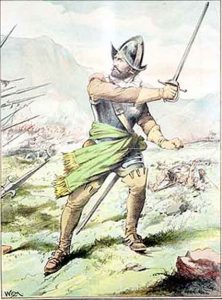
On July 6, 1642, with 100 officers in his company, Owen Roe O’Neill, landed in Donegal. A mere boy when he had left Ireland with his uncle, Hugh O’Neill, during the Flight of the Earls, he had won distinction as a military commander in the Irish Brigade of the Spanish Army. A trained soldier and military leader, he had returned to lead the fight for Ireland’s freedom. He was given command of the northern army which he rebuilt and began to challenge the English on the field of battle. In short order, he regained all that had been lost due to the procrastination of the Confederation, but jealous of his growing power, they hampered his efforts at every turn.
Then, on June 5, 1646, England sent their best field commander, General Monroe, against Owen Roe. This would silence the young upstart forever. Monroe had 6,000 men and a full compliment of field artillery. O’Neill had only 5,000 men and no artillery. The two armies met at the junction of the river Oonah and the Blackwater adjacent to the village of Benburb – a place that would live forever on the lips of the storytellers, for it was here, in one masterful battle, that Owen Roe proved his superiority and that of his army. Monroe’s men were fresh and he set them up so that he would have the advantage of the sun at his back. O’Neill kept Monroe’s nerves and the nerves of his men on edge for several hours in that hot sun while his men harassed them with hit and run skirmishing raids. Finally, when the sun had shifted to behind his back, O’Neill gave the word “Sancta Maria,” and launched a whirlwind attack. His cavalry captured Monroe’s guns, and his infantry overwhelmed the English legions driving them into the river. In one short hour, O’Neill had wiped out the pride of the British army. 32 standards were taken; Lord Ardes and 32 officers were captured; cannon, baggage, and 2-months provisions were taken; and 1,500 horses were now in Irish possession. 3,300 of Monroe’s army lay dead on the field, while Owen Roe lost but 70. Ulster had been won by Owen Roe O’Neill. The Confederation fearing his growing power, would eventually turn on O’Neill, and everything would be lost in the end. But for a brief while, all of Ireland was talking about Owen Roe O’Neill, and the Battle of Benburb on June 5, 1646.
Since the DUP endorsed Brexit it has been something of slippery slope for them, despite them telling us otherwise.
The DUP have successfully ensured that the limelight is fully on them in Britain. They done this by locking down a supply and demand deal with the Conservative Party, a deal they have said will bring untold fortune to Northern Ireland.
The British Government have committed an extra £1bn to NI, over a two-year period, and have also said that they will give the Executive a bigger say on £500m is allocated; all in exchange for he DUPs 10 MPs voting with the government on a “case by case” basis.
The deal between the DUP and Conservatives is one that opposition parties don’t support on the basis that Ms May would rather pay to stay in power than help a fledging NHS and schools:
While our schools are crumbling and our NHS is in crisis, Theresa May chooses to throw cash at 10 MPs in an attempt to keep her place in Number 10 – Tim Farron, Liberal Democrat Leader.
The former permanent secretary to the Treasury, Nick Macpherson ttweeted: “DUP will be back for more … again and again. They have previous in such matters.”
The Labour first minister of Wales, Carwyn Jones, called the agreement outrageous, describing it as a “straight bung to keep a weak prime minister and a faltering government in office”.
The SNP leader, Nicola Sturgeon, expressed anger that the money was being paid outside the Barnett formula, which is designed to distribute funds fairly between devolved nations:
In concluding this grubby, shameless deal the Tories have shown that they will stop at nothing to hold on to power – even sacrificing the very basic principles of devolution.
This £1bn is currently with the Treasury and Parliament haven’t voted on its allocation, so this raises the question for many: When will this money be timetabled for allocation and will it be released during PM Mays tenure? A question the DUP cannot answer, but they continually echo deputy leader Nigel Dodds MP, when he says that outrage at the deal was “hypocrisy of the highest order”, saying the deal would deliver for all the people of the Northern Ireland – and the United Kingdom.
The argument continues that the Conservative government has found a way of making sure the payment to the DUP isn’t ‘Barnettable’ – as described by Gina Miller.
Even before the extra cash given to Northern Ireland, the province was already benefiting from £11,000 public spending per head of population, compared to just £8,800 for England – how is this fair? A question I posed to the DUP via email, but haven’t received a reply.
The questions for the DUP don’t end with their supply and demand deal, the most prevalent at home at present is their views on abortion and the pressure the vote in the Republic of Ireland when the public voted to repeal the Eighth Amendment of the Constitution Act 1983 amended the Constitution of Ireland by inserting a subsection recognising the equal right to life of the pregnant woman and the unborn.
Abortion in Northern Ireland is being blocked by Theresa May’s deal with the DUP, Sinn Féin’s leader, Michelle O’Neill, claims, blaming the party’s confidence deal with the Conservatives for holding back women’s rights.
After meeting the Northern Ireland secretary, Karen Bradley, Ms O’Neill said she was convinced the government was unwilling to move on the issue because of the deal with the Democratic Unionists, whose MPs support May’s minority government.
Ms O’Neill’s comments come as the supreme court narrowly dismissed a legal challenge to Northern Ireland’s tough abortion laws, saying there was no jurisdiction to consider the latest case because there was no actual or potential victim of an unlawful act involved in it.
A majority of judges, however, added that Northern Ireland’s abortion law was incompatible with the right to respect for private and family life as guaranteed by the European convention on human rights.
Many argue that he DUP are increasingly at odds with society on issues such as abortion and their opposition to same sex marriage. These arguments are not coming from opponents, but editors of newspapers such as The Newsletters Editor, Ben Lowry.
Mr Lowry argues that the DUP is out of step with the electorate for two reasons:
1 – DUP vote is more varied than it ever was (debateable)
2 – Society is becoming more liberal than the DUP can keep up with
DUP have also had its elected members, Jim Wells, refer to woman who get abortions as Nazis on the BBC Nolan Show. Sammy Wilson commenting in the HoC that outrageous claim that, without abortion laws, these children would have been: “Discarded and put in a bin before they were ever born” – PR disasters, a continuing theme for the DUP when it comes to societal issues, it seems.
Theresa May has praised “the Irish people” for the success of the Repeal the Eighth campaign, yet the Prime Minister is currently in a difficult situation as she strategically needs to maintain the DUP’s support.
Any speculation that the Republic’s victory would lead to a reconsideration of values by Northern Ireland was dispelled in another speech by Arlene Foster after the constitutional amendment, in which she condemned campaigners taking to the streets in celebration. Foster declared:
The DUP is a pro-life party and we will continue to articulate our position. Abortion is an extremely sensitive issue, and not one that should have people taking to the streets in celebration.
A change from Ms Fosters view in when in the UUP when she stated that Ireland’s stance on abortion as “downright insulting” to women, calling the country’s constitution “an archaic crutch to the Roman Catholic church.” No more “Home Rule is Rome Rule”
Sinn Fein’s leaders held up a sign at Dublin Castle reading ‘The North Is Next’, while in London, female ministers put pressure on Theresa May to demonstrate her feminist credentials by backing reform.
The party now finds itself in familiar hypocritical territory: threatening to self-implode if it doesn’t get the same Brexit treatment as the rest of Britain, while simultaneously relishing its divergence on basic rights like same sex marriage and abortion.
The DUP have also another elephant in the room; working class Loyalism and their failure to work in their favour, despite promising them the moon and the stars during the last election.
It has been argued that the DUP have used jingoism to retain their position of power, but used the working class to ensure that their (slim) lead is retained, but this is now being challenged more and more on social media and within working groups.
Currently there is a vein of Loyalism who want to move break the stereotype that exists when working class loyalism is referred to. At present he Mitchell Peace Institute a Queens University are facilitating discussions that are allowing Republicanism and Loyalism discuss what the working a working class voice needs and how representation can be facilitated regarding social issues; at the core of some thinking is that he DUP need to earn their vote from Loyalism, not just assume that it will be given. Loyalism is asking the mature question: “What’s in it for our community?”
Then we come to Brexit. The DUP have issued all sorts of warnings over Brexit, but have failed to give any assurances on the ongoing issue.
Most recently Arlene Foster has reiterated her red-line that:
No Prime Minister could ever agree to any arrangement which would threaten the economic and constitutional integrity of the United Kingdom.
Michel Barnier responded:
it would not be feasible to extend the European Commission’s backstop plan – under which Northern Ireland would remain part of the EU customs union after Brexit – to include the whole of the United Kingdom.
Without labouring the point, DUP have only one position on Brexit; They don’t want a hard border, but are unsure on how to express their position, without alienating themselves with the British public. Again. They have jumped inboard the May Ship and have total disregard for NI and the impact a Brexit will have on its people and ultimately, the Union.
We then come to the situation of Irish reunification. The DUP leader has said she will leave the country if there is a united Ireland. In other words, she wouldn’t accept democracy via a border poll, which her predecessor Peter Robinson is in favour of (despite wanting to change he goalposts of the GFA to a “majority of one”), much to the dismay of many unionists.
The DUP have helped keep the deepening conversation of Irish reunification alive by pushing their closed agenda in Britain and in turn exposing their fault lines and what they oppose and why. One journalist on Twitter questioned why the treasury wont publish the exact money given to NI and wouldn’t this money be better divided between “the entire UK”
DUP must take heed of census figures in 2011 showing a narrowing gap between the two main religions in NI, putting the Protestant population at 48%, just 3% ahead of the Catholic one (45%).
Figures from 2016 show that among those of working age, 44% are now Catholic and 40% Protestant.
The difference is even more marked among schoolchildren, with 51% Catholic and 37% Protestant.
Only among the over-60s is there a majority of Protestants, with 57% compared to Catholics on 35%.
Ironically, three years from now we will end up on the centenary of the NI state, where we actually have a state that has a Catholic majority; Will the SoS call for a border poll in 2021 if the majority want it?
Overall, societal questions exist for the DUP to answer on Brexit, working class Loyalism, the supply and demand timetable and issues such as same sex marriage and abortion issues and a border poll; These questions aren’t going away, and as society moves on, will the DUP continue to annex itself from us or give us answers?
Brian Horner has a background in the education sector and is now retired in the Portstewart area.