Posted by Jim on June 22, 2018
June 19, 2018 By Irish Echo Staff
By Irish Echo Staff
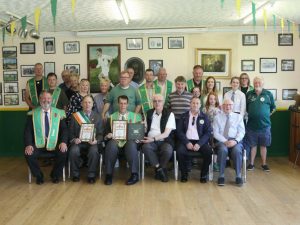
Members of the Ancient Order of Hibernians in County Tyrone have honored New York State and Suffolk County AOH for the existence and preservation of the Thomas Clarke/Kathleen Daly Clarke memorial in Manorville, Long Island.
The honors were bestowed at a special ceremony in Clarke’s hometown of Dungannon.
Tyrone AOH County President Gerry McGeough presented plaques to New York State Secretary John Manning, and Freedom for all Ireland Chairman Martin Galvin in an event co-hosted by the Thomas Clarke Gaelic Football Club at O’Neill Park.
The visiting New Yorkers, on behalf of AOH NY State President Victor Vogel, presented a signed copy of the 1918 Irish Freedom Mandate measure passed by the New York State legislature,
Said Gerry McGeough during the ceremony: “Tyrone AOH is fully aware and deeply appreciative of the work done across the United States and particularly in New York State by the AOH, most recently the 1918 Irish Freedom Mandate.
“We do not often get the chance to thank you directly. Tyrone is especially proud that Thomas Clarke was a Tyrone man and a Dungannon man.
“We learned of the beautiful memorial that New York State AOH and Suffolk County have erected at his American home site. We wanted to give special recognition to you and are grateful to your State President Victor Vogel, and to you for coming and accepting these awards.
“County Tyrone AOH continues to grow, helped by groups like the Thomas Clarke Gaelic Football Club, here with us today, and the efforts of the AOH in America.”
New York AOH State Secretary John Manning said in reply: “On behalf of the New York State Ancient Order of Hibernians and representing our state president, Vic Vogel, we are deeply grateful to County Tyrone AOH and the Thomas Clarke Gaelic Football Club for honoring us with these presentations.
“As an organization that cherishes Irish history and is deeply committed to freedom for all Ireland, we take pride that in addition to being a Tyrone man and a Dungannon man, the great patriot Thomas Clarke was also an American citizen, who lived in Brooklyn and Manorville in Suffolk County New York before returning to Ireland and beginning the work of organizing and leading the Easter Rising of 1916.
“The memorial to him at his home site in Suffolk County, and the many commemorations we hold across the state and across America, reflect our continuing commitment to see Thomas Clarke’s county and all of the six counties get the national freedom and sovereignty he and the other Easter Week leaders proclaimed and pledged in 1916.
“These awards will be carried back and displayed in a special place of honor in our AOH halls and be a sign of further cooperation between us. Our state president, Victor Vogel, has asked me to convey a message that he hopes to visit you soon.”
Martin Galvin, New York State Freedom for all Ireland chairman, presented a copy of the New York State legislature’s measure honoring the centenary of Ireland’s 1918 Mandate for Freedom to Michael Corrigan, chairman of the Thomas Clarke GFC, who hosted the ceremony.
Galvin said: “It is very special for us as New York Hibernians to receive recognition in Ireland. One of the main objectives of the AOH in America is to promote freedom for all Ireland. This year we will mark the centenary of the all-Ireland vote where the Irish people voted an overwhelming mandate for freedom for a thirty-two county all-Ireland parliament, or Dáil Eireann, and for the 1916 Rising.
“Tragically Britain answered this democratic vote for freedom with military oppression, sectarianism and partition, and the price paid here in Tyrone and across the six counties. It never again permitted one all-Ireland vote.
“New York State AOH wishes to present you with a copy of the Irish Freedom Mandate Resolution, bearing the seal of the New York State Senate and Assembly, as a token of our continuing commitment and efforts throughout the year to support your right to freedom for all of Ireland.”
Michael Corrigan accepted the mandate and announced that it would be permanently displayed in the Museum Room of the stadium alongside a framed handwritten letter written by Thomas Clarke while in prison, along with other historical items.
Other dignitaries at the gathering included Dungannon Historian Bertie Foley, GAA official Art McCrory, Ladies AOH officers Michelle Robbins and Catherine Sewell, and Sperrin mountains environmental campaign activist Martin Tracey.
Following the ceremony, Martin Galvin attended a meeting hosted by Mark Thompson of Relatives for Justice at its Dungannon office.
Representatives of a number of victims’ families attended.
Mr. Thompson and the families briefed Mr. Galvin on the newly published legacy consultation document made public by the British government.
According to a release, “family after family talked about the delays, stonewalling and deceit which they have suffered over decades in trying to get justice.
“These tactics have made these victims deeply worried over what will emerge from new legacy structures. They were also deeply encouraged by the congressional initiative and new awakening stemming from the Mark Thompson’s emergency tour hosted by the New York State AOH earlier this year.”
Posted by Jim on
Brian Feeney relentlessly reminds us that the DUP has never accepted the Good Friday Agreement (GFA). This is even hard for someone like me to fully accept, but there is no escaping of it. Feeney, uncomfortably, makes us face it in this article below: ‘The DUP has never accepted the GFA. Instead of agreeing to accommodation offered by Sinn Féin they retreated to wallowing in flags, glorifying [Protestant] murder gangs, provocative Orange marches, denigrating Irish, opposing modernizing legislation, commemorating annually sedition, treason, armed insurrection against their British government and at the same time deploring and condemning anyone engaged in the same activity against the Northern administration.’”—Fr. Sean McManus.
Brian Feeney. Irish News. Belfast. Wednesday, June 20, 2018
THE outgoing President of the Methodist Church here, the Rev Dr Laurence Graham, addressed the Sinn Féin ard fheis at the weekend on the matter of reconciliation.
For some years now, since the Rev David Latimer of First Derry Presbyterian Church spoke in 2011, Sinn Féin have endeavoured to include a Protestant or unionist speaker at ard fheisanna. It’s part of the party’s ‘outreach’ strategy.
Dr Graham reminded delegates that reconciliation is not a project but “a process which never ends”.
Of course, they knew that, but the evidence is that as far as political Unionism is concerned, it’s a blind alley.
Reconciliation has several meanings, the two main ones being restoring friendly relations and making one view, belief or position compatible with another.
You can see that’s never going to happen here. First there never were any relations between Sinn Féin and political unionism, friendly or otherwise, and secondly the views and beliefs of the two are inherently incompatible.
The fundamental mistake Sinn Féin is making is allowing religious concepts and definitions to be confused with politics.
Once you start banging on about reconciliation in the north you immediately enter favourite unionist religious territory of repentance and apology.
In a nutshell, for many DUP people you can’t have reconciliation until you repent of what they, in their insufferable self-righteousness, see as your sins – religious drivel that has nothing to do with politics.
However, before he got onto religious aspects – not, mind you, those of the DUP ‘exclusive brethren’ variety – Dr Graham did suggest one useful element which is essential for successful politics.
He recommended sitting down and having a chat over coffee with someone of different views.
“Get to know the person,” he advised. That, unfortunately, is something DUP politicians refuse to do.
Their behaviour at Stormont (and councils) was/is appalling. They refuse to enter lifts with Sinn Féin people, or in many cases even pass the time of day.
Ironically the only person who developed close personal relations was the most egregious bigot, Paisley.
You won’t remember this, but 25 years ago or so when a trip to South Africa was organised in the futile belief it would broaden the minds of unionists they refused to go into the same room as Sinn Féin even to hear an address by Nelson Mandela, a man who had something to teach about political reconciliation.
So when Mary Lou McDonald says, “People suffered, were hurt, endured pain, inflicted pain. We can’t make that go away but we can say sorry to each other – I believe it’s important that we do”, her voice travels into a void.
There’s no echo from political unionism, no reply, no reciprocation, zero.
No unionist politician has ever apologised for the stinking political slum their forefathers jerry-built here or the way they, with their political police and armed militia, treated northern Nationalists[Catholics].
On the contrary, after the rotten structure collapsed in catastrophe in 1972 they spent 30 years trying to recreate it, refusing to share power with the harmless, hapless SDLP even at council level – laughably at a time when councils had no powers.
Even after the Good Friday Agreement was ratified by 72 per cent in a referendum in 1998 most unionists switched to DUP to reject that democratic decision.
The DUP has never accepted the GFA. Instead of agreeing to accommodation offered by Sinn Féin they retreated to wallowing in flags, glorifying [Protestant] murder gangs, provocative Orange marches, denigrating Irish, opposing modernizing legislation, commemorating annually sedition, treason, armed insurrection against their British government and at the same time deploring and condemning anyone engaged in the same activity against the Northern administration.
Not for a second does it occur to any Unionist [Protestant] political representative that for many Nationalists and Republicans [Catholoc], still, The North has no legitimacy politically or constitutionally.
However, given the reforms and the guarantees of the Good Friday Agreement, Nationalists and Republicans were prepared to cooperate in running The North on the basis of equality of status and parity of esteem.
The DUP bought none of that. None of them has ever praised the concept of sharing power.
You can see the distance they have to travel if they won’t even have a chat with a Republican over coffee.
Posted by Jim on
Tuesday, June 26, is Federal Primary Day and turnout is needed for the following UFA endorsed candidates.
Congressional District 11 Dan Donavan
9:00 AM
Campaign HQ, 109 New Dorp Plaza, Staten Island 10306
Congressional District 12 Carolyn Maloney
Monday, 6/25, 5:00 – 9:00 PM (phone banking)
Tuesday, 6/26, anytime from 9:00 AM – 6:00 PM
204 E23 Street, New York, NY 10010 – 4th Floor
Congressional District 14 Joe Crowley
Help needed in 2 locations:
Bronx
9:00 – 11:00 AM or 4:00 – 6:00 PM
1640 Eastchester Road, Bronx, NY 10461
Queens
9:00 – 11:00 AM or 4:00 – 6:00 PM
80-22 Northern Blvd, Jackson Heights, NY 11371
We support candidates that support our members and their families.
Posted by Jim on
22 June 2018
East Londonderry MP Gregory Campbell has met with the Shadow Secretary of State Tony Lloyd. Mr Campbell was accompanied at the meeting by victims of terrorism from Innocent Victims United (IVU). The DUP MP had previously invited Labour Leader Jeremy Corbyn to meet with victims when he visited Northern Ireland recently.
Mr Campbell said,
“This was a useful discussion with the Shadow Secretary of State on some of the current issues within Northern Ireland. Most importantly however I was glad that Tony Lloyd took the opportunity to meet with some victims of IRA terrorism.
It is disappointing that Jeremy Corbyn could not find the time for such a meeting during his recent visit. I hope this can be the first step to greater engagement by the Labour Party with the victims of terrorism.
As we seek to deal with issues on the legacy of the past in Northern Ireland, the voice of victims must be central to that process. There must be a clear distinction between terrorists and those who suffered at their hands. Given Jeremy Corbyn’s past statements and his close association with republicans there is an obvious unease amongst many victims about the Labour Party’s position on terrorism.
Many of those who suffered at the hands of the IRA also lived in border communities. Many of those who now present themselves as experts on the border with the Irish Republic when it comes to Brexit appear less interested in how, even with a so-called ‘hard border’ in the past, terrorists were able to cross it to evade capture and justice.”
Speaking in the aftermath of today’s meeting facilitated by Gregory Campbell MP, Kenny Donaldson, spokesman for Innocent Victims United stated:
“We welcomed the opportunity to meet with Tony Lloyd, Shadow Secretary of State for Northern Ireland and we are grateful to the offices of Gregory Campbell, MP for facilitating this opportunity.
Today’s meeting is but a first step and the real test of the UK Labour Party’s bona fides towards the legitimate needs and rights of innocent victims and survivors of PIRA’s terrorism will be their leader’s willingness to now meet with such affected individuals. This meeting follows several years of requests made by Innocent Victims United, South East Fermanagh Foundation, Derg Valley Victims Voice, politicians and many others and the person actually sought after – Jeremy Corbyn was of course not the person to come.
Mr Corbyn has felt able to come across and travel to the border to talk about Brexit, to talk about economics, to talk about the need to ensure a frictionless border, to talk about the need to ensure no barriers are put up affecting relationships within and between the people of both jurisdictions on this island, but he has yet to come to the Border to speak to those who bore the price of a porous border which existed for over 30 years and which allowed the Provisional IRA to murder Mr Corbyn’s fellow citizens. That border was not a ‘hard border’ and our neighbouring State – The Republic of Ireland has yet to account for its’ failures in protecting life, failures to prevent attacks from being launched from its’ territory and also failing to extradite terror suspects.”
David Kelly, son of Pte Patrick Kelly, Irish Defence Forces who was murdered by the Provisional IRA alongside a young Garda recruit when attempting to rescue prominent businessman Don Tidey who had been held captive for ransom demands by PIRA terrorists in Leitrim remarked:
“I appreciated the opportunity to advise Mr Lloyd of my family’s story, I am not a citizen of the United Kingdom but my family know too well the impact of Provisional IRA terrorism.”
Meanwhile Shelley Cummings (Castlederg) whose brother Kenneth Smyth and Uncle Lexie Cummings were murdered remarked:
“The victims of Provisional IRA terrorism have been deeply concerned that the leadership of the British Labour Party appears to be heavily influenced by those who have been explainers or apologists for the armed campaign of The Republican Movement. Our loved ones were stolen from us by those who sought to coerce the people into accepting their warped United Ireland, Ourselves Alone utopia. Jeremy Corbyn, John McConnell and others need to come to the border and be educated around the innocent people whose lives were stolen through a campaign of ethnic cleansing and they then need to adapt their policy positioning on these issues.”
Mr Donaldson concluded:
“We call for Mr Corbyn to prioritise a visit to the West of Northern Ireland where victim’s representatives will bring him and colleagues out to the border so that he might be educated as to the ethnic cleansing campaign which threatened to bring about civil war within this Region of the United Kingdom.”
Posted by Jim on
21 June 2018
Following a visit by European Commission President Jean-Claude Juncker to the Republic of Ireland, DUP Deputy Leader Nigel Dodds has said;
“Mr Juncker’s claim that “Ireland is not alone” is false security for the country which would be most severely impacted by a no deal Brexit. If Mr Juncker was really focused on helping Ireland, he would be encouraging the EU to focus on getting a post Brexit trade deal in place.
The Republic of Ireland is being used a bargaining chip by the EU. This is a selfish interest. The United Kingdom is a crucial market for Republic of Ireland companies especially in the agri-food sector.
The plan put forward by Mr Juncker and Mr Barnier which would lead to Northern Ireland being cut off from its main market in Great Britain was disgraceful and offensive to unionism in Northern Ireland. Both the Labour Party and the Prime Minister have ruled out such a step.
Rather than focus on backstop arrangements, Ireland would be better served by a sensible new trade deal which would work for the EU, the United Kingdom and importantly the Republic of Ireland.”