Posted by Jim on

A deep-thinking republican with a great sense of humour
THE FOURTH IRA Volunteer to join the hunger-strike for political status was Joe McDonnell, a thirty-year-old married man with two children, from the Lenadoon housing estate in West Belfast.
A well-known and very popular man in the Greater Andersonstown area he grew up, married and fought for the republican cause in, Joe had a reputation as a quiet and deep-thinking individual, with a gentle, happy go-lucky personality, who had, nevertheless, a great sense of humour, was always laughing and playing practical jokes, and who, although withdrawn at times, had the ability to make friends easily.
As an active republican before his capture in October 1976, Joe was regarded by his comrades as a cool and efficient Volunteer who did what he had to do and never talked about it afterwards.
Something of a rarity within the Republican Movement, in that outside of military briefings and operational duty he was never seen around with other known or suspected Volunteers, he was nevertheless a good friend of the late Bobby Sands, with whom he was captured while on active service duty.
Not among those who volunteered for the earlier hunger strike last year, it was the intense disappointment brought about by the Brits’ duplicity following the end of that hunger strike, and the bitterness and anger that duplicity produced among all the blanket men, that prompted Joe to put forward his name the next time round.
And it was predictable, as well as fitting, when his friend and comrade Bobby Sands met with death on the sixty-sixth day of his hunger strike, that Joe McDonnell should volunteer to take Bobby’s place and continue that fight.
RESOLVE
His determination and resolve in that course of action can be gauged by the fact that never once, following his sentencing to fourteen years imprisonment in 1977, did he put on the prison uniform to take a visit, seeing his wife and family only after he commenced his hunger-strike.
The story of Joe McDonnell is of a highly-aware republican soldier whose involvement stemmed initially from the personal repression and harassment he and his family suffered at the hands of the British occupation forces, but which then deepened – through continuing repression – to a mature commitment to oppose an occupation that denied his country freedom and attempted to criminalise its people.
It was that commitment which he held more dear than his own life.
FAMILY
Joe McDonnell was born on September 14th 1951, the fifth of eight children, into the family home in Slate Street in Belfast’s Lower Falls.
His father, Robert, aged 59, a steel erector, and his mother, Eileen (whose maiden name is Straney), aged 58, both came from the Lower Falls themselves.
They married in St. Peter’s church there, in 1941, living first with Robert’s sister and her husband in Colinward Street, off the Springfield Road, before moving into their own home in Slate Street, where the family were all born.
These are: Eilish, aged 38, married with five children; Robert, aged 36, married with two children; Hugh, aged 34, married with three children; Patsy, aged 32, married with two children, and now living in Canada since 1969; Joe; Maura, aged 28 and single; Paul, aged 26, married with two children and Frankie, aged 24 and single.
Frankie is currently serving a five-year sentence on the blanket protest in H6-Block on an IRA membership charge, following his arrest in December 1976, and is due for release this December.
A ninth child, Bernadette, was a particular favourite of Joe’s, before her death from a kidney illness at the early age of three.
“Joseph practically reared Bernadette”, recalls his mother, “he was always with the child, carrying her around. He was about ten at the time. He even used to play marleys with her on his shoulders.”
Bernadette’s death, a sad blow to the family, was deeply felt by her young brother Joe.
DATING
One of his friends at that time was his future brother-in-law, Michael, and he began dating Goretti from around the time he was seventeen.
Joe and Goretti, who also comes from Andersonstown, married in St. Agnes’ chapel in 1970, and moved in to live with Goretti’s sister and her family in Horn Drive in Lower Lenadoon.
At that time, however, they were one of only two nationalist households in what was then a predominantly loyalist street, and, after repeated instances of verbal intimidation, in the middle of the night, a loyalist mob – in full view of a nearby Brit post, and with the blessing of the raving Reverend Robert Bradford, who stood by – broke down the doors and wrecked the houses, forcing the two families to leave.
INTERNMENT
The McDonnells went to live with Goretti’s mother for a while, but eventually got the chance to squat in a house being vacated in Lenadoon Avenue.
Internment had been introduced shortly before, and in 1972 the British army struck with a 4.00 a.m. raid.
Joe was dragged from the house, hit in the eye with a rifle butt and bundled into a jeep. Their house was searched and wrecked. Joe was taken to the prison ship Maidstone and later on to Long Kesh internment camp where he was held for several months.
Goretti recalls that early morning as a “horrific” experience which altered both their lives. One minute they had everything, the next minute nothing.
On his release Joe joined the IRA’s Belfast Brigade, operating at first in the 1st Battalion’s ‘A’ Company which covered the Rosnareen end of Andersonstown, and later being absorbed into the ‘cell’ structure increasingly adopted by the IRA.
RAIDS
Both during his first period of internment, and his second, longer, internment in 1973, as well as the periods when he was free, the McDonnell’s home in Lenadoon was constant target for British army raids.
During these raids the house would often be torn apart, photos torn up and confiscated letters from Joe (previously read by the prison censor) re-read by infantile British soldiers, and Goretti herself arrested.
In between periods of internment, and before his capture, Joe resumed his trade as an upholsterer which he had followed since leaving school at the age of fifteen. He loved the job, never missing a day through illness, and made both the furniture for his own home as well as for many of the bars and clubs in the surrounding area. His job enabled him to take the family for regular holidays but Joe was a real ‘homer’ and always longed to be back in his native Belfast.
BOMBS
Part of that attraction stemmed obviously from his responsibility to his republican involvement. An active Volunteer throughout the Greater Andersonstown area, Joe was considered a first-class operator who didn’t show much fear. Generally quiet and serious while on an operation, whether an ambush or a bombing mission, Joe’s humour occasionally shone through.
Driving one time to an intended target in the Lenadoon area with a carload of Volunteers, smoke began to appear in the car. Not realising that it was simply escaping exhaust fumes, and thinking it came from the bags containing a number of bombs, a degree of alarm began to break out in the car, but Joe only advised his comrades, drily, not to bother about it: “They’ll go off soon enough.”
Outside of active service, Joe mixed mostly with people he knew from work, never flaunting his republican beliefs or his involvement, to such an extent that it led some republicans to believe he had not reported back to the IRA on his second release from internment.
The Brits, however, persecuted him and his family continually, with frequent house raids, and street arrests. He could rarely leave the house without being stopped for P-checking, or held up for an hour at a roadblock if he had somewhere to go. A few months before his capture, irate Brits at a roadblock warned him that they would ‘get’ him.
Outside of his republican activity Joe took a strong interest in his children – Bernadette, aged ten and Joseph, aged nine – teaching them both to swim, and forever playing football with young Joseph on the small green outside their home.
CAPTURE
His capture took place in October 1976 following a firebomb attack on the Balmoral Furnishing Company in Upper Dunmurray Lane, near the Twinbrook estate in West Belfast.
The IRA had reconnoitred the store, noting the extravagantly-priced furniture it sold, and had selected it as an economic target. The plan was to petrol bomb the premises and then to lay explosive charges to spread the flames.
The Twinbrook active service unit led by Bobby Sands, was at that time in the process of being built up, and were assisted consequently in this operation by experienced republican Volunteers from the adjoining Andersonstown area, including Joe McDonnell.
Unfortunately, following the attack, which successfully destroyed the furnishing company, the escape route of some of the Volunteers involved was blocked by a car placed across the road.
During an ensuing shoot-out with Brits and RUC, two republicans, Seamus Martin and Gabriel Corbett were wounded, and four others, Bobby Sands, Joe McDonnell, Seamus Finucane and Sean Lavery, were arrested in a car not far away.
Three IRA Volunteers managed to escape safely from the area.
A single revolver was found in the car, and at the men’s subsequent trial in September 1977 all four received fourteen-year sentences for possession when they refused to recognise the court.
Rough treatment during their interrogation in Castlereagh failed to make any of the four sign a statement, and the RUC were thus unable to charge the men with involvement in the attack on the furnishing company despite their proximity to it at the time of their arrest.
ADAMANT From the day he was sentenced Joe refused to put on the prison uniform to take a visit, so adamant was he that he would not be criminalised. He kept in touch instead, with his wife and family, by means of daily smuggled ‘communications’, written with smuggled-in biro refills on prison issue toilet paper and smuggled out via other blanket men who were taking visits.
Incarcerated in H5-Block, Joe acted as ‘scorcher’ (an anglicised form of the Irish word, scairt, to shout) shouting the sceal, or news from his block to the adjoining one about a hundred yards away. Frequently this is the only way that news from outside can be communicated from one H-Block to the blanket men in another H-Block.
It illustrates well the feeling of bitter determination prevailing in the H-Blocks that Joe McDonnell, who did not volunteer for the hunger strike last year because, he said, “I have too much to live for”, should have become so frustrated and angered by British perfidy as to embark on hunger strike on Sunday, May 9th, 1981.
IMPACT
In June, Joe was a candidate during the Free State general election, in the Sligo/Leitrim constituency, in which he narrowly missed election by 315 votes.
All the family were actively involved in campaigning for him, and despite the disappointment at the result both they and Joe himself were pleased at the impact which, the H-Block issue had on the election, and in Sligo/Leitrim itself.
Adults cried when the video film on the hunger strike was shown, his family recall, and they cried again when Joe was eliminated from the electoral count.
MARTYR
At 5.11 a.m., on July 8th, Joe McDonnell, who – believeably, for those who know his wife Goretti, his children Bernadette and Joseph and his family – “had too much to live for” died after sixty one days of agonising hunger strike, rather than be criminalised.
Posted by Jim on July 7, 2018
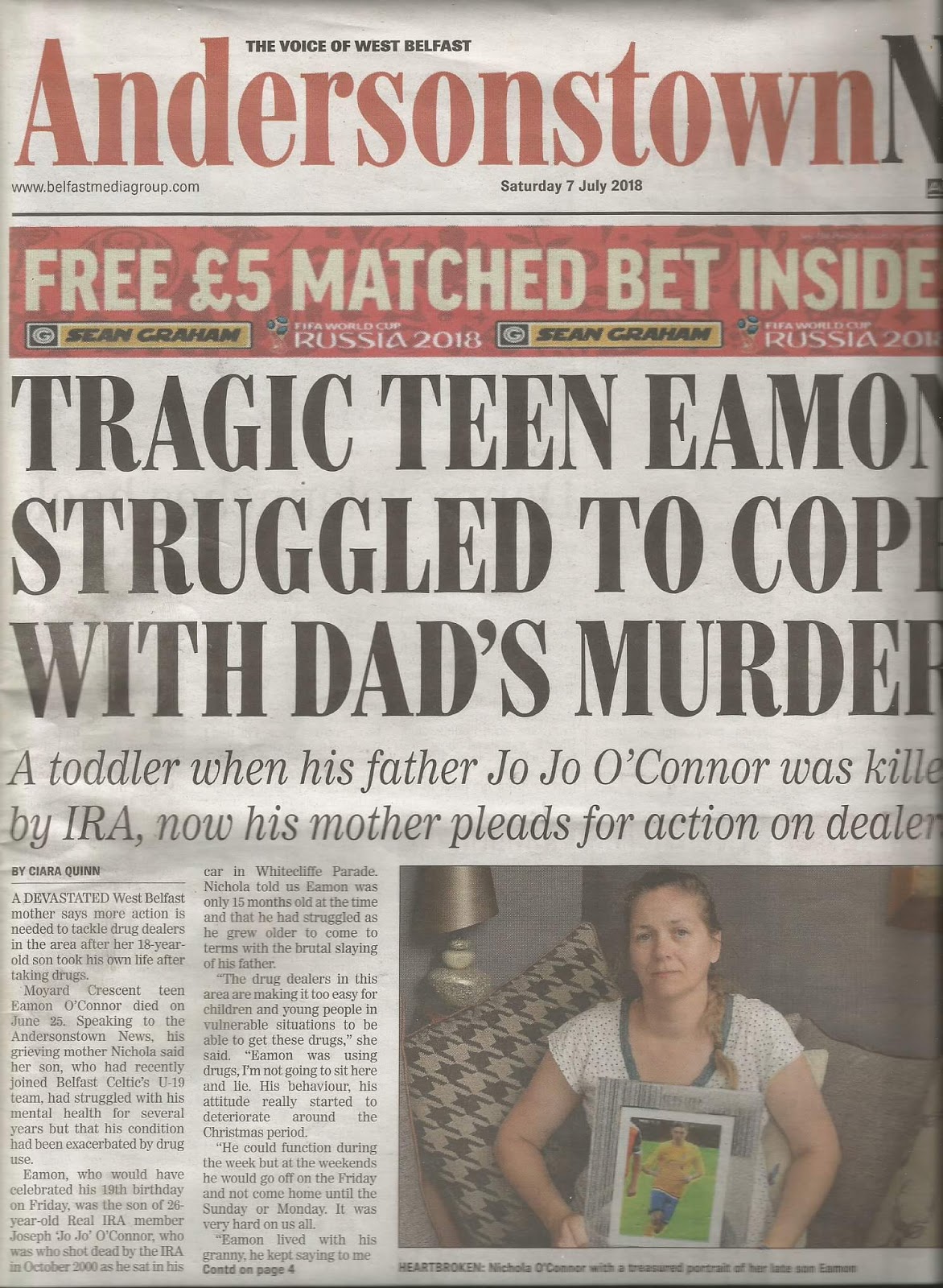
Tarlach MacDhónaill writes on the Andersonstown Town News admission of IIRA culpability in the 2000 murder of Joseph O’Connor.
This week’s Andersonstown News has finally accepted and printed what Belfast Republicans have known for almost two decades, that the Provisional I.R.A. murdered Volunteer Joseph O’Connor.
It is not altogether surprising that such a ground-breaking shift from Provisional policy has passed-off largely unnoticed. The O’Connor family are in mourning following the tragic, sudden death of Jo Jo’s second youngest son Eamon (18) only weeks ago. Eamon’s death was preceded by that of his Grandmother Margaret’s just last year.
It is then understandable that the wider O’Connor family and their friends are presently consumed by grief. As Jo Jo was a member of the Real I.R.A which doesn’t exist anymore; it is unlikely that any statement from the group in relation to Jo Jo’s death will ever be carried in the media again.
The British-backed murder of I.R.A volunteer Joseph O’Connor arrived at an extremely delicate time for the Provisionals, during the initial stages of a sham-peace. The murder was planned and carried out with an immediate dual-aim, to execute an anti-agreement Republican while designating blame to other Anti-agreement Republicans in the process. From the very moment they shot him multiple times in the head and face, the death-squad busied themselves with the task of concealing their movement’s involvement in his murder.
Unfortunately for Sinn Féin, Ballymurphy is a small place. A seemingly arrogance-based brazenness allowed people to identify the death-squad who shot ‘Jo Jo’. This was followed by a number of mistakes being made during their escape. Logistical blunders aside, locals talk, and literally within minutes of Joseph O’Connor’s murder, his neighbours, his family, his friends and his comrades knew who was responsible, the Provisional I.R.A.
Immediately after the murder, local Sinn Féin spokespersons attempted to deflect blame onto other Republicans, they were assisted in their attempts by the RUC who raided the offices of Republican Sinn Féin, publicly citing Joe’s murder as their motive.
Within days the party’s accepted local mouthpiece “The Andersonstown news” also helped to raise the notion of an internal Republican feud by using ambiguous language to report on what the community knew to be facts. Even a year later the “Andersonstown news” continued to ply the idea of an internal Republican dispute as being responsible for the murder of Joseph O’Connor. Upon being challenged by members of Belfast 32CSM the paper’s editorial board smugly stated that their editorial line was ‘No I.R.A. involvement in the murder of Joseph O’Connor’, and that his death was the result of a ‘dissident feud’.
Joseph’s family friends and comrades were not alone in voicing their disgust at what the Provisional movement had done. Many well-known Republicans, including former life-sentence prisoner and blanket-man Anthony McIntyre and Maidstone escapee Tommy Gorman, added their voices to a steady stream of condemnation which naturally emanated from within the Republican base.
All of those who told the basic truth, for the simple sake of basic truth, faced immediate vilification for doing so, homes were picketed, vile abuse was spat at the direction of honest commentators, and one of the weapons used to attack them was the indisputable Sinn Féin alligned “Andersonstown news.”
A decade ago an opinion piece written by ‘Squinter’ criticising Gerry Adams appeared in the Andersonstown News. This story made international headlines because the Andersonstown News was then, as it is now, considered to be an organ of the Provisional movement and such internal criticism of Sinn Féin was unprecedented. When Gerry Adams was accused of forcing the paper’s editorial board to issue a grovelling, front-page apology to him, Sinn Féin’s critics went into overdrive. It is in this story that you will find evidence of the AndersontownNews’ links to and representation of Sinn Féin.
The magnitude therefore of the paper’s admission of I.R.A responsibility for Joe O’Connor’s murder poses a particular significance at this time.
Margaret O’Connor did not want revenge for her son’s death, all she asked was an admission of responsibility, perhaps an apology from those behind it. As a grieving mother, she lobbied Sinn Féin through Relatives for Justice and promised that as a republican, she would not pursue prosecutions, she kept that promise till her dying day.
Margaret O’Connor was denied this grace, she was offered nothing in return and sadly died last year in the very same turmoil that had been imposed upon her by a Provisional death-squad on Friday 13th of October 2000 outside her own home.
Perhaps the Andersons town News did not intend to accept that Jo Jo’s death was at the hands of the I.R.A. It has done so however and this simply cannot be ignored. The paper has gone out of its way over the years in publicizing its position that there is only one I.R.A, and that they are the Provisionals. Maybe it is an editorial oversight and maybe it is in preparation for something to come, maybe it is even a huge-leap forward in the pursuit of truth for victims of conflict.
Whatever the reasons questions now exist which demand answers. Why was Margaret O’Connor sent to her grave without an admission by Sinn Féin that the Provisional I.R.A had murdered her son?
Why has a media outlet, so closely and openly associated with Sinn Féin MLA Máirtín Ó Muilleoir challenged the leadership of Sinn Féin in this fashion?
Will Sinn Féin now tell the Republican people of Belfast the truth and apologise for the lies they told them in 2000 and ever since?
Will all of those who received Provisional death threats for telling the truth about Joseph O’Connor’s murder now be pardoned by the Army Council?
Or, Will Squinter return next Wednesday and apologise for making the biggest blunder since ‘they haven’t gone away you know’?
Posted by Jim on
“Although the Orange Order likes to depict its parades as a quaint custom, a bit like Irish Morris dancing, it practices the dominance of one set of religious beliefs over another-—even though it claims to stand for civil and religious liberty.
It is a sectarian organisation, which influenced and even encouraged successive unionist administrations here in anti-Catholic discrimination….
The Somme dead were slaughtered as much by their own generals as the Germans, in defence of an empire which thrived on atrocities over the next 50 years. These included concentration camps in Kenya and Malaya, in which a total of two million civilians were held, the murder of up to 1,000 peaceful protesters in Amritsar, India, and the torture of about 3,000 civilian in Cyprus…”
Patrick Murphy. Irish News. Belfast. Saturday, July 7, 2018
There was a huge parade in east Belfast on Monday evening, but none on Thursday. “How very uninteresting,” you say, “is that the best you can offer us this morning?”
We are just coming to the interesting bit. Monday’s parade was an Orange Order glorification of British forces fighting for the empire at the Somme, one of the world’s bloodiest battles.
Thursday marked the 70th anniversary of the first patient being treated under the National Health Service. There were no celebratory parades (although the trades unions had a ‘Save the NHS’ march the previous week).
The beginning of the NHS, which saved millions of lives, is less important to us than a battle which cost over a million lives. Bevan, the Labour minister who introduced the NHS, described it as “the most civilised step any country had ever taken”.
The poet Wilfred Owen, who fought at the Somme, wrote of a soldier dying on a moving cart: “If you could hear, at every jolt, the blood/Come gargling from the froth-corrupted lungs”.
Despite that, we celebrated war on Monday and largely ignored medical advances on Thursday. So why have we developed such a shallow understanding of history and how have we allowed it to warp our social values and attitudes? The answer lies in sectarianism, social class and slovenly thinking.
Monday’s Orange parade in east Belfast was just one of several which celebrated the Boyne and, in some cases, the bloody Somme.
Although the Orange Order likes to depict its parades as a quaint custom, a bit like Irish Morris dancing, it practices the dominance of one set of religious beliefs over another – even though it claims to stand for civil and religious liberty.
It is a sectarian organisation, which influenced and even encouraged successive unionist administrations here in anti-Catholic discrimination.
Its glorification of the First World War appears similar to Karen Bradley’s belief that those at the Somme “gave their lives for our freedom” and Sinn Féin’s wreath at Belfast City Hall proclaiming its “proud and loving memory of the dead”.
The Somme dead were slaughtered as much by their own generals as the Germans, in defence of an empire which thrived on atrocities over the next 50 years. These included concentration camps in Kenya and Malaya, in which a total of two million civilians were held, the murder of up to 1,000 peaceful protesters in Amritsar, India and the torture of about 3,000 civilian in Cyprus. (And if I had time, I would mention the Black and Tans.)
Most appalling was Churchill’s starving four million Bengalis to death in 1943 by diverting their food to British soldiers. He later said: ” I hate Indians. They are a beastly people with a beastly religion.”
So whether they knew it or not, those at the Somme fought and died for an evil and inhuman empire. Thus they are to be mourned as victims, not glorified as heroes.
The NHS, on the other hand, is an example of all that is good in our society (or was in the 1940s, when it began.) Oddly, its origins can be traced to the Somme.
The failure of the state to provide employment, housing and health facilities after World War I led to near revolution in Britain. Mindful of what happened in Russia, the Labour Party recognised that there would have to be significant improvements in social welfare to cater for the homecoming heroes after World War II.
The Conservative Party voted 21 times against the creation of the NHS in 1948 and, of course, unionists at Stormont (elected with the help of the Orange Order) unsuccessfully opposed all Labour’s welfare policies.
Doctors voted 10 to 1 against its introduction, so Bevan gave consultants the right to run their own private businesses alongside the NHS, even though public taxes fund their training.
As a result, those with money today can jump the NHS queues – hardly what Bevan had in mind, but an example of the social and economic inequality which the Orange Order appears not to notice.
And that’s where the slovenly thinking comes in. Wilfred Owen described the claim that it was sweet and honourable to die for your country as “The old Lie” (and we should know that here). Dying for a flag is pointless, because those in charge of society before the dying begins tend to be still in charge when the dying is done and they usually do very little dying themselves.
Glorifying war and ignoring people’s welfare is merely the perpetuation of what might be called fake history. There was a lot of it about this week.
Posted by Jim on
Calls for a fresh inquest into the McGurks Bar Bombing in Belfast have
been rejected by the Six County Attorney General.
Fifteen Catholic civilians including two children were killed in the UVF
blast in December 1971, which was then falsely blamed by the Crown
Forces on an IRA ‘own goal’.
Relatives and campaigners discovered a large amount of new evidence not
heard at the original inquest, which was held the year after the
atrocity. It was confirmed that the British Army bomb squad knew the
bomb had been placed at the entrance to the bar and was not inside, as
was claimed.
Gerard Keenan, whose parents Sarah and Edward Keenan were both killed in
the bombing, said, “This is yet another devastating blow to family
members who have campaigned for truth and justice for two generations.
“At no stage up to the present day have our families been able to rely
on a just, fair and transparent police investigation. We have had to
discover and retrieve new evidence regarding the McGurk’s Bar Massacre
ourselves.”
KRW Law, who represent a number of the victims’ families, are expected
to seek clarification of the decision.
“The families are unhappy with the decision given the serious
difficulties they have faced in establishing the truth concerning the
death of their loved ones,” they said.
“There is on-going public law and civil litigation being pursued before
the courts in Northern Ireland but the decision of the Attorney-General
is unwelcome and his response will be carefully analysed.”
A Police Ombudsman’s report in 2011 said RUC (now PSNI) police had shown
an “investigative bias”.
However, the PSNI’s then-chief Matt Baggott refused to accept that
finding by the ombudsman and a subsequent probe by the PSNI’s Historical
Enquiries Team (HET) concluded there was no such bias.
Mr Baggott’s successor George Hamilton reversed the police’s position in
2015, admitting there had been bias in the initial RUC investigation. He
said the HET report findings had been amended to reflect the change in
stance.
Sinn Fein’s North Belfast representative Gerry Kelly expressed “deep
disappointment” at the refusal to hold a new inquest.
“These families have been campaigning for truth and justice for 47
years,” he said.
“There are still too many unanswered questions about the involvement of
various state agencies in the attack on McGurk’s Bar both before and
after the massacre of 15 people.
“A fresh inquest was an opportunity to test in the courts the mounting
weight of evidence, painstakingly uncovered by families and campaigners,
around the involvement of the state.
“The families have waited over 40 years for a new inquest and Sinn Fein
will continue to support the families in their campaign.”