Posted by Jim on July 7, 2018
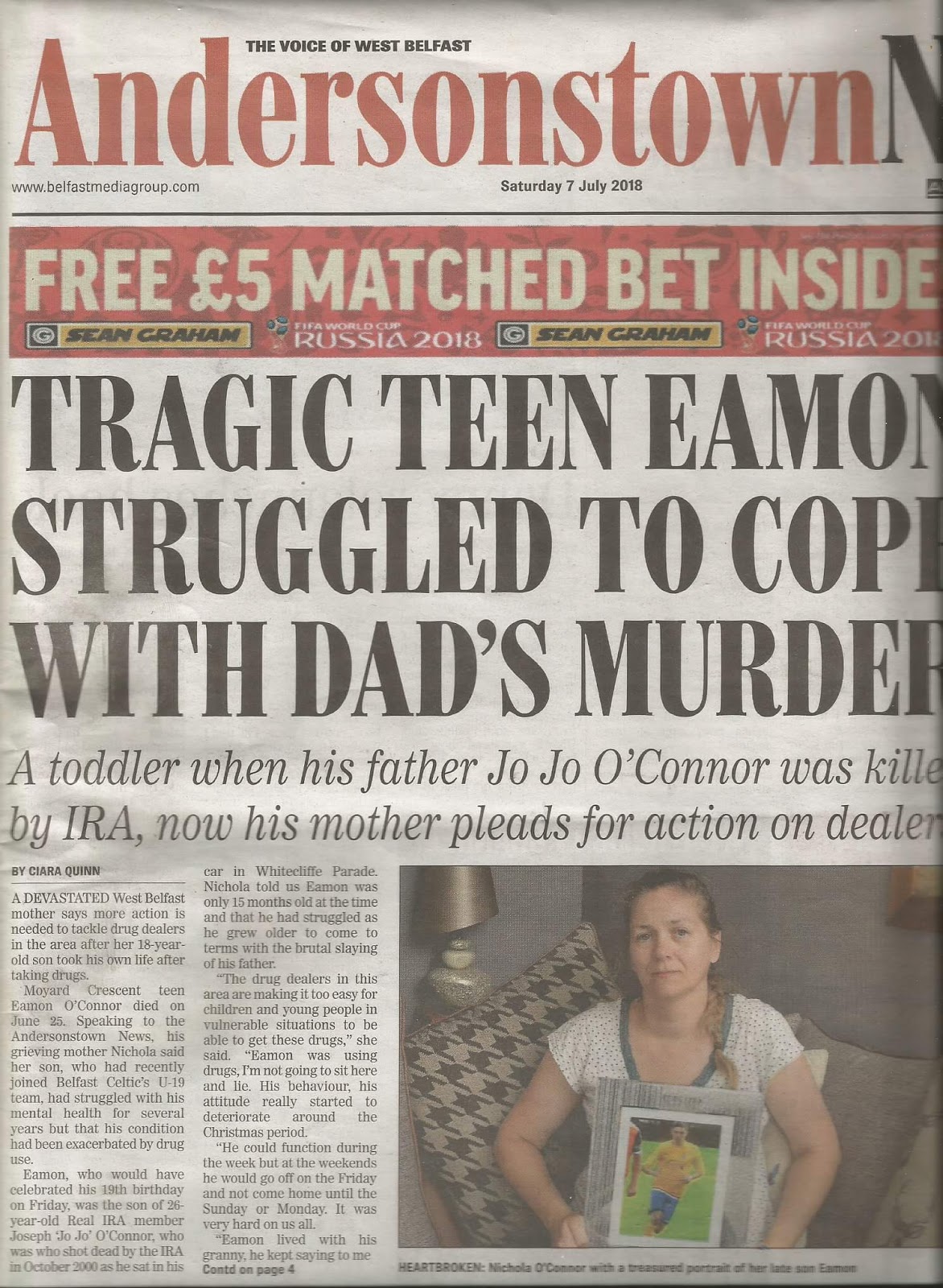
Tarlach MacDhónaill writes on the Andersonstown Town News admission of IIRA culpability in the 2000 murder of Joseph O’Connor.
This week’s Andersonstown News has finally accepted and printed what Belfast Republicans have known for almost two decades, that the Provisional I.R.A. murdered Volunteer Joseph O’Connor.
It is not altogether surprising that such a ground-breaking shift from Provisional policy has passed-off largely unnoticed. The O’Connor family are in mourning following the tragic, sudden death of Jo Jo’s second youngest son Eamon (18) only weeks ago. Eamon’s death was preceded by that of his Grandmother Margaret’s just last year.
It is then understandable that the wider O’Connor family and their friends are presently consumed by grief. As Jo Jo was a member of the Real I.R.A which doesn’t exist anymore; it is unlikely that any statement from the group in relation to Jo Jo’s death will ever be carried in the media again.
The British-backed murder of I.R.A volunteer Joseph O’Connor arrived at an extremely delicate time for the Provisionals, during the initial stages of a sham-peace. The murder was planned and carried out with an immediate dual-aim, to execute an anti-agreement Republican while designating blame to other Anti-agreement Republicans in the process. From the very moment they shot him multiple times in the head and face, the death-squad busied themselves with the task of concealing their movement’s involvement in his murder.
Unfortunately for Sinn Féin, Ballymurphy is a small place. A seemingly arrogance-based brazenness allowed people to identify the death-squad who shot ‘Jo Jo’. This was followed by a number of mistakes being made during their escape. Logistical blunders aside, locals talk, and literally within minutes of Joseph O’Connor’s murder, his neighbours, his family, his friends and his comrades knew who was responsible, the Provisional I.R.A.
Immediately after the murder, local Sinn Féin spokespersons attempted to deflect blame onto other Republicans, they were assisted in their attempts by the RUC who raided the offices of Republican Sinn Féin, publicly citing Joe’s murder as their motive.
Within days the party’s accepted local mouthpiece “The Andersonstown news” also helped to raise the notion of an internal Republican feud by using ambiguous language to report on what the community knew to be facts. Even a year later the “Andersonstown news” continued to ply the idea of an internal Republican dispute as being responsible for the murder of Joseph O’Connor. Upon being challenged by members of Belfast 32CSM the paper’s editorial board smugly stated that their editorial line was ‘No I.R.A. involvement in the murder of Joseph O’Connor’, and that his death was the result of a ‘dissident feud’.
Joseph’s family friends and comrades were not alone in voicing their disgust at what the Provisional movement had done. Many well-known Republicans, including former life-sentence prisoner and blanket-man Anthony McIntyre and Maidstone escapee Tommy Gorman, added their voices to a steady stream of condemnation which naturally emanated from within the Republican base.
All of those who told the basic truth, for the simple sake of basic truth, faced immediate vilification for doing so, homes were picketed, vile abuse was spat at the direction of honest commentators, and one of the weapons used to attack them was the indisputable Sinn Féin alligned “Andersonstown news.”
A decade ago an opinion piece written by ‘Squinter’ criticising Gerry Adams appeared in the Andersonstown News. This story made international headlines because the Andersonstown News was then, as it is now, considered to be an organ of the Provisional movement and such internal criticism of Sinn Féin was unprecedented. When Gerry Adams was accused of forcing the paper’s editorial board to issue a grovelling, front-page apology to him, Sinn Féin’s critics went into overdrive. It is in this story that you will find evidence of the AndersontownNews’ links to and representation of Sinn Féin.
The magnitude therefore of the paper’s admission of I.R.A responsibility for Joe O’Connor’s murder poses a particular significance at this time.
Margaret O’Connor did not want revenge for her son’s death, all she asked was an admission of responsibility, perhaps an apology from those behind it. As a grieving mother, she lobbied Sinn Féin through Relatives for Justice and promised that as a republican, she would not pursue prosecutions, she kept that promise till her dying day.
Margaret O’Connor was denied this grace, she was offered nothing in return and sadly died last year in the very same turmoil that had been imposed upon her by a Provisional death-squad on Friday 13th of October 2000 outside her own home.
Perhaps the Andersons town News did not intend to accept that Jo Jo’s death was at the hands of the I.R.A. It has done so however and this simply cannot be ignored. The paper has gone out of its way over the years in publicizing its position that there is only one I.R.A, and that they are the Provisionals. Maybe it is an editorial oversight and maybe it is in preparation for something to come, maybe it is even a huge-leap forward in the pursuit of truth for victims of conflict.
Whatever the reasons questions now exist which demand answers. Why was Margaret O’Connor sent to her grave without an admission by Sinn Féin that the Provisional I.R.A had murdered her son?
Why has a media outlet, so closely and openly associated with Sinn Féin MLA Máirtín Ó Muilleoir challenged the leadership of Sinn Féin in this fashion?
Will Sinn Féin now tell the Republican people of Belfast the truth and apologise for the lies they told them in 2000 and ever since?
Will all of those who received Provisional death threats for telling the truth about Joseph O’Connor’s murder now be pardoned by the Army Council?
Or, Will Squinter return next Wednesday and apologise for making the biggest blunder since ‘they haven’t gone away you know’?
Posted by Jim on
“Although the Orange Order likes to depict its parades as a quaint custom, a bit like Irish Morris dancing, it practices the dominance of one set of religious beliefs over another-—even though it claims to stand for civil and religious liberty.
It is a sectarian organisation, which influenced and even encouraged successive unionist administrations here in anti-Catholic discrimination….
The Somme dead were slaughtered as much by their own generals as the Germans, in defence of an empire which thrived on atrocities over the next 50 years. These included concentration camps in Kenya and Malaya, in which a total of two million civilians were held, the murder of up to 1,000 peaceful protesters in Amritsar, India, and the torture of about 3,000 civilian in Cyprus…”
Patrick Murphy. Irish News. Belfast. Saturday, July 7, 2018
There was a huge parade in east Belfast on Monday evening, but none on Thursday. “How very uninteresting,” you say, “is that the best you can offer us this morning?”
We are just coming to the interesting bit. Monday’s parade was an Orange Order glorification of British forces fighting for the empire at the Somme, one of the world’s bloodiest battles.
Thursday marked the 70th anniversary of the first patient being treated under the National Health Service. There were no celebratory parades (although the trades unions had a ‘Save the NHS’ march the previous week).
The beginning of the NHS, which saved millions of lives, is less important to us than a battle which cost over a million lives. Bevan, the Labour minister who introduced the NHS, described it as “the most civilised step any country had ever taken”.
The poet Wilfred Owen, who fought at the Somme, wrote of a soldier dying on a moving cart: “If you could hear, at every jolt, the blood/Come gargling from the froth-corrupted lungs”.
Despite that, we celebrated war on Monday and largely ignored medical advances on Thursday. So why have we developed such a shallow understanding of history and how have we allowed it to warp our social values and attitudes? The answer lies in sectarianism, social class and slovenly thinking.
Monday’s Orange parade in east Belfast was just one of several which celebrated the Boyne and, in some cases, the bloody Somme.
Although the Orange Order likes to depict its parades as a quaint custom, a bit like Irish Morris dancing, it practices the dominance of one set of religious beliefs over another – even though it claims to stand for civil and religious liberty.
It is a sectarian organisation, which influenced and even encouraged successive unionist administrations here in anti-Catholic discrimination.
Its glorification of the First World War appears similar to Karen Bradley’s belief that those at the Somme “gave their lives for our freedom” and Sinn Féin’s wreath at Belfast City Hall proclaiming its “proud and loving memory of the dead”.
The Somme dead were slaughtered as much by their own generals as the Germans, in defence of an empire which thrived on atrocities over the next 50 years. These included concentration camps in Kenya and Malaya, in which a total of two million civilians were held, the murder of up to 1,000 peaceful protesters in Amritsar, India and the torture of about 3,000 civilian in Cyprus. (And if I had time, I would mention the Black and Tans.)
Most appalling was Churchill’s starving four million Bengalis to death in 1943 by diverting their food to British soldiers. He later said: ” I hate Indians. They are a beastly people with a beastly religion.”
So whether they knew it or not, those at the Somme fought and died for an evil and inhuman empire. Thus they are to be mourned as victims, not glorified as heroes.
The NHS, on the other hand, is an example of all that is good in our society (or was in the 1940s, when it began.) Oddly, its origins can be traced to the Somme.
The failure of the state to provide employment, housing and health facilities after World War I led to near revolution in Britain. Mindful of what happened in Russia, the Labour Party recognised that there would have to be significant improvements in social welfare to cater for the homecoming heroes after World War II.
The Conservative Party voted 21 times against the creation of the NHS in 1948 and, of course, unionists at Stormont (elected with the help of the Orange Order) unsuccessfully opposed all Labour’s welfare policies.
Doctors voted 10 to 1 against its introduction, so Bevan gave consultants the right to run their own private businesses alongside the NHS, even though public taxes fund their training.
As a result, those with money today can jump the NHS queues – hardly what Bevan had in mind, but an example of the social and economic inequality which the Orange Order appears not to notice.
And that’s where the slovenly thinking comes in. Wilfred Owen described the claim that it was sweet and honourable to die for your country as “The old Lie” (and we should know that here). Dying for a flag is pointless, because those in charge of society before the dying begins tend to be still in charge when the dying is done and they usually do very little dying themselves.
Glorifying war and ignoring people’s welfare is merely the perpetuation of what might be called fake history. There was a lot of it about this week.
Posted by Jim on
Calls for a fresh inquest into the McGurks Bar Bombing in Belfast have
been rejected by the Six County Attorney General.
Fifteen Catholic civilians including two children were killed in the UVF
blast in December 1971, which was then falsely blamed by the Crown
Forces on an IRA ‘own goal’.
Relatives and campaigners discovered a large amount of new evidence not
heard at the original inquest, which was held the year after the
atrocity. It was confirmed that the British Army bomb squad knew the
bomb had been placed at the entrance to the bar and was not inside, as
was claimed.
Gerard Keenan, whose parents Sarah and Edward Keenan were both killed in
the bombing, said, “This is yet another devastating blow to family
members who have campaigned for truth and justice for two generations.
“At no stage up to the present day have our families been able to rely
on a just, fair and transparent police investigation. We have had to
discover and retrieve new evidence regarding the McGurk’s Bar Massacre
ourselves.”
KRW Law, who represent a number of the victims’ families, are expected
to seek clarification of the decision.
“The families are unhappy with the decision given the serious
difficulties they have faced in establishing the truth concerning the
death of their loved ones,” they said.
“There is on-going public law and civil litigation being pursued before
the courts in Northern Ireland but the decision of the Attorney-General
is unwelcome and his response will be carefully analysed.”
A Police Ombudsman’s report in 2011 said RUC (now PSNI) police had shown
an “investigative bias”.
However, the PSNI’s then-chief Matt Baggott refused to accept that
finding by the ombudsman and a subsequent probe by the PSNI’s Historical
Enquiries Team (HET) concluded there was no such bias.
Mr Baggott’s successor George Hamilton reversed the police’s position in
2015, admitting there had been bias in the initial RUC investigation. He
said the HET report findings had been amended to reflect the change in
stance.
Sinn Fein’s North Belfast representative Gerry Kelly expressed “deep
disappointment” at the refusal to hold a new inquest.
“These families have been campaigning for truth and justice for 47
years,” he said.
“There are still too many unanswered questions about the involvement of
various state agencies in the attack on McGurk’s Bar both before and
after the massacre of 15 people.
“A fresh inquest was an opportunity to test in the courts the mounting
weight of evidence, painstakingly uncovered by families and campaigners,
around the involvement of the state.
“The families have waited over 40 years for a new inquest and Sinn Fein
will continue to support the families in their campaign.”
Posted by Jim on
by Joe McVeigh
The claim of the DUP and the Tory London government that Northern
Ireland is part of the United Kingdom is bogus. It is based on the
pretence that part of Ireland still belongs to Britain and must
therefore submit to the wishes of the majority in the United Kingdom.
That north-eastern part of Ireland comprising of six of the 32 counties
is, always was and always will be part of Ireland. It is not now and
never will be British. Those who claim to be unionist may regard
themselves as British but they live on Irish soil and are here as a
result of colonisation. They have a right to live in Ireland but they
have no right to prevent the Irish people from being part of one
historical Irish nation.
The claim by the DUP and the British Tory government that N Ireland
should not be granted special status by remaining in the EU Customs
Union is unacceptable. This claim is based on the bogus argument that
granting special status would undermine the integrity of the
constitutional position of Northern Ireland as part of the United
Kingdom. This bogus argument must be challenged by the Irish people and
by the Dublin government.
The British claim to jurisdiction over a part of Ireland is tolerated
under the terms of the Good Friday Agreement(1998) until such time as a
border poll is held. Irish nationalists and republicans need to argue
now more than ever for the integrity of the Irish Nation – a nation
which has been denied full independence by the British government when
it claimed jurisdiction in the whole island in 1800 and in the
north-eastern 6 counties in 1920. The Unionist claim that the northeast
6 counties is part of the UK has no moral or legitimate basis. That
claim is based on coercion.
The late Sean Mac Bride, Nobel Peace prize winner, wrote once about the
right of the Irish people to Sovereignty and Independence (‘A Message to
the Irish People’, Mercier Press, 1985): ‘The Irish People’s Fundamental
Constitutional Rights in this century to Sovereignty, Independence and
Unity are set forth in the Proclamation of Easter 1916, the Declaration
of Independence of 21 January 1919, the Constitution of Ireland of 1
July 1937, the Republic of Ireland Act 1948 and the unanimous
Declaration of Dail Eireann of 10 May 1949, transmitted to all the
parliaments of the world.’
Faced with Brexit and the probability of a return to border controls, it
is important that the Dublin government and our allies in the EU defend
Ireland’s right to self-determination and Ireland’s right to
independence and freedom from British rule. These rights are inviolable
and must be respected internationally. During the Brexit negotiations
Dublin and the EU have an opportunity to make the case for Irish
re-unification and therefore special status for the 6 counties within
the EU.
The citizens of the north cannot be bound by the results of a referendum
organised by the British parliament and promoted by right wing elements
in the Tory party and the DUP. Since the Belfast Agreement in 1998, the
citizens of the northeast of Ireland must be treated as separate from
the UK. The Dublin government must uphold the rights of Irish citizens
in the north since they are co-guarantors of that Agreement. The
democratic wishes of the majority in the northeast of Ireland who voted
to Remain in the European Union must be upheld.
The only way now to respect that vote and to avoid a hard Brexit is by
respecting the integrity of the Irish nation and the probability of
Ireland becoming a united sovereign nation in the not too distant future
when a border poll is held. It is now up to the Dublin government to
prepare the people of Ireland for a border poll that is required under
the terms of the Good Friday Agreement. This is the democratic way
forward.
Posted by Jim on
Michael Shaw Mahoney captures the Falls Curfew of July 1970 through the
eyes of the late Billy Curran (for the Pensive Quill).
Billy Curran remembered the night Bombay Street went up in flames.
Stretched out in bed with his ubiquitous “fegs” and remote control, his
legs rendered inoperative by protracted medical battles, Billy cast his
mind back. He leaned into the recorder and told me:
Well it was just awful, the whole street was burned, apparently for no
real reason, just sectarian, and the funny thing is during the Second
World War most people from the Shankill hid in the underground monastery
at Clonard from the bombs.
Billy grew up on Leeson Street off the Falls Road, a place some have
called the cockpit of Irish republicanism. The burning of Bombay Street
was a watershed, but in Billy’s opinion the Falls Curfew of July 1970
was the true turning point, the event that took Belfast to the brink
before pushing it over into a roiling sea. Not far from Leeson Street,
walkers and gawkers can now view a large mural that depicts the Falls
Curfew. The mural shows a local woman in a raincoat, her chin up and
handbag swinging. She and her neighbors march proudly to an armed
British soldier wearing a camouflaged helmet. The mural is a reminder,
albeit a pale one obscured by the vibrant and strident images that
surround it, of a summer that changed the Lower Falls forever, a summer
that forced Billy to reflect, to spot and identify an enemy.
“That was awful,” Billy said as he remembered the fires of 1969:
But the Curfew that was something else. General Freeland, I think it
was, came over the rooftops of the houses in our wee streets in a
helicopter and told us we’re all confined to the house. You couldn’t get
in for approximately three days.
Following the shootout at St. Matthew’s Church in the Short Strand on
the other side of Belfast, a battle in which Provo leader Billy McKee
and a small group of IRA men took on Loyalist gunmen, the British Army
raided the Lower Falls looking for arms. The British were not subtle.
They conducted a military operation in a densely populated area not
dissimilar from Liverpool, Manchester or Glasgow. The soldiers kicked
down doors, smashed up furniture, and busted holes in walls and floors
in their mad search for guns and explosives. In some cases they found
what they were looking for, but during the curfew the soldiers fired
1,500 rounds of ammunition. Four civilians were killed. Perhaps worst of
all, the British dumped CS gas on the Lower Falls.
Billy scurried to protect his parents. He was no passive victim that
July, and as a neighborhood defender he had to be extremely savvy and
“cute” to avoid direct conflict with the squaddies flooding the area.
“I myself was on the outskirts and went to leave my father’s car at a
certain place safely,” Billy recalled, “and by the time I got back the
barricades were all up, and General Freeland planted more CS gas in the
area, lorry loads of it. The place was stinking.” Stinking and toxic and
in many cases harmful to the health of Lower Falls residents, especially
to the elderly who had known nothing but deprivation their entire lives.
They grew up in damp two up-two downs without indoor plumbing. “We had
wet blankets over the windows and all sorts of things, people were
throwing water around their faces and it was making the gas worse.”
As the tension and anger worsened during the curfew, several nationalist
locals reached a boiling point and gave in to emotion. Billy remembered
the frustration:
So, you couldn’t get through or anything, but I remember me being
outside standing at St. Paul’s Chapel and a crowd of families, girls and
women, and one boy tried to go over to the soldiers and try to start a
fight, and I particularly held him back and I says, “Don’t!” And just
about five minutes later, of course, he was broken.
According to the now deceased Belfast journalist Jack Holland, both the
Official IRA and the Provisional IRA sent men into the area just north
of the Grosvenor Road. The Sticks, he claims, even ferried in guns in an
ambulance. Billy said:
The women came out with their prams, all their goods, mostly guns (he
laughed) – it’s a true event – and they just ran right past the
soldiers. It was people power.
A good long time ago Billy sent me one of his many letters, this one
featuring his memories of the curfew and the treatment that the British
soldiers meted out to his family and neighbors.
The Brits were ‘hated by all our community’ for their abuse & brutality
– i.e. on our people, we couldn’t leave our homes without being stopped,
spread-eagled, kicked and beat with rifle butts. The Brits and RUC
kicked in our doors in the early hours when we were asleep and ransacked
our little homes, if you could call them that, and on one occasion stole
part of my dad’s coin collection.
He continued:
Nevertheless we set up a watch thru the nights and if a Brit was
sighted, the watch would bang a metal bin lid on the ground to alert
every street and with this we took away the ‘element of surprise’ from
them. In many cases the noise done their heads in to the extent they
physically abused the women who confronted them: this became known as
“the bin lid protest”, one of many tricks that fucked the bastards up
well and truly.
Billy saw the cause and effect relationship between this routine abuse
of the residents of the Falls Road area in particular and the
nationalist community of Belfast in general. A trade unionist with
socialist sympathies, he had a grudging respect for the Provisional IRA,
seeing a distinction between its campaign against the security forces
and its vigilantism, a practice regularly defended by Sinn Fein.
“It’s no wonder P.I.R.A. (Provisional IRA) came into existence,” Billy
wrote, “but have now turned into the ‘dictatorial oppressors’ they have
become: that was the atmosphere in those days.”
In the same letter, Billy recalled the killing of a stray British
squaddie whose capture and gruesome death inspired a scene in the
much-acclaimed film ’71.
Early on in the Troubles a 17 year-old soldier (Brit) was separated from
his patrol in Lady Street in the Lower Falls . . . handed himself over
to a group of women, who assured him they would get him back to safety
in one of the barracks which surrounded our area. I was told he was a
sorry sight and pleading with the women, telling them he had just joined
the army and after training was posted to N.I. and that he meant us no
harm. He had handed his S.L.R. ‘rifle’ over to the women, all of whom I
consider were genuinely trying to lead him to safety (despite what they
and their families had endured from his comrades). He was crying and had
pissed himself when one woman pushed her way thru his protectors and
shot him dead with a pistol. I was told his wound was to the head and he
died instantly: ruthless and unnecessary as one kid murdered in my eyes,
a ‘P.O.W’.
The British reaction to this killing, exacerbated by a mixture of fear
and frustration at becoming targets of an incipient urban guerrilla
force, was quick and ruthless. The whole world over the physical and
psychological abuse of women provokes a visceral response. The men and
gunmen of the Falls Road responded in predictable fashion that summer.
As much as the IRA has engendered censure – and even backlash within the
nationalist community of the North – few could convincingly argue that
the IRA, the Sticks and Provos both, did not feel justifiable outrage at
the treatment of those trapped by the Falls Curfew. The women of the
Lower Falls were roughed up and slimed. They bore the brunt of a British
soldier’s execution and the heavy-handed response it helped spark.
“This led to a reaction from the cops and high ranking Brits,” Billy
remembered:
which took the form of statements to the press and T.V. which were
vulgar and obscene in the contents called all the women ‘en bloc’ every
sort of name: vile vermin, barbarians, savages, whores, etc. That’s rich
coming from them ‘cunts’ that came over our wee houses in helicopters so
close to our rooftops that the houses trembled and announced a curfew
and anyone seen on the streets after (between) 9:00 pm & 8:00 am would
be shot on sight: and then go on to drop CS gas by the lorry loads on
the whole Lower Falls. God knows how many people died later from the
after effects.
Recalling the courage of his own mother, Billy wrote:
A large crowd of women including ‘my mum’ enraged by the statement from
the Brits engulfed Roden St. RUC/Brit barracks and protested to the
bosses: the reaction was to bring down a ‘shield’ between the
authorities and the people, never again to be lifted and therefore
handing the initiative to P.I.R.A.
Those who endured the Troubles as well as a score of academics have
tried to locate that moment when Northern Ireland passed the point of no
return. Bloody Sunday is an obvious candidate. But one could argue the
events of July 1970 made a return to fragile normalcy, to an era marked
by NICRA and a pliable Terence O’Neill, next to impossible.
Billy Curran died on the second of June this past summer. His oldest
son, no stranger to violence himself, claims his father was given his
last rites over a dozen times. For many years Billy suffered from poor
health, the result of the usual Belfast vices, the cigarettes and the
booze. The stress of extremely trying times also played a debilitating
part.
As Northern Ireland moved closer to the Good Friday Agreement, Billy and
I took a black taxi into town one afternoon. We left Robinson’s Bars
earlier than expected when Billy became annoyed at a man staring at us
from across the room. We walked toward City Hall, stopping in front of
its wrought iron gates and manicured green. Suddenly overcome with fury,
Billy shook his large fist at the building and screamed, “Fuck yous, you
left us to rot in them wee houses. We didn’t have a pot to piss in. You
built this and left us to die!”
The Falls Curfew must have pushed Billy past what any reasonable person
could tolerate. It’s hard enough to live in poverty. Poverty and war
make partisans of the poor. The dignity and pride of working class
people, of the beleaguered residents a brick and mortar ghetto, was
severely tested in the summer of 1970. The British Army simply went too
far. Beating and gassing those trapped in economic purgatory forged and
hardened resistance. Tough choices had to be made. For some there was no
choice.