subscribe to the RSS Feed

Friday, August 7, 2026

A senior detective has said police in Northern Ireland are legally obliged to investigate Bloody Sunday.

Posted by Jim on August 10, 2018

This comes after the former head of the British Army urged the Government to put a stop to the “macabre charade” that could see Northern Ireland veterans facing legal action. Lord Bramall said it was “absurd and grossly unfair” that soldiers who took part in the events of Bloody Sunday in Londonderry in 1972, during which 14 innocent people died, should be questioned by police now. He accused the Police Service of Northern Ireland (PSNI) of “harrying” veterans in a “desperate attempt to bring criminal charges” in a piece in the Daily Telegraph. PSNI detective superintendent Ian Harrison, from the Legacy Investigation Branch, said: “Following the publication of the Saville Inquiry an investigation commenced into the actions of a range of people involved in Bloody Sunday, which, as a police service, we have a legal obligation to do.”This lengthy and complex investigation into the events of January 30 1972 is being carried out by a team of highly professional and competent detectives who will, without fear or favour, follow all investigative opportunities.”As with any police investigation, this work is being conducted in accordance with statutory responsibilities and the PSNI code of ethics.”Prosecutors have been examining files of evidence against ex-British soldiers who were on the streets of Londonderry in 1972 when the Parachute Regiment shot and fatally wounded 14 civil rights demonstrators. The new head of the armed forces has spoken out about Northern Ireland veterans being “chased by people making vexatious claims” of wrongdoing, vowing: “That will not happen on my watch.”Chief of the Defence Staff General Sir Nick Carter praised the “remarkable job” done by the British Army in Northern Ireland and said groundless allegations against soldiers risked undermining the Army’s fighting spirit.He promised that soldiers facing any investigation would be looked after “to the best of our ability”.MPs have called on the Government to introduce a statute of limitations to end what some claim is a “witch hunt” against members of the armed forces in Northern Ireland, although official statistics appear to undermine the claim. A consultation document issued by Northern Ireland Secretary Karen Bradley on dealing with the legacy of the Troubles does not include provision for a statute of limitations, to the anger of many Conservative MPs.But Defence Secretary Gavin Williamson has pledged to look at “all options” to protect veterans from legacy investigations.

Read more at: https://www.newsletter.co.uk/news/police-legally-obliged-to-investigate-bloody-sunday-says-senior-detective-1-8597246

Thomas McIlwee

Posted by Jim on August 8, 2018

Sincere, easy-going and full of fun.

THE TENTH republican to join the hunger strike was twenty-three-year-old IRA Volunteer Thomas McElwee, from Bellaghy in South Derry. He had been imprisoned since December 1976, following a premature explosion in which he lost an eye.

Thomas McIlwee

Thomas McIlwee

He was a first cousin of Francis Hughes, who died after fifty-nine days on hunger strike, on May 12th.

One of the most tragic and saddening aspects of the hunger strike was the close relationships between some of the hunger strikers.

Joe McDonnell following his friend and comrade Bobby Sands on hunger strike and then into death, both having been captured on the same IRA operation in 1976.

Elsewhere, similar close ties, parallels, between one hunger striker and another: the same schools; the same streets; the same experiences of repression and discrimination.

And for those families, relatives and friends most acutely conscious of the parallels there is of course an even more intense personal sadness than for most, in the bitter tragedy of the hunger strike.

But of all those close relationships, none was surely as poignant as that between Thomas McElwee and his cousin, Francis Hughes: two dedicated republicans from the small South Derry village of Bellaghy, their family homes less than half-a-mile apart in the townland of Tamlaghtduff, who were close friends in their boyhood years and who later fought side by side in the towns and fields of South Derry for the freedom of their country.

It came then as no surprise to those who knew them when Thomas and Francis stood side by side again in the H-Blocks (along with Thomas’ younger brother, Benedict) in taking part in the thirty-strong four-day fast at the end of the original seven-man hunger strike last December.

And when the deaths of Bobby Sands and Francis Hughes, on the subsequent hunger strike, only months later, failed to break the Brits intransigence, the McElwee family were already certain that either Thomas or Benedict, both of whom had volunteered, would soon be joining the hunger strike as well.

QUALITIES

What are the qualities that make a twenty-three-year-old South Derry man ready to die a painful death on hunger strike, in defence of his political principles and to end, for himself and for his comrades, the horrors of the H-Blocks in which he had already spent almost four years?

The story of Thomas McElwee is not of a uniquely courageous, or uniquely principled young man, any more than were any of the hunger strikers unique in some way.

But it is the story of a fairly typical young Derryman, kind and good-natured, full of life, and with a craze for cars and stock-car racing who is also filled with a love of his country and its way of life, who (like many others) had watched that country overrun by foreign and hostile troops, torn by sectarianism and discrimination, and who had spent over half of his young life striving to achieve the liberation of his country.

Within those few years he had become part of a tradition of the resistance of ordinary Irish people, that will never be criminalised.

CHILDREN

Thomas McElwee, the fifth of twelve children, was born on November 30th, 1957, into the small, whitewashed home built by his father, along the Tamlaghtduff Road in the parish of Bellaghy.

His father, Jim (aged 65), a retired builder, has lived in Tamlaghtduff all his life, coming from a family of farmers which settled in the area at the turn of the century. One of his sisters, Margaret, married into the Hughes family, and is the mother of the late Francis Hughes. Thomas’ mother, Alice (aged 56), lived in Philadelphia until she was seven years old, her family having moved there from County Derry but later returning, and she has lived in Bellaghy for most of her life.

Jim and Alice married in 1950 and had twelve children, the oldest thirty, the youngest fourteen. They are: Kathleen, the eldest; Mary; Bernadette; Annie; Enda; Thomas; Benedict; Joseph; Nora; Pauline; Majella; and the youngest James. Even within the Irish countryside where strong family bonds are the rule, the McElwee family are considered to be particularly close and considerate to one another, and there are strong ties too between them and the Hughes family.

As children, Thomas and Benedict and Francis Hughes, along with other neighbours’ children, used to walk together each day to the bottom of the Tamlaghtduff road to catch the bus to school, returning home again each evening. They went to St. Mary’s primary in Bellaghy, and then to Clady intermediate, three miles away.

Thomas got on pretty well at school. His favourite subjects were English and Maths, and he was also good at Geography and History.

At home he was quiet, very good natured and sincere, and particularly good towards his mother, helping out around the house and with jobs like cutting the hedge and putting up fencing.

He was also, however, very much an outdoor person, and although more serious than Benedict (who would usually have started off the devilment the pair got involved in), he was full of fun, with a strong sense of humour and adventure.

One of the pranks they sometimes got up to along with other local lads, earning them the temporary wrath of neighbours, was climbing on to the roof of a house, blocking the chimney, and then watching as the smoke began to appear in the kitchens. “They weren’t too popular when that happened”, remembers one of their sisters, laughing.

NEIGHBOURS

But frequently too, Thomas was out-at week-ends and during school holidays – helping neighbours, including Protestant farmers, with their crops and machinery. He also used to go to work, picking gooseberries, at the monastery in Portglenone, staying there for maybe ten days at a time, during school holidays.

He had always been a determined person, arguing his point of view with his sisters and brothers, and if he wanted something, often a present for a member of his family, he would work hard to earn enough for it.

From the time he was eleven Thomas had an intense interest in working with cars and all types of machinery. On one occasion his mother brought a lawn mower which Thomas immediately dismantled, to see how it worked. When he reassembled it, it worked, but perhaps not just quite as well as before!

As he grew older, his fascination for engines grew stronger. He got his driving license as soon as he was old enough, and got his own car. He used to travel all over the place to watch stock-car racing, particularly at Aghadowey near Coleraine, in North Derry, and once he even got his own stock-car for a while.

At weekends he used to go to local dances in neighbouring towns and villages such as Ardboe and Clady. Usually, if it was ceilidh dancing, he had to be dragged along, but he enjoyed it once he was there.

REPUBLICAN

Yet, though full of life, there was a serious, reflective side to Thomas too.

He enjoyed playing records, often of traditional music, sometimes of republican ballads, at a time when the ‘troubles’ had barely begun. Even before 1969, the McElwees, including Thomas, would sometimes go to folk concerts in the village where many of the ballads recalled the tradition of resistance to British mis-rule.

Given that background and Thomas’ personal qualities of courage and concern for his neighbours it was not surprising that he joined na Fianna Eireann when he was only fourteen, and subsequently joined the independent unit led by his cousin, Francis Hughes, which concentrated on defence of the local area and ambushes of British forces, before it was recruited in its entirety, after a period of time, into the IRA.

The following few years, before Thomas’ capture in October ’76, were active ones in the South Derry area with a succession of successful bomb blitzes of the commercial centres of towns like Magherafelt, Bellaghy, Castledawson, and Maghera, and a high level of ambushes and booby-traps which made the British forces reluctant to wander into the country lanes surrounding Bellaghy.

Thomas had a reputation of a dedicated and principled republican who knew what he was about, and knew moreover what he was fighting to ultimately achieve. He was particularly interested in local republican history and knew what had happened in Bellaghy and the surrounding areas over the past fifty years.

COLLEGE

Because of his discretion as a republican, and, doubtless, good luck as well, Thomas – unlike Francis Hughes – was not forced to go ‘on the run’ and continued to live at home.

After leaving school he had gone to Magherafelt technical college for a while, but later changed his mind and went to Ballymena training centre to begin an apprenticeship as a motor mechanic. But harassment from loyalist workers there forced him to leave and he then went to work with a local mechanic.

Although not ‘on the run’ Thomas was still subject to the extreme harassment at the hands of the Brits and the RUC that began to be felt in the area in the mid-seventies, even before the IRA’s military campaign in the South Derry countryside, led by Francis Hughes, began to bite deep against the occupation

forces.

Like many young men, whenever Thomas went out he was liable to be stopped for lengthy periods of time along empty country roads, searched, maybe threatened, and abused.

RAIDS

There were also house raids

The McElwees’ home was first raided in 1974, and Thomas was arrested under Section 10, for three days. That time it was over twenty-four hours later before the family learned that Thomas was being held in Ballykelly interrogation centre. On another occasion, both he and Benedict were arrested, and taken to Coleraine barracks, after a raid on their home.

The last time that the family would be together, however, was on the evening of October 8th, 1976. That evening the ‘Stations’ took place in the McElwees’ home, a country tradition where Mass is said in one house in every townland during Lent, and during the month of October. That month in Tamlaghtduff it was taking place in the McElwees’s and most of the neighbours were there as well. After the Mass there was a social evening, with food and music.

The following afternoon – Bernadette’s birthday – at 1.30 p.m. on October 9th, Kathleen answered the phone, to be told that both their brothers Thomas and Benedict were in the Wavery hospital in Ballymena following a premature bomb explosion in a car in the town, shortly beforehand.

EXPLOSION

In the explosion, Thomas lost his right eye, while two other Bellaghy men were also injured: Colm Scullion, losing several toes and Sean McPeake, losing a leg.

Benedict McElwee, fortunately, suffered only from shock and superficial burns. Following the explosion, several other republicans in the town were arrested, later to be charged. These included Dolores O’Neill, from Portglenone, Thomas’ girlfriend, and Ann Bateson, from Toomebridge, both of whom joined the protest in Armagh women’s jail.

Thomas was transferred from the Ballymena hospital to the Royal Victoria Hospital in Belfast for emergency surgery to save his remaining eye. It was three weeks, however before he was able to see at all.

After six weeks he was transferred again, this time to the military wing of the Musgrave Park hospital, where Benedict also was. One week before Christmas, both brothers were charged and sent to Crumlin Road jail.

At their subsequent trial in September 1977, having spent over eight months on remand in Crumlin Road, Thomas was convicted, although he made no statements, not only of possession of explosives but also of the killing of a woman who accidentally died in a bomb attack elsewhere in Ballymena that day and with which other republicans were also charged.

That ‘murder’ conviction was, on appeal, reduced to manslaughter but a twenty-year sentence remained, and Thomas returned to the blanket protest he had joined immediately after his trial, in the H-Blocks of Long Kesh.

Thomas McIlwee IRA firing party

Thomas McIlwee IRA firing party

BRUTALITY

Their imprisonment was particularly harsh for the McElwee brothers who were frequently singled out for brutality by prison warders, outraged at the stubborn refusal of the two to accept any form of criminal status.

For a while they were able to keep in touch with each other as they were both in H6 Block, but they were split up and had hardly any opportunity to see each other at all for over two years.

Both Thomas and Benedict have been frequently mentioned in recent years in smuggled communications detailing beatings meted out to blanket men. On one occasion Thomas was put on the boards for fourteen days for refusing to call a prison warder ‘sir’. In a letter smuggled out to his sister Mary, one time, Benedict wrote of the imprint of a warder’s boot on his back and arms after a typical assault.

Throughout, though, the brutality and degradation they had to endure served only to deepen yet further, and harder, their resistance to criminalisation.

The McElwee family weren’t surprised last December when they discovered that both Thomas and Benedict had joined the thirty-strong hunger strike, as Sean McKenna neared death, but even then the partial breakdown in communications between H Blocks at that critical time meant that the family learnt first that Benedict was going on hunger strike, only to be informed an hour and a half later that Thomas was going on the fast too.

HUNGER STRIKE

Speaking of the hunger strike and her sons and their comrades during Thomas’ strike, Mrs. McElwee said: “I know Thomas and Benedict would be determined to stand up for their rights. In the Blocks one will stand for another. If this hunger strike isn’t settled one way or another they’ll all go the same way. There’ll never be peace in this country.”

Thomas McElwee died at 11.30 a.m. on Saturday, August 8th. Indicative of the callousness of the British government towards prisoners and their families alike neither had the comfort of each other’s presence at that tragic moment. He died after 62 days of slow agonising hunger strike with no company other than prison warders – colleagues of those who had brutalised, degraded and tortured him for three-and-a-half years.
FREEDOM for ALL IRELAND BULLETIN

Posted by Jim on August 7, 2018

July 2018


A chairde:


   FFAI ISSUES UPDATE

A-Paisley Jr. suspended for misconduct faces Westminster recall-Ian Paisley Jr. will be suspended 30 days for taking free luxury vacations in Sri Lanka, then lobbying against a UN resolution to investigate human rights violations in the former British colony. The suspension means a new election if 10% of North Antrim voters sign petitions over a six week period. The Democratic Unionist Party, founded by his late father, also suspended him. His absence will cost the British Prime Minister a crucial vote on Brexit and other close issues. Paisley Jr. became North Antrim MP in 2010. His father Reverend Ian Paisley, the arch-bigot and opponent of civil rights who became Stormont First Minister, held the seat from 1970.Pundits predict enough backing to force a new election but doubtful anyone would beat Paisley in the heavily Orange district,even  as an independent. Paisley did not declare two lavish family vacations funded by Sri Lanka in 2013.The English tabloid which broke the story put the value, including family air fares, luxury hotels, multiple helicopter trips etc. at near one hundred thousand pounds. In March 2014,he lobbied the British Prime Minister to oppose a UN Resolution to investigate torture and sectarian killings under Sri Lanka’s Prevention of Terrorism Act. (Copying British anti-Irish legislation)Westminster requires disclosure of gifts more than six hundred and sixty pounds.

B- May Brexit tour more about DUP than border –British Prime Minister Theresa May’s two day Brexit inspection visit to the north was less about Brexit issues, than cementing DUP support. She held a 2 1/2 hours private dinner with DUP heads Arlene Foster and Nigel Dodds, while slotting 15 minutes each to the Ulster Unionists, Sinn Fein, SDLP and Alliance parties. During her keynote speech, May said she wanted British rule “to endure for generations to come” and that her government “would never be neutral in support for the Union.” This contradicted the neutrality believed to underpin the Good Friday Agreement. May offered nothing new on Brexit, blaming Ireland and the European Community if customs posts and border regulations follow Britain’s withdrawal from the EC. Europe would allow the north to stay within the EU customs area and single market, avoiding any hard border across Ireland. The DUP see any special deal for border regulations to begin in the Irish Sea, as a symbolic weakening of the Union, even though it would benefit people across Ireland including DUP voters. May depends on 10 DUP votes for her majority at Westminster.

C- Rioting in Derry and East Belfast sparked by July 12th- Six days of rioting on a scale unseen in years occurred in Derry,    as the city was the site of its first July 12th parade in 5  years. In the build-up to the 12th, flags of the Paratroop Regiment of Bloody Sunday infamy were hung, along with Union Jacks, Ulster Volunteer flags and sectarian banners. Huge bonfires were again built across the north where Irish flags, photos of the Pope or of nationalist politicians and other symbols were burned. Petrol bombs, seen for the first time in years last April when Constabulary attempted to block a Republican Easter Commemoration, were thrown at the PSNI. Plastic bullets were fired and a number of arrests were made. Meanwhile there were no arrests or searches in east Belfast and Down where loyalists hijacked a bus at gunpoint, set 16 vehicles on fire, rioted and shut down Belfast City Airport for hours. Loyalists rioted after a Court ordered removal of bonfire materials from two dangerous publicly owned sites.

D-Grieving mother ordered from Belfast home while Fermanagh funeral disrupted – A distraught nationalist mother preparing for her son’s wake and funeral was ordered out of her home by loyalist paramilitaries. The Ulster Freedom Fighters painted “All Taigs out”(meaning Catholics), on her garden wall, then smashed the windows of her home and told her to get out within 24 hours. When she pleaded that her son had just died, and asked to remain until after the funeral, they refused and cursed at her. She had lived in the house for 18 months but when loyalists saw facebook sympathy posts about the funeral they realized the family were Catholics. Meanwhile in Fermanagh, a Catholic priest spoke to mourners about the PSNI Constabulary disrupting prayers at the funeral of Michael McManus. McManus a well known Gaelic Athletic Association club president, had been a founding member of Republican Sinn Fein in 1986,and had run as an Independent Republican candidate more than a decade ago. He died at 78. A helicopter flew overhead throughout the procession to the graveyard then remained overhead drowning out the graveside prayers. The priest expressed regret to mourners for the disruption of the prayers.


            BALLYMUPHY TOUR CALL TO ACTION


Newly appointed British Army Commander Nick Carter boasted that British Troops in the north had done a “remarkable job” and were being “chased by people making vexatious claims” but “that will not happen on his watch.” Carter’s words were hurtful and insulting to families who have been fighting for decades to get justice for murdered loved ones. This seems to reflect British policy under British Crown Secretary Karen Bradley.

The AOH is responding!

The Ballymurphy Massacre families have been making the “vexatious claim” that eleven innocent people, including a Catholic priest and mother of eight children, were shot down by  British Army Paratroopers in August 1971. The British did a “remarkable job” of whitewashing these killings with made-up accounts to justify the murders. The inquest these families have been fighting for will begin in September.

The AOH in New York, already arranged a speaking tour at the halfway point in November. Carmel Quinn, one of the Ballymurphy Massacre families, has agreed to come to America and  give the AOH an up to the minute report on the inquest which will answer British claims. The AOH can expand this tour nationally or bring other legacy victims’ speakers to other areas.

CONGRESSIONAL INITIATIVES

Last April sixteen Members of Congress joined in a bipartisan letter sponsored by the AOH to the British Ambassador about the hundreds of families still waiting for legacy truth. We got 16 signatures, because AOH members called or visited local Congressional offices until they signed.

Both the British Ambassador and colonial British Secretary Karen Bradley had to reply. Our initiative was a major story in Ireland and the IRISH ECHO and VOICE. Working nationally, along with our PEC, we can build on that Congressional initiative and show the British that American Congressmen and Senators are watching. During the Ballymurphy Massacre Tour we will be circulating a draft sign -on letter for Congressmen expressing concerns of their constituents and notifying the British they will monitor the evidence and verdict.

IRELAND’S DECLARATION OF INDEPENDENCE

Another key Resolution voted unanimously at our national convention recommended that we commemorate the centenary of Ireland’s Declaration of Independence. On January 21,1919, representatives elected in the 32 county election of 1918, assembled as a National Parliament, and voted Ireland’s Declaration of Independence. Like the signers of America’s Declaration of Independence, Irish patriots risked imprisonment or death at the hands of the colonial British government. We want to promote this proud event with state, city and local proclamations of Ireland’s Independence Day. It is also a reminder that Unionists will celebrate the creation of an artificial six county state, carved out by the British in violation of an all-Ireland vote for 32 county freedom and a Declaration of Independence.

REMEMBERING IRISH PATRIOTS WITH PRIDE

Recently there have been a number of great AOH sponsored events honoring Irish patriots in America. Tyrone AOH honored Suffolk County for its Tom Clarke-Kathleen Daly Clark Monument. There were ceremonies in Philadelphia for two Fenian heroes who escaped on the Catalpa, with the help of the AOH led by Seamus Boyle. On July 22nd there was an impressive ceremony  unveiling  a monument to Robert Emmet and members of the Emmet family in New Rochelle. Congratulations to everyone involved!


Please contact me at MGALVINESQ@AOL.COM.


Martin Galvin


Talks process moribund – Foster still says no

Posted by Jim on

DUP leader Arlene Foster has again ruled out a long-sought Irish
Language Act in any new set of negotiations aimed at restoring the Six
County Executive with Sinn Fein, and said she had no expectation that
talks efforts will begin again after the summer break.

Foster told BBC radio that DUP opposition to stand-alone legislation to
protect the rights of Irish speakers was “non-negotiable”.

“It is non-negotiable, and that has been told to Sinn Fein on a number
of occasions,” she said.

On Wednesday both Ms Foster and Sinn Fein leader Mary Lou McDonald
expressed doubts about the expectation of 26 County Taoiseach Leo
Varadkar that Stormont talks would resume in the autumn.

Last February, when a previous round of talks collapsed, the DUP and
Sinn Fein were reported to have got as far as a compromise that would
have delivered Irish language legislation. A reported draft compromise
on the issue of language which would have seen three acts – an Irish
Language Act, an Ulster-Scots Act and a Respecting Language and
Diversity Act – being introduced in a restored Assembly, but it was
rejected by Foster as unacceptable to her party. This week she said that
position was unchanged, and renewed a call for the British government to
implement full Direct Rule from London.

Local politicians and representatives from various Irish language groups
joined a student protest at the Culturlann culture centre in Derry over
Foster’s comments.

In response, Sinn Fein Deputy Leader Michelle O’Neill said that the
rights of citizens are non-negotiable and if fresh efforts to restore
the power-sharing institutions are to be successful then they must
deliver on “equality, rights and respect for all”.

She also noted a claim by Arlene Foster that a bid to fly an LGBT
rainbow flag from a council building to mark Pride Day in Banbridge,
County Down, was a “ruse” to remove the Union Jack that is flown there.

“Arlene Foster’s comments are disappointing,” she said. “There is a
special responsibility on political leaders to bridge the divide between
us and those we represent.

“That requires positive and progressive thinking to resolve the major
obstacles to restoring genuine power-sharing and accountable
government.”

“We had an agreement in February, which the DUP reneged on and collapsed
the political talks rather than end their denial of rights to citizens.
They continue to oppose marriage equality, language rights, access to
compassionate women’s healthcare and the rights of victims.

“Their attitude towards the LGBT community is epitomised by their
disgraceful attempts to prevent the erection of a Rainbow flag from a
civic building and Arlene Foster’s defence of that was quite frankly
bizarre.

“Sinn Fein is a party of dialogue. We will enter any new talks
determined to resolve the issues of rights and equality, which are not
going away.

“The two governments must ensure that any new talks process is grounded
on a real commitment to implement past agreements and deliver citizens’
rights. The rights of citizens are non-negotiable.”

Former Auburn City Councilor McNabb remembered as humble family man, fair politician

Posted by Jim on August 3, 2018

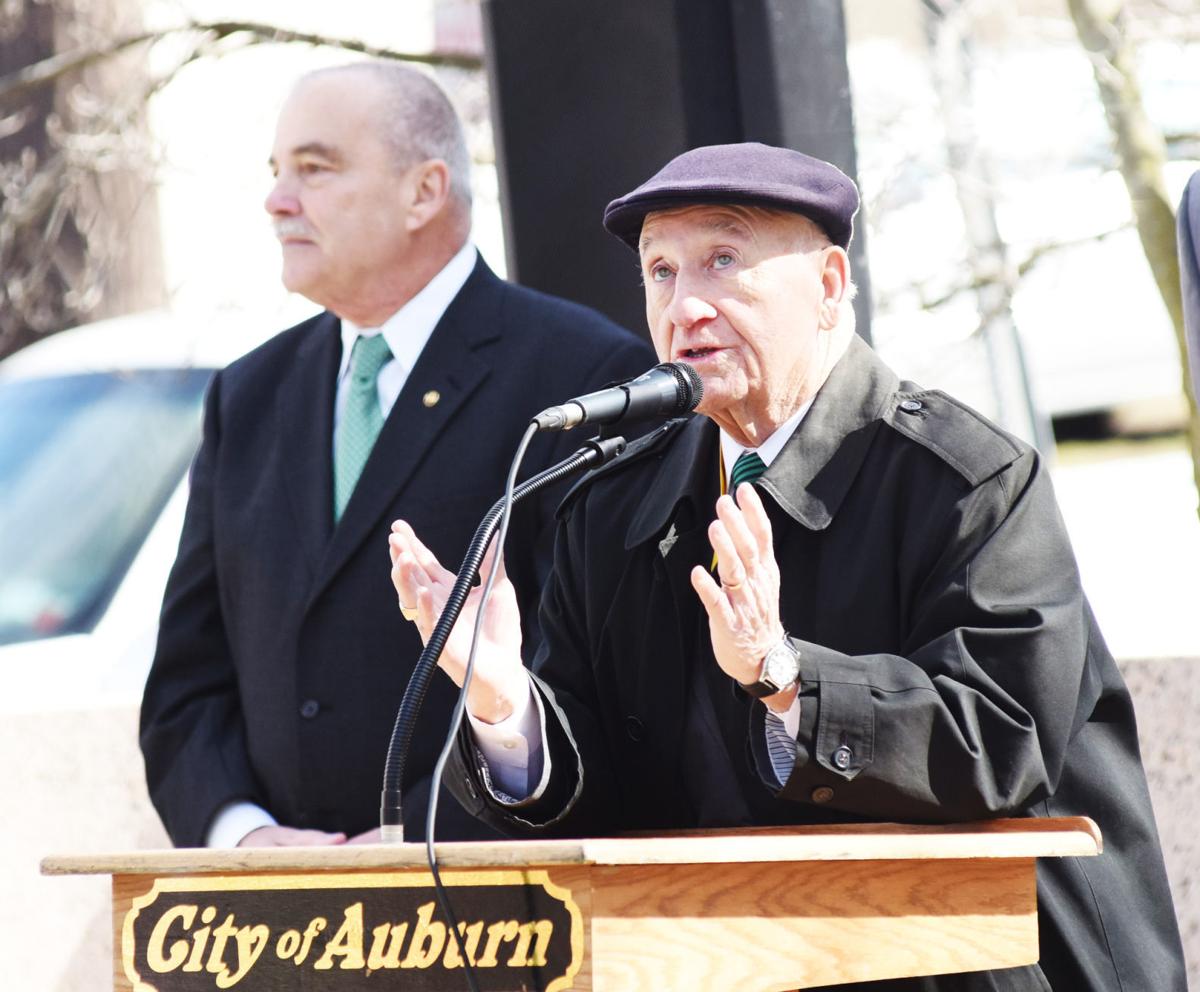
Thomas McNabb

Thomas McNabb speaks during the St. Patrick’s Day ceremony at Memorial City Hall in 2016.

A longtime city of Auburn employee and city councilor passed away Tuesday.

Thomas D. McNabb, 80, was born and raised in Auburn and served on the Auburn City Council for 16 years, from 1995 to 2011, and also worked as a safety inspector for the city for 26 years.

Mayor Michael Quill said he knew McNabb for around 45 years and thought of him as a close friend. He described McNabb as a giving and humble man.

“He would always be in Wegmans buying things with coupons, but he wouldn’t be bringing it home most of the time,” Quill recalled. “He would be bringing it to people in the community who needed a hand up.”

Quill also said McNabb was a tough councilor, who always did what he believed was right. City Manager Jeff Dygert said he was a “fair and level-headed” politician who “listened to both sides of the story.” City Councilor Debby McCormick added that McNabb always had the taxpayers’ best interests in mind.

“He was a good role model for those looking at a position like the city council,” McCormick said. “He did a lot for the community.”

McNabb was also a member of the Ancient Order of the Hibernians for over 50 years, where he held many leadership roles, including national president and vice president, according to a statement from the group. In 2014, the group awarded him the National Secretary Emeritus honor in recognition of his 38 years of service on the Hibernians national board.

“His leadership set the standard for generations of Hibernian leaders to come who will seek to emulate, but never surpass him,” National President James McKay said of McNabb.

McCormick, who was the city clerk during most of McNabb’s time on council, described him as a “good old fashioned Irish gentleman” who was very proud of his heritage. She recalled how McNabb would sing Irish tunes in the elevators after happy hour when the council would travel to Albany for conferences.

“He had a great voice and a great sense of humor,” McCormick said.

McNabb was also a family man, Quill said. His daughter is Cayuga County Legislator Aileen McNabb-Coleman.

“Everything he did in life, he did for his family and his community,” Quill said. “He never did anything self-serving, he was quiet and modest about it. He did accomplish a lot for our community and family and he left a legacy for his family that will be hard to out do.”

According to his obituary, McNabb was an Army veteran and a member of the SK Post of the American Legion and the Knights of Columbus. He was a lifelong parishioner of Holy Family Church, where he sang in the choir.

On Thursday, Quill directed the American flag in front of Memorial City Hall to fly at half mast in honor of McNabb. He was also recognized during a moment of silence before the city council meeting Thursday.

Calling hours will be held from 2 to 4 p.m. and 7 to 9 p.m. Sunday, Aug. 5, at Cheche Funeral Home, 1778 Clark St. Road. Funeral services will be held at 10 a.m. Monday at Holy Family Church. McNabb will be buried at St. Joseph’s Cemetery.