Posted by Jim on September 22, 2018
The British Ministry of Defence (MoD) has sought to block a ruling
ordering it to release information about its ongoing operations in the
Six Counties.
British Army chiefs originally refused to hand over information
requested by the Committee on the Administration of Justice under the
Freedom of Information act, claiming it is exempt.
The CAJ last year asked for the terms of reference for ‘Operation
Helvetic’, the codename for the British Army’s continuing occupation in
the north.
British military officials claimed some of the information should be
legally withheld as “state intelligence” and “national security”.
In a recent decision, Britain’s Information Commissioner’s Office said
while some of the information on Operation Helvetic is exempt, other
information relating to it should be released.
British Army units are increasingly active in the North, carrying out
searches, dealing with bomb alerts, and flying reconnaissance missions
by helicopter and spotter plane. Ongoing recruitment efforts include
controversial promotional activities at secondary schools, including
some in nationalist areas.
Less is known about the activities of the British Army’s undercover
units, such as the Special Reconnaissance Regiment (SSR), and the
infamous SAS, responsible for political assassinations and military
ambushes in the past.
It is thought eight thousand British soldiers are currently stationed on
Irish soil, with many more MoD employees working in support roles.
Deputy director of the CAJ Daniel Holder said “the public have a right
to know whether the scope of the role of the British Army in Northern
Ireland complies with the terms of the peace agreement, Patten
Commission and human rights standards.
“In the absence of transparency about the remit of the armed forces
here, it’s not possible to tell if they are operating under PSNI
direction or if there is instead some undeclared link to MI5 or the use
of covert units, such as the Special Reconnaissance Regiment, that
bypass the oversight arrangements,” he said.
Posted by Jim on
An aggressive and staunchly unionist speech has increased fears that
British Prime Minister Theresa May is prepared to ignore warnings and
crash Britain out of the European Union early next year.
Emboldened by the jingoism of tabloids who described a failed EU summit
in Austria last week as “an ambush”, May and her supporters have
insisted that a technological solution can allow Britain to leave the
Customs Union without creating new border controls in Ireland.
That was rejected by EU leaders in an apparent shock for Theresa May.
It was suggested that she had hoped to be able to deliver a positive
report at the annual Tory party conference without making any
concessions on the border.
With that impossible, and faced with criticism from hardline xenophobic
‘Brexiteers’, May turned to Thatcherite belligerence for her response.
She addressed the news cameras from Downing Street, with two Union
Jacks as a backdrop.
Turning the Good Friday Agreement on its head, she argued the 1998
peace deal actually supports the integration of Ireland’s Six Counties
with Britain, a long-standing unionist ambition.
“Creating any form of customs border between Northern Ireland and the
rest of the UK would not respect that Northern Ireland is an integral
part of the United Kingdom, in line with the principle of consent, as
set out clearly in the Belfast/Good Friday Agreement,” she declared.
“It is something I will never agree to – indeed, in my judgement it is
something no British Prime Minister would ever agree to. If the EU
believe I will, they are making a fundamental mistake.”
She also said that it would be “unacceptable” for the Six Counties to
retain its current status within EU customs controls.
“We will never agree to it. It would mean breaking up our country,” she
declared, without irony. “We will set out our alternative that preserves
the integrity of the UK”, she added, before concluding with a
militant-sounding: “We stand ready”.
After two years of negotiations, what that alternative might be is still
anybody’s guess. But May’s suggestion that it would need to be endorsed
by the defunct Six County Assembly bewildered commentators, and was seen
as a code for stating that a DUP veto would apply — something that the
DUP were quick to confirm.
DUP deputy leader Nigel Dodds said his party warmly welcomed Mrs May’s
rejection of the idea of a ‘border in the Irish Sea’.
“I think the prime minister’s very firm reiteration of not breaking up
the United Kingdom, of the importance of what she has described as our
precious union, is coming across very, very strongly,” he said.
SDLP leader Colum Eastwood accused the British government of
“belligerence” and said May was doubling down on an “unworkable” Brexit.
“Despite the EU attempting to give the UK encouragement to take steps
that will be in the best interests of our citizens the prime minister
has chosen to continue with her failed strategy,” he said.
Sinn Fein leader Mary Lou McDonald said May’s statement had been billed
as a major one but proved to be nothing more than “an exercise in tired
rhetoric”.
“Rather than accepting that her so-called Chequers plan fails to resolve
fundamental issues, Theresa May has engaged in deflection,” she said.
“Her focus has unfortunately remained on infighting within her own party
and her pact with the DUP, instead of coming to an acceptable
negotiating position.”
“More than eighteen months into talks and with time running out, she
continues to show scant regard for Ireland, for our rights, for our
economy and for our Agreements.”
Posted by Jim on
Sean Bresnahan believes that the recent decision on Brexit by the UK Supreme Court leaves no room for doubt that the Good Friday Agreement amounts to nothing more than an exclusively internal solution. Sean Bresnahan is a member of the Thomas Ashe Society Omagh and a longtime contributor to The Pensive Quill. He writes here in an individual capacity.
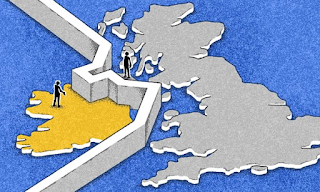
Last month’s decision at the UK Supreme Court, that Brexit in no way defers to the devolved administration in the North, should come as no surprise. It reflects the cornerstone of the devolution set-up: sovereignty resides at Westminster. Those who insisted otherwise, that Stormont had somehow a veto, were chasing their shadow for the purposes of effect – playing to the gallery, intent on distraction. We don’t need a lawyer to know this.
For republicans, all of this reaffirms that the Good Friday ‘architecture’ is wholly internal, with Britain retaining power to withdraw its ‘concessions’ should it ever be required do so. Indeed we are seeing this play out as we speak. How can this be so in the face of the Good Friday Agreement? The Agreement notwithstanding, constitutional authority still resides within the UK Parliament: ‘Parliament giveth: Parliament taketh away.’
As many of us argued from the beginning and is now before all in plain sight, the Good Friday Agreement is essentially an internal settlement, upheld by British law alone. It in no way breaches the ‘constitutional integrity’ of the United Kingdom. It does not even contain ‘transitional’ elements that in time might effect that end – as the republican leadership were forced to concede during internal discussions in its wake.
That they were reduced to describing it as a ‘transition to a transition’ – with ‘transitory potential’ at best – made plain that its terms were in conflict with our fundamental position. That position was and remains that an internal settlement – even one with all-Ireland ‘add-ons’ – is a non-starter and an anathema. It is outside and steps away from republican core thinking. Essentially we are talking about an aberration.
Beneath the appeals to have trust in the project and that the leadership needed time – needed the same level of support and commitment afforded the armed campaign – the reality was obvious for those who chose to look: six inches in front of the face and five times in the first section alone. That reality is that the Good Friday Agreement in no way impacts the British sovereign claim. Indeed it codifies that claim, in a body of text which republicans agreed to be bound by in return for the ‘right to aspire’.
All of this was obvious from the process itself, as many protested ahead of the talks. The Multi-Party Talks were between parties internal to the North, who ‘negotiated’ an agreement within strict parameters set out in advance by the Major Government (with lateral support from Dublin). Within its Framework Document, unilaterally determined by Britain, lay the eventual ‘heads for agreement’. Everything subsequent is no more than semantics and entirely for the optics.
Further to that again, the outcome of a ‘successful’ negotiation and a political ‘settlement’ thereof required majority agreement within the room, majority agreement in the Occupied Six Counties and a majority in turn within the British Parliament. This removed all possibility that anything other than an internal settlement could ever result from the process.
We were already beaten before we began, the outcome predetermined. That outcome? Britain’s sovereign claim intact and her ‘right to rule’ conceded, all wrapped up in an internal arrangement as that we opposed from the outset – in essence the totality of all that the movement had stood against. It’s a cliche of old but it still rings true: ‘for what died the sons of Roisin.’
Last month’s decision on Brexit – denying a role to London’s ‘internal colonies’ on matters impacting their own well-being – is a timely reminder of the above and of where we stand now today. It invites us to reflect on what has become of our struggle. With the legitimacy of British constitutional law conceded, realising Irish self-determination requires no mean feat. That is where we are at.
Ireland’s best hope might very well prove that the triggering of Article 50 comes to tear apart the Union, leaving us ‘incidental victors’, of a sort, in the long fight to free our country. For sure we’ll take freedom by any means going – and rightly so. But let there be no mistake. Should this come to pass, the actions of those who stabilised the rule will have played no part in the achievement.
Indeed if they had had it their way in the first place, if Britain’s Supreme Court had backed their appeals, they would have succeeded in blocking that pathway. That in itself – and not for the first time – points to their direction of travel. Regardless their scheming, we can only await what the time ahead comes to bring. Interesting times in store for sure – of that there can be no doubt.
Posted by Jim on September 21, 2018
By Fr. Sean McManus.Friday, September 21, 2018
I’m lately even more proud of my native Fermanagh since it has been established that the great -grandmother of President Kennedy, Rosanna Cox-Fitzgerald (c.1835-1979) was born in Fermanagh and in the next parish to my own parish of Kinawley.
Indeed, Rosanna’s father was from the parish of Kinawley. Rosanna, who would be the grandmother of rose Fitzgerald Kennedy, apparently immigrated to America in her late teens or early twenties.
The historic parish of Kinawley has essentially been in existence since the Sixth Century. It is now divided by the damn border, its other part being in County Cavan.
The neighboring parish to Kinawley is the parish of Knockninney, and it is in that parish that Rosanna Cox was born.
On Saturday, August 4, I celebrated the fiftieth anniversary of my ordination in St. Naile’s Church, Kinawley (the actual date of my ordination was September 1, 1968).
The Curate of Knockninney, Fr. Ultan McGoohan, was one of the six priests who concelebrated Mass with me, and a few days later he took me on a “pilgrimage” to the ancestral home of Rosanna.
Fr. McGoohan, who has a degree in history, has recently done groundbreaking work in bringing to light this neglected lineage of the Kennedy family.
We have heard a lot about “The Boys of Wexford,” and now it is due time to hear about “The Girls of Fermanagh.”
I am sure the younger generations of the Kennedys will want to pay due homage to the neglected distaff side (female side) of family.
Such neglect, of course, was common in older days. But now, I am hoping the younger Kennedys will see it as a matter of historical justice, as well as due and equal respect to Rosanna Cox-Fitzgerald, to right the family record of this extraordinary Irish-American family.
Fr.McGoohan, in his key article, “The Fermanagh roots of John F. Kennedy” (February 28, 2018) explains how the Fermanagh connection had been lost for so long.
”In summary,” he wrote, “I am proposing that there has been a mistake. Rosanna Cox was not a Cavan woman, but a Fermanagh woman. We know her father was Philip Cox and there is a baptism registered to Philip Cox and Mary McGauran/McGovern in Kinawley parish.
“We know she gave her home address as Tonymore Tomregan, Co. Cavan. Tonymore is in the civil parish of Tomregan, the home address given at the Kennedy Center in the United States and in Dunganstown, as the birthplace of Rosanna.
As we now know, Tomregan was a civil parish, but Tonymore is in the Catholic ecclesiastical parish of Knockninny.
“At the time Tomregan was probably still being used as a postal address by the residents of Tonymore. We can claim her as a Fermanagh woman, with Kinawley and Knockninny roots and to be even more parochial, we might call her a Teemore woman!”
Posted by Jim on
RADIO FREE EIREANN will broadcast this Saturday September 22nd on WBAI Radio 99.5FM or WBAI.ORG at 12 noon-1pm New York time or 5pm-6pm in Ireland or anytime after the program on WBAI.ORG – Archives (scroll back to 12 noon Saturday)
JOHN TEGGART of the Ballymurphy Massacre Campaign will react to British moves to discredit the upcoming Inquest before it begins, a new television documentary “Massacre at Ballymurphy” and film “Ballyymurphy Precedent” about the murder spree and the latest Inquest Court rulings.
As we near the fiftieth anniversary of the start of the Civil Rights movement in the north of Ireland,PATSY GILDERNEW, will give his firsthand recollection of the Caledon Housing Eviction,seen as the iconic incident leading to Civil Rights protests.
RAY LEYDEN will have a full report on on the McLean Avenue Irish Street Fair in Woodlawn.
TOM ABERNATHY,will talk about places where youths can learn and join Gaelic Football in the greater New York area.
We will also have the latest announcements on Irish Festivals and events.
