Please Read, and forward. This will only take 1 minute to read! 28th Amendment, 35 States and Counting. It will take you less than a minute to read this. If you agree, please pass it on.
It’s an idea whose time has come to deal with this self-serving situation: OUR PRESENT SITUATION ! Children of Congress members do not have to pay back their college student loans. Staffers of Congress family members are also exempt from having to pay back student loans. Members of Congress can retire at full pay after only one term. Members of Congress have exempted themselves from many of the laws they have passed, under which ordinary citizens must live. For example, they are exempt from any fear of prosecution for sexual harassment. And as the latest example, they have exempted themselves from Healthcare Reform, in all of its aspects. We must not tolerate an elite class of such people, elected as public servants and then putting themselves above the law. I truly don’t care if they are Democrat, Republican, Independent, or whatever. The self-serving must stop. Governors of 35 states have filed suit against the Federal Government for imposing unlawful burdens upon their states.It only takes 38 (of the 50) States to convene a Constitutional Convention. If each person that receives this will forward it on to 20 people, in three days most people in The United States of America will have the message. Proposed 28th Amendment to the United States Constitution: “Congress shall make no law that applies to the citizens of the United States that does not apply equally to the Senators and/or Representatives; and, Congress shall make no law that applies to the Senators and/or Representatives that does not apply equally to the Citizens of the United States …” This is an idea that should be passed around, regardless of political party. Congressional Reform Act of 2017
1. No Tenure / No Pension. A Congressman/woman collects a salary while in office and receives no pay when they’re out of office. And, no more perks go with them.
2. Congress (past, present, & future) participates in Social Security. All funds in the Congressional retirement fund move to the Social Security system immediately. All future funds flow into the Social Security system, and Congress participates with the American people. It may not be used for any other purpose.
3. Congress must purchase their own retirement plan, just as ALL Americans do.
4. Congress will no longer vote themselves a pay raise. Congressional pay will rise by the lower of CPI or 3%.
5. Congress loses their current health care system and participates in the same health care system as the American people.
6. Congress must equally abide by all laws they impose on the American people (i.e. NO MORE INSIDER TRADING!!!).
7. All contracts with past and present Congressmen/women are void. The American people did not make this contract with Congressmen/women. Congress made all these contracts by and for themselves. Serving in Congress is an honor and privledge NOT a career.
The Founding Fathers envisioned citizen legislators should serve their term(s), then go home and go back to work … not get all kinds of freebies.
Sean Bresnahan responds to an Irish Times piece in which loyalists give their view on the possibility of a united Ireland.
In a recent interview with Simon Carswell of The Irish Times — speaking alongside fellow loyalists Winston Irvine, Jackie McDonald and Sammy Douglas — Rob Williamson, a coordinator with the Reach project in East Belfast, was quoted saying, ‘Sinn Féin and others who want a border poll in Northern Ireland on Irish unification haven’t told people what a united Ireland even entails’.
Williamson, for sure, is right that what a United Ireland entails needs determined — so everyone, including the Ulster Protestant minority on Ireland, know where they stand in the event of Irish Unity. The problem is that the 32-county forum it would require to map such out cannot be stood in advance and makes such a task, therefore, a practical impossibility.
For now, at least — likely until we’ve already arrived at Irish Unity and the ‘sovereign united Ireland’ the current ‘legal’ position (set out under the British-Irish Agreement) demands of an Irish Unity scenario — there is no political means for it to be stood as anything other than a consultative initiative of the Dublin Government, bound entire within its own legal sphere.
That is not to say that Dublin should not attempt towards such a forum but to unearth the reality that, absent political input from the Six Counties — absent a national conversation indeed — the impact of such an initiative, and its ability to forward a concrete proposal that can be authoritatively argued for as the national consensus, will have been undermined at its beginning.
The absence of an ability to map the form of a future United Ireland is not due to failings on the part of Dublin, or any other party on the Irish side, including Sinn Féin (explicitly cited by Williamson). It is the result of political constraints entrenched within the Good Friday Agreement, which upholds Britain’s claim to sovereignty in the North and ensures, thus, that what a United Ireland is to entail not only needn’t be discussed but that it won’t be discussed, with unionism simply refusing to discuss it for fear of undermining the status quo.
In this environment, interim to Irish Unity itself, the best that can be done on the part of Irish nationalism is not to make unionism’s argument for it, as is being foolishly attempted, but to uphold the position that any future United Ireland, while its governmental basis will need to be determined, must entail as its basic starting point that Ireland, as one, will be a sovereign independent state, free to determine her own affairs without external impediment.
If we cannot (outside our own private positions) offer Williamson and his community greater detail as to the form a United Ireland will assume, which they deserve, we can at least ensure that this much is understood and by all concerned — that Irish Unity involves, fundamentally, the end of the Union and the constitution of a sovereign united Ireland, as already set out under binding international treaty.
2019 NYC DISABILITY PRIDE PARADE
Join the FDNY in the 2019 NYC Disability Pride Parade on Sunday, July 14, 2019. Off-duty members and family are invited to assemble on E. 25 Street between 5th Avenue and Madison Avenue at 10:00 AM. For more information, contact Fabricio Caro, Director of Community Affairs, fabricio.caro@fdny.nyc.gov.
FIREHOUSE KITCHEN TALK: EMERGING THREATS & OPPORTUNITIES: COOPERATION WITH THE DEPARTMENT OF DEFENSE AND FDNY
Join Friends of Firefighters at 199 Van Brunt Street, Brooklyn, NY 11231, on Wednesday, July 31, from 6:00 -9:00 PM for a firefighter-prepared dinner followed by a presentation from Battalion Chief Sean Newman and Retired Colonel Patrick J. Mahaney, U.S. Army Special Forces on post-9/11 cooperation between the Department of Defense and the FDNY. This event is free for active and retired FDNY members. No RSVP necessary.
FF PAUL GRECO FAMILY BENEFIT PICNIC
A benefit picnic will be held on August 18, 2019, from 1:00 – 6:00 PM at Chicopee Falls Moose Lodge, 244 Fuller Road in Chicopee, MA, for FF Paul Greco, a 20-year FDNY veteran suffering from 9/11-related health issues, and his family. Tickets are available for purchase and all proceeds will go to FF Paul Greco and family to help rebuild his accessible home that was damaged by a fire in April. There will be food, entertainment, music, dancing and raffles. Tickets cost $20.00 for adults, $10.00 for teens ages 13-17, children under 12 are free with adult ticket purchase, $50.00 for a family package, which includes 2 adults & 2 teens. For tickets and donation information, please contact MariaMidura@aol.com, BrendaMidura@aol.com or EarlineMid@aol.com.
HISPANIC SOCIETY SCHOLARSHIP AWARD AND DINNER DANCE
The FDNY Hispanic Society announces the FDNY Hispanic Society Scholarship Award Application for 2019. All the required information and the electronic application for continuing students that are interested in applying can be obtained via www.hispanicsocietyfdny.com. Eligibility requirements: Must be of Hispanic heritage; FDNY Hispanic Society member for a minimum of 2 years; minimum of 2.5 GPA on a 4.0 scale (or equivalent) for high school students; minimum of 3.0 GPA on a 4.0 scale (or equivalent) for undergraduate and graduate students; must be present to accept the Hispanic Society Scholarship Award. Award winners will be announced at the Hispanic Society Dinner Dance at Villa Barone Manor, 737 Throggs Neck Expressway, Bronx, NY, on October 4, 2019. Award Amount: An award range from $500 to $1,000 is given to the student/s selected. Essay: A required essay of approximately 500 words on how your academic studies will contribute to your personal & professional goals and have demonstrated involvement in and commitment to the Hispanic communities. Application deadline: September 8, 2019. For additional information, contact Lizzette Perez-Cruz, FDNY College Advisor, at (718) 281-8465.
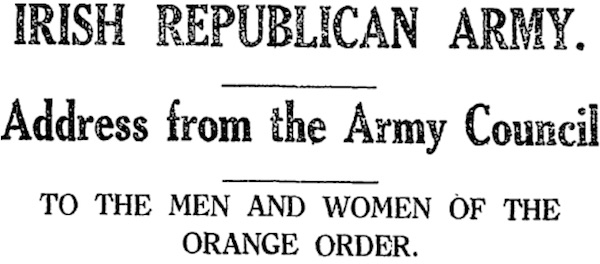
This address was distributed as leaflets in unionist districts of Belfast by IRA Volunteers. Largely written by Peader O’Donnell, it had been circulated with a covering letter from the IRA’s Adjutant General, Donal O’Donoghue, on 8th July 1932 to newspaper editors. Most, including the Belfast Newsletter, published abridged versions as early as 11th July 1932. The text is as quoted by the Treason Felony blog, following the formatting published in the Kerryman.
Fellow Countrymen and Women, It is a long call from the ranks of the Irish Republican Army to the marching throngs that hold the 12th July Celebrations in North East Ulster. Across the space we have sometimes exchanged shots, or missiles or hard words, but never forgetting that on occasions our ancestors have stood shoulder to shoulder. Some day we will again exchange ideas and then the distance which now separates us will shorten. For we of the Irish Republican Army believe that inevitably the small farmers and wage-earners in the Six County area will make common cause with those of the rest of Ireland, for the common good of the mass of the people in a Free United Irish Republic. Such a conviction is forming itself in an ever increasing number of minds in North East Ulster. The Irish Republican Army – within North East Ulster as well as in the rest of Ireland – believe that the mass of the Working-Farmers and Wage-earners must organise behind revolutionary leadership if they are to rescue themselves from a system within they the few prosper and the many are impoverished. It is our opinion, a conviction driven in on our mind by the facts of life around us, that capitalism and imperialism constitute a system of exploitation and injustice within which the mass of the people can know no freedom. The burdens of to-day’s bad times are falling with increasing weight on Working Farmers, who must surrender an increasing part of their produce to meet rents, taxes, bank interest, etc, while their incomes diminish The unemployed workers are being torn at with economies in social services – adding daily to the destitute. The wage earners are finding their conditions _s of employment and standard of living steadily worsening. We can see no permanent solution of these evils except by the transfer of power over production, distribution and exchange to the mass of the people. The power to produce what the many require exists; the Organisation and its distribution presents no insoluble difficulty. But the vested interests of a privileged minority are across the road and progress is impossible, unless we are prepared to clear away these obstacles. These interests that deny their rights to the many are those on which the Empire rests. Touch or threaten these privileged interests and the whole force of the Empire is invoked for their protection. Thus it is that we see and say that the freedom of the mass – of the Irish People is impossible without breaking the connection with Imperial Britain and with all the Imperial system connotes. Do you see any other road to freedom for yourselves and your families? You must realise that the chief industries on which the former alleged prosperity of North East Ulster rested are gone beyond hope of being revived; that the same thing has occurred in Great Britain; that everywhere the pinch grows tighter on those who are unemployed as a result of this breakdown in the whole structure of capitalism. Can the British people help you while their own workers and industries are struggling desperately to exist and are not succeeding in these days? Where do you see any hope? Working-farmers and Wage-earners of North East Ulster. You surely must see that your future is bound up with the mass of the people in the remainder of Ireland. To preserve yourselves from extinction, you and they must combine and go forward to the attainment of A Free Irish Nation within which life and living will be organised and controlled by you to serve your needs and thus end the present economic and social injustices for ever. The industrial capacity, and training of you industrial workers, of North East Ulster ensure you a leading influence and place in the economy and life of a Free Irish Nation. EXPLOITATION OF RELIGIOUS PREJUDICES To prejudice you it is emphasized that we of the Irish republican Army and the mass of Republicans are mainly Catholic, and that your religious beliefs would not be respected in a free Ireland! It is quite true we are mianly Catholics, but in Southern Ireland the same political and economical interests and voices that tell you we are Catholics, tell the Catholic population of the South that we are Anti-God fanatics, and yearning for an opportunity to make war on the religion to which the majority of us belong! The fact is we are quite unaware of religious distinctions within our Movement. We guarantee you, you will guarantee us, and we will both guarantee all full freedom of conscience and religious worship in the Ireland we are to set free. This is the simple truth, and just now when Imperial interests are attempting to conceal themselves behind the mad fury of religious strife you and we should combine to make certain that no such escape should be provided them. In the process of exploitation of the wage-earners and small producers, do you not realise how little religion matters to the exploiters? Orangemen and Catholic, Catholic women and yours toil side by side in the factory and mill, all equally victims Those who thus exploit mercilessly your labour and energies, would outside set you at one anothers throats, because it is to their advantage to divide you and lead you into conflict by arousing religious issues and inflaming passions. Do yon not find yourselves queued shoulder to shoulder outside the Unemployed Exchanges waiting for the ‘Dole’, that crumb which the exploiters throw to the exploited of different religions? In these vital matters jour religion or your membership of the Orange Older counts for little, nor does Catholicism to the unemployed and starving Catholics in Southern Ireland. The fact is that the religious feelings of the masses of both Orangemen and Catholics are played on and exploited by the Imperialists and Capitalists the more surely to enslave them. THE VICTORY OF THE BOYNE! You celebrate the victory of the Boyne. This battle was a victory for the alliance of the then Pope; and William of Orange; strange alliance for you to celebrate; strange victory for Catholics to resist! History has been muddled to hide the occasions when your forefathers and ours made common cause, and passions are stirred to manufacture antagonisms. If William of Orange and His Holiness could achieve an alliance, there is hope that “NO SURRENDER” may come up from a throng which also roars “UP THE REPUBLIC”. Your stock were the founders and inspiration, the North East Ulster the cradle, of the modern Revolutionary Movement for National Independence and Economic Freedom. Your illustrious ancestors and co-religionists, the United Irishmen, by their gallant struggle in 1798 set aflame the ideals of Republicanism which never since have been extinguished. We ask that you should join us to achieve their ideals — National Freedom and religious toleration. It was John Mitchel, a Newry man of your stock, who addressed these words to your forefathers: “In fact religious hatred has been kept alive in Ireland longer than anywhere else in Christendom. Just for the simple reason that Irish landlords and British statesmen found their own account in it, and so soon as Irish landlordism and British domination are finally rooted out of the country it will be heard of no longer in Ireland any more than it is in France or Belgium, now.” Fraternally, Your Fellow Countrymen, The Army Council, On Behalf of the Irish Republican Army
Barbara Flaherty, Dr. Everett Kelley, Fr. Sean McManus
The National Secretary-Treasurer of American Federation of Government Employees (AFGE) is the latest World Peace Prize laureate. AFGE is the largest federal employee Union proudly representing 700,000 federal and D.C. government workers nationwide and overseas. Dr. Everett Kelley, a native of Alabama and a Baptist Minister, was honored with the Prize on Tuesday, July 9, 2019, in a ceremony appropriately held in the George Meany Room of the hallowed AFL-CIO headquarters in Washington, DC. The late World Leader and Master Planner, Rev. Dr. Han Min Su, founded the World Peace Prize in Seoul, South Korea, in 1989.The World Peace Prize Awarding Council consists of 14-member Board of International and Interfaith judges. The Board is comprised of representatives of the world’s nine major religions: Judaism, Islam, Hinduism, Buddhism, Confucianism, Catholicism, Protestantism, Russian Orthodox, and Zoroastrianism.
The presentation was made by Fr. Sean McManus—Chief Judge of the World Peace Prize and President of the Capitol Hill-based Irish National Caucus—and the ceremony was chaired by Barbara Flaherty, a Judge of the World Peace Prize Awarding Council, and Executive Vice President of the Irish National Caucus. Fr. Mc Manus explained: “Working for peace, locally or globally, means, in effect and of necessity, working for social justice. Therefore, members of the Labor Movement are ideally qualified to be recipients of our World Peace Prize.Dr. Kelley eminently deserves this Prize. As Pope John Paul II has said, ‘peace is the fruit of solidarity.’ And the American Labor Movement is dedicated to solidarity, which Pope John Paul II raised to the status of a virtue in his Encyclical: Sollicitudo rei socialis (“Solicitude for social concerns”) 1988.” Dr. Kelley spoke beautifully and humbly about being honored and thrilled to receive the World Peace Prize, the meaning and purpose of which is fully aligned with his own religious view and Labor convictions.Fr. Mc Manus said:“Dr. Kelly is a most impressive man and is deeply respected in the AFGE. The National President of the AFGE, J. David Cox, Sr., attended the Presentation Ceremony and spoke very movingly about his admiration for Dr. Kelley.”