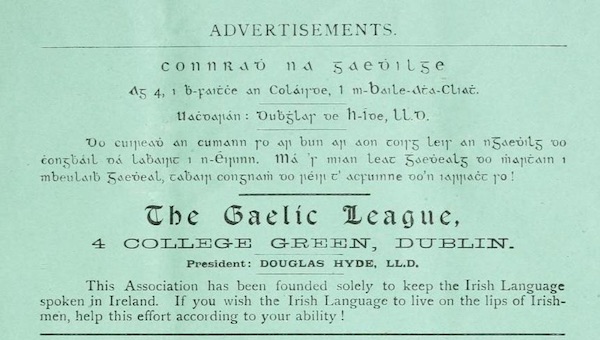
This week 126 years ago – 31 July 1893 – the Gaelic League (Conradh na Gaeilge) was founded. A look at the role it formed in the Easter Rising, by Brian Ó Conchubhair When the Irish Volunteers and the Citizen Army seized key buildings in Dublin City centre on Easter Monday, 24 April 1916, many, if not the majority, were believed to be members of Conradh na Gaeilge/The Gaelic League. When the self-declared Irish republic announced the Proclamation of Poblacht na hÉireann, six of the seven signatories were recognised members of Conradh na Gaeilge.
Of the 16 leaders to be executed, the majority were Gaelic League members and Irish speakers: Ceannt, Clarke, Mac Diarmada, MacDonagh, O’Hanrahan, P.H. Pearse, Willie Pearse, Plunkett, Casement, Heuston, Colbert, Daly and Kent. To further muddle the waters, Eoin MacNeill, in addition to being the co-founder of Conradh na Gaeilge/The Gaelic League in 1893 along with Douglas Hyde, was the president of the Irish Volunteers. One might be forgiven, therefore, for presuming that Conradh na Gaeilge/The Gaelic League was an ardent republican organisation, supportive of the IRB and military action rather than a non-political and non-sectarian association dedicated to the promotion of the Irish-language as a spoken language and the creation of a modern literature in Irish. The Establishment of Conradh na Gaeilge/The Gaelic League Douglas Hyde, following his late 1892 lecture on the need to de-anglicise the Irish nation and race, founded Conradh na Gaeilge/The Gaelic League in conjunction with Eoin MacNeill in 1893. With a focus on the vernacular form of language and modern literature, Conradh na Gaeilge/The Gaelic League distinguished itself from its rivals, The Society for the Preservation of the Irish Language, The Celtic Society and the Gaelic Union. Initially a small Dublin-based group, it gradually spread – geographically and socially – across Ireland and beyond as new branches affiliated: Galway (24 January 1894), Cork (22 April 1894), Derry (1894), New Ross, Wexford (May 1894), Eyries, Cork (December 1894) and London (October 1896). By 1896, 43 branches had registered with the Dublin head-branch, eight of which were abroad. The Rev. Peter C. Yorke’s controversial lecture on 6 September 1899, entitled ‘The Turning of the Tide’ marked a key moment in the League’s fortunes as membership in Dublin and its suburbs subsequently surged. By 1901 the capital boasted some 30 affiliated branches and two years later, in 1903, the League claimed 500 affiliated branches throughout the country. By 1904 Conradh na Gaeilge’s membership extended to some 50,000 members in 600 branches. The rapid growth in members continued the following year with reports of 100,000 members in 900 affiliated branches amongst the Irish diaspora across the globe: Scotland (Glasgow), England (London, Liverpool, Manchester, Porstmouth, Southampton, Rugby, Birmingham, Leicester, Wigan, Oldham, Salford, Coventry, Bolton); Wales (Cardiff); Argentina (Piedad; Buenos Aires), United States of America (Chicago; New York; Holyoke, NY; Rhode Island), New Zealand (Miltown; Balcluttra), South Africa (Capetown; Kimberley). Increased membership impacted revenue: while 1895 showed a mere £43 in membership fees that sum rose to £2,000 by 1900. Such funding allowed the employment of full-time staff and community organisers (timirí) who travelled rural Ireland, often on bicycles or motorbikes, organising lectures, forming night classes, establishing branches, exhorting native and heritage speakers to the value of their linguistic inheritance. The Conradh’s curriculum of events matched the seasons: in winter they focused on classes where members, young and old, mastered the fundamentals of reading and writing – a valuable educational opportunity for many. Social interactions included excursions, céilí/céilithe, dancing, recitations, lectures, musical concerts, plays. Spring and summer months suited fairs, feiseanna, excursions, and exhibitions where the vernacular arts and cultures learned in the winter classes was displayed and exhibited. Irish-Week and the Oireachtas festival were high-points in the cultural calendar. The Irish Volunteers: The Issue of Conradh na Gaeilge? Eoin MacNeill, Gaelic League co-founder 20 years earlier, penned an article ‘The North Began’ in Conradh na Gaeilge’s weekly Irish-language newspaper An Claidheamh Soluis on 1 November 1913 in response to the Ulster Volunteers’ formation. On 25 November, at the Rotunda’s ice rink, some 7,000 people allegedly attended the Irish Volunteers’ first meeting, with 3,000 registering that night. MacNeill, as author of the article, was duly elected president but by his side stood several men associated with Conradh na Gaeilge – notably P.H. Pearse, The O’Rahilly, Thomas MacDonagh, Piaras Béaslaí – while in the background lurked the Irish Republican Brotherhood. At a meeting in Galway to establish the Volunteers in the western region, MacNeill was flanked by Pearse and Casement, all closely associated with Conradh na Gaeilge. Yet the Volunteers, despite their title, Óglaigh na hÉireann, functioned and operated through the medium of English. The close overlap in membership between the two organisations proved detrimental to Conradh na Gaeilge’s activities, which slumped into a decline following the glory period of 1900-1910. Factions within the League considered its linguistic approach and policies too benign and called for more aggressive and confrontational gestures when promoting the language in the face of official intransience. The Great War, Suspense and Suspension When Great Britain entered World War I, the passing of the Suspensory Act (1914) ensured Home Rule’s postponement until the conflict’s conclusion. John Redmond, the Irish Parliamentary leader, urged the Volunteers to enlist in the army, and through their sacrifice ensure Home Rule for Ireland. This policy caused a split in the Volunteers with the majority following Redmond into the National Volunteers and the minority following MacNeill, Pearse, The O’Rahilly and Éamonn Ceannt into the Irish Volunteers. As a self-declared non-political and non-sectarian organisation, Conradh na Gaeilge and its official newspaper, An Claidheamh Soluis, adopted no official stance on the war. But if the movement remained intact, its members disagreed and differed considerably. Hyde’s neutral stance allowed the Gaelic League to remain a home to Irish-speaking Redmonites, and Irish-speaking ‘Sinn Féiners’, Irish-speaking recruiters and Irish-speaking objectors. William Gibson (2nd Baron Ashbourne) and Tomás Ó Domhnaill M.P., both noted Gaelic Leaguers, encouraged young men to enlist, while Irish speakers who spoke at recruitment meetings were arrested and jailed for sedition. If An Claidheamh Soluis attempted to ignore commenting on the war, the Irish-language paper Ná Bac Leis (Ignore It) ridiculed Irish involvement in the war. With Hyde’s shock resignation as President of Conradh na Gaeilge at the 1915 Ard Fheis in Dundalk, MacNeill stepped in temporarily to serve as President until Hyde would be coaxed back. He now, for all intents and purposes, controlled Conradh na Gaeilge and Óglaigh na hÉireann. The links between the two organisations seemed nearer than ever despite their divergent aims. Yet when the press reported the 1916 Rising, they titled it ‘the Sinn Féin Rebellion’ rather than ‘the Gaelic League rebellion’. MacNeill, as is well known, did not condone the rebellion, believing the Volunteers should wait for the war’s end and then seek the implementation of Home Rule as promised, but the IRB cared little for MacNeill once he had served his purpose of providing respectability and profile. By the time the 1916 Ard Fheis convened, most of Conradh na Gaeilge’s officials were in prison in England or Wales. While the links between the executed leaders and the Gaelic League bestowed no little honour on the organisation in the early years of the Free State and since, it spawned an enduring image of Conradh na Gaeilge less as a non-sectarian, non-political organisation but more one sympathetic to advanced republicanism. Such an understanding is far removed from that envisioned by Hyde. Many, if not most, of those who fought on the nationalist side in Easter week were Gaelic Leaguers, but they were also affiliated to numerous other friendly societies: the Gaelic Athletic Association, Cumann na mBan. If there is a tendency to overplay the role of the Gaelic League in the 1916 Rising, it is impossible to underestimate its role in its leaders’ intellectual development and in introducing debates and discussions into early 20th-century Ireland that steeled the public for independence. It was Conradh na Gaeilge during the fin de siècle that provided the intellectual, linguistic and cultural rationale for political independence. But as has been well noted, revolutions are made not by hurleys and footballs but by ideas and Conradh na Gaeilge was the main conduit for radical ideas for reinventing and reenergising Irish society in the period building up to 1916.
The juryless retrial of a man accused of IRA membership collapsed in
farcical scenes this week after a PSNI policewoman did not recognise a
vehicle licence plate from which she was supposed to have recovered DNA
evidence.
It was the second time Gardai police had attempted to imprison Dubliner
Darren Weldon based on so-called “belief evidence”. Token circumstantial
evidence was again presented in support of their allegation that Mr
Weldon was a member of the Real IRA.
The 47-year-old, from Kilbarrack in Dublin, had originally pleaded not
guilty to IRA membership in October 2014.
In the original trial, the prosecution’s case against the accused man
was mainly composed of “belief evidence”. This is a mere statement of a
senior member of the police that their target is guilty as charged.
At the Special Criminal Court, set up in 1939 to accelerate the
imprisonment of republicans and still in use today, such “evidence” is
normally enough to secure a conviction, especially if accompanied by a
plausible supporting argument.
In an initial trial in 2017, memorial photographs of Real IRA leader
Alan Ryan which police said they had found on Mr Weldon’s phone were
presented as corroboration. They also claimed to have found his DNA on a
swab taken from the licence plate of the vehicle used in the attack.
Mr Weldon was quickly found guilty and sentenced to five years
imprisonment. But he had his conviction quashed in 2018 and a retrial
ordered after the Court of Appeal found the Special Criminal Court had
made a “factually incorrect” finding in relation to a photo on Weldon’s
iPhone.
Without this evidence, there was a “substantial gap” in the Special
Criminal Court’s reasoning, causing the Court of Appeal to consider the
conviction “unsafe”. A retrial was ordered.
Last week, and again without a jury present, the alleged supporting
evidence in the form of DNA linking Mr Weldon with the registration
plate was found to be entirely bogus.
In an embarrassing revelation, PSNI policewoman Christine Lumsden
admitted to a panel of judges that the number plate produced to her was
not the same number plate recovered from the scene.
“She went on to state that the number plate looked upside-down and
different,” said the chief judge. He said he could not be satisfied that
“the integrity of the number plate” was “properly preserved”.
“Having found that the belief evidence is not supported by any
independent evidence, we must find the accused not guilty,” he
concluded.
A so-called War Cabinet has been formed by the new British prime
minister, Boris Johnson to aggressively force Ireland to accept a
hardening and reinforcement of Britain’s century-old border across the
island.
With extraordinary speed, Johnson has issued threat after threat to
crash out of the EU with no deal on October 31 unless the Backstop —
the previously agreed insurance policy to avoid a hard border in Ireland
— is abolished.
Johnson has named a cabal of six senior Cabinet Ministers, styled as a ‘War Cabinet’, which will meet every Monday to
take the fight to Ireland and the European Union. They include the
Chancellor of the Exchequer, Sajid Javid, Foreign Minister Dominic Raab,
Brexit Secretary Steve Barclay, Attorney General Geoffrey Cox, and the
‘Minister for No-Deal Brexit’, Michael Gove.
A complicit Tory media has already delivered a barrage of attacks on the
26 County Taoiseach Leo Varadkar, who they have identified as a weak
spot. Leading Tories declared that the Taoiseach “isn’t bright” and “the
Irish will blink”.
In a calculated move, Johnson delayed placing a phone call to Varadkar
for over a week since ascending to the premiership. He has insisted the removal of the backstop is a
precondition for any Brexit deal.
But Mr Varadkar has said there will be no change to the Backstop. He
said “any suggestion that there would be a whole new deal negotiated in
weeks or months is totally not in the real world.”
His deputy, the foreign minister Simon Coveney, warned that Johnson’s
approach to Brexit is “very unhelpful” and has put Britain on “a
collision course” with Ireland and the European Union.
He added: “I think it’s important to say very clearly, if respectfully,
that the facts don’t change around Brexit.”
In response, the Brexiteers described Dublin as “belligerent” and
“inflammatory”, with Varadkar dismissed as “ill-informed and arrogant”.
He and Coveney were blasted as “little Ireland’s ridiculous leaders”.
The DUP piped in by accusing Dublin of “megaphone diplomacy”.
It was a coordinated effort to portray Ireland as the obstacle. Johnson
stands accused of preparing for a Westminster election by fomenting an
international crisis in order to invoke the ‘spirit of the Blitz’,
rallying English nationalism against traditional enemies of Ireland,
Germany, France and the rest of the EU.
It all makes a mockery of the British government’s obligation — as a
co-signatory of the Good Friday Agreement — to exercise its power in
the North with rigorous impartiality.
The principle of consent — that the will of the people in the North is
respected on constitutional matters — also continues to be completely
ignored.
Almost overlooked is that the uncertainty being wrought by Johnson’s
government has deliberately pushed the peace process to the brink.
Official British reports of their crash-Brexit preparations have all but
dismissed the potential of a return to violence in the north of Ireland,
warning only of “potential law and order issues” over a month after
Brexit takes place
The ongoing level of violence in the north is already ignored by the
British media. This includes three nights of rioting by nationalist
youths in the North Queen Street area of north Belfast amid tension over
anti-internment bonfires, which saw several petrol bombs thrown at the
PSNI, as well as ana bomb attack the PSNI described as ‘potentially
catastrophic’.
The Continuity IRA has said it carried out a rocket attack on a PSNI
patrol in north Armagh around midnight on Friday.
They said a horizontal mortar rocket was fired at a passing police
patrol on the Tullygally Road beside Alderdale flats on but had missed
its target. They warned that a “live warhead” remained in the area
before the item was defused by British Army bomb disposal team.
For its part, the PSNI claimed that their patrol had been deliberately
lured to the area by the CIRA warning and that it had been targeted by a
“booby-trap device”. Had it detonated as intended, the result “would
undoubtedly have been catastrophic”.
Following a meeting with Johnson in Belfast on Wednesday, Sinn Féin’s Mary Lou McDonald was unequivocal
that a crash Brexit for Britain must trigger a reunification referendum in Ireland.
“We made it clear to him that the extensive planning he tells us he is
carrying out in respect of a potential crash Brexit has to include the
constitutional question and the issue of a border poll here in Ireland,” she said.
“We have stated to him very clearly that Brexit in any event, but
certainly a disorderly Brexit, represents in anybody’s language a
dramatic change of circumstances on this island and it would be
unthinkable in those circumstances that people would not be given the
opportunity to decide on our future together.”
WHAT WOULD JIMMY DO? 3RD ANNUAL GOLF OUTING
Join in celebrating the life of Jimmy Lanza and help raise donations to the Ray Pfiefer Foundation and the Stephen Siller Foundation on Wednesday, August 14, 2019, from 12:30 PM to 6:00 PM at Pelham Bay Golf Course, 870 Shore Road Bronx, NY 10464. Registrations start at noon. $160 a man includes golf, lunch/dinner and golf shirt. Please make every effort to register in advance online at https://tinyurl.com/y5v6ehb5 so that the proper arrangements can be made.
FDNY MARINE CORPS ASSOCIATION’S 1ST ANNUAL CIGAR NIGHT
FDNY Marine Corps Association’s 1st Annual Cigar Night will be held Monday, August 19th, from 1900-2300 hours at Vetro on the Bay (open air rooftop venue) 164-49 Cross Bay Blvd in Howard Beach, NY 11414. Cost is $130 per person and includes 4-hour open bar with premium liquor, beer and wine, 4-hour buffet catered by Russo’s on the Bay with top notch food and 4 cigars per person plus cutter. There will be raffle prizes as well as a 50/50 throughout the night. Space is limited to the first 150 people. No money will be collected at the door, so you must RSVP with either Joe Bachert at 631-605-1444 or Frank Ancona at 718-986-9822 and mail checks (made payable to FDNY Marine Corps Association) to Marine Corps Association, P.O. Box 1014, Smithtown, NY 11787 to reserve your spot.
STEUBEN ASSOCIATION BOAT RIDE
On Sunday, August 18, 2019, the Annual Steuben Association Boat Ride will be on the Art Cabana Yacht leaving from the Skyport Marina at 2430 FDR Drive Service Road East, (23rd St & FDR) Manhattan. Boarding begins at 5:30 PM (rain or shine); the cruise is from 6-10 PM. Tickets are $30 in advance or $40 at the door. Boat ride includes music by DJ Emjay, complimentary appetizers, and a cash/credit card bar. For ticket information, visit www.fdnysteuben.org or search FDNY Steuben Boat Ride at Eventbrite.com.
20 YEAR REUNION
A 20 year reunion for members in the August 8, 1999 probationary firefighter class will be held on September 20, 2019. For information, please contact Joe Brautigam at joeyb252@gmail.com.
The Brexit crisis is another example of how the UK so often ignores the consequences of its conduct on its neighbor
Richard McMahon. Irish Times. Dublin. Thursday, August 2, 2019(Richard McMahon is a lecturer in history at the University of Limerick and an expert on the history of violence).
Boris Johnson’s approach to Ireland is part of an ignoble tradition in British politics. At its heart is the false assumption that superiority in resources and military prowess equates to a superiority in intellectual power and moral rectitude. In short, the idea that might is right and that, ultimately, Paddy should know his place. This assumption shaped and even, at times, dominated, policy on Ireland for centuries before independence[i.e. in the 26 Counties of southern Ireland but not in the Six Counties of Northern Ireland; Ireland was partitioned in 1920 by the British government].
It runs through 19th-century British depictions of the Irish as incapable of self-government, unreliable, lazy and inferior. For Benjamin Disraeli, a British prime minister who shares some personal characteristics with the current incumbent, the Irish were “wild, reckless, indolent, uncertain and superstitious”. Most obviously, this sense of superiority and a refined “moral” stance was clearly manifest in government policy during the Great Famine of 1845-49, which caused the deaths of more than one million people on the island of Ireland.
This consistently damaging strain of thought continued into the 20th century, with British military and economic power often used crudely to address deep-rooted political conflicts in Ireland, which refused, and continue to refuse, to allow for simple solutions. Ireland, the thinking went, should be the handmaiden for glorious Britannia – and this servile position is for Ireland’s own benefit and ultimately serves Irish interests.
Of course, within this particular strain of British political thought, the history of violence and tragedy in Ireland is sometimes portrayed as a product of Irish recalcitrance – a tendency towards disorder and conflict that fails to recognize the beneficence of British policy on the island. Britain, it is often suggested, is a guarantor of Irish stability, addressing and suppressing the inherent conflicts in Irish society, rather than a highly disruptive force that has often recklessly pursued its own interests at a serious cost to its nearest neighbor. This renders the current crisis part of a rather tragic re-emergence of a longstanding disregard for the consequences of British political action on the economic and political stability of Ireland. Sadly, this is because a powerful element within British political life refuses to accept that the blind pursuit of British interests can have deeply damaging consequences for those beyond its borders.
As Johnson now plays with dangerous ideas, promising a “golden age” while already seeking scapegoats for the failure of his vision, the genuine possibility of real and lasting damage to Ireland is compelling. The reintroduction of a hard border on the island is now a possibility. It would become a permanent target for republicans – and the social and economic damage could also serve as a recruiting sergeant for the disaffected to join the ranks of those committed to violent resistance.
More generally, it demonstrates a disregard for the costs inflicted on the basic standards of living of the inhabitants of both islands. That this prospect might be part of an elaborate and rather shallow bluff in the British government’s negotiations with the EU renders the actions of Johnson and his extremist cabinet all the more troubling. If true, Johnson appears to be depending upon reasonable people to block his unreasonable behaviour in the hope of benefiting electorally from their principled actions and, in the process, is risking stability and peace on the island of Ireland.
This reckless pursuit of a Trumpian, Britain-above-all policy, could unleash forces throughout the United Kingdom of Great Britain and Northern Ireland that Johnson may struggle to contain. The promotion of a deeper and greater sense of Irish history in Britain might serve to highlight this folly, although standing against Johnson’s destructive policies will ultimately have to be the work of committed activists and men and women of principle in the political realm.