The Ancient Order of Hibernians will join with Gaelic
Societies, great local Irish community
groups and parishioners in the strongly Irish Woodlawn-McLean area to host an
Irish language Mass on Saturday, September 7th, at noon. Fr. Brendan Fitzgerald,
will celebrate the Mass in Gaelic, followed by a brief installation ceremony
for newly elected Bronx County officers and refreshments.
Last year, under an initiative by New York State AOH
President Vic Vogel, the Bronx AOH hosted an Irish language Mass for the first
time. This year Irish-English translations of the liturgy will be made
available, so that anyone can read the prayers in English as they hear the Mass
said in Irish. A special musical program will include Sean Ruane, Doherty and
Lauren Tuffy. A representative of the Ladies AOH,Mary Hogan, will be available
to speak about reorganizing the LAOH in the Bronx.
The
Mass will be dedicated to all those who have kept the Irish language and
culture alive. To symbolize this theme, the AOH flyer depicts a Mass Rock where
Gaelic speakers gathered in
secret
to hear outlawed Masses said by outlawed priests in defiance of English penal
laws.
Bronx County AOH President Martin Galvin noted:
“The
Irish language is an important and indestructible part of our Irish heritage.
Measures to wipe out the Irish language began even before penal laws to wipe
out the Catholic religion in Ireland. Ireland’s cherished landmarks include Mass
Rocks, where Gaelic speakers risked death or imprisonment simply to worship.
Even today a simple Irish language Act is denied to six county nationalists.
”
As an organization formed to promote Irish ideals, culture, history and
national freedom, we can think of no more fitting way for AOH members to honor
Irish heritage than an Irish Mass embodying all of these themes.”
“There
has been a great response from AOH officers, Gaelic clubs, community groups and
individuals who would just like to hear the Mass said in the language of our
ancestors. St. Barnabas is fortunate enough to have a pastor like Fr.
Fitzgerald who can say the Mass in Gaelic.”
The
Mass will be held in the St. Barnabas High School Chapel,425 East 240TH Street
near the Bronx River Parkway, Deegan Expressway or Metro-North Railroad, on
Saturday September 7th at 12 noon. Everyone welcome!
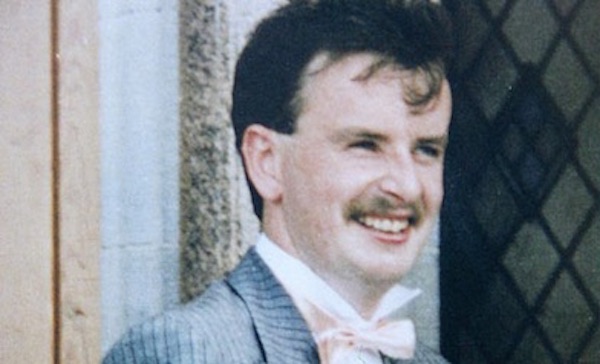
A former British soldier accused of killing Aidan McAnespie more than 30 years ago has appeared in court.A hearing began this week to determine if David Holden, a former Grenadier Guardsman, is to stand trial. He is charged with unlawfully killing Mr McAnespie at a checkpoint in County Tyrone on February 21 1988.
The former soldier has appeared at Dungannon Magistrates Court for the first time. Seated behind him in the public gallery were around 50 family and friends of Mr McAnespie.
A man accompanying the accused was wearing a British military regimental blazer, and there was a heavy PSNI presence both inside and outside.
Mr McAnespie was shot as he walked through a British Army checkpoint in Aughnacloy on his way to a Gaelic football match. Three bullets were fired from a British Army machine gun.
A Preliminary Investigation is now underway and is being heard by District Judge Amanda Brady.
The contents of the hearing cannot be reported at this time. The McAnespie family have urged the public to refrain from making any public comment about the case on social media as to do so could affect the outcome of the upcoming trial.JOHNSON CRITICISED
Meanwhile, Sinn Féin’s Michelle O’Neill has challenged British Prime Minister Boris Johnson to outline what steps he and his government are taking to implement agreements made on dealing with the legacy of the past.
She was speaking after calls by some unionists and Tories to change the definition of a victim in the north of Ireland, and to end prosecutions of members of the Crown Forces.
Ms O’Neill said the British government had failed to fully implement the 2014 Stormont House Agreement.
“Recent comments from Boris Johnson around investigations into the activities of current or former British state forces have caused great hurt to those bereaved by state violence,” she said.
“I have now written to Boris Johnson calling for the implementation in full of the Stormont House Agreement as a matter of urgency and making it clear that there can be no statute of limitation or amnesty for British state forces. No one can be above the law.”
She also said that politically partisan attempts by some unionists and Tories to change the definition of a victim were “a full frontal assault” on the Stormont House Agreement.
“In order to help those struggling with the legacy of the conflict, I also have made it clear once again to the British prime minister that a pension for all those seriously injured should be provided immediately and which contributes to healing all the wounds of the past.
“A collective focus on healing the wounds of the past is required and now is the time for action from the British government to make it happen.”
NATIONAL STAIR CLIMB TO HONOR FALLEN FIREFIGHTERS
This year’s National Stair Climb will be held at Belmont Park on Sunday, September 15, 2019. Proceeds will benefit the FDNY Counseling Services Unit (CSU) and the NFFF. To learn more, register or donate, visit www.nationalstairclimb.org. The goal is to have an active member climb for each of the 343 firefighters lost on 9/11 and all members lost since due to 9/11-related illnesses. If you are interested in climbing to honor the memory of one of these members, please contact: Ret. Capt. John Hemsley at (212) 570-1693 Ext 312 or john.hemsley@fdny.nyc.gov. In a nationwide effort to expand services to more families of fallen firefighters, the FDNY and the National Fallen Firefighters Foundation (NFFF) are sponsoring the annual climb.
JETS FIRST RESPONDER NIGHT
The Jets will be hosting First Responders Night on September 16, as they take on the Cleveland Browns at 8:15 PM for Monday Night Football at MetLife Stadium. Tickets can be found HERE or by visiting https://tinyurl.com/yyq2e3f8. Members interested in purchasing tickets for a group should contact Tyler Jones at tjones@jets.nfl.com or 973-549-4821. Groups will receive discounted tickets to celebrate First Responders Night with your unit, family & friends and a Stealth Black rally towel giveaway.
2019 WEST INDIAN DAY PARADE
Permission is granted for off-duty members to participate in the 2019 West Indian Day Parade on Monday, September 2, 2019. Participating members of the Department should assemble on Eastern Parkway and Schenectady Ave., Brooklyn NY at 1100 hours. Dress uniform shall be worn. For more information contact Neal Francis, FDNY Vulcan Society at (917) 294-0239.
FDNY FIRE MUSEUM FUNDRAISING COOK-OFF
The NYC Fire Museum will once again be hosting the annual FDNY Cook-off Fundraiser. Any members wishing to enter the contest with a signature dish that will be judged by three celebrity chefs should contact Alyssa Borger at the NYC Fire Museum, aborger@nycfiremuseum.org or (212) 691-1303 x16. Please respond no later than September 8th. The event is open to all firefighters, paramedics and EMTs and will be held on the evening of Friday, November 8th in the Museum at 278 Spring Street, Manhattan.
STEPTEMBER BILLION STEP CHALLENGE
The STEPtember Billion Step Challenge is here. WorkWell NYC is partnering with City Unions to bring this month-long City-wide walking challenge to thousands of City employees. Participants will walk, run or roll towards a collective goal of one billion steps. Participants can represent their agency on a team or individually. For details about the challenge, registration information and FAQs, visit nyc.gov/steptember. Registration is currently open and the challenge runs from September 10 – October 8
Stephen Collins. Irish Times. Dublin. Friday, August 30, 2019
Boris Johnson and his supporters in the Conservative Party have made two fundamental misjudgments since the Brexit debate began. One is that Ireland will ultimately have no choice but to bow to British interests and the other is that the European Union is on the verge of breaking up.
In fact the trend has been in the exact opposite direction on both fronts. The EU 27 have shown remarkable solidarity with Ireland not simply out of loyalty to a fellow member state but because of an appreciation that this is an existential moment for the European project. Far from signaling the break-up of the EU, Brexit has acted as a glue to hold it in place.
From an Irish perspective, the Brexit crisis has reinforced the commitment of the population to the EU to such an extent that pro-European sentiment is stronger here than in any other member state. Given the enormous benefits that EU membership has brought to this country this should hardly be a surprise.
The strength and unity of the EU has come as a profound shock to the Brexiteers and it is now the British constitution that is suffering under the strain. The clash between government and parliament is a dangerous moment for British democracy as it deepens the already wide gulf that has opened up not just in politics but right across society. Just for good measure it has also put the future of the United Kingdom into the balance.
Resignation The resignation of the charismatic Ruth Davidson as leader of the Scottish Conservatives represents the loss of an important pro-union figure for the next independence referendum which now appears inevitable.
An insight into the thinking of the Brexiteers can be found in the writings of Dublin-born historian Brendan Simms, professor of international relations at Cambridge University. Writing in the New Statesman back in 2017 he pointed out, correctly, that it would be the Europeans who would have to insist on a border in Ireland after Brexit to protect the single market.
He then went on to say: “To submit to such a demand from Brussels would be as politically impossible for the Irish Republic as it would be difficult for it to resist the economic reprisals that may result from failing to do so. Once again – the last time being during the 2008 financial crisis – Dublin is discovering that it risks becoming an object buffeted by broader European forces that it is unable to control.”
That assessment has proved to be entirely wrong. Far from being politically impossible to back the line coming from Brussels it has become politically impossible for Leo Varadkar and his Government to bow to British demands, regardless of the economic consequences.
Another assessment made by Simms in the same article was that “the European humpty-dumpty is hanging on by its fingernails, as Trump, Vladimir Putin and the various pre-existing crises stomp along the wall. If it comes to a confrontation, Britain could push it off – if the EU does not fall or jump of its own accord first.” So far, at least, the European humpty-dumpty has managed to stay on the wall as it watches the British bulldog attempting to bite off more than it can chew.
Despite the fact that such assessments of the Irish and EU positions have not been borne out by events over the past three years the notion that it is only a matter of time before leaders in Brussels and Dublin buckle continues to persist in the UK and have a big influence on official policy. Even now Johnson continues to insist against all the evidence that there is a good chance that leaders attending the next EU summit in Brussels in mid-October will agree to abandon the Border backstop and give him a good deal.
Final effort
It is important to stress that Johnson and his supporters represent just one strand of opinion in the UK and there are many people in politics and outside it who have very different views on Ireland and the EU. Those who represent the open, tolerant face of Britain will make one final effort next week to try to block a no-deal Brexit through parliamentary action.
They are attempting to build a cross-party majority in the House of Commons that can seize control of the parliamentary agenda and pass legislation blocking a no-deal Brexit. They haven’t been very effective in the past and a successful outcome is probably a long shot. In any case Johnson might even respond to a defeat as the excuse for a general election in which he is confident of winning an overall majority.
That might not be the forgone conclusion he assumes. Look at the way Matteo Salvini collapsed the Italian government in the confident belief he would romp home in an election only to see former allies and opponents joining forces in the Italian parliament to thwart him by forming a new coalition.
Salvini is probably the biggest internal political threat to the EU and his political miscalculation is good news in Brussels. It is just another reason why the notion that the EU is going to cave in at the last minute and give Johnson what he wants is so far-fetched.
The UK government seems hell-bent on crashing out of the European Union without a deal on 31 October. This leap into the unknown carries the threat of economic hardship and disruption, constitutional crisis and the reconfiguration, or even break-up, of the UK.
The political uncertainty since the 2016 Brexit vote, on top of a decade of austerity, is causing most Brits anything from stress to nervous exhaustion. And the next ten weeks are unlikely to be any less worrying.
Can the manic “no deal” crusade be stopped? The short answer seems to be: it’s difficult, but may be possible, provided parliament gets its act together. Suggestions about how that might happen are being made daily by “left” and not-so-left writers who know more about parliamentary procedure than I do.
This article focuses, instead, on what this frenzy tells us about the crisis of the Tory party and the property-owning class it represents. Because, to develop radical politics in the face of this insanity, we need to understand more clearly what generated it.
Our enemies are divided
It’s not the prime minister, Boris Johnson, who is driving the “no deal” process, as far as I can see. Rather, he is the enabler of zealots: Dominic Cummings, chief of staff at no. 10 Downing Street, who made brilliant use of lies (“Turkey is joining the EU”, “£350 million a week”, etc) and social media to help win the Brexit vote; the European Research Group of right-wing Tories who are ideologically committed to “no deal”; Dominic Raab, foreign secretary, who fancies “proroguing” (i.e. disbanding) parliament if it gets in the way; and others.
However, dozens of Tory MPs have publicly opposed a “no deal” Brexit. So have representatives of industrial capital (the Confederation of British Industry) and financial capital (the City of London corporation), editorials in the Financial Times, and leading business figures.
It’s fair to say that most of the British ruling class hates and fears the zealots. So why are they setting the pace?
One obvious reason is that the ditherers – by which I mean the Tory parliamentary majority, which either opposed Brexit or wanted a managed version – have passed up repeated opportunities to stop them.
On 14 March, just before the Brexit deadline was switched from 29 March to 31 October, an amendment proposed in parliament by Labour MP Hilary Benn, which would have given the House of Commons greater power to control the Brexit process – and to block the “no deal” option – was voted down by 314 votes to 312.
Much of the “left” railed against those Labour MPs who opposed this amendment. But I thought it was more significant that only a handful of Tories supported it. If a few more of these ditherers had done so, the whole “no deal” train would have been derailed.
On 13 June, after the Tory leadership campaign had started, and with Johnson the clear favourite, they had another chance. The Labour party, supported by the Scottish and Welsh nationalists, Greens and Liberal Democrats, put a procedural motion designed to block a “no deal” Brexit – which was lost by 11 votes. Again, the “left”’s ire was focused on eight Labour MPs who voted against and 13 who abstained. But the really remarkable thing is that no Tories broke ranks to block an outcome that could destroy their party.
A widely reported poll of Tory party members, taken around the same time, showed that a large majority of them want Brexit to happen, even if it means the Tory party being destroyed, Scotland leaving the UK and “significant damage” to the economy. The only thing most of them were prepared to sacrifice Brexit for was to avoid a government led by Jeremy Corbyn.
But I always thought that – unlike the extremist and English nationalist Tory membership – the parliamentary party mostly believed in the managing capitalism effectively. Historically this was reflected in Tory principles such as a strong UK, a state strong in support of business but not interfering in it or taxing it, and so on. (Of course almost all Tories always agreed on union-bashing, demonising migrants, etc.)
So what happened? The ditherers, in their desperation, have abandoned these traditional Tory principles to support Boris Johnson, who they see as capable of defeating Corbyn’s Labour in an election. Johnson, who never had any principles in the first place, has handed the initiative to the zealots.
This is a deep crisis in the Tory party without precedent in recent history.
Surely the roots of this are in the decline of British capital on the international stage, the changing character of the UK’s economy, and, most of all, the need for new methods of social control.
Ways of disciplining the population have to be found at a time when austerity policies have impoverished and alienated so many millions of working people, financial crisis has disillusioned so much of the middle class, social democracy is in decline, and other mediations between the state and society (the welfare state, local government, etc) have been undermined.
With these more sophisticated levers weakened, the crude stuff comes out: anti-“foreign”, anti-elite and racist demagogy. The tone is set neither by traditional Toryism nor by the “modernisation” attempted by David Cameron (remember him, the bloke who called the referendum?), but by Nigel Farage and the populist extreme right.
I think it’s helpful to think about the Brexit madness in a half-century time frame. Fifty years ago, in the late 1960s, the Conservative party had substantially adapted to the social-democratic-shaped state that emerged from the second world war. The party of capital and empire largely accepted the progress in education, health and other gains made by working class people after the war.
Things changed with Margaret Thatcher’s accession as Tory leader and her election victory in 1979. There was some significant continuity, in terms of both personnel and ideas, with what had gone before: monetarist economic policy, which Thatcher turned into a dogma, had first been put in place in 1977 by James Callaghan’s Labour government under pressure from the International Monetary Fund.
But there was a break, too. Thatcher’s great achievement, from the Tory point of view, was her readiness to take on and defeat the unions, thus breaking up the politics of compromise and managed conflict between labour and capital that had lasted since the 1940s. She initiated many of the policies that have become known as “neo-liberalism”, such as privatisation, deregulation of financial markets, and so on, although these were implemented much more thoroughly by the Labour governments of Tony Blair and Gordon Brown.
But now Tory ideology is in crisis. After financial crisis and a decade of austerity, old assumptions have died away. Attempts to modernise the UK via devolution left many problems unsolved. Before the referendum, racism and English nationalism combined in UKIP; afterwards, the populist right outflanked, and then colonised, the Tories’ anti-Europe wing.
The result is the Johnson government: far more extreme and far more ideologically homogenous than any of Thatcher’s governments. Thatcher persisted by uniting the anti-European and pro-European Tories (and was dropped when she couldn’t do that any longer (in 1990, after a row about how to align the pound with other European currencies)); Johnson has started by throwing out the pro-Europeans. Thatcher married her rhetoric with pragmatism; the zealots’ rhetoric has become completely detached from the economic interests of the ruling class as its own representatives perceive them. Thatcher’s dogma (monetarism) aligned to some extent with British capital’s class interests; the “no deal” dogma subordinates those interests to nationalist rabble-rousing. Thatcher acknowledged the threat of global warming long before many right-wing politicians; Johnson’s government, forty years on, has a strong complement of climate science deniers.
And this ideological meltdown reflects a fundamental crisis of the British ruling class on deeper levels. Its manufacturing base has dwindled; what is left is being shredded by Brexit-related political instability; its economic model is based on a bloated financial services sector and property market in south-east England. Its empire has gone, and its post-imperial grandstanding cuts little ice. (Look how much influence it’s having in Hong Kong right now.) The UK state, one of the oldest imperial states, is being shaken up. It sought to manage the legacy of its colonialism in Ireland with the Good Friday agreement, but the government is now ready to chuck that compromise away in search of Union-Jack-draped chimeras.
What happens next
Here are two sets of alternatives (which probably seem obvious – for which, my apologies).
■ The zealots go ahead with a no-deal Brexit. If this happens, it will be because the ditherers allowed it to, and neither they, nor the other parties in parliament, could get their act together to stop it. I can’t make any meaningful guesses about the consequences, but these could be dire, for people’s lives and for the economy. The damage to the UK state, and to the Tory party, is also unpredictable.
■ The other parties in parliament, with support from some ditherers, block the no-deal Brexit. The methods have been discussed in the press: a no-confidence motion in the government, followed by the formation of an alternative coalition; a legislative manoeuvre; whatever. I hope this happens, although it would surely trigger a campaign of “the people against a parliament of traitors” by the zealots, which could turn into something still nastier.
I don’t think Boris Johnson himself wants “no deal” any more than the ditherers do, but it’s not clear that he can get out of the hole he has dug himself into by committing to it. While the UK government and the EU could come up with some other compromise – a rehashed negotiated exit, an extension of the deadline, whatever – that’s not looking likely right now. One factor that could force change is a further trashing of the pound and the UK economy by international financial markets.
Why this matters to us
By us, I mean, people who hope, and work, for radical social change – which includes me and (I think) most of the people reading this. Here are some reasons why this matters:
1. Although it’s possible that the ditherers and the other parties in parliament will allow themselves to be walked all over by the zealots, it’s also possible that they will resist. In September or October that could lead to some kind of confrontation between government and parliament. Politics might move on to the streets and into communities. A movement e.g. against an unelected bunch of extremists with no mandate railroading through a no-deal Brexit would be something for us all to be involved in.
2. We all surely have a responsibility to lift discussion out of the impoverished binary leave/remain, the effect of which has been disastrous, so corrosive, so divisive, in the labour movement and social movements over the last three years. We must resist our conversations being forced into yes/no arguments about whether “we” (who’s “we”? the British state?) want to be in the EU or not. To the extent that the ditherers, and the other parties, accepted that narrative, they reinforced the zealots’ position. Of course we should discuss how we – working people, communities, migrants from Europe and further afield – can best face the challenges posed by the EU on one hand and the British state on the other, and how we can develop movements that are locally powerful but internationalist in principle. We need to have these discussions on our own terms, not on the terms that have dominated in parliament.
3. Whatever happens in parliament, the zealots will not go away. The Tory party in its old form is gone. Whether they are inside it or outside it, whether Brexit happens or not, the zealots will ramp up their rhetoric against their phantoms: the “parliament of traitors”, “experts”, the judicial system … and then migrant workers, the unemployed, people of Islamic faith. If they stay in government, the zealots will soon supersede the distribution of electioneering cash with new attacks on working people’s living standards.
4. It is not surprising that this government, potentially the most reactionary for a long time on social issues, is also the worst ever on climate change. Dominic Raab, foreign secretary, has close links with the climate-science-denying Global Warming Policy Foundation, which in turn has multiple connections with the Leave Means Leave campaign. Jacob Rees-Mogg, leader of the House of Commons, is a climate science denier. Other ministers have links to fossil fuel companies’ lobbyists, and patchy records, at best, in taking action on climate change. As in the US, these politicians see such action as a threat to the deregulation of business.
5. The drawn-out Brexit saga has exposed again the Labour Party’s inherent limitations. While Jeremy Corbyn and the “left” have made efforts to focus on austerity and its damaging effects, a section of the parliamentary Labour party has spent the last three years undermining Corbyn, apparently more concerned at the prospect of a government led by him than at the government we now have. But Corbyn and his supporters have made matters worse, from endorsing Theresa May’s idiotic decision to trigger Article 50, to waffling on about “respecting the result of the referendum”, as though that was the only issue. The zealots’ narrative has overshadowed the parliamentary Labour party as well as the Tories. And Corbyn’s post-Stalinist advisers, who supported Brexit because they see the EU as a greater enemy than the British state, have been hard at work. A Labour government, or a Labour-led coalition, is still a possible outcome of all this. But its willingness and ability to challenge capital will depend, more than anything, on the movement outside parliament.
6. The Brexit process has already claimed victims: communities such as Scunthorpe, which are suffering job losses and hardship due to Brexit-related industrial closures; migrant workers from EU countries who find their lives thrown into uncertainty and themselves and their families vilified. Their anger is more than justified. But, in addition to this, the Brexit process has produced a gloom, a feeling of powerlessness, of fear, of uncertainty, that is obviously affecting millions of people. I think this feeling is the product of an illusion that our enemies are powerful enough to decide our fate above our heads. It’s another version of the illusions of power that have engendered fear, obedience and subservience to elites for centuries. It’s an illusion, because they, too, are tormented by crisis. It makes them more ruthless, it throws up the zealots – but it doesn’t necessarily make them stronger. We – social movements, communities, workplace organisations, movements about climate change – can find, and are finding, ways to challenge these enemies. (The FcK Boris demonstration when the new government took office was a reminder of this.) This is not a plea for false hope. It’s a suggestion that we evaluate our enemies’ strengths and weaknesses carefully.