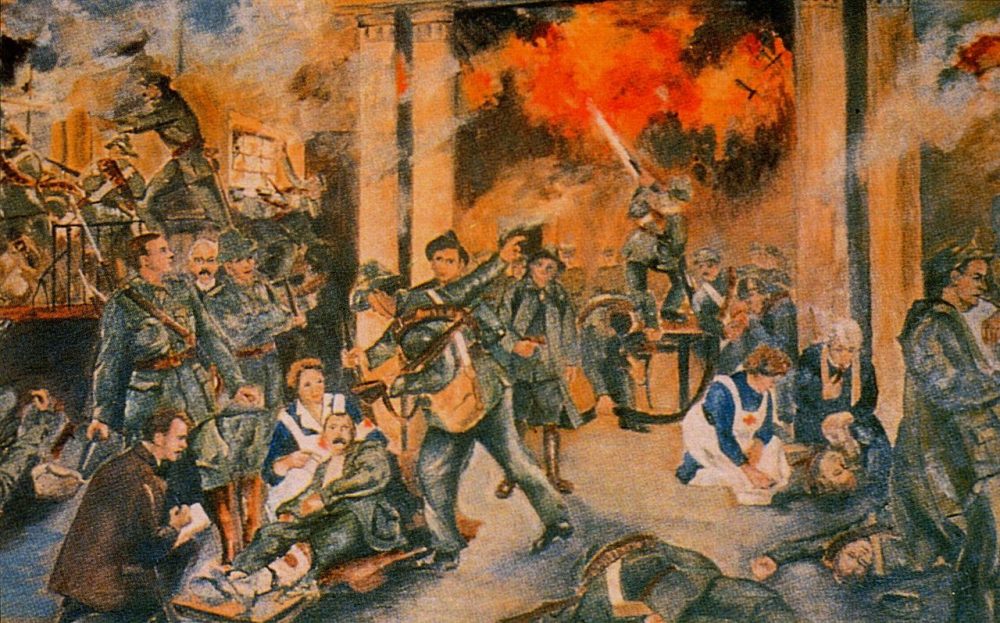
The Easter Rising has gone down in Irish History as a watershed moment. For Republicans especially it is the seminal moment in recent Irish History commemorated with parades and rallies at Easter every year. Many to this day still believe the Rising was an unexpected event from the British perspective. There is a belief that the British were taken totally by surprise by a well- disciplined force, the Irish Volunteers, as most of the Dublin Garrison had left to enjoy the Bank Holiday Easter Monday and attend the horse racing at Fairyhouse which was hosting the Grand National. In this piece of Busting the Myths I will try to examine the Rising from a different angle. Did British Intelligence allow the Rising to go ahead to further the aims of some of their hierarchy and force a confrontation once and for all with Irish Volunteer Movement and is the standard narrative of a shell shocked British establishment coming to terms with a surprise attack fully accurate?
The Easter Rising took place mainly in Dublin between 24th April and 30th April 1916. The event was masterminded by a seven man IRB (Irish Republican Brotherhood) military council with these plans unknown largely to those on the ground- the Irish Volunteers and the Irish Citizen Army. Even some IRB and Irish Volunteer leaders such as Bulmer Hobson and Eoin MacNeil were in the dark. At the last minute the MacNeil however became aware of the plans and attempted to have the Rising cancelled by issuing countermanding orders. His attempts were ultimately futile as the Rising was cancelled for one day and commenced not on Easter Sunday as planned but on Easter Monday. One of the signatories Seán Mac Diarmada was so enraged that he had Bulmer Hobson, who had agreed with MacNeil’s position held under house arrest at gunpoint and circumvented MacNeil’s orders by contacting reliable, as he saw it, Volunteer units.
Ireland at this time was ruled by three administrators, the Lord Lieutenant, the Chief Secretary for Ireland and the Under Secretary for Ireland. In 1916 these positions were held by Lord Wimborne, Augustine Birrell and Matthew Nathan respectively. These three men would be at the heart of what was to come. Prior to the Rising these three men had disagreed with each other on the best way to counter an increasingly aggressive and assertive Volunteer movement who openly drilled on the streets of Dublin. Birrell and Nathan felt that any heavy handed approach would be counter- productive and that such moves would antagonise public opinion against Britain. Wimborne disagreed and he was supported in this assessment by British Intelligence who were aghast at the pacifist approach taken by the Chief and Under Secretaries. Indeed there was a great deal of friction between both sides.
A huge problem that the British faced was its inability or even refusal to have dealt with the Unionist armed mobilisation of 1912-1914. When the army had been ordered North most of the officers had offered to resign their commissions rather than enforce Home Rule on Ulster. For Birrell and Nathan it seemed that to now put down the Irish Volunteers would provoke a ferocious backlash which would show the British to be one sided in Irish affairs confirming to many that the Nationalist Revolutionaries were right all along. However British Intelligence had gleaned some top secret information- there was a rebellion planned in Ireland to commence on Easter Sunday. British Naval Intelligence and the top secret ‘Room 40’ which had broken the German codes had also intercepted communication between Clan na Gael in America and the German Authorities. In fact the British knew a full two months before the Rising occurred that one was planned for Easter Sunday after intercepting a communication from John Devoy of Clan na Gael and the Germans.
Augustine Birrell and Matthew Nathan were informed of these interceptions by Admiral Bayly but as they were not informed from where the information came they dismissed it as too vague and insisted they could not act upon it. General Friend Commander in Chief in Ireland was also informed that a Rising was imminent. However the really key information crucial to the Dublin authorities understanding was not passed on. That information was that British Intelligence had it from an extremely reliable source, namely Room 40, that there would be an uprising on 23rd April 1916. Was it to keep Room 40, a crucial naval intelligence source secret or was there something more sinister. Why this information was not passed on remains an open question. However Roger Casement who was famously arrested on board the Aud with an array of weaponry destined for the rebels declared that during his interrogation he offered to call on the Volunteers to desist from action on Easter Sunday. His Military Intelligence interrogators however told him, “It is a festering sore, much better that it comes to a head”. Casement’s interrogators had been Reginald Hall and Basil Thomson.
The week before the Rising two informers within the Volunteers codenamed ‘Chalk’ and ‘Granite’ had informed their handlers that they had received orders to prepare for mobilisation as they were ‘going out’ on Easter Sunday and some may not come back. Armed with this information and the intercepts it seems incredible that the British did not intervene before the rebels struck. It is even more amazing that the Prime Minister who was also fully aware of the Intelligence available and from whence it came did not directly intervene. Rather he did nothing and the Rising went ahead as planned. To be fair to Nathan and Birrell they had advanced plans in place to arrest key activists after the capture of the Aud and Roger Casement. However by the time those plans were being put into place Padraig Pearse was reading the proclamation on the steps of the GPO.
It is my contention that British Intelligence had achieved what they had been advocating for months and it had been in their interests to let the Rising occur. Certainly those on the ground were taken by surprise at the outbreak of Rebellion and most British forces in Dublin were enjoying the horse racing at Fairy house when they heard of the takeover in Dublin. There also does seem to be some evidence that the Dublin Administration was drip fed information but without the verification needed were reluctant to take decisive action. However, now there had been open confrontation with the Volunteers who were decimated with their leadership executed and their rank and file interned. Dublin city centre lay in ruins and the population were hostile to what had occurred. Birrell and Nathan had resigned, totally discredited and were out of the picture whilst Wimborne who had declared martial law during Easter Week was fully vindicated. However the British Intelligence apparatus had miscalculated the fallout from the Rising. Not six years later Ireland would see a Free State established and the partition of the island. The fallout from the Rising was considerable and in the end although a terrible defeat for the Volunteers in the short term, in the long term Easter week would and still does illicit a massive emotional response in Nationalist Ireland. It is the great question we can’t answer, if the British had intervened before the Rising would events have transpired as they then did? I will leave it to the readers to debate that one.
As this month of March 2020 comes to a close and will go down in history due to the Coronavirus pandemic, we air a podcast by writer Linda Dowling Almeida that she produced to commemorate the 250th Anniversary of the New York St. Patrick’s Day Parade called Memories of The New York City St . Patrick’s Day Parade, which explores the experiences and emotions of a variety of New Yorkers with Irish roots. 10am-12noon: Adrian Flannelly Showlivestreaming worldwide on www.irishradio.com Join us today for easy listening and updated news from Ireland.
New York may have to hand over its title as the oldest St Patrick’s Day parade in the world. iStock
The world’s oldest St Patrick’s Day festival was in St. Augustine, Florida, some 420 years ago.
Boston and New York have long laid claim to being the centers of Irish immigration that saw the very start of St. Patrick’s Day parades before they had even started in Ireland itself with start-up dates of 1737 and 1762 respectively.
In truth, St Augustine in Florida beats them to the mark and is, in fact, home to the oldest St Patrick’s Day parade in the world. (Waterford in 1903 held the first St.Patrick’s Day parade in Ireland.)
According to new research unearthed in Florida, St Augustine may have well over a hundred years on Boston and New York, holding its first St Patrick’s Day celebration in 1600 and its first parade in 1601.
The sensational information was uncovered in December 2017 by historian Dr. J. Michael Francis in a gunpowder expenditures log in Spain’s Archivo General de Indias, or AGI. The documents reveal that spring festivities which included a feast day of San Patricio (St. Patrick) was held in the year 1600 in St. Augustine, Florida.
“While artillery pieces often were fired to help guide ships safely across St. Augustine’s protective sandbar, they were also fired during times of public celebrations and religious festivals,” Francis wrote in his blog for PBS.
“In March of 1601, St. Augustine’s residents gathered together and processed through the city’s streets in honor of an Irish saint, who appears to have assumed a privileged place in the Spanish garrison town. Indeed, during these same years, St. Patrick was identified as the official ‘protector’ of the city’s maize fields.”
The professor and Chair of the Department of History and Politics at the University of South Florida, St. Petersburg, has studied the records on and off over the past 30 years and he was certainly surprised to discover this information on a St Patrick’s Day celebration written in Spanish in Florida.
“It was certainly a surprise … it did not register the first time I looked through it. … It was written in Spanish, and it took a few seconds before it actually hit me that this was a St. Patrick’s Day parade/procession,” Francis explained to Renee Unsworth from totallystaugustine.com.
“I don’t know how much it will change the national perception (of St. Patrick’s Day) which has evolved into something so unique. … It certainly forces people to pause.”
St Augustine is regarded as the oldest city in the US. Image: iStock.
The news was also welcomed by recently-retired City of St. Augustine archaeologist Carl Halbirt who was recently named Parade Marshal of the 2018 St. Augustine St. Patrick’s Day Parade taking place on March 10.
“The history of St. Augustine, its diversity, and place in American (U. S.) heritage is often overlooked by people who do not live in Northeast Florida,” Halbert said to totallystaugustine.com.
“Yet, it is a city of firsts and oldest in terms of the country’s European ancestry. The discovery of this particular cultural tradition only adds to the city’s mystic and place. The late historian Luis Arana stated that ‘we have only scratched the tip of the iceberg’ regarding the historical records (and I might add the city’s buried archaeological record). Dr. Michael Francis’s discovery of these documents adds to St. Augustine’s cultural heritage.”
From his research, Francis believes that the St Patrick’s Day parade in St Augustine was influenced by the Irish priest Richard Arthur.
Did the first St Patrick’s Day parade take place here in St Augustine? Image; iStock.
“It is likely that Richard Arthur was responsible for the Irish saint’s short-lived prominence in St. Augustine,” he writes.
“When Arthur disappears from the historical records, so too do the references to the Irish saint, and soon thereafter, the memory of the St. Patrick’s Day celebrations and processions began to fade from public memory.
“Today, St. Patrick’s Day is one of St. Augustine’s most popular celebrations, but its early seventeenth-century origins have long been forgotten.”
While St Augustine could prove to be the oldest St Patrick’s Day parade in the world, as there was no continuation of the parade throughout the past 400 years, Boston and New York could still continue that they are the owners of the oldest continuous parade.
New York may have to hand over its St Patrick’s Day title. Image: iStock.
The first parade was held in New York on held on March 15, 1762, in Bowling Green in lower Manhattan. Before this time, St. Patrick’s Day was honored as a Catholic feast day on which a special Mass was attended and nothing more, but in a show of national pride, Irish soldiers within the British Army marched through Bowling Green in honor of their patron saint, with New Yorkers claiming that this would spark a trend that would result in the worldwide festivities we celebrate today.
Boston, on the other hand, could claim the first celebration but not first St. Patrick’s Day parade. On March 17, 1737, as a gesture of solidarity among the city’s new Irish immigrants, Boston’s Irish community joined together in festivities of their homeland.
Either way, all three locations in the US were hundreds of years before the first St Patrick’s Day parade in Ireland which was held in Waterford in 1903.
Irish-American Heritage Month is celebrated by proclamation of the President and Congress in the United States to honor the achievements and contributions of Irish immigrants and their descendants living in the United States. It was first celebrated in 1991. The heritage month is in March to coincide with Saint Patrick’s Day, the Irish national holiday on March 17. Heritage Months are usually proclaimed by nations to celebrate centuries of contributions by a group to a country.
Saint Patrick’s Day is a Roman Catholic religious holiday that honors the saint, who introduced Christianity to Ireland in the early fifth century. It has developed in the United States as a celebration of all things Irish. With large ethnic Irish populations, Boston and New York City both claim the world’s first Saint Patrick’s Day parade, while Philadelphia claims to be the second oldest behind New York City. In New York City, it occurred on March 17, 1762, featuring Irish soldiers serving in the British military protecting the Colonies during the French and Indian War. In 1948, President Harry S. Truman, of Scottish descent, attended the New York Saint Patrick’s Day parade and gave a speech to attendees. This was a proud moment for the many Irish whose ancestors had to fight stereotypes and prejudice to find acceptance in the United States. In 1960 John F. Kennedy was elected as the first Irish American Catholic President; in 1961 he was in New York to review the Saint Patrick’s Day Parade.
In tribute to all Irish Americans, the US Congress, by Public Law 101-418, designated March 1991 as “Irish-American Heritage Month”[1] Congress again proclaimed March as Irish-American Heritage Month for 1995 and 1996.[2]
Within the authority of the Executive Branch, the President of the United States has also issued a proclamation each year since 1991.[3][4]
Each year in March, the Irish Taoiseach visits the United States for Saint Patrick’s Day. A Shamrock Ceremony takes place in the morning at the White House where a crystal bowl containing shamrock, a traditional symbol of Ireland, is presented to the President in the Oval Office. This is followed by a Friends of Ireland luncheon hosted by the House Speaker in the U.S. Capitol or the Rayburn House Office Building.[5][6] The luncheon is attended by the President, Vice President, the Taoiseach, the Speaker, and other officials.[7] In the evening, a Saint Patrick’s Day Reception takes place at the White House.[8]
An essay originally written by Bobby Sands in the H-Blocks of Long Kesh
in 1979.
When one spends each day naked and crouched in the corner of a cell
resembling a pigsty, staring at such eye-sores as piles of putrifying
rubbish infested with maggots and flies, a disease-ridden chamber pot,
or a black, disgustingly-scarred wall, it is to the rescue of one’s
sanity to be able to rise and gaze out of a window at the world.
My cell window, fortified by thick concrete slabs which serve as bars,
affords me with a view of nothingness, unless a barbed wire jungle and
rows of blank faceless tin timbers offer an artistical appreciation
unknown to me. It’s what passes by, lingers, or materialises, in front
of my humble little window that saves me, that can dampen depression,
allow me to contemplate, serve as an enjoyable distraction from my
surroundings, and provide me with a once unknown pleasure.
On a dreary, dull, wet, morale-attacking November afternoon, when one’s
stomach is empty, and when the monotony begins to depress and
demoralise, it is soothing in many respects to spend a half-an-hour with
one’s head pressed against the concrete slabs, gazing in wonder, and
taking in the antics of a dozen or so young starlings bickering over a
few stale crusts of bread. Circling, swooping, sizing up and daring an
extra nibble, continually on their guard, and all their tiny nerves on
end, the young starlings feud among themselves, the greedy one continually trying to dominate and always wanting the whole haul to
himself, fighting with his comrades whilst the sparrow sneaks in to
nibble at the spoils.
But the ruler of the kingdom of my little twenty-yard arched view of the
outside world, is the seagull, who dominates, steals, pecks, and denies
the smaller birds their share. The seagull takes it all. In fact, his
appetite seems insatiable. He goes to any length to gorge himself. Thus
I dislike the seagull, and I often wonder why the starlings do not
direct their attention to the predator, rather than each other. Perhaps
this applies to more than birds.
During the summer months, finches were abundant, and the music of the
lark a constant symphony of sound and a reminder of life. The various
crows, the odd magpie, and the little wagtails are still to be seen and
heard from dawn to dusk.
In the late evening, when most of the prisoners of war are sleeping,
when a hush descends, amplifying the gentle sound of a breeze, one can
gaze upon the ocean of sky arid the multitude of stars that seem
embedded and ablaze. In that black root of nothingness that not even the
moon in all her beaming regalia can penetrate, and one can dream a
thousand dreams of yesterday, of childhood and happiness, of love and
joy, and escape through make-believe and fantasy. The evils that engulf
each day, forgotten about, and tomorrow as far away as the unreachable
stars.
On many a summer evening and cold winter night I stand with only my old
shabby blanket wrapped tightly around me, my breath pouring out into the
blackness, in ghost-like clouds, just dreaming. Many a day in the
eternal hours, I stand watching the birds and listening to the lark,
trying to discover its whereabouts in that stagnant blue ocean above me
that represents the outside world, and I long for the liberty of the
lark.
I suppose, to many, a few birds, the sound of a lark, a blue sky, or
full moon, are there, but unnoticed most of the time. But, to me, they
mean existence, peacefulness, comfort, entertainment, and something to
view, to help forget the tortures, brutalities, indignities and evils
that surround and attack my everyday life.
Today, the screws began blocking up all the windows with sheets of
steel. To me this represents and signifies the further torture of the
tortured, blocking out the very essence of life: nature!
A few words I once read came echoing back to me today: ‘No-one can take
away from a person his or her ability to contemplate. Throw them into
prison, give them hard labour, unimaginative work to do, but you can
never take away from them the ability to find the poetry and music in
life: And I also realised that, here, my torturers have long ago
started, and still endeavour, to block up the window of my mind.