WASHINGTON — United States intelligence officers and Special Operations forces in Afghanistan alerted their superiors as early as January to a suspected Russian plot to pay bounties to the Taliban to kill American troops in Afghanistan, according to officials briefed on the matter.
The crucial information that led the spies and commandos to focus on the bounties included the recovery of a large amount of American cash from a raid on a Taliban outpost that prompted suspicions. Interrogations of captured militants and criminals played a central role in making the intelligence community confident in its assessment that the Russians had offered and paid bounties in 2019, another official has said.
Armed with this information, military and intelligence officials have been reviewing American and other coalition combat casualties since early last year to determine whether any were victims of the plot. Four Americans were killed in combat in early 2020, but the Taliban have not attacked American positions since a February agreement to end the long-running war in Afghanistan.
The details added to the picture of the classified intelligence assessment, which The New York Times reported Friday has been under discussion inside the Trump administration since at least March, and emerged as the White House confronted a growing chorus of criticism on Sunday over its apparent failure to authorize a response to Russia.
Mr. Trump defended himself by denying the Times report that he had been briefed on the intelligence, expanding on a similar White House rebuttal a day earlier. But leading congressional Democrats and some Republicans demanded a response to Russia that, according to officials, the administration has yet to authorize.
The president “needs to immediately expose and handle this, and stop Russia’s shadow war,” Representative Adam Kinzinger, Republican of Illinois and a member of the House Foreign Affairs Committee, wrote on Twitter.
Appearing on the ABC program “This Week,” Speaker Nancy Pelosi said she had not been briefed on the intelligence assessment and had asked for an immediate report to Congress. She accused Mr. Trump of wanting “to ignore” any charges against Russia.
“Russia has never gotten over the humiliation they suffered in Afghanistan, and now they are taking it out on us, our troops,” she said of the Soviet Union’s bloody war there in the 1980s. “This is totally outrageous. You would think that the minute the president heard of it, he would want to know more instead of denying that he knew anything.”
Spokespeople for the C.I.A., the director of national intelligence and the Pentagon declined to comment on the new findings. A National Security Council spokesman did not immediately respond to a request for comment.
Though the White House press secretary, Kayleigh McEnany, claimed on Saturday that Mr. Trump had not been briefed about the intelligence report, one American official had told The Times that the report was briefed to the highest levels of the White House. Another said it was included in the President’s Daily Brief, a compendium of foreign policy and national security intelligence compiled for Mr. Trump to read.
Ms. McEnany did not challenge The Times’s reporting on the existence of the intelligence assessment, a National Security Council interagency meeting about it in late March and the White House’s inaction. Multiple other news organizations also subsequently reported on the assessment.
The officials briefed on the matter said that the assessment had been treated as a closely held secret but that the administration expanded briefings about it over the last week — including sharing information about it with the British government, whose forces were among those said to have been targeted.
Republicans in Congress demanded more information from the Trump administration about what happened and how the White House planned to respond.
Representative Liz Cheney of Wyoming, the third-ranking House Republican, said in a Twitter post on Sunday: “If reporting about Russian bounties on U.S. forces is true, the White House must explain: 1. Why weren’t the president or vice president briefed? Was the info in the PDB? 2. Who did know and when? 3. What has been done in response to protect our forces & hold Putin accountable?”
Multiple Republicans retweeted Ms. Cheney’s post. Representative Daniel Crenshaw, Republican of Texas and a former member of the Navy SEALs, amplified her message, tweeting, “We need answers.”
In a statement in response to questions, Senator Mitch McConnell of Kentucky, the majority leader, said he had long warned about Russia’s work to undermine American interests in the Middle East and southwest Asia and noted that he wrote an amendment last year rebuking Mr. Trump’s withdrawal of forces from Syria and Afghanistan.
“The United States needs to prioritize defense resources, maintain a sufficient regional military presence and continue to impose serious consequences on those who threaten us and our allies — like our strikes in Syria and Afghanistan against ISIS, the Taliban and Russian mercenary forces that threatened our partners,” Mr. McConnell said.
Aides for other top Republicans either declined to comment or did not respond to requests for comment on Sunday, including Representative Kevin McCarthy of California, the top House Republican; Senator Marco Rubio of Florida, the acting chairman of the Senate Intelligence Committee; and Senator Jim Risch of Idaho, the chairman of the Senate Foreign Relations Committee.
In addition to saying he was never “briefed or told” about the intelligence report — a formulation that went beyond the White House denial of any formal briefing — Mr. Trump also cast doubt on the assessment’s credibility, which statements from his subordinates had not.
Specifically, he described the intelligence report as being about “so-called attacks on our troops in Afghanistan by Russians”; the report described bounties paid to Taliban militants by Russian military intelligence officers, not direct attacks. Mr. Trump also suggested that the developments could be a “hoax” and questioned whether The Times’s sources — government officials who spoke on the condition of anonymity — existed.
Mr. Trump then pivoted to attack former Vice President Joseph R. Biden Jr., who criticized the president on Saturday for failing to punish Russia for offering bounties to the Taliban, as well as Mr. Biden’s son, Hunter, who is the target of unsubstantiated claims that he helped a Ukrainian energy firm curry favor with the Obama administration when his father was vice president.
“Nobody’s been tougher on Russia than the Trump Administration,” Mr. Trump tweeted. “With Corrupt Joe Biden & Obama, Russia had a field day, taking over important parts of Ukraine — Where’s Hunter?”
American officials said the Russian plot to pay bounties to Taliban fighters came into focus over the past several months after intelligence analysts and Special Operations forces put together key pieces of evidence.
One official said the seizure of a large amount of American cash at one Taliban site got “everybody’s attention” in Afghanistan. It was not clear when the money was recovered.
Two officials said the information about the bounty hunting was “well known” among the intelligence community in Afghanistan, including the C.I.A.’s chief of station and other top officials there, like the military commandos hunting the Taliban. The information was distributed in intelligence reports and highlighted in some of them.
The assessment was compiled and sent up the chain of command to senior military and intelligence officials, eventually landing at the highest levels of the White House. The Security Council meeting in March came at a delicate time, as the coronavirus pandemic was becoming a crisis and prompting shutdowns around the country.
A former American official said the intelligence analyst who briefs the president and the national security adviser, Robert C. O’Brien, working with his chief of staff, Mark Meadows, would have been involved in any decision to brief Mr. Trump on Russia’s activities. The director of the C.I.A., Gina Haspel, might have also weighed in, the former official said.
Ms. McEnany cited all three of those senior officials in her statement saying the president had not been briefed.
National security officials have tracked Russia’s relationship with the Taliban for years and determined that Moscow has provided financial and material support to senior and regional Taliban leaders.
While Russia has at times cooperated with the United States and appeared interested in Afghan stability, it often seems to work at crosscurrents with its own national interest if the end result is damage to American national interests, said a former senior Trump White House official, who spoke on the condition of anonymity to discuss sensitive security assessments.
Revenge is also a factor in Russia’s support for the Taliban, the official said. Russia has been keen to even the scales after a bloody confrontation in 2018 in Syria, when a massive U.S. counterattack killed hundreds of Syrian forces along with Russian mercenaries nominally supported by the Kremlin.
“They are keeping a score sheet, and they want to punish us for that incident,” the official said.
Both Russia and the Taliban have denied the American intelligence assessment.
Ms. Pelosi said that if the president had not, in fact, been briefed, then the country should be concerned that his administration was afraid to share with him information regarding Russia.
Ms. Pelosi said that the episode underscored Mr. Trump’s accommodating stance toward Russia and that with him, “all roads lead to Putin.”
“This is as bad as it gets, and yet the president will not confront the Russians on this score, denies being briefed,” she said. “Whether he is or not, his administration knows, and some of our allies who work with us in Afghanistan have been briefed and accept this report.”
John R. Bolton, Mr. Trump’s former national security adviser, said on “This Week” that he was not aware of the intelligence assessment, but he questioned Mr. Trump’s response on Twitter.
“What would motivate the president to do that, because it looks bad if Russians are paying to kill Americans and we’re not doing anything about it?” Mr. Bolton said. “The presidential reaction is to say: ‘It’s not my responsibility. Nobody told me about it.’ And therefore to duck any complaints that he hasn’t acted effectively.”
Mr. Bolton said this summed up Mr. Trump’s decision-making on national security issues. “It’s just unconnected to the reality he’s dealing with.”
Eric Schmitt is a senior writer who has traveled the world covering terrorism and national security. He was also the Pentagon correspondent. A member of the Times staff since 1983, he has shared three Pulitzer Prizes. @EricSchmittNYT
Adam Goldman reports on the F.B.I. from Washington and is a two-time Pulitzer Prize winner. @adamgoldmanNYT
Nicholas Fandos is a national reporter based in the Washington bureau. He has covered Congress since 2017 and is part of a team of reporters who have chronicled investigations by the Justice Department and Congress into President Trump and his administration. @npfandos
Daniel O’Connell in a 1836 watercolor by Bernard Mulrenin.
Between the Lines / By Peter McDermott
Irish singer-songwriter Imelda May said in a poem earlier this month, “You Don’t Get To Be Racist And Irish.”
She’s a big talent and has a way with words. One can’t say she doesn’t act from the best of intentions or that her aims aren’t hopeful.
The problem here is the uncritical way the media lapped this up. RTÉsaid the poem was “stunning,” while Irish Central labeled it “powerful.” One would have thought at this point the right thing to say is: “You don’t get to be racist. Period.” Ditch the simplistic, self-regarding nationalist narrative.
Keep up to date with the latest news with The Irish Echo
Over the past seven days, every Premier League player, every coach, every referee and other match official has taken the knee as part of the struggle against racism and in solidarity with the Black Lives Matters movement. The idea was pretty elemental in a sport in which players face racial abuse constantly. Get the message across: inclusion, equality before the law, full citizenship.
The use of 19th-century Irish history was a strong argument when it came to making a case for people being accepted as refugees and as immigrants into Ireland in the late 20th century and into this one. It resonated. “You Don’t Get to Be Racist and Irish,” on the other hand, is convoluted and confused.
It is no more truthful than Brendan Gleeson’s Garda Gerry Boyle, AKA “The Guard,” saying, “I’m Irish. Racism is part of my culture.”
Brendan Behan suggested that it was part of our culture in the sense that the Irish were just as bad in their roles as European whites when dealing with non-white people overseas. Why can’t we deal with the actual history?
The poem invokes unnamed militant nationalist heroes and martyrs, but some of them were racists; and it wasn’t the cherished hope of those who left Ireland starving that the slaves should be free. Far from it.
Conjuring up an imaginary non-racist past doesn’t help. But we should study and celebrate the Liberator Daniel O’Connell’s abolitionism, and understand the extent to which he was going against the grain. Also fighting a brave uphill battle were the nine young people, eight of them women, who went on strike at the Henry Street outlet of Dunnes Stores in Dublin in the 1980s. They refused to handle produce from Apartheid South Africa, in accordance with their union’s stated policy.
And at a time when we’re marking the passing of Jean Kennedy Smith, we might put her brothers in the O’Connell category: men who often used their privilege in the service of principle. A woman recalling last week in the comments section of the New York Times obituary the contributions of Ambassador Smith’s siblings, male and female, added: “As a person of color, I didn’t feel safe in this country unless there was a Kennedy in the Senate.”
Explaining his support for Robert Kennedy in the 1968 Democratic primaries, singer-songwriter Bobby Darin, a white Italian-American from the Bronx, said the senator “has a spiritual understanding of what it means to be poor,” while Sammy Davis Jr. said about RFK, “No one relates to the black man like Bobby.”
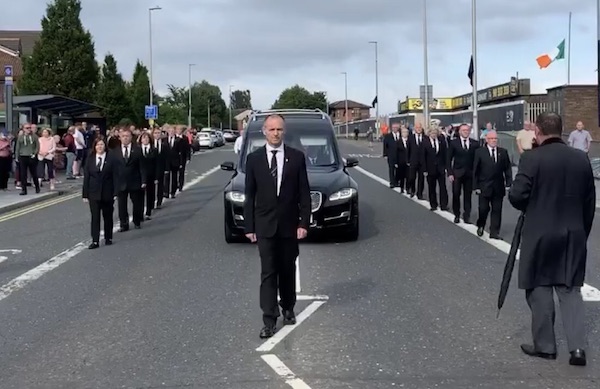
Former Sinn Féin president Gerry Adams has released a personal tribute to the former political prisoner and former party chairman Bobby Storey following his death at the age of 64.Mr Storey died in England last Sunday, June 21, following an unsuccessful lung transplant. Hundreds of mourners lined the Falls Road on Friday as his body arrived back to Belfast. Republicans wearing white shirts and ties formed a guard of honour and flanked the coffin as it was driven to his home.
His funeral is to take place in Belfast on Tuesday, June 30. It is understood that Sinn Féin has met with the PSNI to discuss arrangements. His remains will leave his home in Owenvarragh Park at 10.30am for 11am Mass at St Agnes’ Church on the Andersonstown Road and afterwards to Milltown Cemetery.
Thousands of mourners are expected to attend and republicans are being urged to ensure social distancing measures are maintained.
Mr Storey, who spent more than 20 years in prison, was loved and respected, and his death had come as a political as well as a personal blow, Mr Adams said.
“Bobby Storey was a stalwart of the struggle for Irish freedom for almost 50 years. As a young teenager growing up in North Belfast he witnessed, like many others of his generation, the violence and bigotry of the Unionist state, and then of the British Army.”
He said the introduction of internment in August 1971 and the Bloody Sunday killings in Derry had a huge influence on him.
“He was interned aged seventeen, one of the youngest internees, and in the decades that followed he spent over 20 years in prison.”
Mr Adams said he was an important advocate of the peace process.
“Bobby had a sharp, insightful political mind. He embraced the opportunity for building the republican struggle and advancing our goal of Irish Unity created by the peace process.
“At countless republican meetings he spoke in favour of Sinn Féin’s peace strategy. And when, following years of negotiations, the potential emerged for republicans to engage with the new policing dispensation Bobby played a leadership role in persuading others to grasp this new opportunity.”
He also said Mr Storey was one of the bravest people he had ever known.
“Whether inside or outside of prison, or through the years of harassment and beatings, arrests and torture from the RUC and British Army, Big Bobby demonstrated time and time again his enormous personal commitment and courage.
“He was also one of the funniest people I know. Big Bobby made light of his stammer. He could hold a group spellbound with his stories of past escapades and derring-do. His accounts of life in prison in England were hilarious. He was kind, thoughtful, loyal and very giving.”
He said even as he battled his illness, he remained cheerful.
“Big Bobby’s death is a huge political blow for republicans but is also a very personal loss for all of us who knew him. There were tears shed across Ireland as comrades got news of his death.
“On behalf of Colette and myself and our family I extend my sincerest and deepest sympathies and solidarity to Teresa, their children and grandchildren, his brothers Seamus and Brian, his sister Geraldine, his extended family circle and his many friends.
The Ancient Order of Hibernians has congratulated Ireland on its election to the United Nations Security Council.
In a letter to Irish Ambassador to the United Staes, Daniel Mulhall, AOH National President James McKay wrote: “As Ireland’s exiled children in America, we take special pride in being able to congratulate the Republic of Ireland in securing a position on the UN Security Council.
“For a nation that has yet to achieve its 100th birthday, for Ireland to now join the Security Council for the fourth time is truly an extraordinary accomplishment. It is a fitting recognition to the sacrifice of Ireland’s young men and women who have served as peacekeepers in some of the world’s most troubled areas. It is a testament to the energy and drive of the Irish people.
“As noted by former Ireland Justice Minister Frances Fitzgerald, ‘Ireland has never invaded any other land, never sought to enslave or occupy.’ Ireland brings a unique perspective to the critical deliberations of the Security Council that is sorely needed in a troubled world seeking lasting peace.
“In this year 2020, we mark the sad 175th anniversary of the nadir of Irish history, the start of the Great Hunger, a time when Ireland was degraded and abandoned; a time when she lost a quarter of her population to starvation and immigration. For Ireland in this commemorative year to take a place of leadership amongst the nations of the world is as appropriate as it is remarkable.
“May God continue to bless Ireland as she confidently strives forward, reaching new heights.”
Dear Editor, Sadly, your Washington correspondent has got it exactly right:“ that much of the success of Donald Trump was based on racism.” ( Suzanne Lynch,” Donald Trump’s political success is based on racism.” June 6).
Americans have been slow to actually come to terms with that. Even leading media people, who are critical of Trump, have been loath to actually and outrightly state it: fudging it with words like “ We don’t/can’t understand why he says/does that…” —making this Fermanagh man shout back at the TV :” because he’s a damn racist, that’s why he’s doing it.”
A Catholic from Northern Ireland can quickly spot racism/sectarianism (the twin evils of the world).Ms. Lynch rightly says slavery was the original sin of the United States. Racism (anti-Irish) and sectarianism (anti-Catholicism) were the original sin of England’s 1920 creation of Northern Ireland
There was a time not so long ago that White racists in America were proud to boast that they were anti-Black; and extreme Unionist/Loyalist/Protestants were likewise proud to demonstrate their anti-Catholicism. Now both groups will deny that they are bigoted. Indeed, it has now reached a ridiculous point that if one dares to criticize state-sponsored sectarianism in The North—the real serious issue, not individual bigotry, which may always be with us —one can be accused of being sectarian! But nothing can deny the enduring pathology, in significant sections, in both the United States and Northern Ireland.
One cannot watch the TV scenes of American police battering peaceful protesters off the streets and not immediately be reminded of the RUC. [Royal Ulster Constabulary, name of the former police force]. And one cannot hear about “collusion” (a word, I think, was first made popular in The North) and not think of The North when Trump keeps saying “ no collusion, no collusion”—knowing that that was England’s constant response, deny, deny.
And, I cannot watch Attorney General Bill Barr ( whom I call Lord Widgery) without thinking of cover-up, corruption, and lies.[The late Lord Widgery covered-up the State-massacre by the British Army of 13 innocent Catholics in Derry city, January 30, 1972.The British Army opned fire on thousands of peaceful Civil Rights protesters].
When I first came here in 1972, I , of course, knew that this great country still had problems. But it never occurred to me to be worried about the future of the United States—what new immigrant does?
But now, after almost 50 years, I am deeply concerned about the future of the United States, especially if Trump is re-elected for another four years. He has already hollowed out the main institutions: The State Department, the Justice Department, the FBI, the Separation of Powers (White House, US. Congress, Supreme Court), and he wants to use the U.S. military as his own Pretorian Guard or “B Specials.”
Historians warn us that great powers collapse from the inside, not the outside. This appalling occupant of The White House is a present and clear danger to the United States; he is the cancer on the presidency; he is a bully, a coward, and a narcissist beyond imagination, without a shred of empathy. He either does not know objective truth or he does not care about truth. He lies about everything, and according to the facts checkers of the Washington Post he has told about 20,000 lies since becoming president—and yet the Religious Right and many Catholics still support him, while he uses religion to divide and conquer.
Mother of God, how did this happen to this great country that I and every Irish immigrant love?