The Ancient Order of Hibernians is angered by decision not to prosecute
By Irish Echo Staff
The Ancient Order of Hibernians has expressed its anger and frustration over a decision not to prosecute British soldiers involved in the Bloody Sunday killings.
AOH National Freedom for All Ireland Chair, Martin Galvin, in a statement, has reacted critically to the decision by the Northern Ireland’s Public Prosecution Service not to prosecute 15 British Soldiers accused of participating in the killings of Bloody Sunday in Derry in 1972.
“The refusal to charge British troopers for Bloody Sunday seems to signal an undeclared amnesty or de facto immunity for these soldiers, and for others in British uniforms who carried out a shoot-to-kill policy or collusion murders for the crown, with impunity,” said Galvin.
“Thirteen people were shot dead by British troopers on Bloody Sunday. Fifteen more were wounded. A British Prime Minister, David Cameron, admitted these shootings were ‘both unjustified and unjustifiable.’
“Unjustifiable killings would seem to be textbook definition of murder. The British troopers who opened fire on the peaceful civil rights marchers were known and identified. What explanation can there be for only one British trooper being charged for so many murders and attempted murders?
“Moreover the crimes of Bloody Sunday did not end with these murders and attempted murders. There was a criminal cover-up that followed. British troopers gave sworn statements about non-existent gunmen and bombers to justify these murders and attempted murders to the Widgery Tribunal.
“Years later these troopers gave more testimony under oath in London, before the Saville Inquiry, where nothing said could be used against them, if they at last told the truth. Each trooper had the opportunity, after 30 years of reflection, to express remorse or give the heroic Bloody Sunday families the truth those families deserve.
“Instead these British troopers decided once again to blame their victims for getting in the way of the bullets. One Para after another swore to tell the truth then recited scripted cover stories of the sort whitewashed by the Widgery Tribunal.’
Galvin said that Saville himself noted that the soldiers had “knowingly put forward false accounts in order to justify their firing.”
And he added: “How can there be no perjury charges? The AOH has marched with the Bloody Sunday families in Derry and in demonstrations across the United States. On September 19th, hundreds of AOH members heard a briefing from Bloody Sunday campaign leader John Kelly, the brother of Michael Kelly.
“We were also able to present a grant for the Bloody Sunday Trust and Museum of Free Derry. These families are determined to fight for justice for the Bloody Sunday victims no matter how many times justice is denied. The AOH is determined to stand behind them until they get it.”
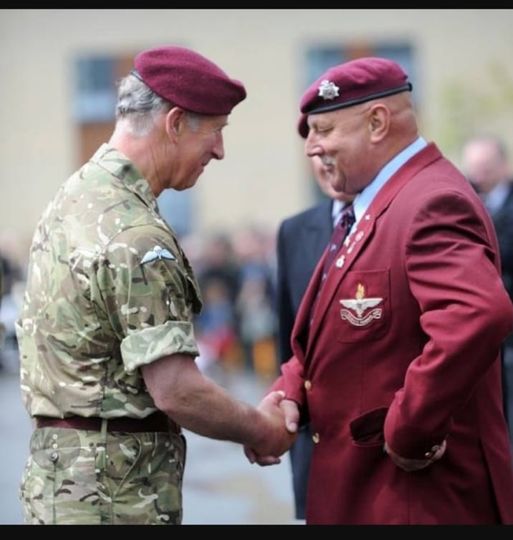
The arrogance of the British is on display yet again. Barely a day has passed since the Bloody Sunday families were told that no Paras would be held accountable for their murderous actions in Derry and the Colonel-in-Chief of the Paras, Prince Charles pays a one day visit to the North. Remember that he also did the same thing during the Ballymurphy Inquiry…
The DUP and Sinn Fein have said that a strong relationship with the US is key to supporting Northern Ireland’s economic recovery from the Covid-19 pandemic.
The parties were speaking after meeting US Special Envoy Mick Mulvaney at Stormont on Tuesday.
He also held talks with the Ulster Unionists and is set to meet the SDLP and Alliance at Westminster on Wednesday or Thursday.
His visit is part of a week-long trip to the UK and Ireland.
First Minister Arlene Foster said: “It was a pleasure to meet Mr Mulvaney for the first time formally in his role as Special Envoy.
“As our biggest international investor, the United States is hugely important to Northern Ireland. They have long since recognised the strength of our people and the value of our skilled workforce.
“Our meeting afforded the chance to discuss, not just the challenges facing us in Northern Ireland, but the opportunities for trade and investment that will be crucial as we work to rebuild our economy.
“Mr Mulvaney’s interest in the digital economy is particularly relevant to us given our world leading expertise in this sector. I look forward to exploring opportunities to drive investment in this key area.”
Deputy First Minister Michelle O’Neill couldn’t attend the meeting because she was unwell. She has tested negative for Covid-19.
Sinn Fein was represented by junior minister Declan Kearney.
“We have a long-standing relationship with the United States and in recent years have been uniquely placed to harness some of the huge potential that offers us,” he said.
“This is no doubt a turbulent time globally as we face the shared challenge of responding to, and recovering from, the Covid-19 pandemic.
“We discussed this issue with the Special Envoy, along with the additional challenges presented by the fast approaching end of the Brexit transition period.”
Speaking after his talks with Mr Mulvaney, Ulster Unionist leader Steve Aiken said: “The meeting provided the opportunity to raise a number of issues with the US Special Envoy, not least our concern and frustration at how a number of politicians are incorrectly misrepresenting the Belfast Agreement in the current Brexit withdrawal negotiations and completely ignoring the unionist position.
“We stressed that the Belfast Agreement must be supported in all its forms and that any barriers to trade within the UK are unacceptable to all of us who put interests of Northern Ireland and it people first.”
Mr Aiken added: “We discussed the issue of state aid which is causing so much angst to Dublin as Brexit approaches, and highlighted the importance of the UK Government being able to support Bombardier and the local aerospace industry and how this must not be thwarted by Northern Ireland being subject to rulings from the European Court of Justice.
“We also briefed the Special Envoy on the need for legacy arrangements to be fair to all, including former police officers and soldiers, and that we will not accept the rewriting of history.
“It was a very positive meeting and we look forward to continuing our engagement with the US government as we move forward.”
Earlier this week, Mr Mulvaney met Secretary of State Brandon Lewis. The US Special Envoy said he was optimistic that the UK and EU could reach a trade deal before the end of the year.
If British Foreign Secretary Dominic Raab was seeking some comfort and reassurance in Washington Wednesday he got some from the Trump administration, specifically from Secretary of State Mike Pompeo.
If Raab was considering the future possibility of a Biden administration in the specific context of Brexit and its possible negative effects on the Northern Ireland peace and political process, he would have been left Washington feeling a good deal less than comfortable.
With Raab making the rounds in the nation’s capital, former vice president and Democratic presidential candidate Joe Biden Tweeted: “We can’t allow the Good Friday Agreement that brought peace to Northern Ireland to become a casualty of Brexit.
“Any trade deal between the U.S. and U.K. must be contingent upon respect for the Agreement and preventing the return of a hard border. Period.”
It was as clear and blunt a message as could be delivered from a man who tends to speak plainly.
And the plain simple message from Biden was don’t mess with the Good Friday Agreement.
Biden was echoing not just fellow Democrats, but also the words of a bipartisan letter penned by four leading members of the House of Representatives, Eliot Engel, Richard Neal, William Keating – all Democrats – and Republican Peter King.
Congressman King today tweeted: “Congress will bock trade deal with Britain if Good Friday Agreement is not honored in entirety. No hard border!”
CNN reported that Biden had provided UK Prime Minister Boris Johnson with the latest reminder that the world was watching how his government was handling Brexit.
The report pointed to the Johnson’s government’s proposed legislation that would override parts of the Brexit deal that the UK agreed with the European Union last autumn.
The report stated: “Specifically, it would override a part of the deal known as the Northern Ireland protocol. This exists for the primary purpose of there being no hard border between the Republic of Ireland, an EU member state, and Northern Ireland, which along with the rest of the UK has left the EU and is in a transition period out of the bloc that expires on December 31.
“Members of Johnson’s government have previously admitted that the legislation, if passed, would ‘break international law in a very specific and limited way.’ This set off alarm bells among lawmakers in Johnson’s own party, many of whom said publicly that they would rebel and vote for measures aimed at pulling teeth from the bill next Tuesday.
“Biden’s comments will serve as an uncomfortable reminder for the UK that despite the British perception it has a special relationship with the US, the Irish lobby in DC is strong. The Democrats have a particular interest in this, as former President Bill Clinton took a leading role in the negotiations which led to the Good Friday Agreement.”
On Saturday, Sept. 19th join us for another historic first as we present the AOH – LAOH 2019-2020 Freedom for All Ireland grants via zoom. You can watch live on the AOH Facebook page beginning at 2:30pm Eastern time. Please share this information and be sure to join us Saturday for the FFAI Christmas Appeal Donations.
Yours in Motto, Danny O’
Some of my most memorable moments as a Hibernian came during the 2019 FFAI Tour when we presented Christmas Appeal grants. Recipients included leading justice campaigners like Mark Thompson of Relatives for Justice, former political prisoners like Bik McFarlane of Belfast National Graves, Fr. Gary Donegan and others.It was special to hear them talk about how important America and the AOH AND LAOH are to them. We are still working on the schedule but our National President Danny O’Connell and LAOH President Karen Keane are working on a live event Saturday September 19th which will allow you to see and hear this year’s FFAI GRANT recipients talk about their work for Freedom for all Ireland and how much they count on AOH-LAOH GRANTS.
This is something you will not want to miss being a part of and I urge you to get the word out now!!!!!