Four years ago this week, the party which for more than a decade has represented the lone voice of anti-Agreement unionism met for its annual conference in Cookstown.
Mandatory coalition is breaking – but it will not be replaced by the sort of majority rule familiar to Edward Carson a century ago. Photo: Adrian Dennis/AFP via Getty
In the closest that a political party comes to dejection in public, attendance was noticeably down, applause was modest and in private party members accepted that they were at a low ebb.https://buy.tinypass.com/checkout/template/show?
With typical defiance, leader Jim Allister attempted to rally his party after a year in which it had polled less than 24,000 votes across Northern Ireland, had lost its most high profile councillor and had seen Arlene Foster take over as an exceptionally popular leader of the DUP, which had swept all before it in that year’s Assembly election. For all the QC’s talent and zeal, there was a sense of his political project having failed in its central aims.
Yet within a fortnight the apparently secure Stormont institutions began to slip towards self-destruction as the RHI scandal emerged beginning a process which exposed devolution’s innards so that they cannot be unseen.
Now, four years on, Mr Allister’s single transferable speech – which denounces the Stormont system of mandatory coalition as undemocratic and unworkable – is being replicated by some of those who have little in common with his brand of hardline unionism and is resonating with a section of the public yearning for anything which might produce good government.
Two weeks ago, after the Executive’s shambolic handling of the pandemic saw its reputation reach a new nadir, Alliance leader Naomi Long sent an email to party members in which she bemoaned the Executive’s “continued dysfunction”.
Emphasising that last year saw Alliance emerge as Northern Ireland’s third party, the justice minister said: “Let’s be clear: the only way to overcome the failures of leadership we have witnessed at the Executive in recent days is by ending mandatory coalition and breaking the governance structures that have held Northern Ireland back for far too long.”
Voluntary coalition has long been Alliance policy – but even many people who follow politics closely would not realise that, so rarely has the issue been raised, with the party pragmatically accepting that such sweeping reform of the Belfast Agreement has not been imminently realistic. Searching through Alliance press releases, the last time I could find reference to ending mandatory coalition was eight years ago.
But now the party leader is seeing at first hand in the Executive the chaos being delivered under the current arrangements where even the threat of mass death and economic collapse are insufficient to force together the DUP and Sinn Féin into even a temporarily harmonious coalition.
On paper, it is the policy of the DUP, UUP, and Alliance to scrap mandatory coalition – a slightly misleading term in that it is not mandatory to be in the coalition, but is mandatory to offer every party with significant Assembly representation a place in the coalition.
There is also significant consensus on what they would like to replace it: A voluntary coalition which would have to command significant support across the Assembly, taking in some unionists and some nationalists rather than merely a simple majority of MLAs.
But the SDLP and Sinn Fein, fearing anything remotely akin to the resurrection of majority rule, have opposed changes to that part of the Agreement. In 2016 the SDLP joined Sinn Fein in tabling a Petition of Concern to veto the then independent MLA John McCallister’s attempt to end the current requirement to designate as ‘unionist’, ‘nationalist’ or ‘other’ and replace the petition of concern system with qualified majority votes to protect minorities.
Sinn Féin has been most trenchantly opposed to moving to voluntary coalition, viewing efforts to do so as a Trojan horse to exclude it from the Executive. The party also points to the fact that an Executive including all the major parties was at the heart of the Agreement.
Yet none of the architects of the Agreement (and Sinn Féin did not initially even endorse the accord on Good Friday 1998, only doing so later and after David Trimble, John Hume and the other parties had done so) envisaged it as a permanent and unalterable settlement.
Indeed, the Agreement itself contained the mechanism for its alteration, referring in two separate sections to the need for “a review of these arrangements…with a view to agreeing any adjustments necessary in the interests of efficiency and fairness” and stating that “each institution may, at any time, review any problems that may arise in its operation and, where no other institution is affected, take remedial action…it will be for each institution to determine its own procedures for review”.
Two years ago SDLP leader Colum Eastwood called for such a review, arguing that the process ”wouldn’t be about pulling the Agreement apart, it would instead be about getting back to it” by reversing some of the DUP-SF changes at St Andrews. And in 2017, the Green Party endorsed an end to mandatory coalition, arguing that “our institutions must adapt to survive”.
Yet when Stormont returned in January no radical reforms took place. Instead, the same defective machine was cranked into gear and those responsible seemed to expect a different result because it had been repainted.
Sinn Féin remains vociferously opposed to change, arguing that the failures of the Executive have all been the fault of the DUP. Yet there are three areas in which Sinn Féin could benefit from voluntary coalition. Firstly, it would be more likely to be an effective government for which Sinn Féin, if it was in the Executive, could take credit rather than the present embarrassment.
Secondly, if Sinn Féin is moving towards a border poll campaign within the next decade, then being in opposition is arguably a more comfortable place to be. Arguing that Northern Ireland is unworkable is less coherent from a party which for almost two decades has been at the heart of the new Northern Ireland establishment.
Thirdly, if Sinn Féin decides that it suits its purposes to stay in the Executive, then there is now every reason to believe that a voluntary coalition could see Sinn Féin at the head of government – and the DUP forced into opposition.
In recent years the DUP has become increasingly toxic to other parties and has regularly seen the centrist parties join with Sinn Féin on everything from Brexit to gay rights. The idea that a voluntary coalition would automatically mean Sinn Féin’s exclusion from government is outdated.
Whether the DUP or Sinn Féin led a voluntary coalition – or whether, as deeply pragmatic parties who work far more closely than either publicly acknowledges, they chose to share power with each other – it would incentivise them towards accommodation, without which they would know that they may be replaced by the Opposition.
That would mirror what happens in Belfast City Hall where Alliance holds the balance of power and the DUP or Sinn Fein need to persuade Alliance of the merit of their arguments if they are to get controversial measures passed.
It would also end the untenable current situation whereby Alliance’s votes count for nothing in crucial Stormont votes. In order to ensure power-sharing continued, qualified majority voting would be required, meaning that something like 65% of MLAs would have to support key legislation such as the budget, ensuring that unionists and nationalists had a brake on each other.
It would therefore not be anything like a return to majority rule – and even if it was, that form of rule no longer favours unionism, which is a minority at Stormont.
Strikingly, what is driving people away from mandatory coalition is not the opposition of hardline unionists, but its failure to deliver good government. By persisting in its defence of a system so demonstrably broken, Sinn Féin risks undermining its own ambitions – on both sides of the border.
Trying to rewrite history is never a good idea. So when Sinn Féin’s official social media account claimed at the weekend that “On this day in 1905 Sinn Féin was founded” and proceeded to say that on that day “we outlined our position”, it naturally raised a few eyebrows within the historian community. The thing is with historians, they are fact-based people, so if you lie about something in history they will ruthlessly expose you for it. The backlash to the accuracy of the Sinn Féin tweet was immense and has accumulated into what will follow in this piece. For a political party so proud of its history, maybe it is time they are actually taught their own history.
As mentioned above Sinn Féin claim to be founded in 1905, this is not true, it was not until 1907 that an organisation by the name of the Sinn Féin League was established after two groups of nationalists merged, the Dungannon Clubs and Cumann na nGaedheal. Also existed was a dual-monarchist organisation called the National Council of which Arthur Griffith was a major component of. Eventually the Sinn Féin League and the National Council merged completely, and the name Sinn Féin was officially adopted for the party in 1908.
Arthur Griffith was founding father of Sinn Fein, yet he is not widely celebrated within the party today. Why is that? Arthur Griffith was a monarchist, he aspired to see Kings, Lords and Commons of Ireland, a British monarch as Head of State, this was official policy of his Sinn Féin. Griffith was also a strong advocate for peaceful resistance. The complete opposite to what Sinn Féin is today.
The 1916 Rising unintentionally gave rise to Sinn Féin as a prominent party, it ended up being the party associated with the organisation of the Easter Rising, which in truth was completely incorrect. From there, nationalists flooded into the party, policies drastically changed to more deep-rooted separatist policies, de Valera became leader and Sinn Féin became government of the revolutionary state which declared its independence from the United Kingdom in 1919.
The Anglo-Irish Treaty and the subsequent conflict it caused, let to the demise of this Sinn Féin. With de Valera losing the presidency of the Dail due to his opposition to the treaty, he along with his allies proposed to leave Sinn Féin and formed Cumann na Poblachta, an anti-treaty wing of Sinn Féin. It was not until in 1926 that de Valera finally left with his allies and formed Fianna Fail. Pro-treaty members also left and formed Cumann na nGaedheal which would later merge with other parties to become Fine Gael.
The split of Sinn Féin led it into a period of electoral decline, by 1940 the party had become completely irrelevant. In 1948, Sinn Féin lost a court case in which they claimed ownership to funds deposited with the High Court in 1924 which belonged to the Sinn Féin party before its split. The Sinn Féin funds case as it became known decided against Sinn Fein on the basis that the pre-1923 party was a separate party from the one that existed in the 1940’s. It was no longer even up for debate that the Sinn Féin that existed after 1923 is not remotely the same nor recognised by the courts as the same party that existed pre-1923.
Not long after the ruling in the case, Sinn Féin was taken over by a rejuvenated IRA which would later adopt socialist policies for the party. However, the party split again in 1970. What came out of the split was a party called Official Sinn Féin on one side which became Sinn Féin – The Workers Party in 1977 and is today simply known as The Workers Party. Another party called Republican Sinn Féin also came out of the split, but they run no candidates in elections.
On the other side of split, a party by the name of Provisional Sinn Féin was formed on the 11th of January 1970. It was intrinsically linked to the Provisional IRA. This is the party in which today’s Sinn Féin originated from, not that of 1907. Ruairí Ó Bradaigh became the first President of Provisional Sinn Fein and was succeeded by Gerry Adams in 1983 and the rest is history. It eventually dropped the word ‘provisional’ from its name and became just Sinn Féin.
Sinn Féin has a complicated history. There have been more splits in the party than you will see at gymnasium. In truth, Fianna Fail and Fine Gael have far more claim to have been descended from the 1918 Sinn Fein than that of the Sinn Fein we see today. All political parties have parts of their history’s they wish to forget, Fine Gael have the Blueshirts, Fianna Fail have Charles Haughey as examples. Yet the breath-taking historical revisionism by Sinn Fein to try and associate themselves with the party of 1907 and suggest continuity with a party led by Arthur Griffith, who would turn in his grave if he knew modern day Sinn Fein were trying to claim continuity to his party, is simply historically inaccurate and a blatant lie.
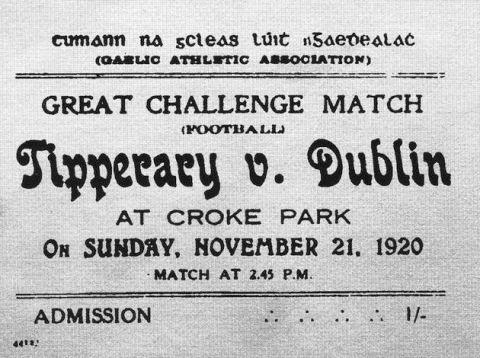
A ticket from the game at Croke Park in which 14 people were shot dead
Bloody Sunday 1920 earned its name. Unlike the Bloody Sunday of 1972, there were two bloodbaths occurred on Sunday 21 November 1920.
In the morning the first batch of killings were carried out under instructions from Michael Collins. A hand-picked group of IRA Volunteers assassinated fifteen members of what was known as the ‘Cairo Gang’ – undercover British intelligence agents, living in and working from South Dublin. When news of the killings filtered through, several other British agents in the Dublin area fled to the security of Dublin Castle.
In the afternoon, the second round of killings happened. These occurred at Croke Park that afternoon and are often referred to as ‘retaliation’ by the British forces for the elimination of the Cairo Gang in the morning. However, on its website last week the BBC claimed that “The British authorities suspected some of the gunmen had disappeared into the crowd at Croke Park, so armed police were deployed to block all the exits and search thousands of spectators.”
I haven’t heard that explanation before. If it’s true, it shows the British authorities were more than a little dim. How did they hope to locate their suspects among the thousands of spectators, and what did they think the thousands attending the game would have been doing while they conducted their search?
Whatever the thinking, following a flare signal from a small spotter plane overhead, the British military fired into the crowd and at players on the field. In all, fourteen people were killed, including three schoolboys aged 10, 11 and 13, and one player on the field, Mick Hogan, after whom the Hogan Stand in Croke Park is named.https://www.youtube.com/embed/Jmno-XmdYJw
There are those who see the morning and afternoon events as providing some kind of gruesome balance: the IRA killed British agents, the British military shot people in Croke Park. But that’s a false equivalence. The British agents killed were British spies in Ireland, working to kill IRA Volunteers. In contrast the killings in Croke Park were random, as the deaths of the three boys clearly indicates.
In the film Michael Collins, the IRA men chosen to carry out the assassinations are shown as having to nerve themselves to go through with the killings. Most of us understand that – the taking of human life is a terrible, final thing. But once a society or country commits to war, that’s what people do. The Cairo Gang were part of the British forces in Ireland, intent on crushing republicans and Ireland’s drive for independence.
In contrast, those in Croke Park were overwhelmingly people not involved in the military conflict. They were innocents, mowed down while they attended a sporting event in their own country.
Judging by the number of TV and radio programmes devoted to Bloody Sunday 1920, I would guess people in the south of Ireland are still horrified by the slaughter at Croke Park and see the elimination of the Cairo Gang as a justified act of war. How odd, then, that so few in the south appear to see the Bloody Sunday events of 1972 as equally monstrous.
Again in 1972, armed British soldiers fired into a crowd of innocent Irish civilians and killed fourteen. In the south there is, naturally, sympathy with the families of those killed; but there is no demand that those who ordered the killings and/or carried out the killings should be charged with murder. On the British side, there is even indignation that any of those guilty be held responsible.
Which is astonishing, when you think of it: nearly fifty years after Derry’s Bloody Sunday, not a single British soldier has been charged, let alone punished for what happened. Yes, David Cameron squeezed out an apology after more than thirty years, but how absurd is that? Supposing your neighbour came into your house one afternoon and killed several of your family, lied that your family was armed when they were totally defenceless, and eventually, decades later, confessed that it was a bad act he had done and says very sorry. No charge, no jail sentence for the killings.
Maybe we shouldn’t be surprised. The history of British involvement in Ireland, including Bloody Sunday 1920 and Bloody Sunday 1972, shows that British forces in Ireland can kill at will, secure in the knowledge that their superiors will always find a way to protect them.
Ireland international soccer star James McClean wrote this article on his reasons for supporting Irish Unity for nationalist lobby group ‘Think 32’ and the Derry News.I have had the honour of representing my country on the football pitch.
Captaining Ireland was among the proudest moments in my life because I am an Irishman to the core.
But despite being able to do these things, I have always been conscious of the fact that some rights are still denied to me because I happen to have been born in the North.
I can captain my country, but I still can’t vote for my country’s President.
I can represent the FAI (Football Association of Ireland) at home and abroad, but I can’t have any democratic say in the make up of the government that funds it.
Partition is rife with such failures and contradictions.
To me, it simply doesn’t make sense to have two ‘national’ football teams on an island this size never mind two health systems, two education systems and two governments.
As an Irish man and an Irish citizen, I want the island of Ireland to be reunified under a government for all our people.
I don’t want to have any technicalities, caveats or doubts questioning my nationality.
And I strongly believe that everyone who lives on this island should be entitled to the same rights as each other.
The best way to achieve all of that is through the reunification of our island and the creation of a new all-Ireland administration that governs in the best interests of the people.
I am certainly not alone in that belief.
Every day, more and more people are coming to the same conclusion when they look at what is happening with Brexit, austerity and the handling of the pandemic.
And at the end of the day, all we are asking for is the right to choose our own future through a referendum on Irish unity.
That’s democracy and what has anyone got to be afraid of in that?
I want my children to grow up in a better country than the one I and generations before me, grew up in.
Surely that is what all parents want.
I am convinced that a better Ireland is possible through reunification.
In the dock: Winston Churchill Rea (aka Winkie Rea), at the opening of his trial at Belfast Crown Court on Monday
Michael Donnelly
November 25 2020 07:27 PM
Innocent Catholics were considered legitimate targets by roving loyalist gunmen because they had supposedly contributed to the coffers of the IRA, a loyalist paramilitary leader allegedly confessed on tape.
The tape, one of seven, was allegedly made by one-time Red Hand Commando head Winston Churchill Rea, for the so-called ‘Belfast Project’.
The project saw former loyalist and republicans allowing themselves to be interviewed by the Boston College about their terrorist past.
At one stage the 69-year-old also allegedly claimed there was a time when “buck-shee” Army privates handed over their SLR weapons to loyalist gunmen to fire into Catholic estates, as long as they provided their own ammunition.
The tapes, which were supposedly to remain confidential until his death, form the backbone of the prosecution case against the pensioner and the 19 offences he faces, allegedly committed between 1973 and 1996, including involvement in murder.ADVERTISING
The prosecution at his Belfast Crown Court Diplock-style, non-jury trial claim that Mr Rea, who alluded on tape to his identity as “Winston Winkie Rea”, is the person designated as “Interviewee L” and who confessed to the terrorist crimes he denies.
On Wednesday, during one tape section, ‘L’ was asked about the strategies of the RHC in the opening days of the Troubles between 1971 and 1972, to which he replied it was “his belief, if there hadn’t been a Protestant/loyalist backlash”, they would have been “driven into a United Ireland”.
He said “back in them days” the RHC, who were “prepared to enter enemy territory”, regarded ordinary Catholics as legitimate targets because they were seen almost every day, putting money into the “wooden collection boxes” of the IRA at the chapel gates as they left Mass.
Loyalists felt those monies were used to buy guns and bullets and the “Red Hand viewed those people contributing … were just as guilty as those who pulled the trigger”.
‘L’ went on to explain that while they much preferred to target and kill actual republicans because of the publicity from their IRA televised funerals, which provided “a moral-boost”, to the RHC leadership “the killing of ordinary Catholics was very much viewed as still part of the strategy”.
And with regard to the loyalist community, to ‘L’, they were “very much 100% behind us … no doubt about that”. The speaker said that doors in loyalist areas were always “left open for you”, and that “without the support of the community, you didn’t stand a chance”.
Later in that first interview, ‘L’ confided that when troops were initially deployed, “obviously the soldiers would have been favourable to loyalists”. He further claimed “so much so” soldiers had “no hesitation” in handing over their SLR weapons to loyalist gunmen to fire into Catholic housing estates.
The soldiers, who had to account for their ammunition, only handed over their rifles if the gunman could provide the correct ammo and ‘L’ even claimed to have witnessed it with his “own eyes”.
However, the speaker said this happened only between individual soldiers and loyalist gunmen, and that it was “just something” that came from privates themselves, “from the buck-shee privates”, it was “nothing orchestrated, it was just something, not from the top”.
Things changed, however, when that particular unnamed regiment was moved to be replaced by 2nd Para, and while there was still “a bit of a relationship” it was not the same.
‘L’ explained that 2nd Para operated a more “neutral” policy whereby “if loyalist broke the law they would come down hard on them and if republicans broke the law they would come down hard on them”.
The trail, of Mr Rea, AKA ‘Winkie Rea’, from the Springwell Road, in Groomsport, Co Down, continues.
The charges he denies include aiding and abetting, and conspiring to murder Catholic men John Devine in July 1989 and John O’Hara in April 1991.
Membership of the Red Hand Commando, aiding, abetting and conspiring to murder Catholics and conspiring to threaten to kill LVF leader Billy Wright in August 1996.
He has also pleaded not guilty to attempted murder and other terror-related charges, including conspiring to possess firearms secured from the Ulster Resistance paramilitary group on dates between November 1986 and October 1994.