I have met them at close of day Coming with vivid faces From counter or desk among grey Eighteenth-century houses. I have passed with a nod of the head Or polite meaningless words, Or have lingered awhile and said Polite meaningless words, And thought before I had done Of a mocking tale or a gibe To please a companion Around the fire at the club, Being certain that they and I But lived where motley is worn: All changed, changed utterly: A terrible beauty is born.
That woman’s days were spent In ignorant good-will, Her nights in argument Until her voice grew shrill. What voice more sweet than hers When, young and beautiful, She rode to harriers? This man had kept a school And rode our wingèd horse; This other his helper and friend Was coming into his force; He might have won fame in the end, So sensitive his nature seemed, So daring and sweet his thought. This other man I had dreamed A drunken, vainglorious lout. He had done most bitter wrong To some who are near my heart, Yet I number him in the song; He, too, has resigned his part In the casual comedy; He, too, has been changed in his turn, Transformed utterly: A terrible beauty is born.
Hearts with one purpose alone Through summer and winter seem Enchanted to a stone To trouble the living stream. The horse that comes from the road, The rider, the birds that range From cloud to tumbling cloud, Minute by minute they change; A shadow of cloud on the stream Changes minute by minute; A horse-hoof slides on the brim, And a horse plashes within it; The long-legged moor-hens dive, And hens to moor-cocks call; Minute by minute they live: The stone’s in the midst of all.
Too long a sacrifice Can make a stone of the heart. O when may it suffice? That is Heaven’s part, our part To murmur name upon name, As a mother names her child When sleep at last has come On limbs that had run wild. What is it but nightfall? No, no, not night but death; Was it needless death after all? For England may keep faith For all that is done and said. We know their dream; enough To know they dreamed and are dead; And what if excess of love Bewildered them till they died? I write it out in a verse— MacDonagh and MacBride And Connolly and Pearse Now and in time to be, Wherever green is worn, Are changed, changed utterly: A terrible beauty is born.
Michael Jackson March 29, 2021 09:10MAYBE NEXT YEAR: The Workers’ Party Easter Parade 2019
Republicans across Belfast will host their Easter commemorations online this year as the annual parades are cancelled for a second time due to the pandemic.
Last year, there was no Easter parade on the Falls Road for the first time since marches were banned during World War II.
With Covid-19 restrictions still in place, parties and organisations will host a range of virtual commemorations and small ceremonies with limited numbers.
The National Graves Association, which hosts the largest of the parades, will once again mark the occasion with an online broadcast that will start at 2.30pm on Easter Sunday (4 April). Belfast National Graves Association Chair, Joe Austin, will deliver an Easter message that will pay particular tribute to the those buried in the Republican Plot at Milltown Cemetery.
The event will also feature music and a poetry recital, with William Butler Yeats’ poem ‘Easter 1916’ read by young people sporting their GAA jerseys at the Republican Plot. By incorporating music, sport and the arts, Mr Austin said this year’s commemoration will mark the legacy of local martyrs who were “much more” than IRA Volunteers and political activists.
While republicans will be unable to gather in numbers at the cemetery, Mr Austin said the thousands who visit the Republican Plot throughout the year continue to “recognise the sacrifice” of Ireland’s patriot dead.
Sinn Féin President Mary Lou McDonald will also give an Easter address, which will be released online.
The Irish Republican Socialist Party (IRSP) will hold its virtual commemoration at 2pm on Easter Sunday.
The IRSP urged people to join them as they “commemorate those that paid the ultimate sacrifice for national liberation and socialism in Ireland.”
The Workers’ Party will host an online commemoration at 1pm on Easter Sunday when the party will deliver its annual address. Party activists will also hold wreath-laying ceremonies in Belfast, Dublin, Cork, Waterford and Lurgan.
At 3pm on Easter Sunday, Saoradh will hold its online national commemoration. The party stated: “It is at this time of year as Irish Republicans we take stock and reflect upon the deeds of the past, our efforts within the last year and indeed our plans to bring about National Liberation and a Socialist Republic in the future, and this year will be no different as we virtually celebrate Easter.”
Socialist Republican group Lasair Dhearg will hold a virtual 1916 Rising commemoration, streaming across social media at 1pm on Easter Monday (5 April).
The broadcast will include its Easter message and associated commemorative display. Republican Sinn Féin has said its commemorations and wreath-laying ceremonies will take place this year while “adhering to restrictions”. However, it has yet to specify when these will take place.
A fascinating new podcast has been launched to mark the 40th anniversary of the 1981 hunger strike.
The Guthanna/Voices of ’81 Podcast features first-hand testimony from the men and women of the H-Blocks and Armagh Gaol as well as the stories of those outside the prisons who were involved in the struggle against criminalisation.
Episode One saw former IRA Officer Commanding (OC) for the H-Blocks, Bik McFarlane reflect on the events surrounding the 1981 hunger strike and the experience of the PoWs in Long Kesh at the time.
The latest episode features the fascinating account of Mary Nelis – a leading campaigner with the Relatives’ Action Committee during the prison protest – who recalls her memories of visiting Long Kesh and seeing her two sons’ experience the brutal prison regime.
Voices of ’81 will contain a total of 30 episodes, which will be launched in the months ahead.
Speaking about the initiative, former blanketman and H-Blocks OC, Séanna Walsh, said the podcast aims to ensure that the public hears “from a broad number of voices about the period”.
“There is so much interest out there and it is not waning in any way, and those of us who are left look at it as our duty to make sure that people understand what happened at that time, why we did what we did, and why the state fought so viciously to deny our demands,” he said.
“The podcast will be available for people throughout the world and it’s a recording that will be there forever.
“There will be other things happening locally, but we thought this was very worthwhile and we want to make sure that the voices that are often not heard are brought to the fore and the story is heard.”
It was quite refreshing to see a reasonable debate on a United Ireland on Claire Byrne Live on Monday. There were pivotal moments from the get-go with Mary Lou McDonald and Leo Varadkar seeming to build a cautious consensus together in regard to the Northern Ireland question and how to go about it. It certainly felt from the outside looking in, a true start to the conversation of seeking Irish unity in the South in the modern era.
For many people watching, especially in the South, it was a good experience to lay witness to the Unionist perspective of things. Judging by the reactions of some on social media, it was quite the eye-opening experience to see the likes of Gregory Campbell from the DUP in full-flow and well as Loyalist activist Jamie Bryson.
At one point Bryson saying “all of the economic benefits in the world wouldn’t change my unionism and wouldn’t want me to be part of a United Ireland” should demonstrate to people in Ireland the large task at hand of possibly having to accommodate people which such opinions into a future United Ireland. These are not people who will exactly be persuaded by the idea of a United Ireland by the Republic simply fixing it’s health service to bring it in line with the NHS among other things.
But it also showed the alarming position unionism finds itself in. When your response to the idea that a United Ireland could benefit everybody on the island is to throw your head in the sand, say no and not even try and suggest the benefits of Northern Ireland remaining part of the UK, it hardly sends a positive signals to viewers at home that unionism has this grand vision for a brighter future for Northern Ireland.
On the other hand you had people like Andrew Trimble, former Ireland Ulster Rugby player on the show. Trimble offered the most balanced view of the night and its voices like him we need to hear more from. Trimble highlighted the massive issue around the segregated school system in Northern Ireland and how young Catholics and Protestants weren’t meeting one another until college. The de-segregation of Northern Irish schools is an essential step that must be taken long before a border poll happens.
There too is a massive education exercise required in Ireland to bring people up to speed with the affairs of modern-day Northern Ireland. Education in the South in regard to events such as the Troubles and Good Friday Agreement is lacking. Speaking personally, I went through the whole secondary school cycle without being taught about the Troubles. Made worse by the fact I live in Louth, beside the border, meaning I was not taught about the history 10 minutes down the road.
Not only should history be a compulsory subject in schools, but Northern Ireland’s history also should be at the heart of it together with normal Irish history. An end should be brought to Catholic-patronage of our education system in the Republic. Our national broadcaster RTE should also begin reporting more heavily on Northern Ireland news. These are not factors that should be considered when a United Ireland comes about, these are actions that should be taken now.
Irish political leaders seemed united in believing the reunification of the country is more presentable than ever before. It is far too early to set a date for a border poll, but it is never too early to start building trust. It will involve having conversations between North and South to understand each other before setting a true vision for a shared united Ireland. That involves trying to sell the idea of a United Ireland to those in the middle ground and to moderate unionists.
One such method of not building that trust is with Joe Brolly, who came on the show and decided bashing the DUP was the best course of action. When will some nationalists and republicans learn you cannot guilt people into a United Ireland? Thankfully, Claire Byrne rightfully cut off Brolly in what was a rare blip in an otherwise engaging debate.
It is at least the start of a conversation. For the foreseeable future efforts and resources should be poured into making the Good Friday Agreement work. Time should be set aside to reach out to unionists and to the middle ground in Northern Ireland to get their views on how they would see re-unification happen and what steps could be taken to build a truly shared island first. Finally, begin the conversation in the Republic of Ireland about what the Irish people are willing to change such as symbols and titles within the political sphere, in order to accommodate those who are British becoming part of a United Ireland. It’s time to dream big, start small but most all, start.
Investigative journalists Barry McCaffrey and Trevor Birney received an unreserved apology in a Zoom call with the chief constable
23 March, 2021 01:00
PSNI Chief Constable Simon Byrne `reiterated his unreserved apology’
THE PSNI chief constable has apologised in a face-to-face meeting to two journalists arrested over material that appeared in a documentary on a Troubles massacre.
Over a “constructive” Zoom meeting, Simon Byrne repeated the “unreserved apology” he gave in writing to investigative journalists Barry McCaffrey and Trevor Birney last July after the Court of Appeal quashed a search warrant used to raid their homes and offices in August 2018.
They were detained over the alleged theft of a police watchdog document which appeared in their film `No Stone Unturned’, based on a notorious loyalist massacre in Loughinisland in 1994.
Mr McCaffrey and Mr Birney worked with Oscar-winning director, Alex Gibney on the film which focused on how the RUC handled the UVF murders of six Catholic men at a pub in the Co Down village.Subscribe to our Morning newsletter
A PSNI spokesperson told the investigative news website The Detail the meeting had been “constructive”, saying “the chief constable reiterated his unreserved apology for the distress and upset caused to both men and their families as a result of their arrest”.
The journalists said they recognised their arrests happened before to his appointment.
They also raised recent death threats against reporters working on Northern Ireland titles including Allison Morris, Patricia Devlin and others.
“Even if journalists are pursuing stories that police could view as uncomfortable, they should be respected for their vital role in a democratic society,” Mr Birney told The Detail.
Mr McCaffrey said the PSNI “chose to arrest journalists for simply exposing the truth” in a “disastrous and unforgivable decision which caused untold hurt and pain to the victims’ families”.
“Attacking the media and threatening press freedom is not good policing.”
Amnesty International and the National Union of Journalists have called on the Policing Board to investigate the full circumstances behind their arrest.
The Detail reported an investigation into the leaking of the documents has ceased.
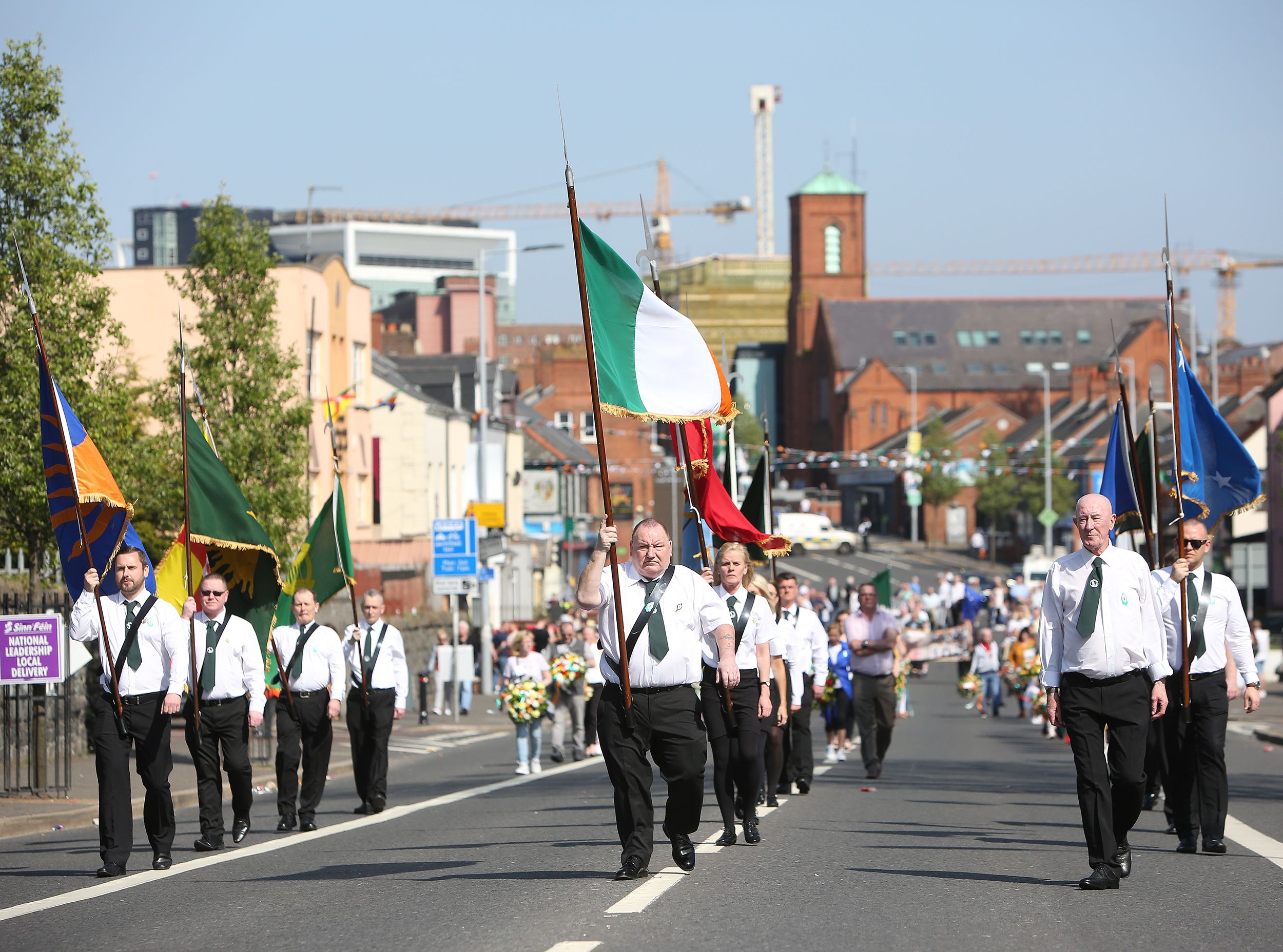 MAYBE NEXT YEAR: The Workers’ Party Easter Parade 2019