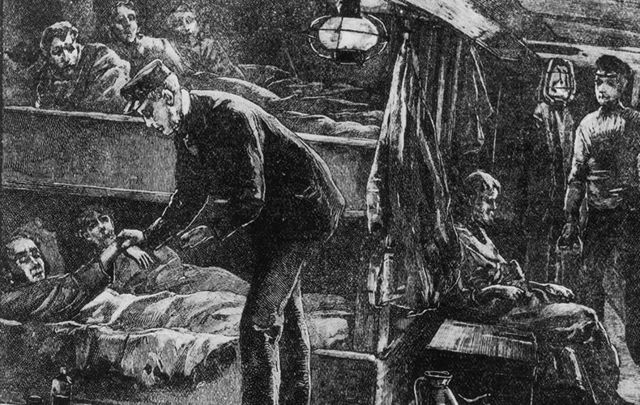
Ireland’s Great Hunger: Inside the coffin ships. GETTY
The Catholic Church needs heroes like never before, and Bishop Michael Power of Toronto, who was placed on the path to sainthood in 2017, certainly deserves that title.
Bishop Michael Power was the founding bishop of the Diocese of Toronto in 1842 and built a splendid Catholic cathedral there at a time of deep animosity toward Catholicism.
But a recent discovery lays out with far greater definition why the son of Irish emigrants deserves sainthood.
Canadian scientists finally identified the remains of 21 people as Famine emigrants from Ireland who died after their coffin ship was shipwrecked just off the northern coast of Canada.
Three of the bodies were found in 2011 after a great storm washed them ashore. The remains were of two seven-year-old boys and an 11-year-old boy. The bones showed signs of advanced malnutrition.
The 18 others, mostly women and children, were found after an archaeological dig in 1916.
They were among a party of 180 wretched souls from north Sligo, forced off their land by Lord Palmerston, a two-time British prime minister who owned 10,000 acres in the area.
3
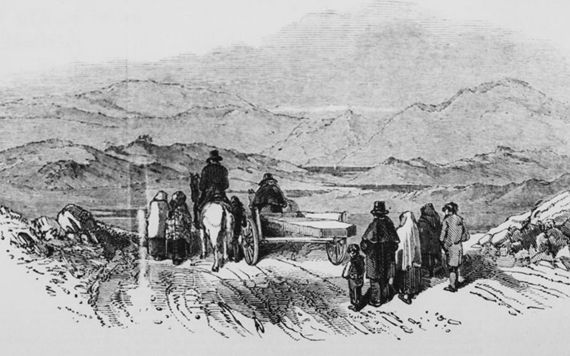
Desperate scenes of loss during the Famine.
The peasants had no choice. It was either to hell or to Canada, and Palmerston rented several coffin ships to rid himself of his tenants.
Of the 100,000 who fled to Canada in the year 1847, 20,000 died on coffin ships.
Thousands died on land, but the numbers would have been far greater but for Bishop Power.
In one of his first pastoral letters, Power wrote, “We should not forget that we have not fulfilled our duty towards our neighbor if we confine our charity and our solicitude to those with whom we live; for the divine light of our revelation shows us a brother, a friend in being, a member of the human race…that all men, without exception, are our neighbors and should be dear to us. “
Power realized that to fully staff his parish he needed to find more priests, and he departed on a mission to Ireland in early 1847 to recruit them. While there, he realized the horrific consequences of the Famine and the fact that hundreds of thousands would be fleeing to Canada, with first stop his diocese.
While the city hid in fear of the contagion, Power gathered what help he could to tend to the plague-stricken and starving Irish immigrants. He built fever huts and a makeshift hospital which saved hundreds of lives.
3
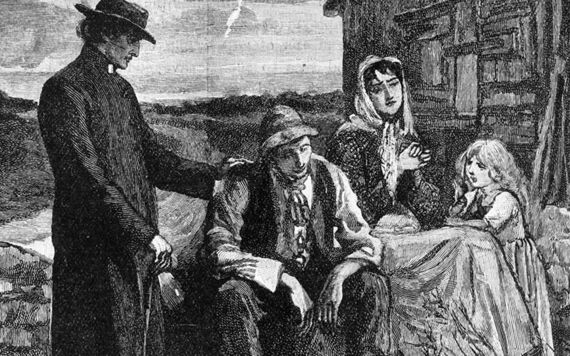
Families made impossible decisions during Ireland’s Great Hunger.
Historian Murray Nicholson writes that Power appealed for help. “Archdeacon Hay, himself ill with tuberculosis, Father Kirwin, Father Proulx from the north, Father E. Kelly, Father Schneider from Goderich and Father Quinlan from Brantford answered their bishop’s plea,” Nicholson wrote.
“These men, along with John Elmsley, a dedicated Catholic layman, and the Anglican Bishop J. Strachan, courageously entered the fever sheds set up on the wharves to tend the sick and the dying. Bishop Power contracted the disease and paid the supreme price on October 1, 1847, in service to his church and his laity.”
The Cross newspaper in its obituary said, “It is said that neither night nor day witnessed his absence from the depositaries of disease, until at length kneeling over the bed of infection, and listening to the sorrows of some poor penitent, he inhaled the miasmata of death. Grief of such a loss is natural.”
He was just 42. Bishop Power deserves his sainthood.
True patriots don’t fuel racist, religious or ethnic divisions. Patriots seek to confirm and strengthen and celebrate the ‘we’ in ‘we the people of the United States’
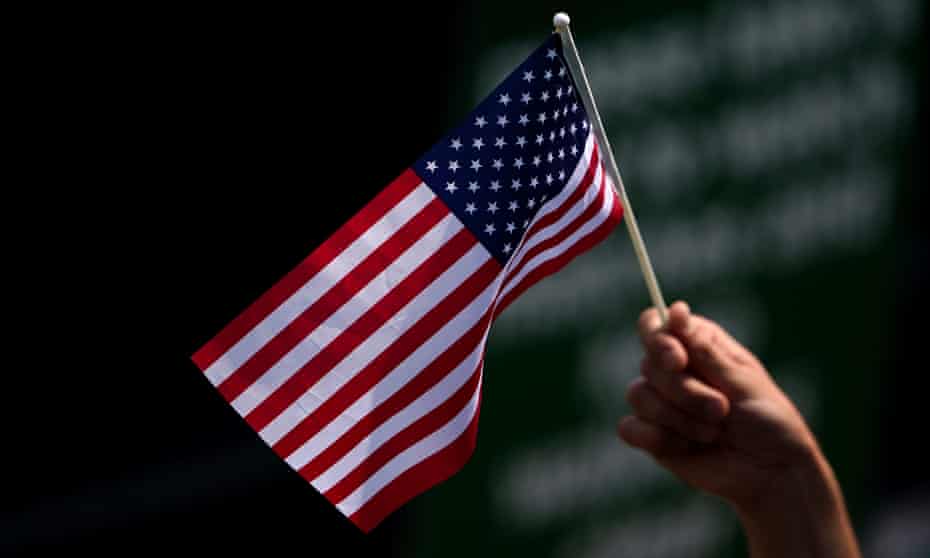
‘True patriots don’t put loyalty to their political party above their love of America.’ Photograph: Zac Goodwin/PA
Mon 4 Jul 2022
On this Fourth of July, it’s worth pondering the true meaning of patriotism.
It is not the meaning propounded by the “America first” crowd, who see the patriotic challenge as securing our borders.
For most of its existence America has been open to people from the rest of the world fleeing tyranny and violence.
Nor is the meaning of patriotism found in the ravings of those who want America to be a white Christian nation.
America’s moral mission has been greater inclusion – equal citizenship for Native Americans, Black people, women and LGBTQ+ people.
True patriots don’t fuel racist, religious or ethnic divisions. Patriots aren’t homophobic or sexist. Patriots seek to confirm and strengthen and celebrate the “we” in “we the people of the United States”.
Patriots are not blind to social injustices. They don’t ban books or prevent teaching about the sins of our past.
They combine a loving devotion to America with a demand for justice.
This land is your land, this land is my land, Woody Guthrie sang.
Langston Hughes pleaded:
Let America be America again,
The land that never has been yet –
And yet must be – the land where every man is free.
The land that’s mine – the poor man’s, Indian’s, Negro’s, ME –.
Nor is the meaning of patriotism found in symbolic displays of loyalty like standing for the national anthem and waving the American flag.
Its true meaning is in taking a fair share of the burdens of keeping the nation going – sacrificing for the common good. Paying taxes in full rather than lobbying for lower taxes, seeking tax loopholes or squirreling away money abroad.
It means refraining from political contributions that corrupt our politics, and blowing the whistle on abuses of power even at the risk of losing one’s job.
It means volunteering time and energy to improve the community and country.
Real patriotism involves strengthening our democracy – defending the right to vote and ensuring more Americans are heard. It is not claiming without evidence that millions of people voted fraudulently.
It is not pushing for laws that make it harder for people to vote based on this “big lie”. It is not using the big lie to run for office.
True patriots don’t put loyalty to their political party above their love of America.
True patriots don’t support an attempted coup. They expose it – even when it was engineered by people they once worked for, even if it’s a president who headed their own party.
When serving in public office, true patriots don’t try to hold on to power after voters have chosen not to re-elect them. They don’t make money off their offices.
When serving as judges, they recuse themselves from cases where they may appear to have a conflict of interest. When serving in the Senate, they don’t use the filibuster to stop all legislation with which they disagree.
When serving on the supreme court, they don’t disregard precedent to impose their ideology.
Patriots understand that when they serve the public, one of their major responsibilities is to maintain and build public trust in the offices and institutions they occupy.
America is in trouble. But that’s not because too many foreigners are crossing our borders, or we’re losing our whiteness or our dominant religion, or we’re not standing for the national anthem, or because of voter fraud.
We’re in trouble because we are losing the true understanding of what patriotism requires from all of us.
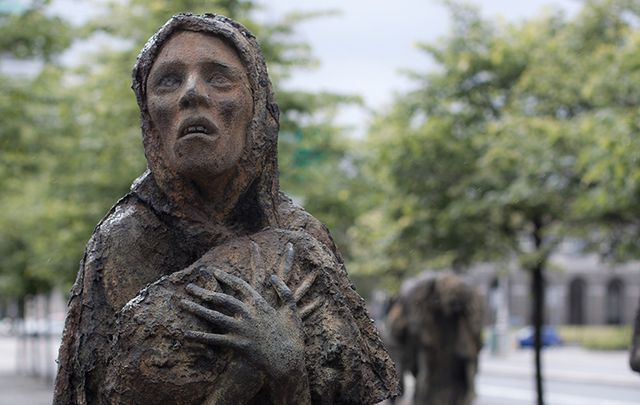
Statue by Rowan Gillespie, on Liffey Quay, a Memorial to the Irish Famine.
This letter was written on 22nd September 1850 by Margaret McCarthy to her family and would have served as an emigrant’s guide.
She was 22 years of age, the daughter of Alexander (Sandy) McCarthy, carpenter to the Crown estate, native of Boherboy, and Nell, his wife. Margaret sailed from Liverpool on 7th September 1849 on the Columbus and arrived in New York on 22nd October. She settled in New York.
My Dear Father and Mother, Brothers and Sisters,
I write these few lines to you hoping That these few lines may find you all in as good State of health as I am in at present thank God. I received your welcome letter to me Dated 22nd of May which was A Credit to me for the Style and Elegance of its Fluent Language but I must Say Rather Flattering. My Dear Father, I must only say that this is a good place and A good Country for if one place does not Suit A man he can go to Another and can very easy please himself.
But there is one thing that’s Ruining this place Especially the Frontier towns and Cities where the Flow of Emigration is most, the Immigrants has not money Enough to Take them to the Interior of the Country which obliges them to Remain here in York and the like places for which Reason Causes the less demand for Labour and also the great Reduction in wages.
For this Reason I would advise anyone to come to America that would not have Some Money after landing here that (would) Enable them to go west in case they would get no work to do here but any man or woman without a family are fools that would not venture and Come to this plentiful Country where no man or woman ever Hungered or ever will and where you will not be Seen Naked, but I can assure you there are Dangers upon Dangers Attending coming here but my Friends nothing Venture nothing have.
Fortune will favour the brave, have Courage and prepare yourself for the next time that worthy man Mr. Boyan is Sending out the next lot, and Come you all Together Courageously and bid adieu to that lovely place the land of our Birth, that place where the young and old joined Together in one Common Union, both night and day Engaged in Innocent Amusement. But alas. I am now Told its Gulf of Misery oppression Degradation and Ruin of every Description which I am Sorry to hear of so Doleful a History to Be told of our Dr. Country. This my Dr. Father Induces me to Remit to you in this Letter 20 Dollars that is four Pounds thinking it might be Some Acquisition to you until you might Be Clearing away from that place all together and the Sooner the Better for Believe me I could not Express how great would be my joy at our seeing you all here Together where you would never want or be at a loss for a good Breakfast and Dinner. So prepare as soon as possible for this will be my last Remittance until I see you all here.
Bring with you as much Tools as you can as it will cost you nothing to Bring them And as for you Clothing you need not care much But that I would like that yourself would Bring one good Shoot of Cloth that you would spare until you come here. And as for Mary She need not mind much as I will have for her A Silk Dress A Bonnet and Veil according and Ellen I need not mention what I will have for her I can fit her well. You are to Bring Enough Flannels and do not form it at home as the way they wear Flannel at home and here is quite different For which reason I would Rather that you would not form any of it until you Come, with the Exception of whatever Quantity of Drawers you may have you can make them at home But make them Roomy Enough But Make No Jackets.
My Dr. Father I am Still in the Same place but do not Intend to Stop there for the winter. I mean to Come in to New York and there Spend the winter. Thade Houlehan wrote to me Saying that if I wished to go up the Country that he would send me money but I declined so doing until you Come and then after you Coming, if you think it may be Better for us to Remain here or go west, it will be for you to judge but until then I will Remain here.
Dan Keliher Tells me that you knew more of the House Carpentry than he did himself and he can earn from twelve to fourteen Shillings a day that is seven shilling British and he also Tells me that Florence will do very well and that Michl can get a place Right off as you will not be In the Second day when you can Bind him to any Trade you wish.
As for John he will Be Very Shortly able to Be Bound too So that I have Every Reason to Believe that we will all do well Together So as that I am sure its not for Slavery I want you to Come to here, no it’s for affording My Brothers and Sisters And I, an opportunity of Showing our Kindness and Gratitude and Comeing on your Seniour days that we would be placed in that position that you my Dr. Father and Mother could walk about Leisurely and Independently without Requiring your Labour, an object which I am Sure will not fail even by Myself if I was obliged to do it without the assistance of Brother or Sister for my Dr. Father and Mother. I am proud and happy to Be away from where the County Charges man or the poor Rates man or any other rates man would have the Satisfaction of once Impounding my cow or any other article of mine.
Oh how happy I feel and am sure to have luck as The Lord had not it destined for (hole in paper probably obliterating “me”) to get married to Some Loammun or another at home that after a few months he and I may be an Encumbrance upon you or perhaps in the poor house by this. So my Dr. Father according as I had Stated to you I hope that whilst you are at home I hope that you will give my Sister Mary that privilege of Enjoying herself Innocently, on any occasion that She pleases so far as I have said Innocently and as for my Dearr. Ellen I am in Raptures of joy when I think of one day Seeing her and you all at the dock in New York and if I do not have a good Bottle of Brandy for you Awaiting your arrival it’s a Caution.
Well I have only to tell My Dr. Mother to Bring all her Bed-Close and also to bring the Kettle and an oven and have handles to them and do not forget the Smoothing Irons and Beware when you are on Board to Bring some good flour and Engage with the Captain Cook and he will do it better for you for very little and also Bring some whiskey and give them to the Cook and Some Sailors that you may think would do you any good to give them a Glass once in a time and it may be no harm.
And Dr. Father when you are Coming here if you Possibly can Bring My Uncle Con. I would be Glad that you would and I am sure he would be of the greatest acquisition to you on board and also Tell Mary Keeffe that if her Child died that I will Pay her passage very Shortly and when you are Coming do not be frightened. Take Courage and be Determined and bold in your Undertaking as the first two or three days will be the worst for you and mind whatever happens on board keep your own temper do not speak angry to any or hasty; the Mildest Man has the best Chance on board so you make your way with everyone and further you are to speak to Mr. Boyan and he I am sure will get one Request for you; Mr. Boyan will do it for me. When you are to Come ask Mr. Boyan to give you a few lines to the Agent or Berth Master of the Ship that will Secure to you the Second Cabin which I am sure Mr. Boyan will do and as soon as you Receive this letter write to me and let me know about everything when you are to come and what time and state Particulars of everything to me Direct as before. And if you are to come Shortly when you come to Liverpool write to me also and let me know when you are to sail and the name of the Ship you sail in as I will be uneasy until I get an answer.
No more at present But that you will give Mr. And Mrs. Boyan my best love and respect And let me know how they and family are as they would or will not Be ever Better than I would wish them to be; also Mrs Milton and Charles, Mr. And Mrs Roche and family, Mr. And Mrs. Day and family, Mr. Walsh and as for his family I sure (hope) are all well, Mr. And Mrs Sullivan and family, Mrs. O’Brien, Con Sheehan, wife and family, all the Herlihys and families, Tim Leahy and family, Own Sullivan of Cardigans and family, Darby Guinee and family, John and family, Timothy Callaghan and family, Timothy Sheehan and Mother.
So no more at present from your Ever Dear and Loving Child
Margaret McCarthy
*Originally published in 2017. Updated in July 2022.
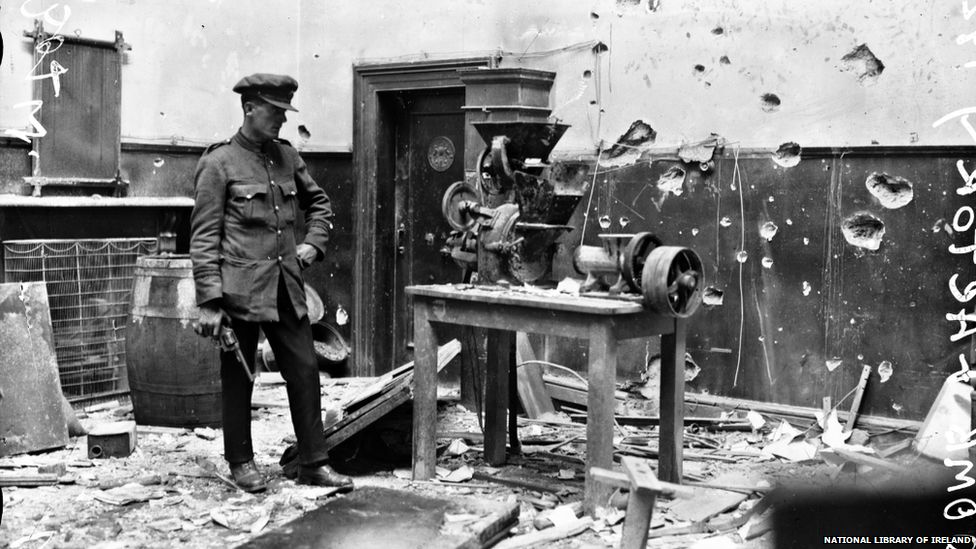
Image caption,National Army soldier examines bomb-making equipment in the ruined Search Room of the Public Record Office, 30 June 1922
One hundred years ago this week, Ireland was plunged into civil war and much of its history seemed to go up in smoke.
An attack on the Four Courts in Dublin marked the beginning of a bitter civil war between those who supported the Anglo-Irish Treaty and those opposed to it.
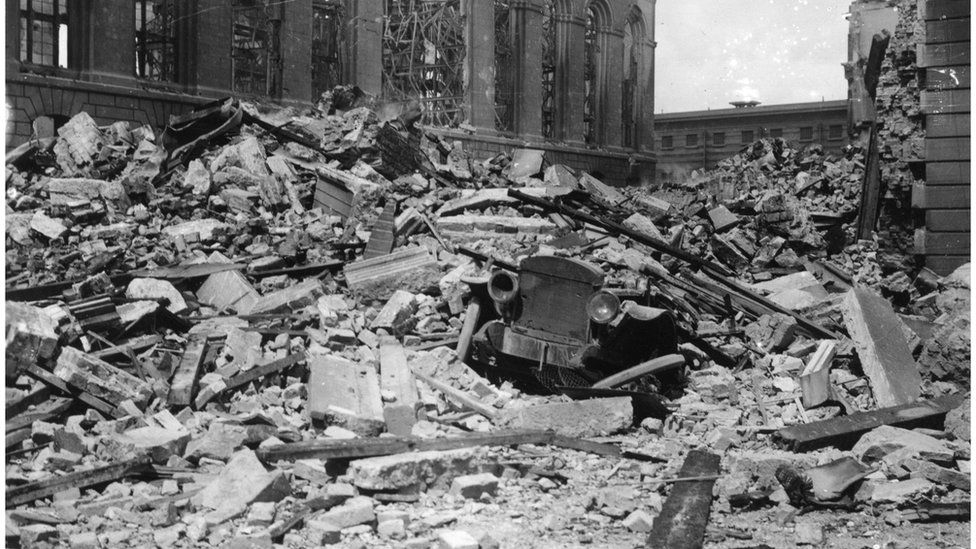
Ireland’s Public Record Office – a precious history – was destroyed.
On 30 June, as the building burned, the official documents charting a country through the centuries burned with it.
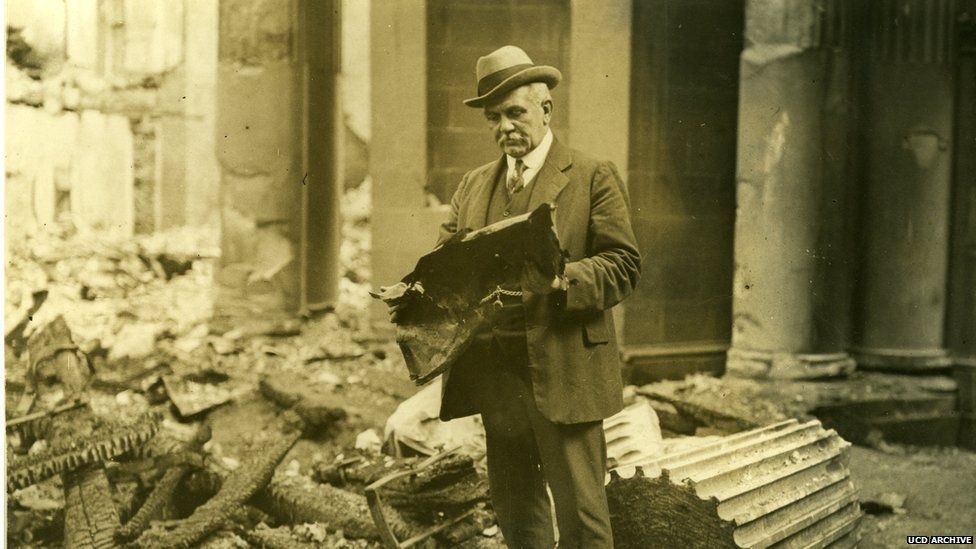
When the deputy keeper of the Public Record Office, Herbert Wood, saw the damage, he said that “at one blow, the records of centuries have passed into oblivion”.
Image caption,An official in the ruins of the Four Courts
Three years earlier, he had written a book – A Guide to the Records Deposited in the Public Record Office of Ireland.
It would later become known as “the most depressing book in Irish history”, as it catalogued hundreds of thousands of documents which had been destroyed and were considered lost forever.
But a century later, it is clear that all was not lost.
A ground-breaking project, The Virtual Record Treasury of Ireland – the Beyond 2022 project, has uncovered a treasure trove.
Archives from around the world joined forces to share their documents and bring the destroyed records back to life.
It spans an arc of Irish history from 1174 right up to 1922.
Image caption,The ruined record treasury of the Public Record Office a century ago
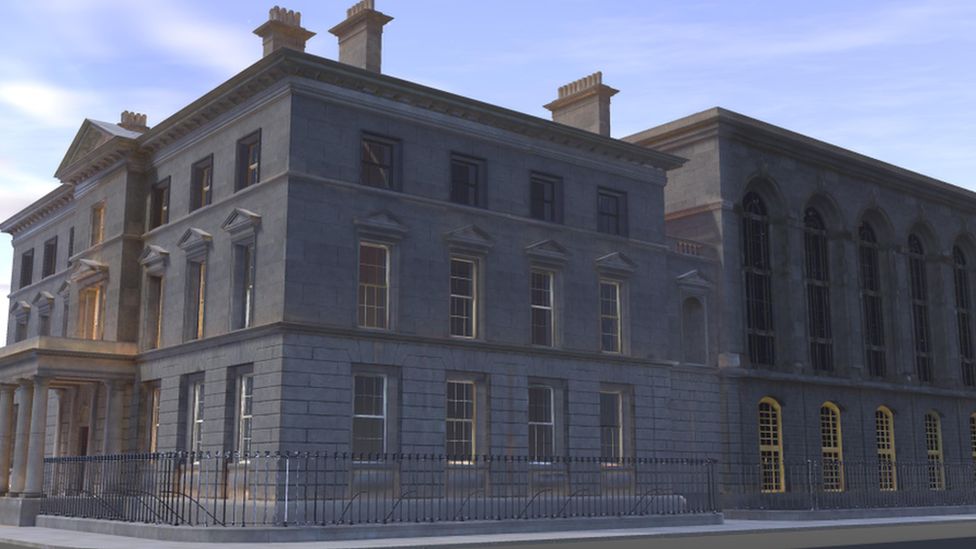
Visitors will be able to “step back in time” to explore a virtual recreation of the Public Record Office of Ireland and its collections, as they were on the eve of their destruction at Dublin’s Four Courts at the outset of the civil war.
About 150,000 records, ranging from single sheets to entire series of bound volumes, and more than 6,000 maps are online.
The treasury is the outcome of a five-year state-funded programme of research led by Trinity College, Dublin, called Beyond 2022.
It combines historical investigation, archival conservation and technical innovation to re-imagine and recreate, through digital technologies, the archive that was lost on 3 June 1922.
The Taoiseach (Irish PM) Micheál Martin called it an “enduring and meaningful legacy”.
“It belongs to the people of Ireland, democratising access to our rich archival heritage and making our shared history accessible for everyone,” he said.
“It is an invaluable historical resource for people of all traditions across the island and for everyone of Irish heritage around the world.”
Image caption,A 3D model of the Public Record Office of Ireland destroyed on 30 June 1922
Historians from TCD worked alongside computer scientists in the to create the archive made in partnership with the National Archives of Ireland; National Archives (UK); the Public Record Office of Northern Ireland; the Irish Manuscripts Commission and the Library of Trinity College Dublin.
People will be able to:
‘Step inside’ the six-storey Victorian Public Record Office, as it was on the eve of its destruction in 1922, via an immersive 3D experience
Search the Treasury’s collection of 50 million words of text, 150,000 records and more than 6,000 maps spanning an arc of Irish history from 1174 right up to 1922
Find out about Ireland’s first census which took place in 1766, discover how the country was intensely mapped during the Cromwellian era or how Ireland was governed by the English crown in the Middle Ages
Discover the Three Gold Seam collections, where up to 80% of the lost material has been retrieved
Dive into Ireland’s past with the Knowledge Graph for Irish History – a research tool which allows for the discovery of new connections between people and places with 2.7 million linked data entities available to search
You can find out much more about the partition of the island of Ireland in 1921 by listening back to the BBC podcast series, Year ’21, on BBC Sounds.
By Nuala McCann BBC News NIPublished8 hours agoShare
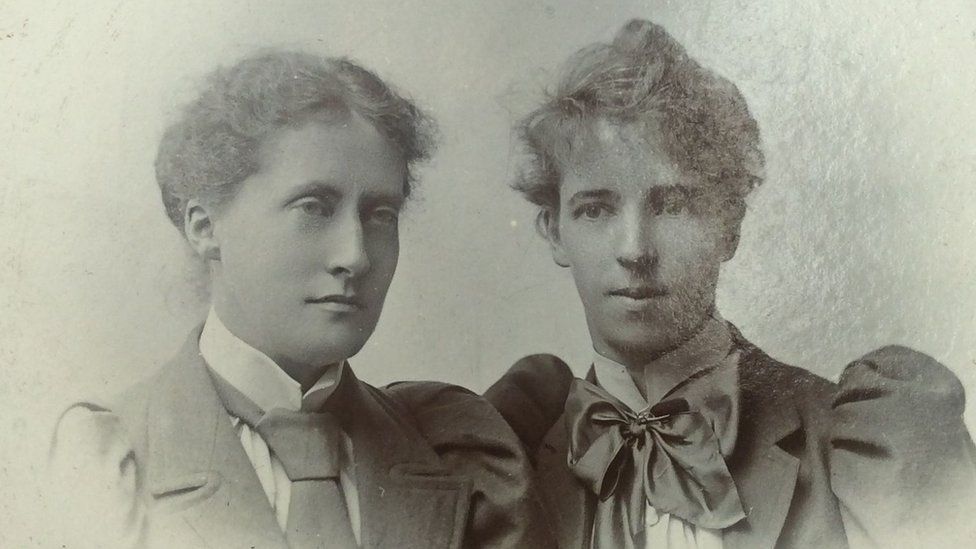
Image caption,Lily and Elizabeth Yeats helped create a new sense of Irish identity
A blue plaque on a house in Chiswick, London, commemorates three famous men who lived there.
On it are John Butler Yeats, portrait painter, and sons Jack Yeats, the well-known artist, and William Butler Yeats, Nobel prize-winning poet.
But what of their sisters, the forgotten Yeats women?
Sisters Elizabeth and Lily Yeats share a fleeting derogatory reference in James Joyce’s Ulysses where they are labelled the “weird sisters”.
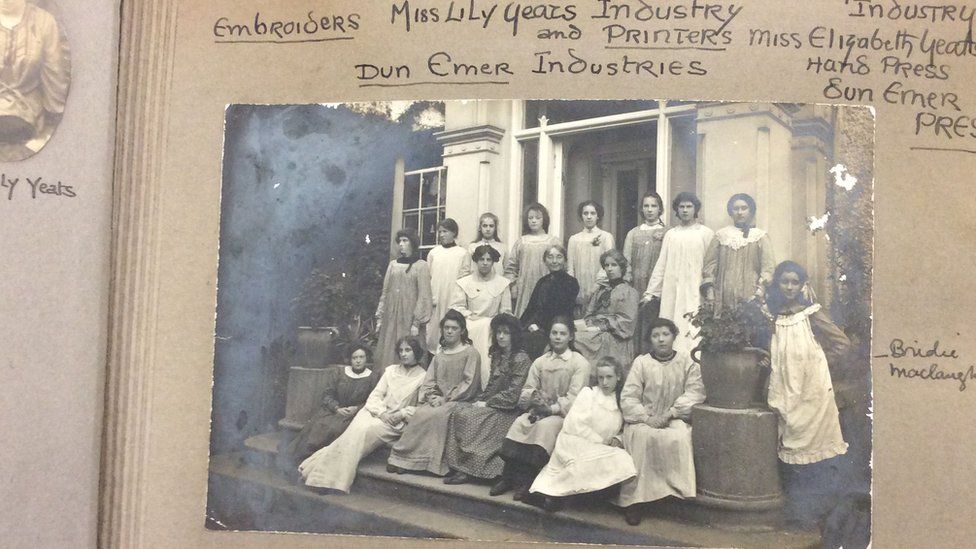
Image caption,The Yeats sisters and their staff who were all women
Aside from that, their important role in the Celtic revival seems to have been overlooked.
Now an academic project at Trinity College Dublin is bringing the sisters and other Irish women artists back into the spotlight.
The Yeats sisters built careers in their own right and were instrumental in creating a strong sense of Irish identity in the early 1900s.
The Cuala Press Project at Trinity shines a light on the arts and crafts enterprise set up by them in Ireland in 1908.
As the country moved to partition in 1921, Cuala Press presented a fresh image of Ireland across the world. Their handprinted books, cards and prints were popular in Ireland, the UK and America.
ADVERTISEMENT
Now, for the first time, the Cuala prints are being digitised and offered to a wider audience online.
Dr Angela Griffith from Trinity’s History of Art department said the aim is to generate fresh interest on the women artists of the Cuala Press.
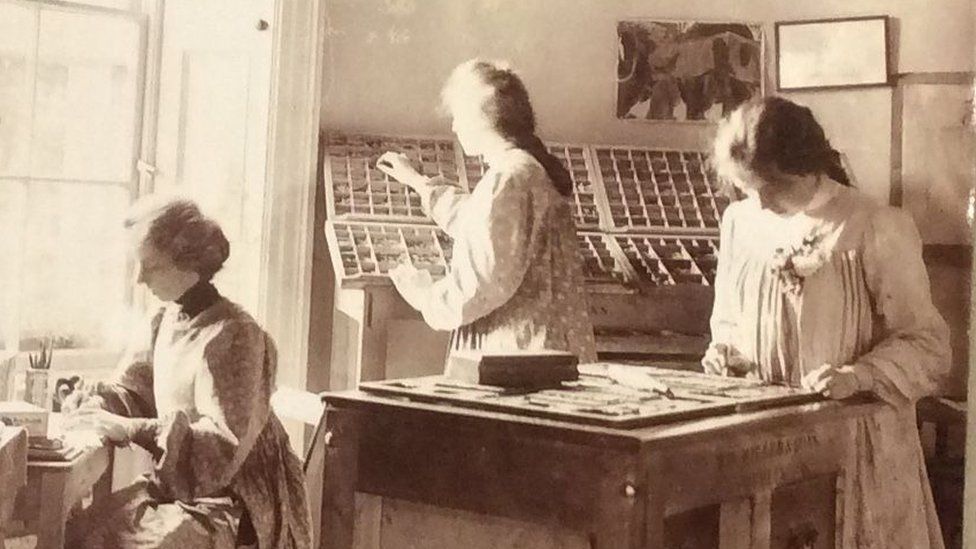
Image caption,Elizabeth Yeats and two employees in Dublin in 1904
“We believe that the work of Elizabeth Yeats, and the female artists who worked with her, deserves to be re-visited,” she said.
“Having public access to this material as a curated collection, allows us to think more about what it was like to live and work as a woman 100 years or more ago during a time of new – and ever-changing – cultural, social, and political landscapes.
“And, as is the role of art, it makes us think and re-evaluate our lives today.”
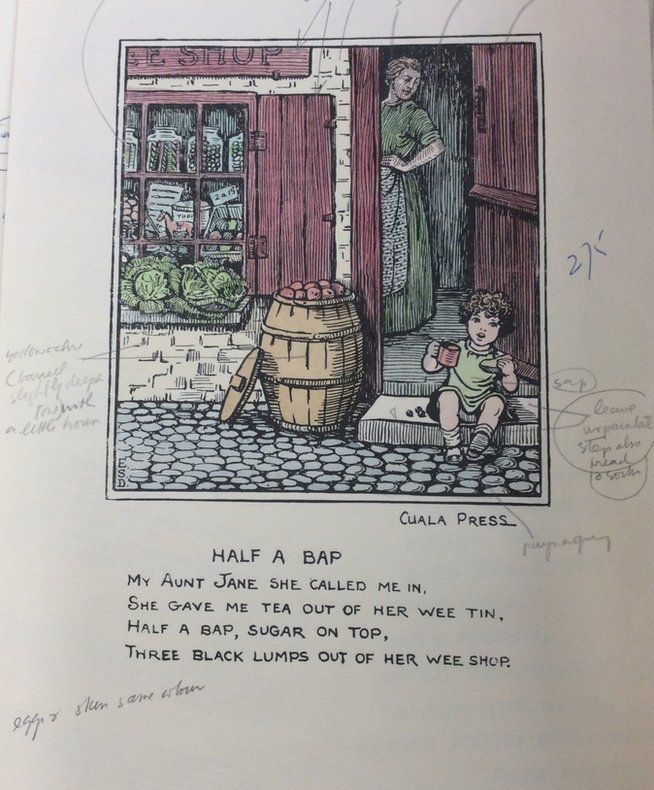
Image caption,A Cuala Press print of an old Belfast song
At the turn of the last century, Lily Yeats trained in embroidery with William Morris’s daughter May at the world famous arts and crafts centre. Elizabeth published books about painting.
They set up Cuala Press, which specialised in embroidery and handprinted books and prints of the Irish literary revival, employed only women – 20 to 30 at any one time.
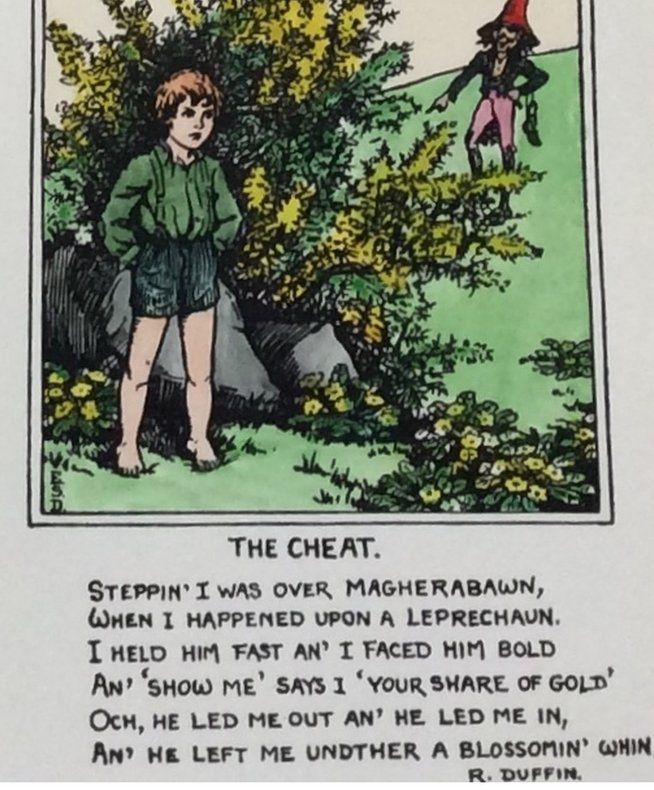
Image caption,A Cuala Press print by Belfast sisters Ruth and Emma Duffin
Among those whose work featured were Belfast sisters artist Emma Duffin and writer Ruth Duffin,
“It was an all-Ireland enterprise,” said Dr Griffith.
“There was a real connection across the country, arts and designers were supporting each other and that continued even after independence and the setting up of the [Irish] Free State.”
As Ireland moved forward politically, the work reflected the sense of a country forging its individual identity.
“It was about giving Irish people a view of themselves set in their own landscape,” said Dr Billy Shortall, her colleague on the Cuala Press project at the Irish Art Research Centre.
“Prior to that, a lot of art work was about landlords commissioning landscape paintings of their estates to be hung on the wall.
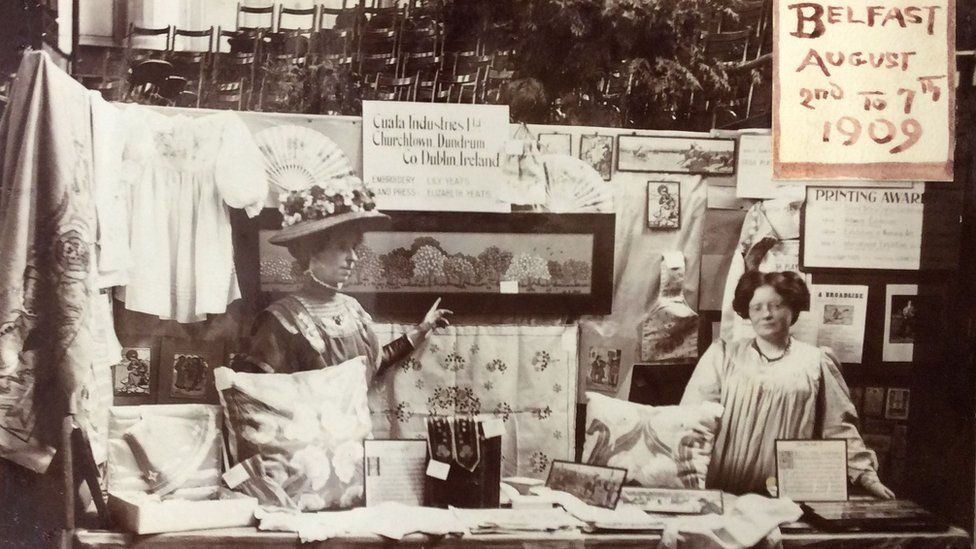
Image caption,Elizabeth Yeats, left, at an arts and crafts fair in Belfast
“Clichéd cartoons in newspaper of the time were of the dumbfounded Irish person…that was a common narrative particularly in the British press that fed into the stereotype of British colonial rule – ‘We’re only colonising these people because they are incapable of self government’.
“The Celtic Irish cultural revival had its roots in literature and art and music and language.
“It gave people a view of themselves that was different to what they had been used to seeing.”
Some might argue that the paintings are chocolate boxy or stage Irish.
Some prints appear strikingly odd to the modern eye.
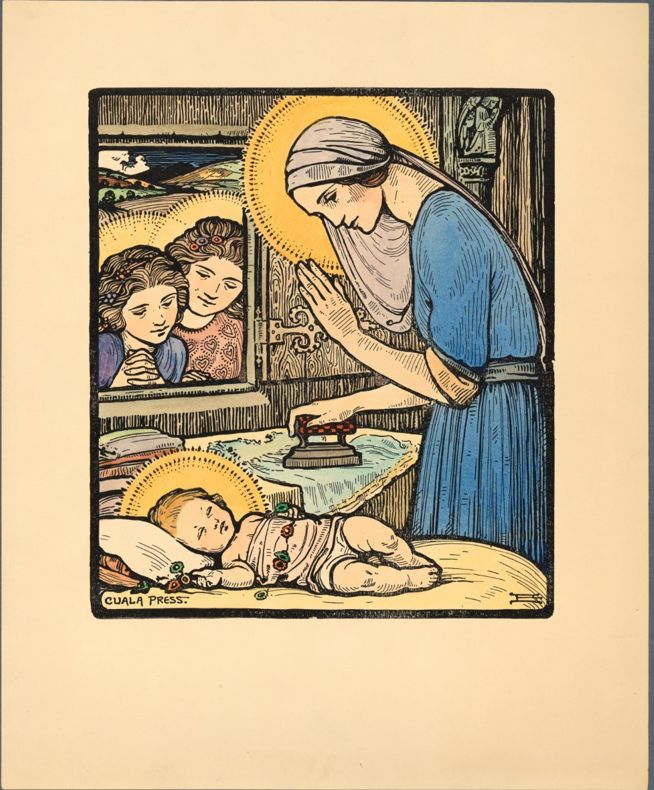
Image caption,A portrait of the Madonna as an Irishwoman ironing
One shows the Madonna as an Irishwoman ironing as a red-headed baby Jesus lies close by.
But the project leaders argue that they were radical for their time.
“People will be able to look at these images and ask new questions – what do they tell us of the time and what do they tell us about ourselves,” said Dr Griffith.
The first images from the archive – donated by the Yeats family and by Vin Ryan from the Schooner Foundation – are already on line.
The hope is that galleries and museums will add to the collection, helping to bring the Yeats sisters and women artists who worked alongside them out of obscurity.