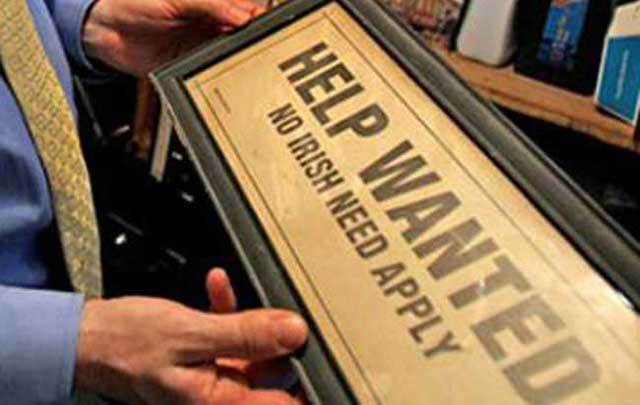
“No Irish Need Apply,” a song written in 1862, tells the story of an Irish immigrant who faces outward discrimination in his search for a job on the grounds that he is Irish.
The Clancy Brothers and Tommy Makem are widely regarded as one of Ireland’s greatest-ever ballad groups and their cover of the 19th-century ballad “No Irish Need Apply” tells the story of anti-Irish discrimination in the United States.
Written in 1862, the song tells the story of an Irish immigrant who faces outward discrimination in his search for a job on the grounds that he is Irish.
The immigrant is faced with a sign bearing the slogan “No Irish Need Apply” (NINA), causing his temper and sense of injustice to rise. He argues with the business owner responsible for the slogan, reasoning that their ancestors also emigrated to America and were welcomed with open arms but is unsuccessful in his attempts to gain employment.
Unperturbed, the Irish immigrant notes that the business owner is one of a few “bad apples” that persevere with anti-Irish prejudices and that most employers would be happy to hire an Irishman.
The song is rooted in anti-Irish sentiment in America and Britain throughout the 19th century.
In America, Catholic Irish immigrants faced discrimination from nativists, often facing NINA signs when looking for work, with a significant amount of discrimination coming from Irish and English Protestants living in the United States.
Irish Catholics were largely marginalized in mid-19th century American society, with future President Theodore Roosevelt describing them as a “stupid, sodden and vicious lot, most of them being equally deficient in brains and virtue”.
In Britain, Irish immigrants faced similar discrimination and prejudice and were regularly faced with NINA signs. The rampant anti-Irish discrimination in Britain gave rise to the first known versions of the famous song, with two editions making their way across the Atlantic Ocean to the United States.
In one version of the song, the immigrant faces discrimination in London and emigrates to America to escape the anti-Irish prejudice in the Land of the Free.
In another, the immigrant still faces discrimination in America despite fleeing London.
It was the latter version of the song that became popular among Irish immigrants in the United States, popularizing the idea that the Irish community faced NINA signs no matter where they turned in search of employment.
That theory has been questioned by some scholars, like American historian Dr. Richard Jensen of the University of Illinois, who claimed that No Irish Need Apply was nothing more than a “myth of victimization”.
Jensen claimed that there was no significant discrimination against the Irish in the job market in America, but his argument was rebutted by Rebecca Fried, an eighth-grader from Washington DC.
Fried found that there was plenty of evidence that disproved Jensen’s argument and proved that there was a significant amount of discrimination against Irish immigrants looking for work in 19th-century America.
Despite Jensen’s protestations, it seems as though NINA signs really did exist on a tangible level in America as they did in Britain, giving rise to the famous song.
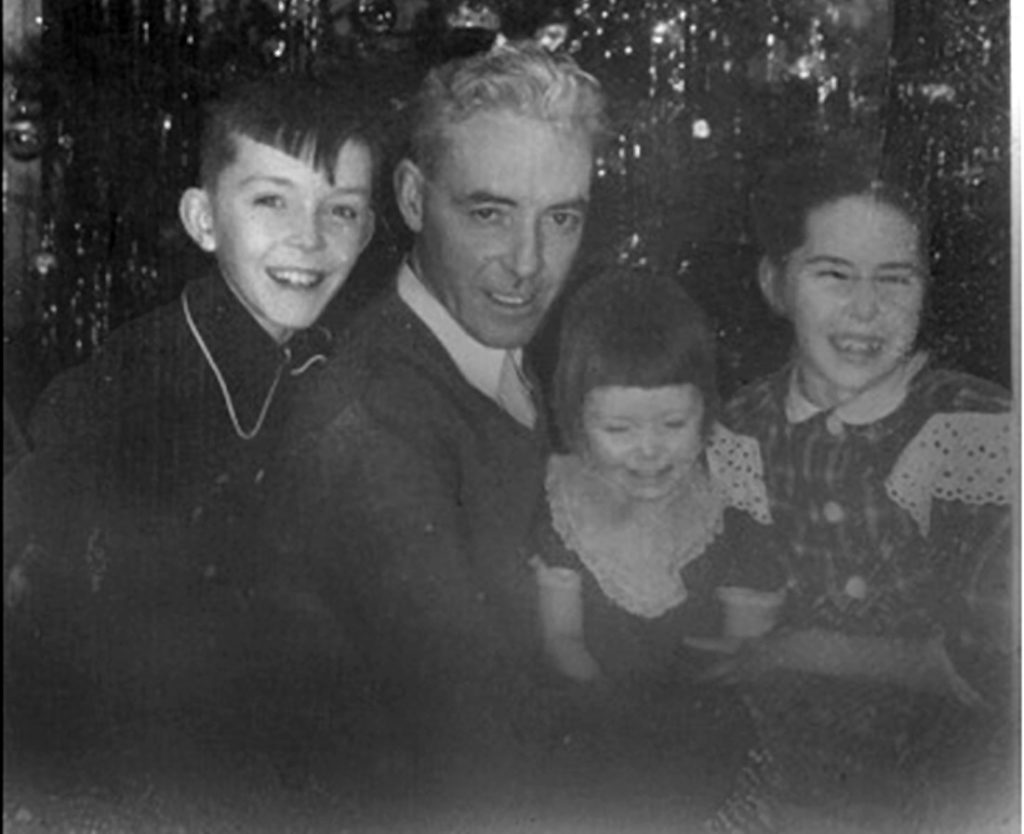
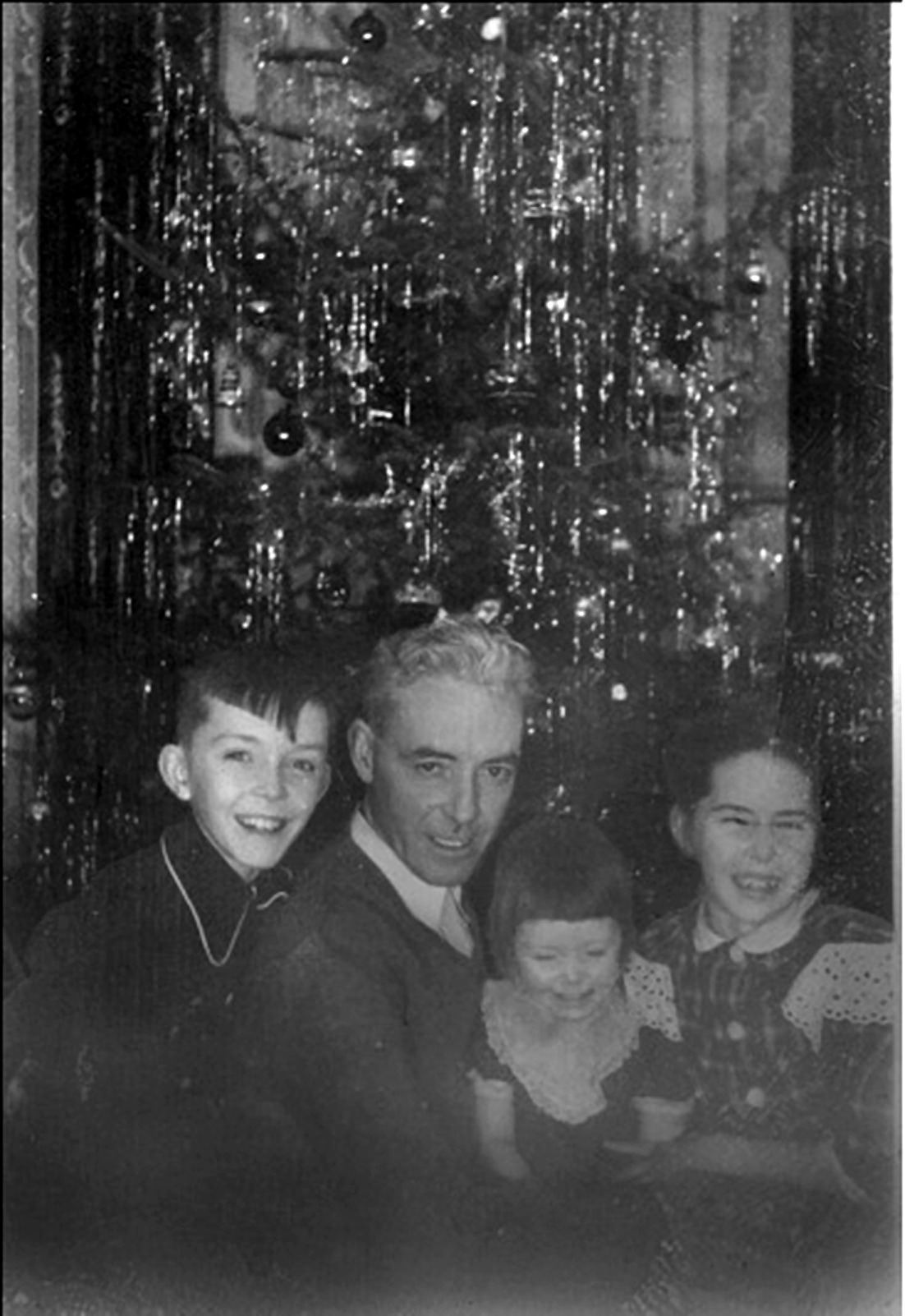
Jimmy, Eileen, and Joan with their dad, Patrick “Joe” Murphy on Christmas Day, 1948. Photo courtesy of Jim Murphy
In the Brooklyn world of my childhood, Ireland seemed especially close at Christmas. While we kids looked forward to Santa, Mom and Dad were looking back to Ireland. Cards would arrive, and Mom would cherish each and every one, especially those from her sisters, my Aunts Una and Joan, who would include letters for her to linger over, her eyes growing all teary. My parents left home in the 1920s – Mom at age 16 from Ballyhaunis, Co. Mayo, and Dad at 21 from Cloone, Co. Leitrim. They met in an Irish dance hall in Manhattan, courted, married, and worked hard to keep our family of five afloat. They are both long gone now, but each year at Christmas, I hear their voices again.
One Christmas was so much like another in those years that they now all blur into one big ball of holidays. Let me pick one sometime in the late 1940s: our apartment on Newkirk Avenue is alive with expectation because today we will bring home our tree. It’s sure to be a fine big tree because each year Dad helps Paddy Power sell trees after Sunday mass at St. Jerome’s Church on Nostrand Avenue.
“Prime location, that’s the key,” Dad says. “The subway and church are right there so there’s lots of traffic. After mass people are feeling good about things and they know you’re one of their own since you’re there at the church and Paddy is an usher.Sure you couldn’t keep the man out of church, so naturally he gets the business instead of some huckster who might not even be a Christian. There’s no flies on Paddy Power, that’s for sure. He knows where his bread is buttered and, fair play to him, he’s there all year with the ushering so why shouldn’t he pick up a few dollars when the time comes? I must say, selling trees to a crowd spilling out of church is ‘easy pickins,’ as your man would say.”
On Sundays leading up to Christmas, the streets are alive with families and trees moving in all directions. Sometimes a father would throw one up on his shoulder and march away, or maybe he’d hug the trunk of a bigger one, his kids grabbing the other end, and off they’d go. Lots of people from apartment buildings like ours have a tree so small they could tuck it under their arms and carry it home, but Dad doesn’t approve of those trees. “Dwarfs,” he says, “a poor excuse for a tree. You might as well bring home a twig or a stalk of celery.”
For us, this year’s tree is so big it has to come home by car. Paddy Power and Dad have it all roped up and hoisted up onto the roof of our old 1938 Plymouth and tied it down tight. I’m allowed to stand in the rumble seat to make sure it doesn’t move. “Jimmy, hold tight to the seat. If the tree starts to move, give me a shout.” Off we go, and I’m like a fireman on a hook and ladder or the lucky trash-man hanging on to the back of his truck. I cling to the seat with one hand and the tree with the other, but I’m able to give a quick wave to anyone who sees us go by. “You okay back there, cowboy?” shouts Dad.
When we get home, Mom and Joan have to come down to help us lug the tree up the flight of stairs to our place, apartment 2A.
“Joe, that’s an enormous tree, my God. Where in the name of God will we fit such a tree? Have you gone mad?” Mom inquires.
“‘Joe, take any tree,’ that’s what Paddy Power said to me, and so I’d say he was a shocked man to see the one we took. Isn’t that right, Jimmy? It’s one he could have sold to a bishop, but it’s here now, all ours. ‘Take any tree you want, Joe’ and so I took him at his word.”
And so we huff and puff our way up the stairs. Joan and I are as happy as Larry to have such a tree. In the days leading up to Christmas the apartment building becomes a forest of evergreen as people lean their trees on the walls outside their doors. If there’s no tree by a door, it must be the apartment of one of the Jewish families, or maybe a widow, or one of the atheists we heard about and prayed for in school, or maybe a Scrooge like Mr. Madden who lives in 3B and is always telling us kids not to play in the hallways on rainy days.
The ceilings in our apartment are high so our tree is always tall but this year’s tree is bigger than ever. Dad has to nail it down so it won’t topple over. Mom worries about the banging and the holes in the floor, but Dad says the rug will be put back down after Christmas and who’ll be the wiser.
“Joe Murphy, you’re mad about Christmas trees. Next year you’ll be drilling a hole in the ceiling.” Dad just laughs, “A good idea, Kathleen. Maybe 2A and 3A can share a tree. We’ll just send it on up through the floor to them. We’ll be like Rockefeller Center. What do you say to that?”
We all laugh to think of the Hurcombs up in 3A watching a tree poke up into their living room as we manage to make it stand and wait for Dad to cut the ropes. When he does, the branches spread like wings to nearly fill the living room.
“A redwood couldn’t match it,” he says with a big smile, proud as a peacock. On the Victrola, our cherished Bing Crosby’s “Merry Christmas” collection sets the tone. There are five of us and the album has five 78 rpm records so we take turns from oldest to youngest and stack up our choices on the turntable.
Jimmy, Eileen, and Joan and their dad, Patrick “Joe” Murphy on Christmas Day, 1948.
Jimmy, Eileen, and Joan with their dad, “Joe” in front of one of their tall Christmas trees in 1948.
Dad picks “Silent Night,” then Mom takes “I’ll be Home for Christmas,” a hard choice for her since “Danny Boy” is on the flip side of that one, even though it isn’t a Christmas tune. I go for “Santa Claus Is Coming to Town” instead of “Jingle Bells” on the flip side, and Joanie takes “White Christmas,” leaving my baby sister Eileen, who doesn’t know any tunes at all, with the only one left – “God Rest Ye, Merry Gentlemen.”
Dad says, “Let the concert begin.” “Silent Night” fills the room as the tree awaits us. First, my baby sister Eileen is held up and we pretend she puts the star at the top of the tree. Then Dad and I begin with the lights, each of us on a chair since the tree is so high. We slowly work our way down, passing the string of lights from hand to hand. He reaches through all the wide branches to me, with my fingers searching for his on the other side of the tree.
Behind us, Mom and Joan unpack the ornaments, waiting for Dad to signal that we’re done and they can begin. Mom has two special ornaments, both from Ireland, and they are given a pride of place near the top of the tree – a crocheted star and a little cottage whose paint has chipped and dulled and whose chimney is missing. Once she has these placed on the tree, Joanie and I are free to add all the other ornaments and school cutouts wherever we wish. Then comes the finishing touch – the tinsel.
We hang a few tangled strands here and there on our own, but then we give way to Dad, as if by some unspoken signal. We don’t quite measure up when it comes to hanging tinsel.
It’s a special gift and Dad alone has it. His quiet patience, his silent introspection, humming as he works.
“Take your pick,” Paddy Power had said, and Dad had taken him at his word, so it was his tree. We all do our part to decorate it, but at heart it is his tree. He spends hours at it, a strand of tinsel at a time, absorbed in it as we all go off to whatever else calls us. But he stays there stepping back and looking at his work, correcting some of the chaos we’ve created in our clumsy tinsel efforts, a man at peace with himself. By now, we have heard all of Bing Crosby’s
Christmas songs at least twice, so our Irish records start to make their way onto the turntable, especially any one with a Christmas theme.
Because he works for Hostess Cakes and at Christmas he sells fruit cakes to one and all, Dad’s favorite is the McNulty Family singing “Miss Fogarty’s Christmas Cake.”
“Give us the Murphy Family version,” says Dad, and we all sing along with the McNultys, waiting to change the last line:
“There were plums and prunes and cherries, / There were citrons and raisins and cinnamon too, / There was nutmeg, cloves and berries / And a crust that was nailed down with glue. / There were caraway seeds in abundance / That would work up a fine tummy ache / It would kill a man twice after eating a slice / Of a Hostess Christmas cake.”
Mom’s favorite is “Christmas in Killarney” which, like “I’ll Be Home For Christmas,” makes her eyes fill up. “At home in Mayo,” she tells us, “It’s God’s truth what the song says, ‘The door is always open / The neighbors pay a call.’” Joanie and I like best when the song says, “And Santa Claus you know, of course / Is one of the boys from home.” But Dad says, “Santa’s not a Mayo man at all, he’s a likable, lovely Leitrim lad like myself.”
When we have everything all ready for the lighting, we place our manger at the base of the tree. We have Mary and Joseph, but no Baby Jesus because that’s Santa’s job when he comes on Christmas Eve. We have two shepherds but only two wise men. Dad says the third one must have followed the wrong star. “He’s like your Uncle Frank.”
Last come the animals, there’s a camel, a cow, and two sheep, all of them lying down. Mom says that’s because at home in Ireland all the animals in the fields would lie down on Christmas Eve to wait for the Baby Jesus. We have no fields or animals on Newkirk Avenue, so I picture the animals in Prospect Park Zoo. Come Christmas Eve, surely the lions and tigers and elephants and rhinos will all be lying down for the Baby Jesus.
When the stage is all set, Dad says, “Ready now? Close your eyes and count to three.” One, two, three, and we open. The tree fills the room with light, a waterfall of tinsel, and glistening ornaments. It is a Christmas tree of dreams.
“You know, Kathleen,” Dad says, “at home in Leitrim we didn’t have a tree at all. We hung some holly around the place, candles in the windows, but no tree. No room for one in small house with fifteen of us. So we settled for the holly and the ivy all over the place, just like in the tune.”
He winks at us. “No tree, but you know what, Jimmie and Joanie? Santa found us each and every year. At least we had a chimney for him. No chimney here in this apartment, but, by God, we’ll have a mighty tree for Santa when he comes.”
Pope Francis has branded laws criminalising homosexuality “unjust” – saying God loves his children just as they are – and called on Catholic bishops supporting the laws to welcome LGBTQ people into the church.
“Being homosexual isn’t a crime,” Francis said during an interview with the Associated Press on Tuesday.
He acknowledged Catholic bishops in some parts of the world support laws criminalising homosexuality or discriminate against the LGBTQ community – and referred to the issue in terms of “sin”.
But he attributed such attitudes to cultural backgrounds and said bishops in particular need to undergo a process of change to recognise the dignity of everyone.
“These bishops have to have a process of conversion,” he said, adding that they should apply “tenderness, please, as God has for each one of us”.
Some 67 countries or jurisdictions worldwide criminalise consensual same-sex sexual activity, 11 of which can or do impose the death penalty, according to The Human Dignity Trust, which works to end such laws.
Experts say even where the laws are not enforced, they contribute to harassment, stigmatisation and violence against LGBTQ people.
In the US, more than a dozen states still have anti-sodomy laws on the books despite a 2003 Supreme Court ruling declaring them unconstitutional.
Gay rights advocates say the antiquated laws are used to harass homosexuals, and point to new legislation, such as the so-called “don’t say gay” law in Florida, which forbids instruction on sexual orientation and gender identity from nurseries through to school year four, as evidence of continued efforts to marginalise LGBTQ people.
The United Nations (UN) has repeatedly called for an end to laws criminalising homosexuality outright, saying they violate rights to privacy and freedom from discrimination and are a breach of countries’ obligations under international law to protect the human rights of all people, regardless of their sexual orientation or gender identity.
Being homosexual is not a crime. It’s not a crime. Yes, but it’s a sin. Fine, but first let’s distinguish between a sin and a crime. It’s also a sin to lack charity with one another
Pope Francis
Declaring such laws “unjust”, Francis said the Catholic Church can and should work to put an end to them.
“It must do this. It must do this,” he said.
Francis quoted the Catechism of the Catholic Church in saying gays must be welcomed and respected and should not be marginalised or discriminated against.
“We are all children of God and God loves us as we are and for the strength that each of us fights for our dignity,” Francis said, speaking from the Vatican hotel where he lives.
Such laws are common in Africa and the Middle East and date from British colonial times or are inspired by Islamic law.
Some Catholic bishops have strongly upheld them as consistent with Vatican teaching that considers homosexual activity “intrinsically disordered”, while others have called for them to be overturned as a violation of basic human dignity.
In 2019, Francis had been expected to issue a statement opposing criminalisation of homosexuality during a meeting with human rights groups that conducted research into the effects of such laws and so-called “conversion therapies”.
In the end, the pope did not meet with the groups, which instead met with the Vatican number two, who reaffirmed “the dignity of every human person and against every form of violence”.
On Tuesday, Francis said there needs to be a distinction between a crime and a sin with regard to homosexuality.
“Being homosexual is not a crime,” he said.
“It’s not a crime. Yes, but it’s a sin. Fine, but first let’s distinguish between a sin and a crime.”
“It’s also a sin to lack charity with one another,” he added.
Catholic teaching holds that while gay people must be treated with respect, homosexual acts are “intrinsically disordered”.
Francis has not changed that teaching but he has made reaching out to the LGBTQ community a hallmark of his papacy.
Starting with his famous 2013 declaration, “Who am I to judge?” when asked about a purportedly gay priest, Francis has gone on to minister repeatedly and publicly to the gay and trans community.
As archbishop of Buenos Aires, he favoured granting legal protections to same-sex couples as an alternative to endorsing gay marriage, which Catholic doctrine forbids.
Despite such outreach, Francis was criticised by the Catholic LGBTQ community for a 2021 decree from the Vatican’s doctrine office that the church cannot bless same-sex unions “because God cannot bless sin”.
The Vatican in 2008 declined to sign onto a UN declaration that called for the decriminalisation of homosexuality, complaining the text went beyond the original scope and also included language about “sexual orientation” and “gender identity” it found problematic.
In a statement at the time, the Vatican urged countries to avoid “unjust discrimination” against gay people and end penalties against them.
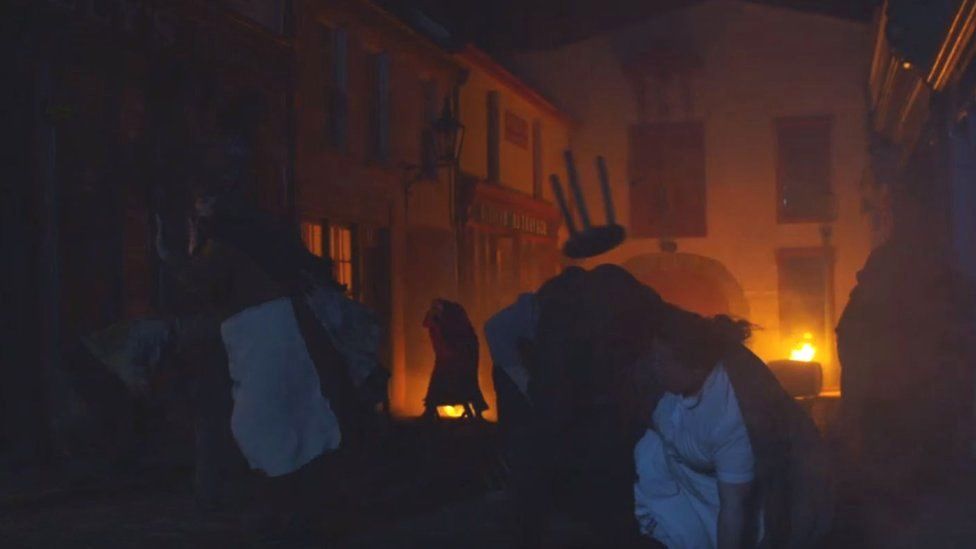
Image caption,The events of the Night of the Big Wind were recreated for Lagan Media’s Oíche na Gaoithe Móire in 2015
By Niall Glynn
BBC News NI
It left towns and villages in Ireland looking like battlefields and killed dozens of people, and destroyed tens of thousands of homes.
In comparison with the more recent Beast from the East, the Night of the Big Wind sounds like something that would cause minor inconvenience, judging by its name.
In reality, the 1839 storm is considered the deadliest ever recorded on the island of Ireland.
It struck without warning during the night of Sunday 6 January, bringing hurricane-force winds to a poor and vulnerable country, lasting 12 violent hours.
There had been heavy snowfall the day before but it started to melt on the Sunday due to a burst of warm weather.
Later that night, at about 21:00, the winds, which may also have featured tornadoes, came from the Atlantic and hit the west coast first.
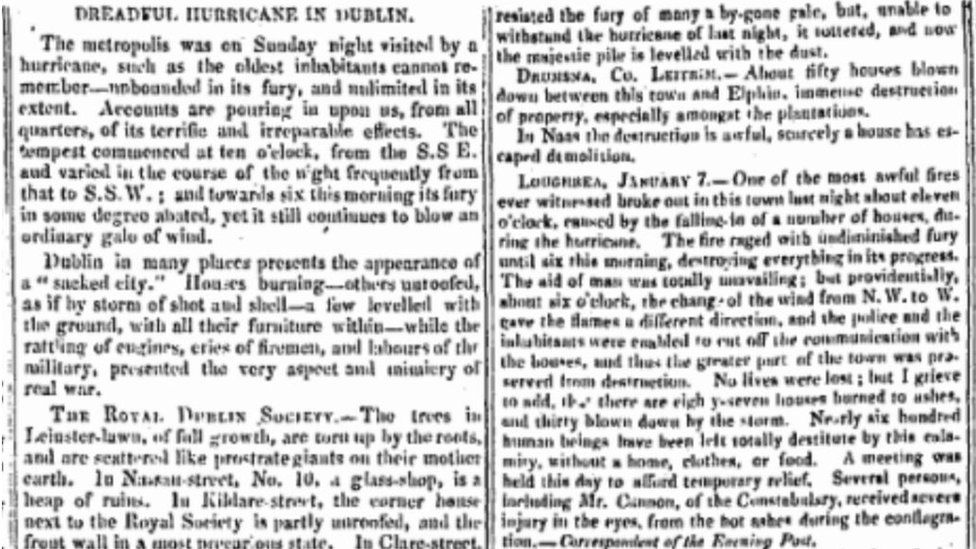
An Enniskillen Chronicle report from the time said that the sound of the wind in County Sligo was like “the deafening roar of a thousand pieces of artillery”.
In Donegal, the Ballyshannon Herald reported that “the sea rose to such a height that the poor inhabitants thought it was the end of the world”.
The northern half of the island was worst hit – north Connacht, Ulster and north Leinster.
In north Dublin alone, 20 to 25% of homes were reported to have been either destroyed or badly damaged.
Image caption,A report of the storm appeared in a copy of the Belfast News Letter in January 1839
“Judging by the damage descriptions the winds’ strength were up to hurricane force – up to one or two hurricane category on the wind scale,” said Paul Moore of Irish weather service Met Éireann.
“Category two is sustained winds of 96mph to 110mph.
“There’s one description that Dublin resembled a sacked city, from one of the news articles of the time, so that’s consistent with that strength of wind.”
The winds struck an island ill-prepared to withstand them.
“One third of the population was living below the poverty line – you’re talking potentially up to about three million people,” Dublin City University historian Prof James Kelly explained.
“So there were a lot of people living in what we would identify today as very substandard, perhaps even spartan, conditions which would have meant that they were very vulnerable.”
Queen’s University Belfast historian Dr Ciaran McCabe added: “A lot of people in rural Ireland, particularly in the west and parts of Leinster and Munster, were living in thatched mud cabins.
“They would either have been levelled or the thatched roof would be be blown off completely.
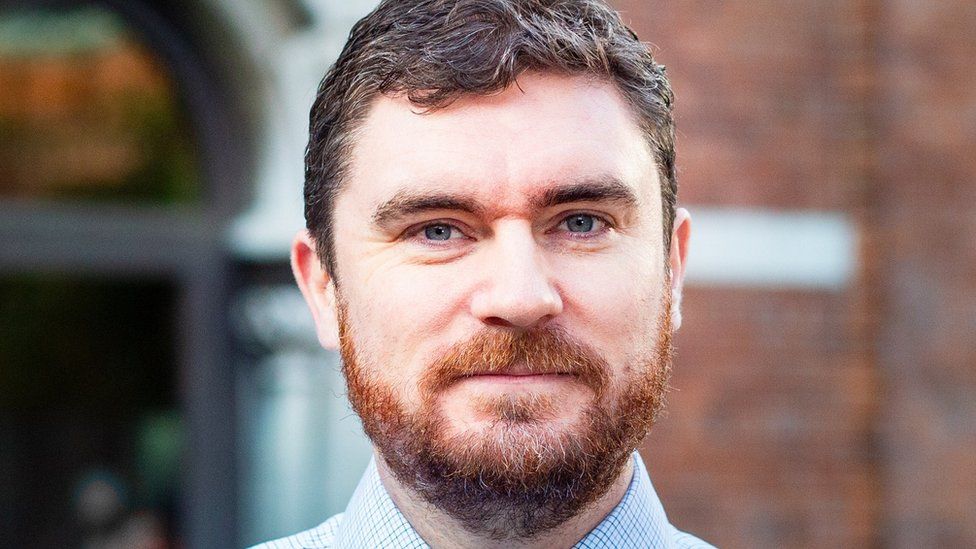
Image caption,Dr Ciaran McCabe said Ireland was left looking like a battlefield
“Or in a lot of cases you get reports of fire in houses and buildings being burned down.
“People might have had the fire on and the wind came in the window or door, threw the cinders up into the thatch and that would have caught fire.”
But it was not just the shacks of the poor that were destroyed.
Residential, commercial and industrial buildings in urban areas were also damaged.
“Newspaper reports for Belfast, where you have a lot of factories and distilleries, say there was a huge amount of commercial and industrial chimneys being blown down and collapsing,” Dr McCabe said.
“The building would be destroyed and there is the occasional instance of them falling on people who were, needless to say, killed.
“A lot of reports in the following days and weeks say that Ireland was left – the town or the village or whatever – almost like a battlefield: damage strewn as far as the eye could see.”
It was not just on land that the storm wrought destruction – many people were caught out in boats at the mercy of the winds.
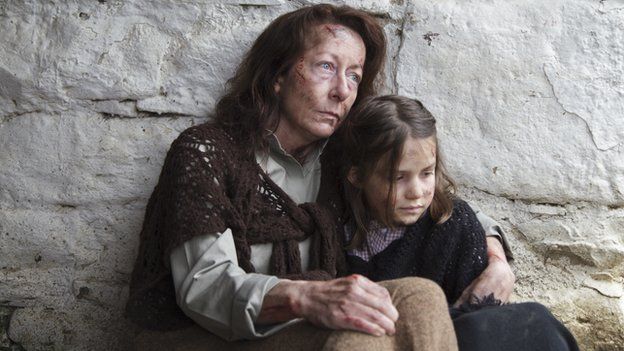
Image caption,The poverty in Ireland at the time made it particularly vulnerable (reconstruction from Lagan Media’s Oíche na Gaoithe Móire)
The captain and 14-man crew of the vessel Andrew Nugent all perished off the coast of County Donegal.
Dozens of other lives were lost at sea.
Inevitably this trail of destruction left many dead and injured.
Met Éireann, using contemporary reports, cited the “surprisingly low” figure of 90 to just over 100 lives lost.
“There wouldn’t have been anything like that [in storms] since,” Mr Moore said.
However, Dr McCabe said there were other estimates that put the death toll at 300 to 500.
As fallen masonry caused many injuries and deaths, perhaps such figures reflect people who died in the weeks and months afterwards.
As well as the loss of life and the damage to the country’s infrastructure, the natural landscape was also ravaged, with hundreds of thousands of trees uprooted.
In one estate alone – Castle Coole in County Fermanagh – the Enniskillen Herald reported that a previous estimate of 15,000 trees destroyed “should be changed to 100,000”.
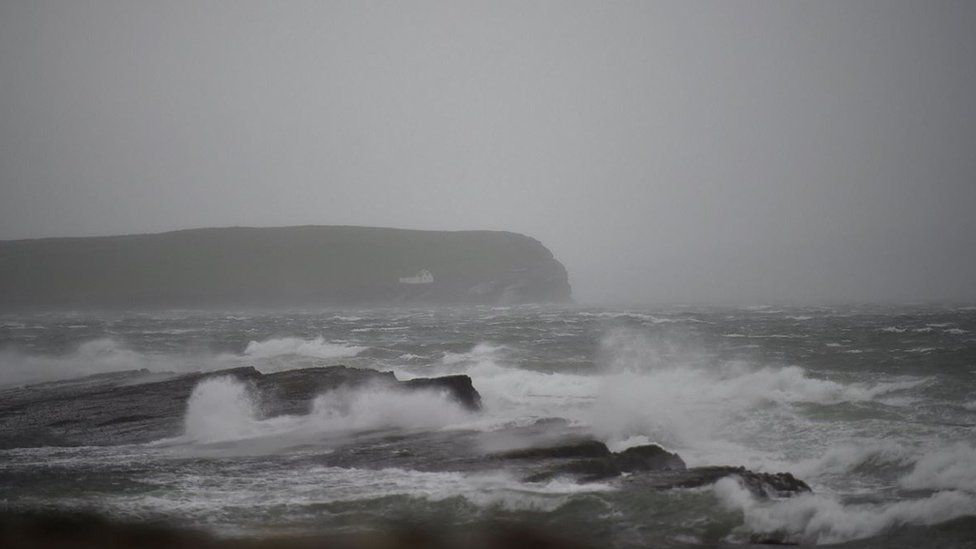
Image caption,Storm Ophelia in 2017 came close to matching the wind strength of the Night of the Big Wind
It was not the first climatic disaster to hit Ireland that century.
Crops failed in 1816 due to the effects on the northern hemisphere of the Mount Tambora volcanic eruption, in what is now Indonesia.
The year was alternatively known as the “year with no summer” and the “year of the beggar”.
There had been local famines in 1822 and heavy rains and flooding in the autumn of 1839 ruined crops and compounded the disaster of the Big Wind.
Then in 1845 came the Great Famine.
“The point that you can make about this whole period is that – and this is what distinguishes it from the present that we don’t always acknowledge – there was a vulnerability to extreme weather,” Prof Kelly described.
“Exceptional weather was going to take a particularly heavy toll on a population that was already disproportionately poor.”
Mr Moore of Met Éireann said while recent storms such as Ophelia in 2017 came close to the strength of the Night of the Big Wind, none have matched it.
He added that Ireland would be much more capable of coping now.
“Now when a storm comes in it’s forecast, a lot of the boats come in from sea, but that came without warning,” he said.
“The construction of buildings nowadays would be a lot stronger than they were back then, especially for the poor.”
Although it would be overshadowed by the disaster of the Great Famine, which started just six years later, Dr McCabe said the Night of the Big Wind was Ireland’s “worst storm, certainly in modern history and going back to the 1500s and 1600s”.
Prof Kelly said such events “are a constant reminder to us of our frailty in the face of the power of the environment and basically how changeable weather is, how destructive it can be at any particular moment”.
Legacy Bill ‘runs contrary to Good Friday Agreement’ legal expert warns London
CONNLA YOUNG
A LEADING legal expert has warned that a key amendment to the British government’s controversial Legacy Bill “runs contrary to the Good Friday Agreement”.
The proposed legislation, which has been dubbed the ‘Bill of Shame’ by some opponents, goes to committee stage at the House of Lords today.
The Northern Ireland Troubles (Legacy and Reconciliation) Bill has sparked cross-community opposition.
Under the plan only inquests which have reached substantive hearing stage a year after the bill will be allowed while civil cases have been stopped.
Immunity from prosecution will also be offered in some circumstances.
Last month ex-Irish foreign affairs minister Simon Coveney said his government could not support the bill, while Labour leader Keir Starmer has promised to repeal the legislation if he leads the next London government.
Under the contentious blueprint an Independent Commission for Reconciliation and Information Recovery (ICRIR) will be established.
Last week the British government tabled a series of amendments to the bill, including a proposal which would remove a key component of the Good Friday Agreement focusing on provision made around prisoner release.
Under the 1998 agreement paramilitary prisoners were released early from prison.
In addition, people subsequently charged in relation to incidents which took place prior to the Good Friday Agreement being signed will only face a maximum of two years in prison if convicted.
In a statement issued by the Northern Ireland Office last week the British government revealed it is now planning to “disapply the Northern Ireland (Sentences) Act 1998 for individuals who choose not to tell the commission (ICRIR) what they know and are then convicted of an offence so that they face a full, rather than reduced, sentence”.
Experts believe the proposal is a “way of ‘incentivising’ applications to the ‘conditional immunities’ amnesty scheme”.
Professor Kieran McEvoy of Queens University School of Law last night said “the proposed amendment to disapply the early release scheme runs contrary to the Good Friday Agreement”.
“In addition, these amendments are not actually designed to help victims get to the truth,” he said.
“If the government wished to facilitate truth recovery it would ensure that the proposed commission had the proper legal powers to conduct investigations to get to the truth.
“It would also ensure that anyone benefitting from an amnesty would have to provide ‘full disclosure’ as happened in South Africa.”
Daniel Holder, deputy director of the Committee on the Administration of Justice, was also critical.
“The NIO statement is entirely misleading,” he said.
“There is no requirement on suspects to tell the proposed legacy commission ‘what they know’ to avail of the amnesty.
“The threshold remains remarkably low and does not require any new information.
“The amnesty does however put suspects beyond the scope of any legacy investigation with teeth.”