US Secretary of Homeland Security Kristi Noem says she will review the case of Donna Hughes Brown, an Irish citizen and green card holder in ICE detention.
Kerry O’Shea
@kerry_oshea
Dec 12, 2025
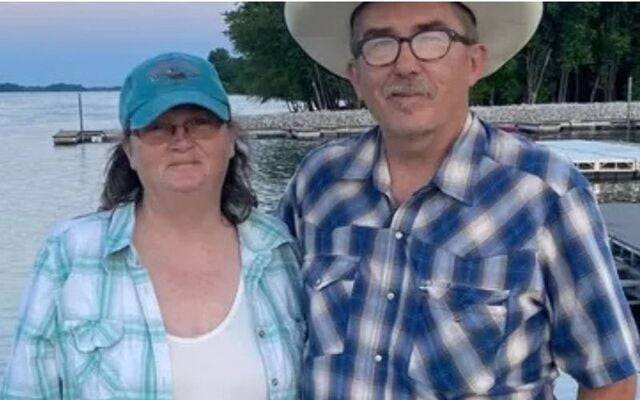
The case of Donna Hughes Brown, the Irish citizen and US green card holder who has been in ICE detention since July, is set to be reviewed by the US Secretary of Homeland Security, Kristi Noem.
Hughes Brown, who was born to Irish parents in England and raised in the US since she was a child, was arrested at Chicago’s O’Hare International Airport in July when she and her husband Jim Brown were returning from Ireland.
About ten years ago, Hughes Brown, who was facing hard financial times as a single mother, wrote two bad checks while grocery shopping. She was charged with a misdemeanor, paid the restitution, and completed one year of probation.
Hughes Brown is understood to have been detained in July under the Immigration and Nationality Act, which was amended by President Trump on July 4 as part of his so-called ‘One Big Beautiful Bill Act.’
According to the Irish Times, the changes stipulate that any foreign-born resident of the US who has violated any law whatsoever at any stage over the previous two decades can be deemed inadmissible or barred from entry to the US.
It came into effect on July 24, when the Browns were already in Ireland. Hughes Brown has been in the Campbell County Detention Center in Kentucky since July.
Her case was raised twice during a House Homeland Security Committee hearing on ‘Worldwide Threats to the Homeland’ in Washington, DC, on Thursday, December 11, by two Democratic Congressmen – Representative Lou Correa and Representative Seth Magaziner.
US Secretary of Homeland Security Kristi Noem, a close Trump ally, was among the witnesses during Thursday’s hearing.
The green card holder’s case was also previously raised last month during a hearing hosted by the House Committee on Homeland Security Democrats.
Hughes Brown’s husband, a decorated retired Navy combat veteran, testified during last month’s hearing and was present for this week’s hearing.
“Secretary Noem, Trump administration, you are going after the worst of the worst criminals, and we agree with you,” Rep Correa said to Noem during Thursday’s hearing.
“The problem is, 70% of the people you arrested have no criminal record. You’re going after noncriminal immigrants, US citizens, and permanent legal residents.
“Donna Hughes Brown, Irish citizen, green card holder, 48 years in the United States. She also happens to be the mother of a US Marine, sister to a retired Army colonel.
“She is in ICE detention since July. She tried to come back from Ireland, arrested, has been there since then.
“Her crime? She wrote two bad checks for less than $80 a decade ago.
“You arrested her, she’s in custody. Her husband Jim Brown came to us and told us her story. Jim told us, ‘I voted for President Trump because he promised to go after criminals in our community, not people like my wife.'”
Correa then played a video for Noem of Brown admitting that he voted for Trump because he’s “an idiot,” adding that Evangelical Christian people “were lied to.” He said he and his wife are ministers who help the needy.
Addressing Noem, Correa said: “These people, Donna Hughes Brown, are not the individuals that should be deported.”
Hughes Brown’s story was raised again later by Rep Seth Magaziner, who introduced Brown to Noem and highlighted how he is a combat veteran.
“Because of you, Jim’s wife Donna has been in prison for the last four months,” Magaziner told Noem.
“She did not come here illegally, and she has never committed any crime other than writing two bad checks totalling $80 ten years ago. She is currently in prison and facing deportation.”
Magaziner asked Noem “what possible explanation could there be” for “locking up” Hughes Brown.
Noem responded: “Sir, it is not my prerogative, my latitude, or my job to pick and choose what laws in this country …”
Magaziner interjected: “You have broad discretion as the Secretary. You can issue parole, you can do all kinds of things, but you’re choosing not to.
“Will you commit, again, to just reviewing Donna’s case and reuniting this combat veteran with his beloved wife, who also loves this country?”
On This Day: Liam Clancy of The Clancy Brothers passes away in 2009/
Renowned Irish folk singer Liam Clancy died on December 4, 2009. We look back at the legendary singer’s lifetime.
Dermot McEvoy
@IrishCentral
Dec 04, 2025
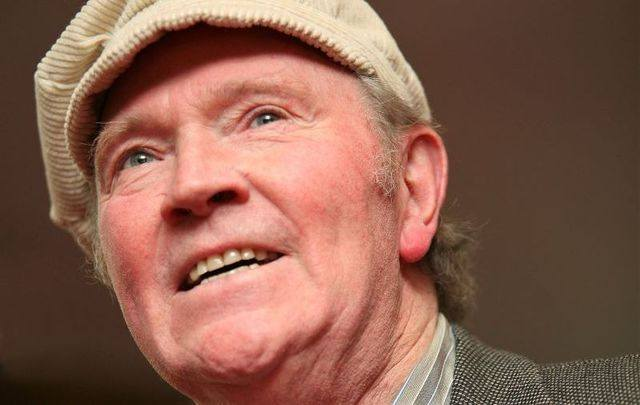
Remembering the late, great Liam Clancy. Remembering the late, great Liam Clancy. RollingNews.ie
Legendary Irish singer Liam Clancy passed away on December 4, 2009, at the age of 74
When I was growing up in the Irish-heavy north Greenwich Village of the 1960s, most of my pals wanted to be Mickey Mantle or Willie Mays. I was different. I wanted to be Liam Clancy.
Why?
Because he was a rebel. And a rogue. He taught me about the audacious Brennan on the Moor and the deadly fate of young Roddy McCorley. He sang sad love songs in that beautiful voice that would bring you to tears—then tore into the English with something like “God Bless England” or “Mr. Moses-Ri-Tooral-i-ay.”
I first learned of the pleasures and evils of drink because of “Whiskey, You’re the Devil” and a young girl named “Nancy Whiskey” who’d grab you by the knees.” And he didn’t let the all-powerful clergy off the hook either, poking gentle, but pointed, fun at the priests and nuns in the audience.
There was another reason he was my hero—I knew Liam always got the girl. And, boy, knowing what I know now, did he ever!
I got to know Liam casually in the 1970s and ‘80s when he drank at the Lion’s Head saloon on Christopher Street in the Village. I would tease him about why he always wore a cap—the worst show business sin, baldness!—and he would go right back at me, commenting about my scrawny red beard.
At the Head, he was a regular and a regular guy, and at home, he was, because of his albums, part of the family. He was loved and admired on both sides of the Atlantic, and as soon as his death was announced on RTE on December 4, 2009, my phone started ringing with calls from cousins and friends in Dublin. His loss was profoundly felt not as a celebrity but as a friend.
Liam Clancy was a superb performer and showman
The Clancy Brothers and Tommy Makem famously burst on the scene with an appearance on “The Ed Sullivan Show” in January 1961.
“We weren’t that impressed,” wrote Liam in his autobiography. “We were arrogant. Young and arrogant. As they say in Ireland, we didn’t give a tinker’s damn. But we accepted.”
There was a cancellation of one of the acts, and the Clancys and Makem filled, getting 15 minutes of uninterrupted publicity. Fifteen minutes and 80 million viewers later, they were, as Tom Clancy succinctly said, “Fuckin’ famous!” After working at their craft in the back room of the White Horse saloon on Hudson Street in the Village for years, they were instantly, because of the power of television, celebrities.
Greenwich Village contributed a lot to the group. Back then, in the early ‘60s, it was a hotbed of poets and folksingers. Odetta at one joint, Tom Paxton at another, Peter, Paul & Mary around the corner. And a young future Nobel Laureate, Bob Dylan, hobnobbing with them all, especially one Liam Clancy. Liam was Dylan’s hero, too.
In his obituary, the New York Times quoted Clancy saying: “People who were trying to escape repressed backgrounds, like mine and Bob Dylan’s, were congregating in Greenwich Village. It was a place you could be yourself, where you could get away from the directives of the people who went before you, people who you loved but who you knew had blinkers on.”
Blinkers off, Clancy, in Dylan’s eyes, attained new artistic heights. “I never heard a singer as good as Liam, ever,” said Dylan. “He was just the best ballad singer I ever heard in my life.”
Liam Clancy was a man of his time through his songs
Liam could sing about anything—the sea, apple orchards, traveling people—but he also had a social conscience. He sang poignantly about homelessness in “Streets of London”.
He sang about our delicate ecological balance on Mother Earth in “The Garden Song”.
He did not avoid the hot issues of the Northern Ireland Troubles either. In the 1970s, when RTE banned the voices of protest in the North—one of the dumbest political decisions ever conceived by the Minister for Posts and Telegraphs, the highly overrated Conor Cruise O’Brien—Liam did not forget the struggle.
It was almost impossible, even in the United States, to get a recording of “The Men Behind the Wire,” but Liam sang it—and was criticized for it—when others would not even touch the incendiary rebel song, the best song to come out of the Troubles.
Liam’s nationalism ran deep. His family owned a pub in Tipperary during the War of Independence, and the Black and Tans often paid unwelcome visits.
He could as easily recite Robert Emmet’s Speech from the Dock as belt out Padraic Pearse’s “Oro Se Do Bheatha” in Irish.
But he was also a showman in the best sense of the word. He could robustly recite the degenerate French poet Charles Baudelaire’s “Get Drunk”, then launch into a rendition of “Ar Fol Lol O,” a song about the innate beauty of mankind.
His signature song, of course, was “The Band Played Waltzing Matilda,” maybe the most beautiful anti-war song ever written. At concerts, when he sang this song, you could hear a pin drop, and when he was finished, there was no applause because the audience was stunned. It was not unusual to hear sobbing from men and women alike.
The Clancy Brothers and Tommy Makem taught me about Orangemen’s Day.
The almost Clancys & Makem sitcom: “Bigger Than the Beatles”
A couple of years ago, I came across one of the extraordinary oddities about the Clancys and Makem. There was an old rerun of Danny Thomas’ show Make Room for Daddy from 1963 on TV called “Oh, the Clancys.” They sang “Brennan on the Moor” and “Portláirge.”
I was so surprised by this show, I emailed the late Jerry Campbell, who was their manager for most of the 1960s. Back in the ’60s, Danny Thomas not only had his own show but also, with Sheldon Leonard, successfully packaged two other hit sitcoms: Andy Griffith and Dick Van Dyke.
Campbell’s response shocked me:
“I had a deal with Danny Thomas & Sheldon Leonard,” Campbell emailed me, “what you saw was basically the ‘pilot.’ It went well, and I got a firm offer for CB & TM to star in their own weekly show on NBC, produced by Danny Thomas & Sheldon Leonard & I was to be the associate producer. A lot of money is involved. Firm 13 weeks on NBC, plus 13-week options on & on and rerun right going on for years.”
“Then the ‘fun’ began!! When the ‘folkies’ found out about it, they struck Liam—He was ‘selling out,’ etc. Heavy-duty pressure from a number of people. Basically, these people were very jealous that they hadn’t been offered the ‘deal’. They all backed Liam into a corner & I kept explaining to him what was going on, so did the William Morris Agency, who represented Thomas & Leonard, and so did NBC.”
“Then, a number of people got onto Tommy Makem & he caved in saying he didn’t want to play an Irishman on TV. I told him point-blank that I would be hard put to see him playing an Italian on the show. Crazy Shit!! All the ‘Irish’ who got into the ‘discussion’ were basically afraid CB & TM would be very successful and they didn’t want that to happen & CB & TM. I didn’t, couldn’t understand this. When these same people who talked Liam & Tommy out of ‘selling out’ got their own deal with the networks, they jumped right on the ‘bandwagon.’ They turned down the entire deal—left big time $$Millions on the table.”
“They did the same thing on a movie deal I had with Peter Bogdanovich for them to star in a Western that he & Larry McMurtry wrote. CB & TM made some big-time dumb career decisions, but there was nothing I could do about it. If they had accepted the deals I got for them they would have been bigger then the Beatles.”
“Our Revels Now Are Ended”
One of my proudest possessions is a copy of “The Mountain of the Women” that Liam sent me. I gave Liam a cameo in my Michael Collins fantasy novel, “Terrible Angel,” sent him a copy in Ireland, and invited him to my book party at the old Lion’s Head, now the Kettle of Fish.
In response, he sent his autobiography to me with this inscription: “For Dermot McEvoy, January 17th, 2003. One good book deserves another. Thanks for thinking of me. I’d love to have been at the launch in the Head/Kettle of Fish. Let’s have a glass there sometime. Give my best to any of the old gang you may come across and—great good luck with the book.—Liam Clancy.”
We never had our glass, but I got to know Liam better, for in the last decade of his life, he published an autobiography, “The Mountain of the Women: Memoirs of an Irish Troubadour,” which told his story, his struggles, and his many loves and many children.
He went even further in the documentary “The Yellow Bittern: The Life and Times of Liam Clancy,” which is a brutally honest look at the rise, the tragic fall, and the heroic rise again of Liam Clancy.
He once famously said to Bob Dylan, “No fear, no jealousy, no meanness,” which is about the best philosophy a man can have in this tough life.
Liam ended every concert with “The Parting Glass.” It’s as if Liam were trying to give his life philosophy—be true to yourself and do no harm to others.
“Of all the money that ere I had, I spent it in good company.
And of all the harm that ere I’ve done, alas was done to none but me.
And all I’ve done for want of wit, to memory now I cannot recall.
So fill me to the parting glass. Goodnight and joy be with you all.
Of all the comrades that ere I had, they’re sorry for my going away,
And of all the sweethearts that ere I had, they wish me one more day to stay,
But since it falls unto my lot that I should rise while you should not,
I will gently rise and I’ll softly call, “Goodnight and joy be with you all!”.
In the history of the conflict in Ireland, truth like peace comes dropping slow. This week, Operation Kenova, a police led investigation into the actions of state agents and agencies suspected of involvement in killings, published its final report.
The report brought various strands and murders together. One strand of investigation was into 127 killings by one group of “loyalist paramilitaries” known as the Glennanne Gang,
I put “loyalist paramilitaries” in quotes because there is little distinction in the actions of the British military and paramilitaries. Some of the killings were conducted by members of the British Military.
In several cases, the report found “clear evidence of collusion with loyalist paramilitaries by state actors”.
Branches of the military provided intelligence and materials for this gang. They also covered up their actions and failed to prosecute the known killers and the murders continued. The Kenova investigation was hampered by the destruction of military files and evidence.
Another section of the report dealt with the actions of a State Agent within the IRA. This agent, codenamed Stakeknife, aka Freddie Scappaticci, was involved in providing over 3,500 intelligence reports to the Irish Republicans. He was also directly implicated in the killing of 14 murders.
Most of those cases involved the killing of suspected British agents. The report makes clear that to protect Scappaticci, the British allowed the killings of others, including their own agents.
Kenova reported that Stakeknife killed more people than his intelligence saved. As if there would be some morally devoid ledger in which these actions would have been acceptable.
In the case of Stakeknife, the report details how files had been destroyed or withheld by MI5, who had claimed to have little or no interaction with the agent.
The report found that British Military Intelligence had handled Stakeknife from the beginning and for decades had protected him. They funded him, advised him on hiding assets, took him on holiday when the police had a warrant for his attest and finally resettled and supported him in Britain until he died.
Even after his death, they protected him by blocking the publication of his will for 70 years. The British Military still refuse to acknowledge that Freddie Scappaticci was Stakeknife.
The Kenova Report is not definitive, as evidence was destroyed and information withheld.
The report nails the lie that the British were neutral referees between warring tribes. The British pursued a war against Irish Republicans by any means necessary. That included working with unionist paramilitaries in the case of 127 killings by the Glennane Gang and the killing of 14 to protect their agent in the IRA.
Margaret Thatcher infamously said in denying political status to Bobby Sands and the Hunger Strikers, “A crime is a crime, is a crime”. At the same time, her agents and agencies were killing and covering up the murders of hundreds.
There are some who might say that these were the actions of a few bad apples. The evidence points to a widespread and ongoing cover-up. We now know the whole orchard was rotten.
Have a great weekend.
Ciarán
Ciarán Quinn is the Sinn Féin Representative to North America
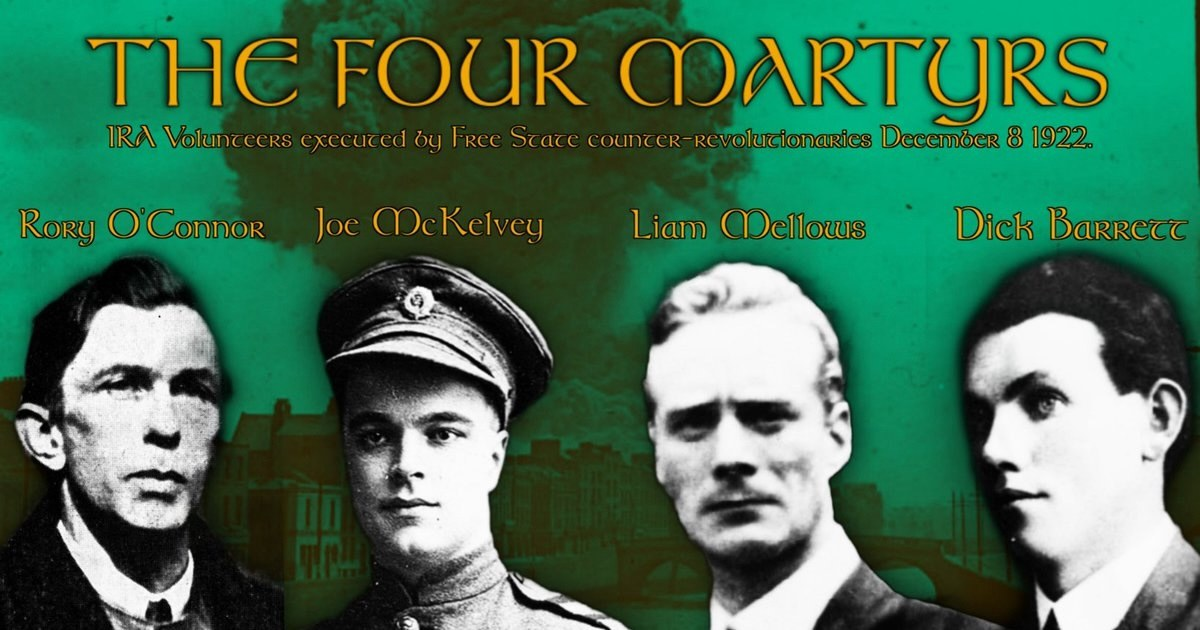
On December 9, 1922, four anti-Treaty IRA prisoners were murdered at the hands of the pro-Treaty Free State forces. An account by Peter McDermott, originally published by the Irish Echo newspaper.
In the dark hours of Friday morning the Dec. 8, Joe McKelvey, Liam Mellows, Rory O’Connor and Dick Barrett, were woken from their sleep by armed guards and the Deputy Governor Paudeen O’Keeffe. They were told to dress and to pack their meagre belongings, but they were given no hint of what was to come. Joe piled his little collection of books into a pillowcase, including ‘The Gadfly,’ and threw them over his shoulder as he left. Most likely they believed that they were being moved to another part of the prison or indeed another location. They were moved to another wing without any disturbance or commotion from the other prisoners, who like Peadar O’Donnell continued to sleep through their removal. They were each placed in a cell alone. O’Keeffe entered each in turn, handed each man a document which informed them that they were to be shot at 8am in reprisal for the killing of Seán Hales:
“You Joseph McKelvey are hereby notified that, being a person taken in arms against the government, you will be executed as reprisal for the assassination of Brigadier Seán Hales TD in Dublin on December 7th, on his way to a meeting of Dáil Eireann and as a solemn warning to those associated with you who are engaged in a conspiracy of assassination against the representatives of the Irish people.”
Only a select few were aware of the impending executions. The then Archbishop of Dublin Dr Edward Byrne spent the early hours trying to persuade W.T.Cosgrave, the head of the Free State cabinet, to reverse the decision of the government, but his pleas fell on deaf ears. After the executions he wrote to Cosgrave:
“…….the policy of reprisals seems to me to be not only unwise but entirely unjustifiable from the moral point of view. That one man should be punished for another’s crime seems to me to be absolutely unjust.”
All four were brought to the prison chapel to hear mass. McKelvey, O’Connor and Barrett received Holy Communion but Mellows did not, Mellows had been asked to repudiate the Republican cause by the priest and had refused. They left the chapel in single file, led by Mellows, with O’Connor at the rear. When they entered the hallway, they were blindfolded. Canon Pigott, one of the priests in attendance who was there at O’Connor’s request, intervened and took Mellows back to one of the cells and after a short delay, he too received Holy Communion. He held a little crucifix in his hand and asked Cannon Pigott that it be returned to his mother after his death.
Once again they were blindfolded and led to the prison yard together. Dick Barrett, struck up the song, “The Top of the Cork Road,” as they were positioned beside one another in a row. “Here’s a health to you, Father O’Flynn, Slainte and Slainte and Slainte agin…” Their hands were tied behind their backs and a target pinned over each of their hearts. Mellows bid the lads “Slán Libh.”
They faced a firing squad of twenty Free State soldiers, lined up in two rows of ten, one row kneeling in front of the other…Four parties of five soldiers were instructed to fire on a different prisoner in order to ensure that each were killed. The order was given “Fire!”
The results were tragically shambolic. For some reason, most of the soldiers fired on Rory O’Connor and he was struck that many times that his clothes caught fire. The gruesome sight sent some of the soldiers into confusion and panic. O’Connor was the only one to be killed immediately, the other three were gravely wounded, though only Joe McKelvey remained conscious.
McNeill and Gunn stood by to deliver the coup de grace and after some confusion and hesitation moved among the dying prisoners finishing them off. Canon Pigott and Canon McMahon anointed three of the men but heard Joe call out, “give me another one,” McNeill fired a shot into McKelvey’s chest but once again missed the heart, Joe called again “and another” before being finished off with a shot to the head.
Dorothy McArdle who was being held in the women prisoner’s wing in Mountjoy, recalled hearing the first volley of shots closely followed by nine single shots. As Canon Pigott made to leave the prison, he remembered Mellows request to deliver the small crucifix to his mother. He returned to where the bodies still lay and found the crucifix lying close to Mellows body. On leaving the prison, he made straight to the home of Mrs Mellows and broke the horrible news of her son’s death to her.
Their broken bodies were then transferred to another part of the prison, placed in coffins and buried in four unmarked graves. That morning the prisoners made their way to mass, as it was a holy day. It was here that their comrades were told the grave news by Canon McMahon. Peadar O’Donnell recalled the moment: “I got the news in the door of the chapel. I just went wooden. I was completely dried of all feeling. I saw men sob and I heard men curse but the whole chapel was detached. I didn’t kneel during mass. The priest had said before turning to the altar to begin: ‘We will offer this mass for your four comrades who have gone before their God.’”
The world is on fire. There are wars in Africa. There are conflicts in Asia. There is the ongoing, grinding bloodbath in Ukraine. And of course, there is Israel versus everyone seemingly within striking distance.
So why has Donald Trump been ratcheting up the pressure on Venezuela since the Summer, seemingly risking yet another bloody conflagration? This is the man apparently so committed to peace that he regarded NOT receiving the Nobel Peace Prize this year as something of a personal insult. Who beamed like a child on Christmas morning when awarded the ‘FIFA Peace Prize’ by the obsequious FIFA president Gianni Infantino, an award that was transparently created with the sole purpose of giving it to one Donald J.Trump and thus stoke the man’s already monstrously inflated ego. As mortified as I was watching the event, I was thankful he didn’t at least start barking ‘Award! Award!’ in anticipation of his bauble, as a certain Father Jack did at a Christmas many years ago…
What then explains this mismatch between a man who supposedly loves peace so much he is determined to achieve it in as many places as possible, no matter the cost (particularly if he won’t be the one paying or if, even better, he can extort a benefit for the United States from another country’s agonies…) and the man who is clearly pushing for regime change in Venezuela?
In reality, it’s not that complex, but it does have to be unpacked.
THE MONROE DOCTRINE
First, we have to start with the Monroe Doctrine. This is so named because it was articulated by American President James Monroe in 1823 and the basis for the doctrine is that any interference by foreign powers in the affairs of the Americas, north or south, was a threat to the security of the United States and that the United States could take steps against any such power. Now the United States of 1832 wasn’t the hyperpower it is today and this led to the great colonial empires of the time essentially ignoring the proclamation and continuing to do as they willed. The French invasion of Mexico of 1861-1867 (when the United States was embroiled in civil war) is remembered as a pretty egregious example of a European power disregarding the Monroe Doctrine but over time, as the United States’ might grew, European powers began to respect it.
As the pre-eminent power in the Western hemisphere, the United States became prone to meddling in the affairs of its neighbours. There was the dismemberment of Colombia in 1903 when the US supported the secession of Panama from that nation in order to secure the rights to build the Panama Canal. Which lead to the creation of a Canal Zone that cut the new country in two over which the United States had sovereignty and which then either justified or precipitated multiple American interventions in that state in the years that followed. Most notable among these interventions were the response to the riots in 1964 (commemorated in Panama as Matyr’s Day) and the invasion of 1989 that removed the dictator Manuel Noriega from power.
There were the Banana Wars, a term used to describe American adventurers in Latin America during the early years of the 20th century and which included long-lasting occupations of both Haiti and Nicaragua as well as interventions in Honduras, Mexico and the Dominican Republic, interventions that were often driven by American commercial interests.
The Cold War saw American meddling in the region become endemic, with multiple dictatorships in South America propped up by virtue of their hardline anti-communism and, where the government was NOT anti-communist, support given to rebel groups who espoused those critical anti-communist perspectives regardless of their commitment to democracy. A particularly nasty example was the 1954 coup d’état in Guatemala where a left-leaning government was toppled at the behest of the American United Fruit Company (whose commercial exploitation of the region had been threatened) and replaced with a military dictatorship, which then triggered a long-running civil war. The United Fruit Company profited handsomely from the takeover of course as restrictions placed on their business were removed. The company later rebranded as Chiquita, still selling fruit today.
Of course, the biggest sore spot for the United States in the Americas was Cuba. The American obsession with Cuba is tied to the Monroe Doctrine, because it is a government inimical to the interests of the United States. Cuba, an unfriendly nation in the heart of the Western hemisphere, can be used by other Great Powers to undermine the security and hegemony of the United States. As a result, the United States has sought to either contain or undo the communist regime there. This was most obvious during the Bay of Pigs invasion when American backed forces attempted to start a counter-revolution in Cuba (which failed miserably) and its sequel, the Cuban Missile Crisis of 1962, when America sought to dislodge their great rival the Soviet Union from the island, after the Soviet Union was invited to base nuclear missiles and military forces there to defend those missiles (and thus, by extension, the island itself).
What I want you to take away from this is that the Monroe Doctrine is not a high-minded attempt to protect the independence, rights and dignity of other nations in the Americas. It was about ensuring that America was the undisputed hegemon in the region and that if anyone was going to meddle, it was going to be them. Other nations doing the same, that just won’t be tolerated in Washington’s backyard.
But I do want to clarify that I am not someone who thinks that ‘If you oppose the United States, you are automatically the good guys’. Everyone is responsible for the own actions, their virtues and most especially their sins. Cuba’s government is, at the end of the day, not a democracy and it is somewhere where you can be imprisoned for your political beliefs. I wouldn’t weep if that government fell tomorrow, and I hope that one day they find their to a pluralistic liberal democracy that serves the wishes of the people who live there. You can condemn or hold in suspicion the government of a country whilst doubting the motives of their opponents.
Which is important as I move into the next part of this essay.
VENEZUELA
There are few governments in the world as unlikable as that of Nicolás Maduro. He’s the successor to Hugo Chavez, the firebrand politician who rode to power on a wave of left-wing populism in 1999, survived a coup attempt in 2002 that was the subject of an Irish documentary, ‘The Revolution Will not be Televised’ and who succumbed to cancer in early 2013. He made his anti-Americanism a pillar of his ideology, and he never missed an opportunity to rail against the iniquities of Uncle Sam. But whilst I can acknowledge that the American interest in Venezuela is far from benign and that Chavez fashioned a pretty compelling case against American Imperialism (and much of Chavez’s rhetoric took place in the aftermath of the Iraq War and the occupations of both Iraq and Afghanistan under the Bush administration), I will also argue that tremendous democratic backsliding occurred in the country under both Chavez and Maduro. Venezuela’s economy has contracted by some 70-80% since 2014. The media has been increasingly restricted. The democratic opposition has been driven underground. Roughly a quarter of the population, some eight million people, have fled to neighbouring countries to escape the increasing poverty and repression. And it is generally accepted internationally that Maduro rigged the last election to ensure he would continue in office despite his government bringing Venezuela to its nadir.
Basically, this man and those backing him deserve no sympathy and I fervently hope that one day he gets a much-deserved comeuppance. After all, just because the United States is opposed to Maduro’s government and has sought to stymie and undermine it, that does not make Maduro a legitimate leader. He is by any standard a dictator who cheated to retain power and continue inflicting misery on his own country. Trump apparently loathes him for his mismanagement of his country, though more to do with how his policies have impoverished it rather than his evisceration of the rule of law.
Maduro’s worst mistake though in the eyes of Washington has been cosying up to Beijing and Moscow.
THE DONROE DOCTRINE
Donald Trump is not one for playing nice with others. He abhors the multilateralism that the United States relied upon as the foundation of their global power from 1945 until the present day, a point of view he articulated in his free-wheeling address to the United Nations in late September.
He hates the European Union, an alliance of democracies, because the multi-lateral co-operation and co-ordination built into that organization means he simply cannot use the heft of the United States vis each of the much smaller, individual states to achieve maximal gains for the US (though perhaps he needn’t have worried given how the last round of trade talks turned out…).
He also openly admires Vladimir Putin’s Russia, and his antipathy towards Ukraine’s struggle against its mightier neighbour can be explained by…Zelensky stiffing Trump’s request to launch an unfounded investigation of Hunter Biden (whilst threatening to withhold American aid) in an attempt to damage his prospective electoral opponent in the 2020 election and thus triggering his first impeachment…but also by his sympathy for one of Putin’s animating drives.
The need for a sphere of influence.
It seems Trump respects Putin’s desire for Russia to be dominant in its near-abroad, which means the former territory of the Soviet Union, because Trump wishes to emulate him with a sphere of influence over the Western Hemisphere. And the thing about spheres of influence is that they take no account of the feelings or wishes of the inhabitants or even governments in the states that the sphere encompasses, instead they must be subordinate to the whims and interests of the hegemon.
Last Thursday, the Trump administration released their new ‘National Security Strategy’ or NSS. According to Wikipedia, ‘The National Security Strategy (NSS) is a document prepared periodically by the executive branch of the United States that lists the national security concerns and how the administration plans to deal with them…The document is purposely general in content, and its implementation relies on elaborating guidance provided in supporting documents’. In other words, it is an articulation of the vision of the President.
Politico’s examination of the document says that
“It has an unusually heavy focus on the Western Hemisphere that it casts as largely about protecting the U.S. homeland. It says “border security is the primary element of national security” and makes veiled references to China’s efforts to gain footholds in America’s backyard.”
The report further quotes from the NSS itself when it says…
“The United States must be preeminent in the Western Hemisphere as a condition of our security and prosperity — a condition that allows us to assert ourselves confidently where and when we need to in the region,” the document states. “The terms of our alliances, and the terms upon which we provide any kind of aid, must be contingent on winding down adversarial outside influence — from control of military installations, ports, and key infrastructure to the purchase of strategic assets broadly defined.”
(Some smart wag reframed this modern embrace of the Monroe Doctrine as ‘the Donroe Doctrine’).
Politico goes further…
“The Trump strategy suggests the president’s military buildup in the Western Hemisphere is not a temporary phenomenon. The strategy also specifically calls for “a more suitable Coast Guard and Navy presence to control sea lanes, to thwart illegal and other unwanted migration, to reduce human and drug trafficking, and to control key transit routes in a crisis.”
The strategy says the U.S. should enhance its relationships with governments in Latin America, including working with them to identify strategic resources — an apparent reference to materials such as rare earth minerals. It also declares that the U.S. will partner more with the private sector to promote “strategic acquisition and investment opportunities for American companies in the region.”
To sum up then, what is driving the United States actions towards Maduro and Venezuela is that the current US administration is looking to firm up their sphere of influence in the Western hemisphere, something many in the current government believes is America’s due by virtue of its status as a Great Power. Whilst Trump is clearly sympathetic to Putin, he will not tolerate Russia or China attempting to use an American adversary such as Venezuela as a proxy with which to make mischief. If he is going to respect Russia’s sphere of influence, he demands reciprocity.
The stationing of huge quantities of American naval assets in the Caribbean, the strikes on alleged drug boats in the Caribbean and Trump admitting he has authorised covert ops in Venezuela are all part of a strategy to apply pressure to the already unstable Maduro government. The best-case scenario for Trump is that this pressure is enough to topple the regime and allow the installation of a government far friendlier to American interests. The illegitimacy of the Maduro regime means that, if successful, Trump may face limited diplomatic blowback. But if it doesn’t work and Maduro manages to cling on despite this intense, crushing pressure, then who can say what will happen? Antipathy towards the military adventurism and failed nation-building efforts of his neo-conservative predecessors in the Republican party is a cornerstone of his MAGA movement, and Trump has said on more than one occasion that he shares those sentiments so it would be a surprise for him to begin dabbling in overt regime change.
But on the other hand he no longer has to worry about re-election so perhaps the feelings of his base isn’t as important to him now that he no longer needs them, as we saw with his response to their demand for the Epstein files, where he lambasted his supporters as ‘stupid’ and ‘foolish’.
Some hope that his desire for the Nobel peace prize may stymie his more aggressive instincts, his desire to match the achievement of his great bête noire, his ideological and temperamental opposite Barack Obama may yet prove irresistible for him (and on that we can but hope). Still, he already has A peace prize now, if not THE peace prize. Maybe that’s enough.
In a sign of the darkness that is descending with the advent of this multi-polar world, Russia said that the new strategy articulated by Trump ‘aligns with Moscow’s vision’. The carving up of the world into spheres of influence, where the strong do what they will and the weak suffer as they must. A return to how politics used to be conducted, and one that shows that the internationalism of the past century was a historical aberration.
Trump seems determined to either contain Venezuela or bring it to heel in realisation of his vision of predominance of the United States in the Americas. That Maduro and his cronies don’t deserve our pity is irrelevant to the fact that when a great power decides to work its will through force of arms, it is ordinary folks who pay the price.