The moments that defined Thomas Clarke’s life and why he is such an important figure in Irish history
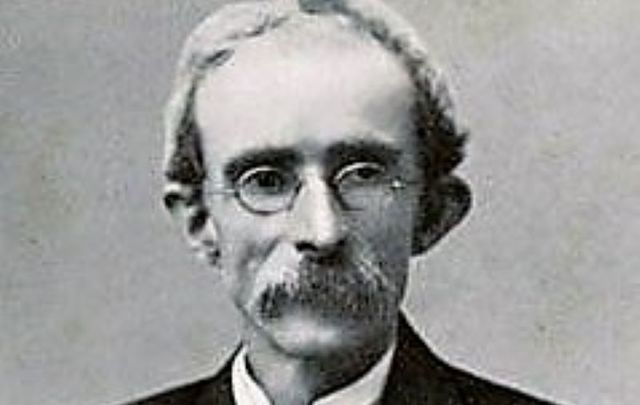
Thomas Clarke, a key member of the Irish revolutionary and a leader of the 1916 Easter Rising. was among the rebel leaders executed on May 3, 1916.
Thomas J. Clarke was born in 1858 on the Isle of Wight but grew up in County Tyrone.
At age 20 he joined the Irish Republican Brotherhood (IRB) and his career as an indefatigable Irish revolutionary began. After a skirmish with police, he was forced to flee to America where he became a citizen of the United States in the City of Brooklyn in 1883. (He was the only American citizen involved in the 1916 Rising executed by the British.)
In that same year, he heeded the call of Jeremiah O’Donovan Rossa and returned to England on a secret mission – to blow up London Bridge. He was apprehended and spent the next 15 years in British prisons.
At Millbank Prison, he was Prisoner J464 and was treated brutally:
“I remembered with what relentless savagery the English Government had always dealt with the Irishman it gets into its clutches, and the future appeared as black and appalling as imagination could picture it.”
Upon his release, he returned to New York. There he married Kathleen Daly – of the radically Republican Daly family of Limerick – in 1901. John MacBride was his best man and John Devoy, who Pearse called “the greatest of the Fenians,” was also in the wedding party. The Clarkes lived all over New York City and Long Island as Tom was employed at various jobs, including working for Devoy on the Gaelic American newspaper.
In 1907 he decided, with unrest between the European superpowers becoming apparent, it was time to return to Ireland. He opened several newsagent stores, the most prominent one being on the corner of Sackville (now O’Connell) and Great Britain (now Parnell) Streets, directly across from the Parnell Monument. It became a prime meeting place for every prominent Fenian leader of the coming revolution.
Clarke became the Fenian pied-piper and brought such young men as Seán MacDiarmada, Padraig Pearse, Joseph Mary Plunkett, and Thomas MacDonagh into his Fenian sphere of influence. He even influenced the young Michael Collins.
“It was in 1914, just before the declaration of war, that the chance came to take passage to New York,” Collins is quoted in Hayden Talbot’s “Michael Collins’ Own Story.” Collins went on to state that “…when I laid the scheme before Tom Clarke…he advised me not to go. His reason satisfied me. He said there was going to be something doing in Ireland within a year. That was good enough for me. I changed my mind about going to America, and plodded along in my uncongenial job [in London].”
Britain’s entry into the Great War in 1914 presented a unique opportunity for Clarke and the radical IRB. With the advent of war, John Redmond of the Irish Parliamentary Party had urged Irishmen to join the fight for Britain. This had caused a split in the Irish Volunteers and Clarke and his group of young revolutionaries moved in to fill the void.
By 1915 planning for a rebellion was underway. Sir Roger Casement and Plunkett traveled to Germany to try and raise arms for the rebellion. Early in 1916 James Connolly and his Irish Citizen Army were brought into the conspiracy.
The Rising was initially set for Easter Sunday 1916, but things went wrong from the start. Eoin MacNeill, the nominal leader of the Volunteers, was kept in the dark about what was happening, and when he learned that the “maneuvers” were actually a march to insurrection he countermanded the order. The Rising was then moved to Easter Monday, but the revolt had been stripped of much of its impact.
On Easter Monday Clarke’s name was the top signature on the Proclamation and, as a mark of admiration and honor, he was the first to march into the GPO to take over the building. On Friday, with the GPO engulfed in flame, Clarke led his men out across Henry Street and into buildings on Moore Street where the rebels made their last stand.
After the surrender, Clarke was bivouacked for the night with the rest of the rebels in the garden of the Rotunda Maternity Hospital. There, according to reports, he was stripped naked by Captain Percival Lea Wilson and beaten. (Michael Collins witnessed this and had Wilson shot dead in Gorey, County Wexford, three years later.) From there, Clarke was transported to Richmond Barracks for court-martial, found guilty, and transported to Kilmainham Gaol for execution.
Unlike Pearse and MacDonagh whose families could not visit in time, Clarke was able to say goodbye to his wife, Kathleen. According to her autobiography, “Revolutionary Woman,” he told her his trial had been a “farce.” He then told her, “I suppose you know I am to be shot in the morning. I am glad I am getting a soldier’s death.” Kathleen wrote, “he faced death with a clear and happy conscience.”
But the old Fenian wasn’t finished yet. He railed against Eoin MacNeill who had countermanded the maneuvers for Easter Sunday. “To send out countermanding orders secretly,” Clarke told his wife, “giving us no hint of what he was doing, was despicable, and to my mind dishonorable.” Just hours before he was executed Clarke gave this command to his wife: “I want you to see to it that our people know of his treachery to us. He must never be allowed back into the National life of the country, for so sure as he is, so sure will he act treacherously in a crisis. He is a weak man, but I know every effort will be made to whitewash him.”
Kathleen Clarke may have suffered more than any other survivor of the Rising. She not only lost her husband, but also her brother, Ned Daly, the commandant in charge of the Four Courts.
In addition, she was pregnant at the time of the Rising. “A baby was coming to us,” wrote Kathleen, “but [Tom] did not know. I had not told him before the Rising, fearing to add to his anxieties, and considered if I could tell him then but left without doing so.” Her final tragedy of 1916 was to miscarry that baby. Besides his widow, Clarke was survived by sons Emmet, John Daly, and Tom Jr.
Kathleen Clarke was to carve out a Republican reputation of her own. In 1917 she appointed the young rebel her husband had persuaded not to go to America – Michael Collins – as director of the National Aid and Volunteers Dependents Fund, a charity for indigent survivors of the Rising. Starting with that position Collins was to go on and strike fear into the hearts of the British establishment. During the War of Independence, she served as a judge in the Republican courts and was elected to the Dáil.
In 1939 she became the first woman to become Lord Mayor of Dublin. One of her first official acts was to remove a portrait of Queen Victoria. She died in 1972 at the age of 94. She outlived her husband by 56 years.
~~~~~
* Dermot McEvoy is the author of “The 13th Apostle: A Novel of a Dublin Family, Michael Collins, and the Irish Uprising and Irish Miscellany” (Skyhorse Publishing). He may be reached at dermotmcevoy50@gmail.com.
Easter Rising 1916: Six days of armed struggle that changed Irish and British history
Published 23 March 2016
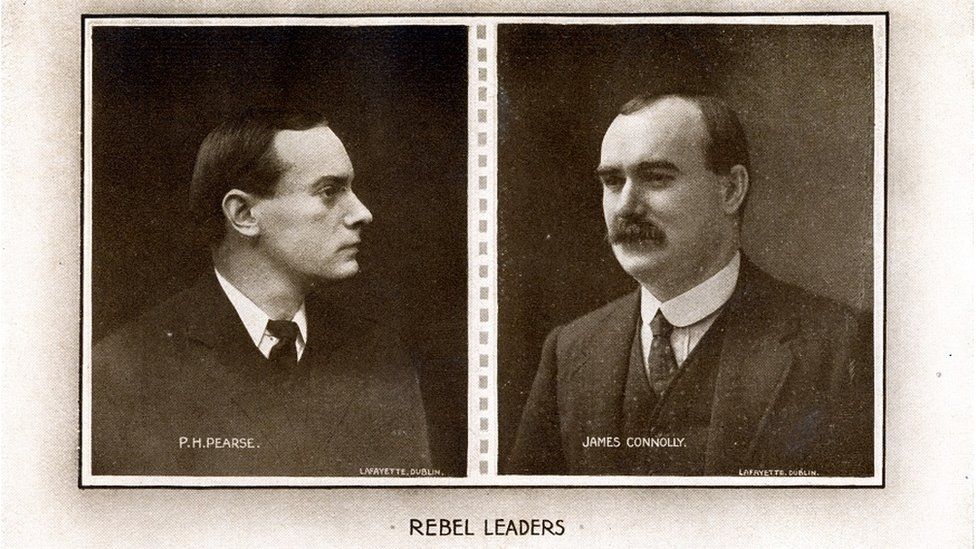
Image caption,Pádraig Pearse and James Connolly, two of the leaders of the military council
The years leading up to the rebellion against British rule in Ireland in April 1916 were marked by significant political, cultural and military developments in Ireland and throughout Europe.
The emergence of these forces undermined British rule in Ireland.
However, the possibility of violence in Ulster was averted by the outbreak of World War One.
The main party in favour of Home Rule, the Irish Parliamentary Party, agreed that attempts to secure self-governance should be postponed for the duration of the war.
Many Irishmen joined the call to arms and fought in western Europe.
However, others were angered by what they regarded as the Irish Parliamentary Party’s acquiescence to Westminster.
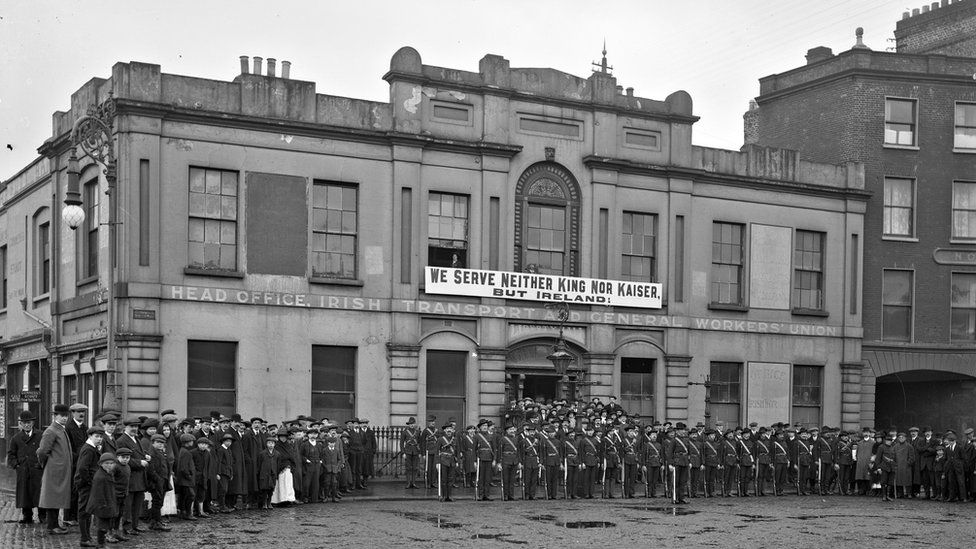
Image caption,The Irish Citizen Army, a socialist militia, led by James Connolly also played an important role in the rising
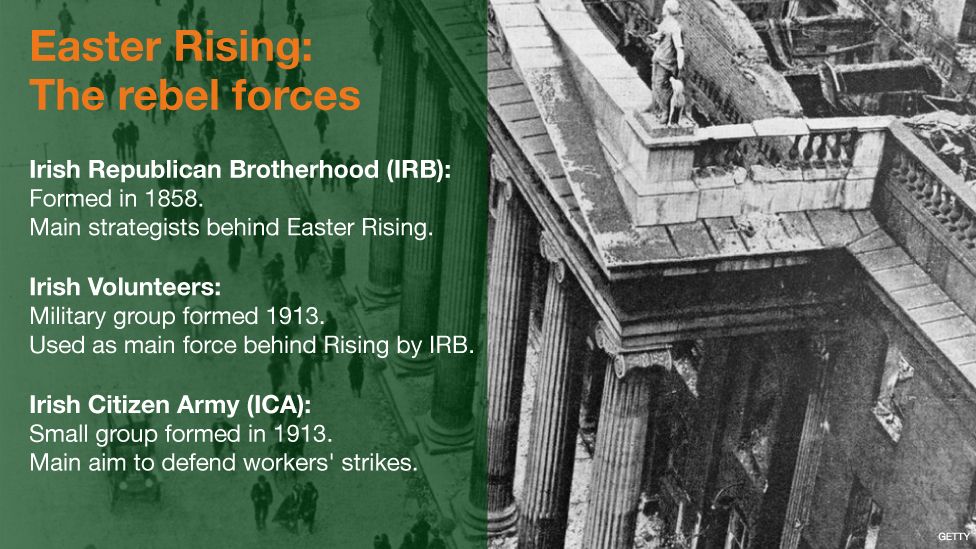
Three groups were behind the rising but the most important was the Irish Republican Brotherhood (IRB) which was formed in the mid-19th century.
Thomas Clarke and Seán Mac Diarmada were the key figures in the IRB.
The Irish Volunteers were a military group formed in 1913 and its members accounted for the largest number of men who were called out on Easter Monday.
The Irish Citizen Army, a socialist militia, led by James Connolly also played an important role.
The key group was a seven-man IRB military council, drawn from those three organisations, which planned the Easter Rising with complete secrecy.
The decision to rise was based on the traditional dictum that England’s difficulty was Ireland’s opportunity.
But it also reflected the military council’s fear that Irish nationalism was in decline, a concern reinforced by popular Irish nationalist support for the aims of the Irish Parliamentary Party and the British war effort.
On 23 April, the council agreed to proceed with the rising the next day, Easter Monday.
It decided that the proclamation should be read to the public outside Dublin’s General Post Office (GPO) by the president of the Provisional Government of the Irish Republic.
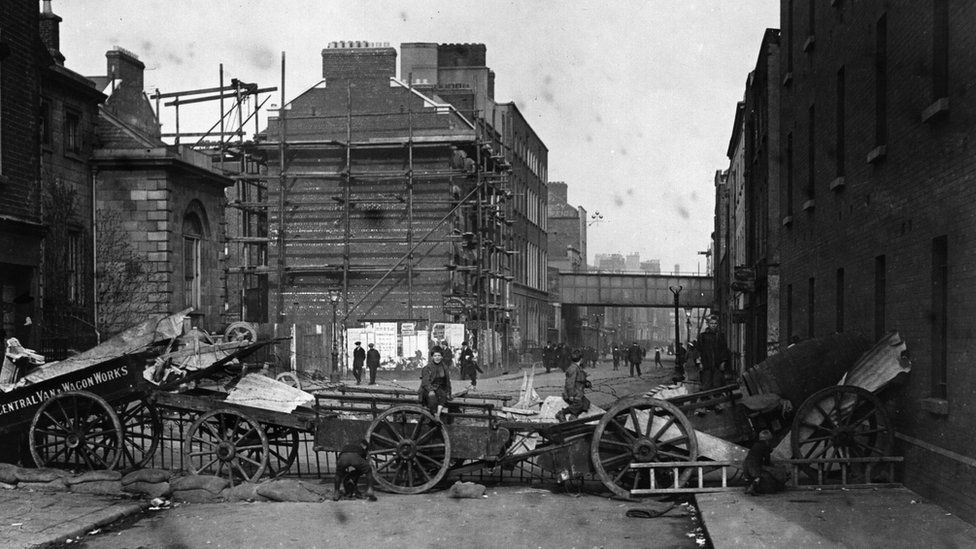
Image caption,Irish Volunteers barricade Townsend Street, Dublin, to slow down the advance of troops, during the Easter Rising
Despite Thomas Clarke’s seniority, it was agreed that Pádraig Pearse should act as president.
Shortly after noon on Easter Monday, Pearse accompanied by an armed guard, stood on the steps of the GPO and read the proclamation, signalling the beginning of the Easter Rising.
Ireland’s ‘national right to freedom and sovereignty’ was asserted.
The conflict that followed was largely confined to Dublin.
The British military onslaught, which the rebels had anticipated, did not at first materialise.
When the rising began, the authorities had just 400 troops to confront roughly 1,000 insurgents.
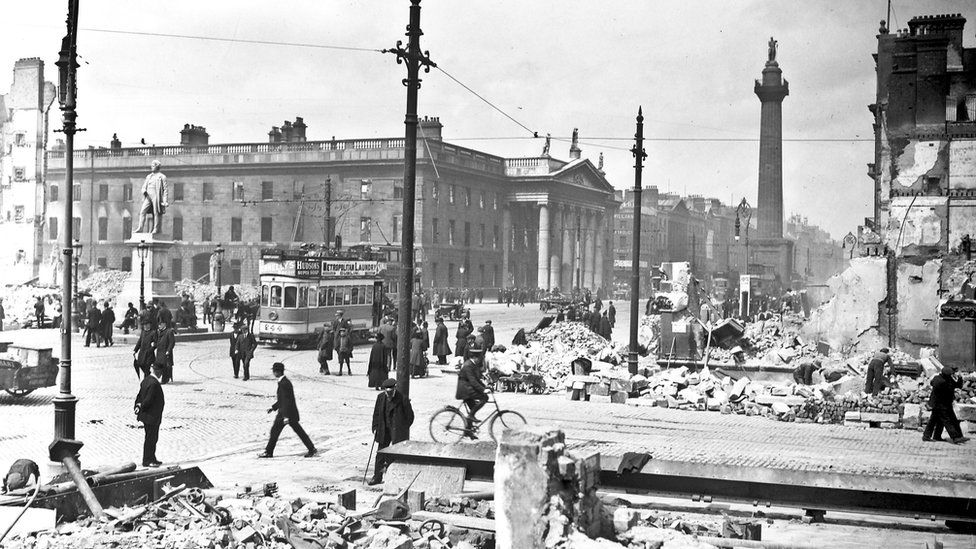
Image caption,Crowds in Sackville Street (now O’Connell Street) can be seen next to the General Post Office showing damage from shelling following the Easter Uprising
As the week progressed, the fighting in some areas became more intense, leading to several prolonged, fiercely contested street battles. Military casualties were highest at Mount Street Bridge.
By Friday 28 April, about 18-20,000 soldiers had been amassed in the capital against about 1,600 rebels while much of the city centre had been destroyed by British artillery fire.
The next day, Pearse surrendered unconditionally on behalf of the Volunteers and issued orders to this effect.
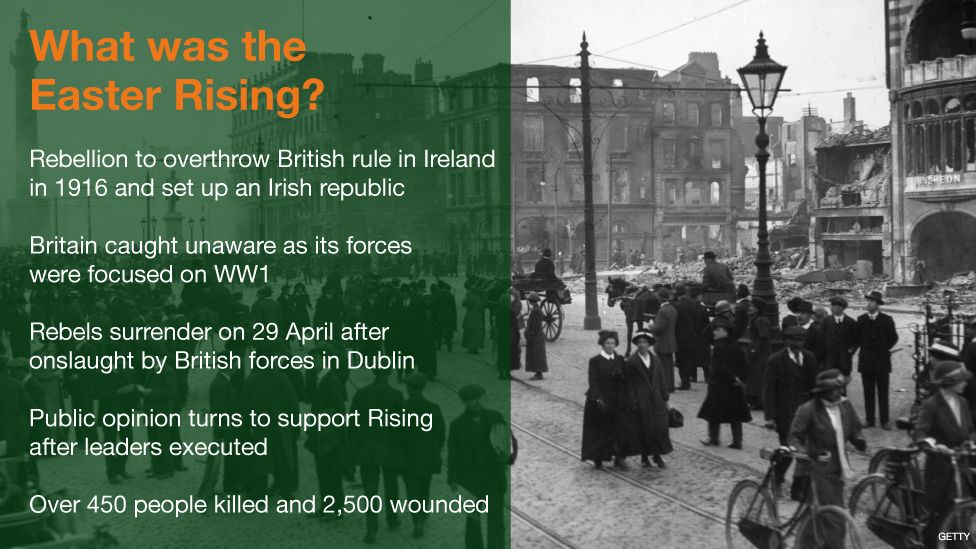
A total of 450 people were killed during the rebellion, among them 64 rebels. 2,614 were injured, and nine others were reported missing, almost all in Dublin.
The British capture of a shipment of German arms three days before the rebellion was partly responsible for the failure of the nationwide mobilisation.
Dr Fearghal McGarry, from Queen’s University Belfast, said although there was very little support for the rising at the time, it was enormously successful in terms of what the organisers of the rising wanted to achieve.
“They did not expect it to win power, what they planned was a spectacle, a gesture to transform public opinion,” he said.
“They knew they would not win, they knew some of them would die.”
He said that, in political terms, the rising achieved everything that the organisers thought it would.
“It destroyed the Irish Parliamentary Party’s credibility and it derailed Home Rule,” he said.
“It exposed the oppressive nature of British rule and it transformed public opinion by winning public support for republicanism.
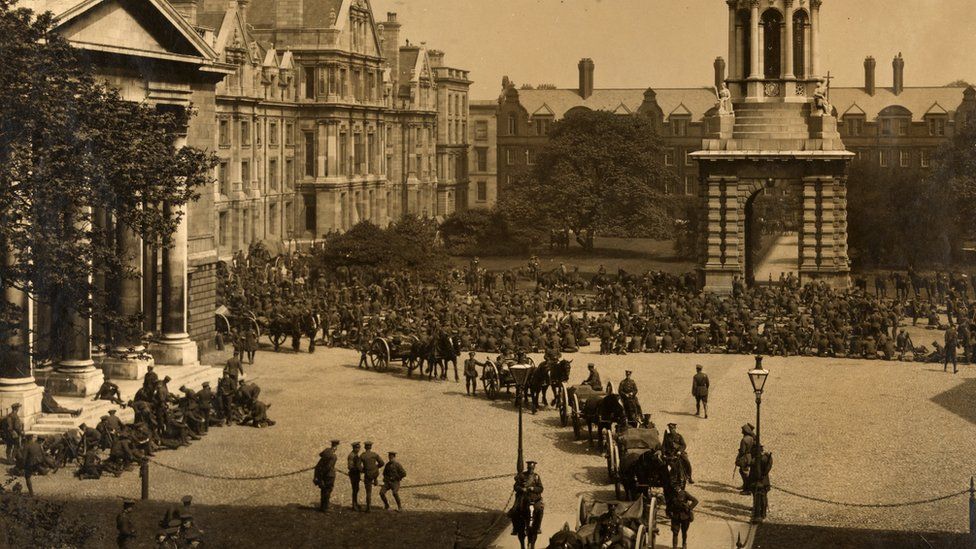
Image caption,British soldiers parading in front square of Trinity College Dublin in the aftermath of the Easter Rising
“What might have surprised the leaders was how quickly all this happened. Within a year and a half republicanism had become the most important movement in Ireland.”
Dr McGarry suggests that, for many Irish people, the significance of the rising lies less in the events of Easter week than in their longer term legacy.
“I think for most Irish, certainly people south of the border, the event’s significance is not primarily centred on the week-long violence that took place in Dublin,” he said.
“Rather it’s focused on the attainment of Irish sovereignty, self-determination.
“It’s bound up with national identity. In contrast, the rising’s significance for many northern nationalists over the past century reflects partition and the failure to achieve a united Irish Republic.
“In the south, the rising is increasingly seen as history, not politics.”
During his rousing speech in Ballina, County Mayo, President Biden paid homage to the many Irish who have fought and died for the United States down the generations,
And he paid particular tribute to Mayo native Patrick Gallagher, in whose name and honor a U.S. Navy destroyer is currently under construction in Maine.
Said the president: “When one other Irish-Catholic President — only other one — John F. Kennedy, visited Ireland 60 years ago — and you can clap for him, man. He was something else. He presented your parliament with the flag of the regiment of that Irish Brigade, honoring Ireland’s great contributions to American freedom. It still hangs there to this day.
“It’s a legacy of faith and fidelity to freedom to one another that has been handed down generation to generation to generation.
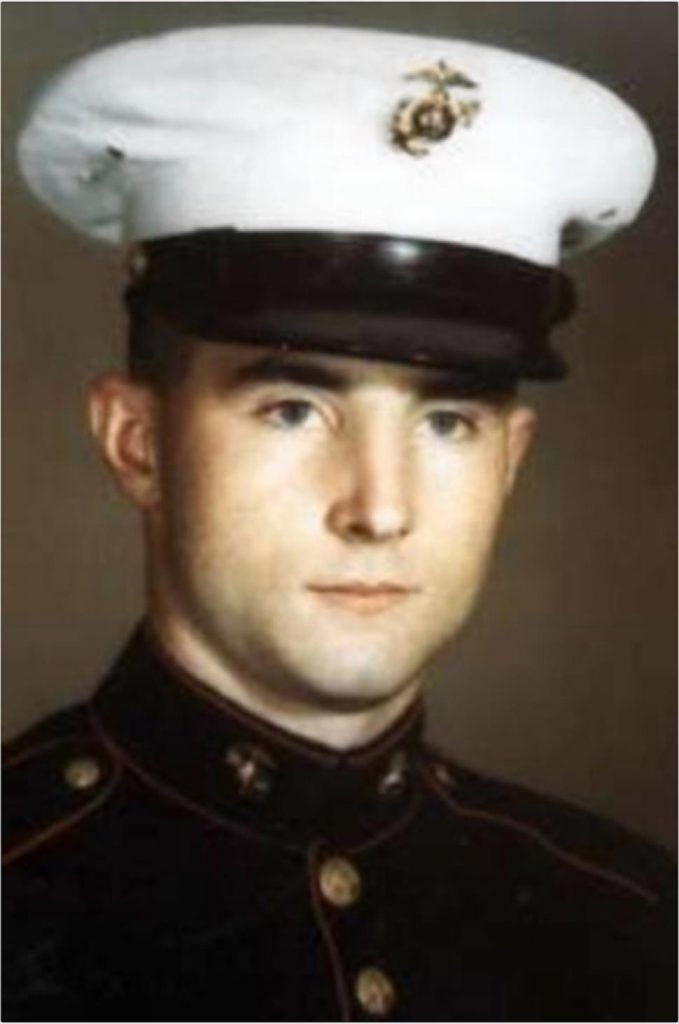
“Today, the United States continues to honor that legacy, including that one of a Mayo-born Marine named Patrick Gallagher. Patrick immigrated to New York in 1962. He worked for the Senate campaign of one of my political heroes, Robert F. Kennedy.
“A few years later, when he wasn’t even a U.S. citizen, Patrick joined the United States Marine Corps and deployed to Vietnam. In 1966, Patrick’s team was attacked in an ambush.
When the enemy hurled a grenade at his team, Patrick threw himself on top of that grenade. He was willing to sacrifice his life to save his brothers-in-arms. He survived that attack, was awarded the Navy Cross for his bravery. Sadly, he was later killed in action.
But this year, his name will be honored in iron as the United States launches a new Navy destroyer, the USS Patrick Gallagher — from Mayo.”
At ninety George Mitchell rocked the house yesterday treating his audience to the wisdom, humour and realism no doubt honed over many years in American public life. For today, I’ll stick to his opening remarks (and a recurring theme here of renewal)…
On the evening the Agreement was reached I commended the men and women who wrote and signed it. But I also said that it would take other leaders in the future to safeguard and extend their work. And so it has. I am here, with many others, to sound that bell one more time.
Life is change: For every human being, for every family, for every government, for every society. All human beings, every single one of us, is fallible, as are all human organisations and institutions. In human affairs the answer to every problem contains within it the seeds of a new problem.
Today, a quarter century after the agreement, the people of Northern Ireland continue to wrestle with their doubts, their differences, their disagreements.This of course is only natural. They will continue to do so, no matter how successful their political leaders are.
The answer is not perfection, or permanence. It is now, as it was then, for the current and future leaders of Northern Ireland to act with courage and vision, as their predecessors did 25 years ago.
To find workable answers to the daily problems of the present. To preserve peace.To leave to the next generation peace, freedom, opportunity, and the hope of a better future for their children.
One of the strengths of democracy is the right of all citizens to publicly disagree with and to criticize their government officials and their policies. But all values, when carried to extremes, can become vices.
So, if there’s one bit of unsolicited advice I’d give to the people of Northern Ireland, it’s this, “Don’t always be so hard on yourselves”. At the same time, never ever give up on the belief that we all can do better and be better.
The future becomes the present in a heartbeat.
Perhaps the most poignant moment was when he called for a moment of silence, which he presaged with the following in which he highlights the full extent of the cost of our brutal and unnecessary war (in the frighteningly large number of its casualties):
According to the Northern Ireland Police Service and the Northern Ireland Statistics Agency, from the start of The Troubles until 1998, over three thousand and five hundred people were killed, and an estimated fifty thousand were injured in sectarian violence.
In the twenty-five years since the agreement was reached there have been about one hundred sixty-four security-related deaths. But don’t think of them just as numbers, because they are not.
Think of them as mothers and fathers, sons and daughters, whose lives were cut short, or were permanently impaired. Still, to this day their lives echo down the years.