Posted by Jim on March 2, 2018
Almost 24,000 homes and businesses across Ireland are without power amid
one of the worst winter storms the country has experienced for decades.
Much of the country heeded warnings to stay indoors amid extreme weather
conditions overnight.
Sub-zero temperatures led to extremely dangerous road conditions and
virtually all public transport was cancelled, with flights at Dublin
Airport suspended until Saturday. All Dublin Bus, Luas and Irish Rail
services are suspended.
Dublin fire brigade reported trees being down, a roof collapse and poor
conditions on the roads, with their own vehicles struggling to get
through the snow drifts.
A Status Red alert will remain in place in Leinster, Munster and Galway
until 6pm today. However, a public safety notice for people around the
country to stay indoors has been withdrawn this morning.
“As expected [the storm] moved up across country and brought and is
continue to bring strong easterly winds,” Gerry Murphy of Met Eireann
told RTE radio.
“As well as that as it met the cold air it brought snow up over parts of
Leinster and Ulster.”
Cold air from the east clashed with warmer collided with strong winds
from the south east to produce snow of up to 60cm in depth, although a
meter of snow could yet fall on the country, according to forecasts.
“There will be continuation of that snowfall as we go through the day.
Leinster and Munster will continue get the bulk of that snow,” Mr Murphy
said. “The winds will continue quite strong along the coast”.
A number of people became stuck in their cars overnight when blizzards
hit making roads impassable and visibility was reduced to zero. People
remained stuck in their vehicles across Dublin.
“It seems some people may have left the city late in the day yesterday,
and judged local conditions in town as being manageable, but as they got
out of the city to where conditions were worse they got stuck,” said a
garda spokesman.
Last night a total of 115 homeless people were allocated beds in the
Extreme Cold Weather Accommodation in the sports centre in Dublin’s
South Inner City according to the Peter McVerry Trust.
Some 21 people were found to be sleeping rough despite the extreme
conditions. The team managed to persuade six to use the emergency
shelter.
Posted by Jim on
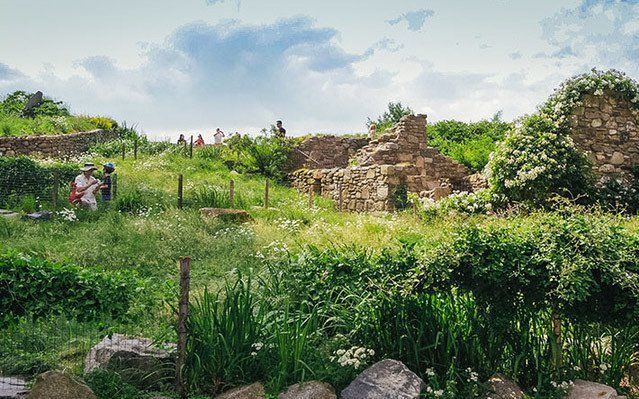
New York’s Great Hunger Memorial Battery Park
New York’s Irish Hunger Memorial is open again after renovations!
The $5.3 million renovations and waterproofing of the Irish Hunger Memorial in Battery Park in Manhattan is finally completed and the memorial is now ready for visitors. The Great Hunger Memorial depicts a ruined cottage in a rural Mayo setting smack in the middle of downtown Manhattan.
The project restored the monument to its former magnificence, while rendering it significantly less susceptible to damage from weather for years to come. It has been closed for close to two years. It opened briefly last year but other problems arose.
According to the Tribeca Trib newspaper, the renovation process was especially difficult because the landscaping, reproduced from Ireland, had to be re-assembled just as it was.
All of the stones on the memorial, which sits on a half-acre at Vesey Street and North End Avenue, “had to be removed, taken down and catalogued, and soil was removed and in some cases brought back,” Gwen Dawson of the Battery Park City Authority said.
“All of those stones got put back in the right place. Our contractor has done a spectacular job.”
The memorial, according to its official description, “represents a rural Irish landscape with an abandoned stone cottage, stone walls, fallow potato fields and the flora on the north Connacht wetlands. It is both a metaphor for the Great Irish Famine and a reminder that hunger today is often the result of lack of access to land.”
The restoration project at the 15-year old memorial located in Battery Park City, overlooking the Hudson River, commenced after the site was closed waterproofing and drainage issues — some of which were related to Hurricane Sandy in 2012 — which caused significant decay to the tourist attraction.
The Memorial, designed by internationally renowned sculptor and public artist Brian Tolle, originally opened in 2002. It is a contemplative space devoted to honor the Great Irish Hunger and Migration of 1845-1852, while encouraging viewers to contemplate present-day hunger worldwide. Over the years, it had succumbed to water infiltration from above and subsequent water damage
The half-acre site on the corner of Vesey Street and North End Avenue, in the Battery Park City section of downtown Manhattan, overlooks the Hudson River. Visitors to the 96′ x 170′ Memorial wind through a rural Irish landscape, with paths carved into a hill thickly lined with native Irish plants and stones imported from each of Ireland’s 32 counties.
The paths lead to a breathtaking viewing point 25 feet above street level, which boasts views of the Statue of Liberty and Ellis Island. Located centrally along the pathways is an authentic Irish Famine-era stone cottage that was donated to the Memorial by Tolle’s extended family, the Slacks of Attymass, County Mayo. It was disassembled and brought over from Ireland and reconstructed on-site, within the green “hillside” of the Memorial.
“The Irish Hunger Memorial was first dedicated over 15 years ago; it has now re-opened to stand for coming generations as a place of reflection and remembrance. And just as America has long welcomed immigrants from Ireland and beyond, we’re pleased to once again welcome Battery Park City visitors to experience this poignant tribute to the unbreakable human spirit,” said a statement from the Battery Park City Authority.
The cottage, pathways, and plant-filled meadows are cantilevered over a layered base of glass and polished fossil-bed limestone from County Kilkenny, Ireland. Shadowy text that relates to both the Famine and reports of contemporary hunger form upon the frosted glass panels, wrapping around the exterior of the Memorial and into the passageway leading to the cottage.
This project held vital significance for CTA. According to principal Daniel J. Allen, AIA, “Many of us on the project have strong ties to Ireland, making this much more than basic renovation work to us. We were painstaking in our repairs in order to keep the artist’s vision intact.” Similarly, CTA’s project manager for the Memorial, Frank Scanlon, AIA, grew up in County Roscommon and in County Mayo. “We were thrilled to be able to provide a solution to keep the Memorial open year-round for years to come,” he said.
The project team also included The LiRoconstruction group, landscape consultant and architect SiteWorks; mechanical, electrical, and plumbing (M/E/P) engineer Collado Engineering, P.C.; and structural engineer GACE Consulting Engineers.
Soon after the Memorial was first opened to the public, Battery Park authorities noticed cracking and a leak from the cantilevered slab where the monument’s landscaping and cottage were located. Despite a temporary fix the problem continued but it has now been completely dealt with.
The New York Times raved about the memorial when it opened in 2002. Critic Roberta Smith said it struck a “deep emotional chord” and expanded “the understanding of what a public memorial can be.”
The memorial’s cultural liaison was Adrian Flannelly, the long-time Irish radio show host. Flannelly was one of the driving forces behind the creation of the memorial, which is open every day from 11 am until 6:30 pm and is free of charge.
Posted by Jim on February 28, 2018
Stormont on hold as EU draft includes North in trade zone
The European Union has published its fallback plan to effectively keep
the north of Ireland in the single market and customs union after
Brexit, in a 120-page draft withdrawal agreement.
The Six Counties would be considered part of the EU’s customs territory
after Brexit, with checks required on goods coming in from Britain,
under the text produced by the European Commission.
Other trade legislation will also apply to ensure the North stays
aligned with the 26 Counties and the rest of the EU.
“A common regulatory area comprising the Union and the United Kingdom in
respect of Northern Ireland is hereby established,” the draft says. “The
common regulatory area shall constitute an area without internal borders
in which the free movement of goods is ensured and North-South
cooperation protected.”
At a press conference in Brussels, the EU’s chief Brexit negotiator
Michel Barnier said nothing in the text should be a surprise given what
was agreed between in December between the EU and the British
government.
The draft text gives legal effect to the pre-Christmas deal on the
issues of citizens’ rights post Brexit, the financial settlement between
the EU and UK, and issues specific to the island of Ireland.
It has been agreed among the remaining 27 EU members but is still
subject to negotiation with London The DUP, which supports Ms May in a
confidence and supply agreement in Westminster, has already objected to
the contents of the text.
There is no mention in the paper of Britain’s promise in the initial
negotiations in December to maintain regulatory harmony between the
north of Ireland and the island of Britain. Brussels regards that as a
domestic deal brokered by the London government with the DUP.
Mr Barnier said discussions on other options — including British ideas
for a ‘frictionless’ border or an overall trade deal — could continue
in parallel.
“My attitude is and always will be: key calm and be pragmatic,” he said,
adding that he would meet Michelle O’Neill of Sinn Fein and Arlene
Foster of the DUP next week.
He insisted “daily life around the border should continue as before…
we stand by our commitment to discuss all three options.”
Welcoming the text, the Irish Minister for Foreign Affairs, Simon
Coveney, said the protocol gives legal effect to the firm commitments
made in December, but added it is “very much a default and would only
apply should it prove necessary”.
He said: “We have always been clear that our preference is to avoid a
hard border through a wider future relationship agreement between the EU
and the UK, a view we share with the British government.”
A new ‘hard border’ across Ireland would likely involve the return of
militarised customs posts and/or border patrols and could fuel demands
for a united Ireland.
JOHNSON’S BORDER
Earlier this week, a letter from British Foreign Secretary Boris Johnson
was leaked in which he indicated the British government was still
considering such a border, despite its repeated denials.
Johnson claimed that if there was a hard border, 95% of traffic would
still pass unchecked. But in a subsequent radio interview, Johnson
bizarrely compared such a border with the introduction of the traffic
congestion charge in London, for which vehicle details are recorded by
camera.
Following the letter’s emergence, the British Labour Party called for Mr
Johnson to be dismissed “before he can do any more damage”. “This man’s
ego, and his ‘Brexit at any cost’ strategy cannot be allowed to
jeopardise peace,” said Labour’s spokesperson on the North of Ireland,
Owen Smith.
The British government distanced itself from Johnson’s statement and
denied it was still making plans for a hard border.
In a related development, the Dublin and London governments have asked
the parties in the North to put the Stormont talks on hold while
intensive discussions on Brexit take place.
Irish Taoiseach Leo Varadkar said that the Brexit negotiations were
going to enter a very intense phase over the next couple of weeks. He
told parliament that the two governments “have asked the parties to
pause for reflection. We think that is advisable at this stage.”
‘WRECKING AGENDA’
Speaking following the publication of the EU’s draft Brexit withdrawal
treaty today, Sinn Fein President Mary Lou McDonald TD has said “the
Tory-DUP wrecking agenda cannot prevail”.
She welcomed the recognition, contained within the EU draft agreement,
of the need for special arrangements for the North, including remaining
within the Customs Union.
Speaking at Leaders’ Questions in the Dublin parliament, Ms McDonald
said the British government and the ‘Brexiteers’ had “zero regard” for
the impact on Ireland.
“No concern for our economy. No concern for the rights of our people. No
concern for the peace process,” she said.
“Now, they want to conclude their debate, and make their exit, by
putting the Good Friday Agreement through the shredder.
“The Tory-DUP axis is satisfied to treat the welfare of the people of
this island as collateral damage so long as they achieve their ‘little
Englander’ vision for Brexit.
“Their arrogance is best highlighted by their rejection of vote of the
people of the North to remain in European Union and most recently
crystallised by Boris Johnson’s juvenile and dangerous commentary.
“The DUP has hitched itself to the Tory wagon. They have put narrow
political interests ahead of the good of the people of the North from
all communities, ahead of our economic well-being and a head of the
political process.
“The position of the Tory-DUP Brexiteers is that they will have their
Brexit at any cost. Except it won’t be them who foots the bill. It will
be the ordinary people of this island both north and south.
“That can’t be allowed to happen. The Tory-DUP wrecking agenda cannot
prevail.
“Taoiseach, it is your job and that of government to ensure that this
doesn’t happen. There is no doubt that the British government will
attempt to undermine the text of this agreement in the time ahead.
“In the context of the DUP’s collapsing of the talks in the North, I
asked you to convene the British-Irish Intergovernmental Conference.
This development clearly adds weight to the need for that to happen.”
Posted by Jim on February 27, 2018
‘There’s a deep-rooted hatred toward the indigenous culture of Ireland, above all its language’
When Northern Ireland was formed, unionist were determined to kill off the Gaeltacht communities, writes Caoimhín De Barra.

Caoimhín De Barra.TheJournal. During blin. Belfast. February 17, 2018
(Caoimhín De Barra is Assistant Professor for Irish History and Culture at Drew University, New Jersey.)
THE COLLAPSE OF talks to restore the power sharing arrangement in Northern Ireland has come as no surprise to many. The crisis has developed due to a perfect storm related to both ancient and recent history, and exacerbated by a deep flaw in the Good Friday Agreement.
Firstly, part of the problem is a deep-rooted hatred toward the indigenous culture of Ireland, above all its language.
This dates back centuries, and indeed was central to justifying England’s colonial venture in Ireland. Long after that project has ended, the hatred itself lives on. Remnants of it can still be found south of the Border, but for obvious reasons it takes a more potent form amongst the Unionist community in Ulster.
When Northern Ireland was formed [ by the 1920 British Government Act of Ireland], there were still Gaeltacht communities within its boundaries. But Unionists were determined to kill the language off quickly. A scheme set up by the British government to give students the option of studying Irish after school was cut once Stormont took control of education.
This contempt for Irish manifested itself in the pettiest of ways. Starting in 1922, the Northern Irish government interned about 700 people, mostly nationalists, as threats to public order. The teaching of Irish in these internment camps was forbidden, and those who tried were moved to a different location and placed in solitary confinement. Like carriers of some horrible disease, they were effectively quarantined.
‘No-one admits to being a bigot’
Unionists today deny their opposition to a language act is based on spite. They claim their resistance is founded on practical considerations. But hatred always tries to hide behind the mask of logic. No-one ever admits to being a bigot, after all.
Yet a loathing of Irish is only part of the equation. The unionist identity has been constructed on a tradition of uncompromising defiance. From the siege of Derry in 1689, to the mobilisation of the UVF in 1912, through to the strikes that destroyed the Sunningdale Agreement in 1974, unionists have a proud history of getting their own way when they dig in.
But modern Unionism has not had similar success. Massive protests organized to derail the Anglo-Irish Agreement in the 1980s, to recognise the right of the Orange Order to march on the Garvaghy Road in the 1990s, and to restore the daily flying of the Union Jack from Belfast City Hall in recent years, have all ended in failure.
‘It’s about taking a stand’
We often forget that a majority of Unionists actually voted against the Good Friday Agreement. As far as some are concerned, this has turned out to be a shabby peace, where they feel they are the ones doing all the compromising while Nationalists lord it over them.
In this light, what might be contained in any proposed language act is actually irrelevant. For many Unionists, it is about taking a stand. The Irish Language Act has effectively become the twenty-first century equivalent of King James’s army at the walls of Derry, to be defied at all costs.
Of course, opposition to legislation is something every government faces, and often overcomes. But things are not so simple in Northern Ireland. Contrary to what one might think, the power sharing arrangement set up under the Good Friday Agreement encourages stubbornness, not compromise.
More extreme
The agreement guaranteed that power be shared between a Unionist and Nationalist political party, as neither community trusts the other to govern alone. But this creates two separate electorates in Northern Ireland, a Unionist one that Unionist parties cater to, and a Nationalist one served by Nationalist parties.
Far from healing tribal divisions, the Agreement makes them the central basis of the electoral system.
In order to gain power in the Northern Irish Assembly, parties have to be more Nationalist or more Unionist than their direct competitors. This is precisely why Sinn Féin and the DUP have shunted aside the two parties that originally brokered peace, namely the SDLP and the UUP.
It is also the reason that the strongest voices against the Irish Language Act have come from the UUP and the TUV. They know that if the DUP does concede on this issue, they stand to benefit the most at the polls.
Such a situation might still allow for compromise in most countries, but Northern Ireland does not need to resolve government gridlock because it has an autopilot function i.e. direct rule from Westminster.
Put yourself in Arlene Foster’s shoes. You can compromise on the Irish Language Act and watch many of your colleagues, and possibly yourself, become unemployed at the next elections. Or you stand firm and continue to get paid while someone else handles the responsibility of government. It is a no-brainer. Let Theresa take the wheel.
Of course, when it comes to Northern Ireland, identifying the problem is always the easy part. Finding a solution is another matter entirely.


