There are few other British historical figures more controversial – and
more reviled – in the popular culture of Ireland than Winston Churchill.
Described by Eamon de Valera in a carefully worded eulogy upon his death
in 1965 as a “dangerous enemy of the Irish people”, the career
politician is best remembered in this country for his close association
with the United Kingdom’s violent rejection of pro-autonomy majorities
in four plebiscite-elections held on the island between 1918 and 1921.
As the Secretary of State for War, the Secretary of State for Air and
later as the Secretary of State for the Colonies his malevolent
influence contributed significantly to the UK’s political and military
responses to the 1916-23 Revolution. Including, most obviously, the
partition of the country in December 1920, and the deployment of three
infamous militia units in 1919-20: the Royal Irish Constabulary Special
Reserve (the RICSR or Black and Tans), the Auxiliary Division of the
Royal Irish Constabulary (the ADRIC or Auxies) and the Ulster Special
Constabulary (the USC or B-Specials).
Given that record, one would assume a fair degree of caution on behalf
of any politician visiting Ireland from Britain who might choose to
summon up his opinions on matters Irish related, however distant in
time. Especially during a period of high crisis and low relations
between Dublin and London, thanks to the ongoing Brexit debacle and the
failure of the latter capital to negotiate a feasible withdrawal plan
with the European Union. However no such thoughts seem to have entered
the head of the British prime minister Theresa May and her advisers on
Friday as she adorned her speech in the city with some remarks by
Churchill lauding the nature of the British legacy colony in the
north-east of the island.
Short of pulling out a Tricolour, the national flag of Ireland, and
setting it on fire on the dais, it is difficult to imagine how much more
undiplomatic and positively provocative the Conservative Party leader
could have been in her words and sentiments on Friday. Gone was any real
attempt at nuance or subtlety, of an authentic reaching out to that half
of the population in the UK-administered Six Counties with an Irish
nationality. Instead we were treated to an egregious display of British
revanchism, of territorial colonialism by rhetoric, with a deceitful
twisting of the principles underlying the Good Friday Agreement of 1998;
the complex, multistranded peace settlement which effectively ended
thirty years of armed conflict in the contested region.
In the full speech delivered in the Waterfront Hall there is little
evidence that the minority Conservative Party government in London,
reliant on a parliamentary alliance with the far-right hibernophobic
Democratic Unionist Party for survival, is now willing to deliver on the
commitments given to Dublin and Brussels in the “backstop” agreement of
late 2017. A Brexit-facilitating deal guaranteeing continued regulatory
alignment under EU rules on the island of Ireland in the absence of any
similar arrangements with the United Kingdom. On the contrary, ministers
and officials in the increasingly desperate UK seem determined to use
the political stability and economic prosperity of this island nation,
and the very peace process itself, as a playable card in its chaotic
negotiations with its former partners and neighbours in Europe.
The French did not coin the phrase, la perfide Albion, for no reason.
The Irish Republican Prisoners Welfare Association has relayed
serious cases of abuse of republican prisoners at Maghaberry and
Hydebank jails.
One prisoner who suffered an untreated heart attack in 2014 has been
subjected to a strip search by prison warders just after he had received
urgent hospital treatment.
Thomas ‘Ta’ McWilliams from Ardoyne was diagnosed with renewed heart
palpitations and forced to attend an outside hospital while handcuffed
to a warder.
“At hospital he was fitted with numerous heart monitoring devices which
have been kept on him to monitor his heart rate etc over the next 48
hrs,” the IRPWA said.
“On return to the jail this evening he was stripped standing up as he
was unfit to be laid on the floor. This was while continuing to wear
heart monitoring equipment.
“Although all objective bodies have called for an end to forced strip
searching, the issue of forced stripping of those in ill health was
raised by the Prisoner Ombudsman only weeks ago.
“This behavior, including the presence of screws in medical
consultations, is a flagrant violation of Human Rights. It cannot be
ignored that this is occurring as we approach eight years since the
signing of the August 2010 Agreement- 8 years after NIPS [the Northern
Ireland Prison Service] agreed to end strip searching. Such actions
speak to the depravity of the Maghaberry administration and the Six
County prison service as a whole.”
The IRPWA also highlighted recent threats and attempted assaults on
republican prisoner Christine Connor at Hydebank women’s prison in south
Belfast. As the only republican prisoner at the jail, Ms Connor is
already living in isolation and has previously been subjected to
sustained verbal abuse and other oppressive measures.
This recently escalated into two attempted physical attacks, the IRPWA
said.
“On the first occasion Christine was left trapped in an enclosed space
by a screw who had abandoned his post when a male attacker attempted to
reach her whilst shouting sectarian abuse.
“He managed to get past the useless security measures before being
restrained by his own escort.
“On the second occasion three would-be attackers overcame the measly
security measures, with one of these attackers armed with a sharp
implement. When Christine made her way to safety she was greeted with
hostility and ambivalence by the screw who was on duty.
“When Christine complained she was subsequently charged by Hydebank
jail. The jail has offered only a worthless apology, and it is clear
that Hydebank is determined to see harm come to Christine.
“The treatment of Christine Connor is ample evidence of the depths of
reactionary control and sectarian bigotry in the Six-County prison
service.”
DUP leader Peter Robinson has said he believes reunification
could happen because of Brexit and has called for a debate on
“protections” for the unionist community.
His remarks came as an official report showed that people in the north
of Ireland would be better off in a united Ireland inside the European
Union.
Speaking at the McGill summer school on Friday, Peter Robinson, who
retired as the Six County First Minister in 2016, said he believes the
North must now prepare for the possibility of a united Ireland.
The former leader of the hardline Democratic Unionist Party (DUP) said
he would accept the results of a border poll which could led to the
North joining the South, if there is a majority within the Six Counties.
“As soon as that decision is taken every democrat will have to accept
that decision,” he said in response to a question from the audience. But
he said holding a border poll without preparation for reunification
would be “madness”, and compared it to the British decision to leave the
European Union.
While he said he did not believe it would happen, he said he could not
rule it out. The unionist community should have “protections” in the
event of reunification, as the nationalist community currently enjoys in
the North, and he called for “a working north-south institution” to
smooth relationships across the two islands.
In a response to Robinson’s comments posted on Twitter, Sinn Fein’s
spokesperson on reunification Matt Carthy said: “Something big is
happening — change is coming. We all need to prepare for unity.”
Earlier this week a committee of the Dublin parliament circulated a
report internally which confirms the financial benefits of reunification
in the aftermath of Brexit. The main author is a German economist, Gunther
Thumann, who worked as a senior economist at the German desk of the
International Monetary Fund at the time of German reunification. He
brought his understanding of that process to the situation in Ireland.
The Six County budget, which currently faces an annual deficit of some
nine billion pounds, would be near balanced in a reunification scenario,
he reported. Some three billion could be saved be ending the North’s
contribution to British defence expenditure and debt interest, among
others, while almost two billion could be saved by combining public
services across the island.
It also argues that there wold also be a significant adjustment due to
pensions, as these would remain the legal responsibility of the British
government since the pension liabilities accrued under British rule.
Sinn Fein has long argued that unification would be beneficial to
Ireland and published a report two years ago to dispel what it calls the
“unaffordability myth”.
The Thumann research has inexplicably not been published, apparently at
the request of Irish diplomats, but it was passed on to members of the
Dublin parliament by the Committee on the Implementation of the Good
Friday Agreement.
Its ultimate conclusion was that everybody in the North of Ireland would
be better off in a united Ireland, and inside the EU.
“This is of course, before taking into account the likely potential for
growth in Northern Ireland following unification as happened in East
Germany following its reunification,” said Fianna Fail Senator Mark
Daly, who co-authored the report.
Reports of the research emerged as a historic meeting took place of the
British-Irish Intergovernmental Conference (BIIGC) in London, its first
meeting in eleven years.
With the collapse of the devolved institutions at Stormont, the
conference gives Dublin a consultative role on most issues affecting the
north of Ireland. Dismissed by unionists as a talking shop, many
nationalists see it as a possible first step to joint authority of the
North by the two governments, and therefore a potential stepping stone
to reunification.
An agenda for the meeting was not released to the public.
RADIO FREE EIREANN will broadcast this Saturday July 28th on WBAI Radio 99.5FM or WBAI.ORG at 12 noon-1pm New York time or 5pm-6pm in Ireland or anytime after the program on WBAI.ORG – Archives (scroll back to 12 noon Saturday)
Radio Free Eireann, will interview JOE BARR of Saoradh in Derry about Ian Paisley’s 30 day suspension and possible removal from Westminster,the recent upsurge in violence in Derry and Belfast , Saoradh’s condemnation of attacks on the homes of former Sinn Fein President Gerry Adams and party member Bobby Storey or of any Republicans, and his party’s reaction to requests for dialogue.
As a new Irish festival begins in Queens,RFE will get the latest details from organizers.
This is a special pledge program where listeners will get a chance to become WBAI Pledge Buddies.
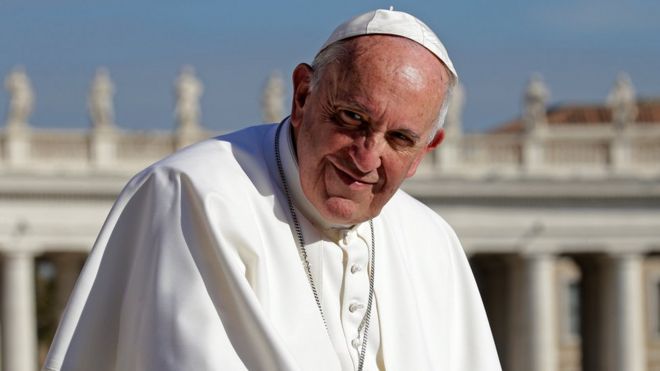
Pope Francis will be the first pontiff to visit Ireland since John Paul II in 1979
By Mark SimpsonBBC News NI
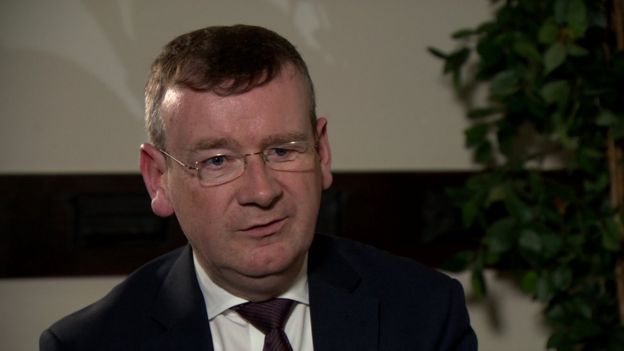
Pope Francis may signal on his visit to Dublin next month that he is considering a separate visit to Northern Ireland, according to a former British Ambassador to the Vatican.
Francis Campbell, who helped to organise Pope Benedict’s trip to the UK in 2010, said a papal visit to Northern Ireland could happen in 2019.
The Pope is due visit to Ireland in August.
There are no plans for him to travel across the border.
Mr Campbell said: “With Pope Francis, I would never rule out the spontaneous. Much to the regret of a diplomat, he is a Pope who is very difficult to predict.
“However I think that on this occasion, I think it will be a visit that will be confined to the south and the World Meeting of Families.
“But I think, I would be hopeful, that perhaps there will be some words in the context of his visit that might signal a very strong desire or willingness on the part of Pope Francis to visit Northern Ireland at some point in the very near future.
“Remember we are dealing with someone who is quite advanced in age.
“I think if Pope Francis wishes to come north of the border and wishes to do a visit to Northern Ireland, then one has to think in terms of a timescale of 12 or 18 months.”
Pope Francis is 81 years old. The last pontiff to visit the Republic of Ireland was Pope John Paul II.
He drew crowds of over 2.5m – more than half the state’s population – in 1979.
‘Abuse’
Mr Campbell, who is vice chancellor at St Mary’s University, London, said Pope Francis’ visit is likely to be very different.
“He knows the country somewhat, but on another level he’s coming from Latin America, he is not a European like his predecessor, so in a sense this is a visit that is very difficult to type-cast,” he said.
Mr Campbell said also it is “inevitable” that Pope Francis will address the issue of sex abuse scandals in the Irish Catholic church.
“It will be an opportunity for Pope Francis to say something directly, not only to the people who identity as Catholic but to the whole of society about the abuse issue and, I hope, to actually be able to give some healing in relation to that as well.”
Francis Campbell was British Ambassador to the Holy See from 2005 to 2011
‘Refugees and migrants’
Mr Campbell said the Vatican will be choosing their words carefully during the two-day visit.
“How do you tackle the negative aspects, for example, that have been thrown up by the abuse but how do you also remind a society of the deeper meaning in life, that it’s not simply about economic wealth?
“That’s what I’ll be listening for when Pope Francis comes.
“Pope Francis is someone who is critiquing society, in particular western society, reminding western society about those that are marginalised and forgotten.
“People who are homeless, people without health care. Refugees and migrants coming in.
“And I think there will be some challenge or some call, perhaps, to wider Irish society not just to focus on the material, but to focus on something of the soul of the nation, and asking people difficult questions.”
Ireland since 1979
Mr Campbell said the Vatican would also be looking at the “huge social change” that has taken place in Ireland.
“And the question is – where does faith and where does the Church and where does society find an accommodation around that?
“These are fundamental questions and they’re not the same questions that would have occurred in 1979,” he said.