The British government has provoked anger after it said Irish citizens born in the north of Ireland cannot vote in a unity border poll or any other referendum under British law, and cannot have the same rights as other EU citizens.
Direct Ruler Karen Bradley blankly told the London parliament this week that Irish citizens living in the North of Ireland could not vote in any referendum.
Under current British legislation, voting rights of Irish and British people living in each other’s jurisdiction are reciprocal. Bradley claimed this only extends to local and parliamentary elections.
Her comments were apparently designed to address continuing confusion over the rights of EU citizens living in British jurisdiction, but only served to increase it. They followed a statement from the British government’s Home Office that Irish citizens born in the Six Counties will always be considered British, and therefore their rights as EU citizens would not be recognised.
The combination made for a shocking one-two punch to northern nationalists and their perceived status under the 1998 Good Friday Agreement.
Sinn Féin Deputy Leader Michelle O’Neill said: “Once again, the British Secretary of State has betrayed a staggering ignorance of the Good Friday Agreement which guarantees the rights of citizens, whether they identify as Irish, British or both.”
“The agreement clearly recognises ‘that it is for the people of the island of Ireland alone, by agreement between the two parts respectively and without external impediment, to exercise their right of self-determination on the basis of consent, freely and concurrently given, North and South, to bring about a united Ireland’.
“For Karen Bradley to suggest that Irish citizens would not be entitled to vote in a unity referendum is patently ridiculous.”
Ms O’Neill pointed out that thousands of Irish citizens voted in the Brexit referendum in the North, in 2016.
“Is she now saying that they did so illegally?” asked Ms O’Neill. “Her comments may be laughable but they are also typical of a wider disdain within her government for the Good Friday Agreement and the protections contained within it.
“At every stage of the Brexit process, they have sought to undermine the Good Friday Agreement and have recently declared their intention to treat everyone in the North as British citizens.
“That is entirely unacceptable. The British Government cannot and will not be allowed to redefine Irish citizenship or rewrite the Good Friday Agreement.”
Deputy Director of the Committee on the Administration of Justice Daniel Holder said: “The lack of any understanding of the GFA among the current government is getting beyond a joke.”
He said that the changes are not only incompatible with the Good Friday Agreement, but also Theresa May’s own Withdrawal Agreement with the EU>
This week’s statements have increased concerns that the weakened hull of the Good Friday Agreement will not withstand the pressures being exerted by Brexit. The political crisis is exposing the London government’s failure to take the GFA seriously, a legal expert has said.
Colin Harvey, a Queen’s University Belfast law professor, said that Irish citizens who are also considered British citizens will not be entitled to EU “settled status” after Brexit, and therefore could lose the right to be considered an EU citizen.
“There is little evidence thus far, including in the latest immigration rules, that the birthright provisions of the Good Friday agreement are being taken seriously,” said Prof Harvey.
“These latest rules confirm what we already know about the implementation gap that predates Brexit, but that Brexit is exposing.”
Emma DeSouza, a County Derry woman and Irish citizen fighting a labyrinthine appeals process for residency for her US-born husband, has argued that British citizenship is being imposed on the people of the north of Ireland.
She says they two tiers of Irish citizens are being created, those who can retain their EU rights and those who cannot. She questioned how London could justify opening the ‘settled status’ scheme for EU citizens differentially to Irish people based on their birthplace [south or north of the border].
“To me, that is the definition of second-class citizenship,” she said. She found it “extremely distressing” to see that she no longer met the definition of EU national, which has been used to deny her the right to live with her husband in the north of Ireland, a matter which is the subject of an ongoing court battle.
Una Boyd, a lawyer at the Committee on the Administration of Justice who previously represented Ms DeSouza, said the change in the definition underpinning eligibility in the EU settlement scheme was “not surprising” but that it was “disappointing”.
“There was an opportunity here for change to ensure the UK government fulfil the commitments under the withdrawal agreement and the Good Friday Agreement,” said Ms Boyd.
In Brussels, Sinn Féin MEP Martina Anderson described it as another “breach” of the Good Friday Agreement due to Brexit.
Ms O’Neill said the crude attempts by London to undermine or redefine the rights of Irish citizens were “reckless” would be rigorously opposed.
“The Good Friday Agreement, and the rights afforded by it, are international obligations,” said said. “They cannot be ignored or set aside.
She urged the Dublin government to defend the rights of Irish citizens as a co-guarantor of the peace deal. “This is not the first time London has sought to undermine the Good Friday Agreement to suit its own needs.”
Forty-five years ago, three men and one woman became mired in a notorious miscarriage of justice that continues to tarnish the name of British justice.
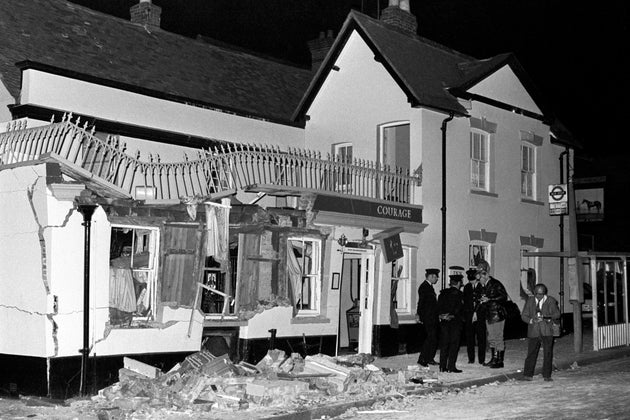
In January this year, it was announced that the inquest into the 1974 Guildford Pub bombings that killed five people would be resumed.
The inquest had been suspended in 1975. At the time there wasn’t any question over who was guilty of the bombings. Three Irishmen, Gerry Conlon, Paul Hill and Gerry Armstrong, and Gerry’s English girlfriend, Carole Richardson, all signed confessions stating they carried out the attacks.
For many of the public, and for the judge who presided over their trial, the only contentious issue was that the three men could not be hanged for their crimes.
In 1974, the IRA’s bombing campaign in mainland Britain was causing panic. The people and the press were angry. There were repeated calls, inside and outside parliament, for the return of capital punishment.
Irish people in England hid their accents in public; they were spat at in the streets, beaten up outside pubs. There were attacks on Irish homes.
A panicked Labour Home Secretary, Roy Jenkins, introduced the temporary Prevention of Terrorism Act which allowed police to hold suspects without charge for a week.
The first man held under the new powers was a young Belfast lad called Paul Michael Hill.
Paul had come to London to pick up casual work and escape the Troubles back home.
After a week in the cells of Guildford Police Station, he had confessed to his part in eight murders and three pub bombings and he implicated every person he knew in London.
Paul remembers his rationale back in the interrogation room. His confession and the list of people he implicated were so ridiculous and absurd the police would soon dismiss it.
Instead, his testimony set a ball rolling that would led to more arrests, more interrogations and more confessions that would decimate the lives of the other members of the Guildford Four.
The confessions Paul and the others signed had been beaten out of them. Paul underwent mock executions, was beaten and thrown down metal stairs along with sleep, water and food deprivation and threats made against his family and his pregnant girlfriend.
Evidence that would have helped clear the suspects, including forensic data and witnesses who could provide alibis when the bombs went planted, was not revealed at the original trial.
Equally compelling was the 1977 trial of the so-called Balcombe Street gang, genuine IRA bombers who confessed in court to carrying out the bombings. They exonerated the Guildford Four.
Despite all this it would take 15 years and a lengthy, frustrating campaign that garnered support from former Law Lords and Home Secretaries, including Roy Jenkins, US Senators, Archbishops and even Soviet leader Michael Gorbachev, before the Four had their convictions quashed and they were released.
Paul Hill sent letters to his family across those stolen years. The letters are, at turns, poignant, angry, philosophical and funny, but always articulate and filled with the rage of an unjustly accused man.
After his release, Paul donated the letters to the Irish archive of the London Metropolitan University.
When I contacted Paul, who now lives quietly in Washington DC, to ask permission to use them he told me what he hoped people would learn from the letters.
“I took some comfort from the thought that at least my misfortune would lessen the possibility of it happening to others.
“It would appear that nothing has been gleaned from the many miscarriages of justice, especially those with political overtones.
“We live in an age in which you can disappear into a black hole, be held without charge indefinitely and be subject to torture, whilst Ivy League educated politicians play verbal gymnastics with the meaning of the word.”
It feels like Paul is right.
The Guildford Four, Maguire Seven, Birmingham Six. These notorious miscarriages of justice are a stain on the name of British justice.
They occurred because the authorities, fearing to the mob in the streets, withheld basic tenets of our criminal system to suspects and turned a blind eye to police brutality and torture.
Today, there’s a President in the White House who repeatedly praises torture.
Closer to home, we see a UK and Europe where an ugly strain of angry, popularist politics is on the rise, and a climate of nationalist swagger and intolerance are becoming increasingly normalised.
The mob are being listened to again.
Fifteen is a short film that tells the story of the Guildford Four and has been selected to be part of the Belfast Film Festival, which runs from 11 to 20 April.
WTC Retired Firefighter Kevin E. Lennon Ladder Company 175
WAKE Monday, April 8, 20192:00 PM – 4:00 PM and 7:00 PM – 9:00 PM Brueggemann Funeral Home of East Northport522 Larkfield Road East Northport, NY 11731
FUNERAL Tuesday, April 9, 11:00 AM St. Francis of Assisi Church
29 Clay Pitts Road Greenlawn, NY 11740
All Off-Duty Members should attend in Class A Uniform.
I pray that this email finds you well and that this Lent has been a season of grace.
If not, there are still 2 weeks until Holy Week, and it is never too late with the Lord.
This email is meant to cover a few things in regards to being your chairman of these two committees.
I wish to begin with Pro-Life.
We have seen over the past several months, since the beginning of the new year, an abhorrent increase in the attack on life.
The legislation signed into law by the so-called Catholic governor of New York and the attempted legislation in Virginia, as well as laws that were quietly, might one say secretly, passed in states like New Jersey, have put at risk even
more babies’ lives.
This new wave of attack allowing the killing of children in the third trimester of a woman’s pregnancy should sicken us all.
But if one is still unmoved, the willingness to allow a child to die outside the mother’s womb following an attempted abortion is abominable.
In the state of Florida at this current time, our laws are more respectful of life. However, until abortion is no more, we have work to be done.
And we always need to remember the following saying from Sir Edmund Burke.
And although I am not a man who cares to go around quoting members of the British parliament, Burke had several incredible things to say.
He stated in a letter the following: “The only thing necessary for the triumph of evil is for good men to do nothing.”
So I encourage you to make sure you reach out to our representatives and senators.
For those who are registered in Florida, the following is a resource from the Florida Catholic Bishops;
On this site, you are able to reach out to your elected officials and communicate with them your desire to make sure that our state does not embrace the culture of death that these other legislatures have in these terrible laws.
For those who are part-time residents and are registered in other states, there should be resources from the Catholic Bishops of your state for you to use.
If you have a specific question about another state, I would be happy to try and find information for you. Just email me your request.
Also a new movie came out highlighting the activities of Planned Parenthood and their abortion mills.
It is called Unplanned. I would encourage each division to look at organizing a movie activity in their parishes and to attend this movie as a group.
It is not only educational but it will change hearts. And unless it is supported by Pro-lifers like us, other truthful movies about the effects of abortion might not be made.
We need the Truth about the sanctity of all human life and the horrible threats that are in our world to get out and be understood.
Now for Catholic Action, here is just a simple insight regarding the week before Easter, that might become for you one of the most extraordinary weeks of your life.
Our Church provides so many wonderful opportunities for us, her children, to grow in grace. One of the most wonderful is the fact that our Church Year, what we call the Liturgical Year, has seasons. The seasons mark not only the passage
of time, as our secular seasons of Winter, Spring, Summer and Fall do, but they reflect the Paschal Mystery. The week that falls between Palm Sunday and Easter Sunday is a transition time between the two seasons of Lent and Easter, and it is the Holiest of
Weeks – hence its name Holy Week.
This week makes present to Catholics in a most profound way the reality of the Paschal Mystery: Jesus’ Life, Death and Resurrection. We are invited to participate in liturgies, the public worship of the Church, more profoundly with devotion
that focuses on each of the steps our Savior took to Calvary. We share in His joyous entry into the Holy City of Jerusalem by waving branches and proclaiming Hosanna in the Highest. On Holy Thursday we celebrate the institution of the Eucharist at the Mass
of the Last Supper and also the institution of the ministerial Priesthood. As Christ washed the feet of His disciples, the foundation of a priesthood of service was confirmed and it is remembered by the Priest-Celebrant’s actions of love, mirroring our Lord.
During Good Friday we cry out for Jesus’ blood as we joined the angry crowds before Pilate.
Beside Mary Magdalen and the faithful women who ministered to Jesus, we sit outside the tomb as the Tabernacle is emptied and the Eucharistic Presence of Christ is removed. We wait in hope for a New Dawn. And finally, on Saturday at the
Easter Vigil, we gathered in darkness and began our worship by sharing in the story of Salvation History told through readings of the Old Testament and the igniting of the Easter Fire.
This holy light signals the fulfillment of all of God’s prophesies. The night is set ablaze and the Light of Christ is manifested once more through the illumination of the Easter Fire and the hearts of the faithful.
Holy Week is a time to embrace our faith more fully: in our families, in our churches, in our divisions. We are an Easter People. Death has no victory over us. We live in Christ and so we face our crosses, but we also know we have the promise
of eternal life. I encourage and challenge you to not let this Holy Week pass without partaking in the liturgies of the Triduum. Do not go simply from Palm Sunday to Easter Sunday without the Grace of Holy Week. You will cheat yourself of an experience that
might transform your very faith.
God Bless and Keep You,
Fr Timothy…
Chairman Florida State Board – Catholic Action / Pro-Life
Reverend Timothy J Harris, T.O.R.
Parochial Vicar –
Our Lady Queen of Martyrs
President – St Finnian of Clonard Division
Ancient Order of Hibernians
“We seem to have lost. We have not lost.
To refuse to fight would have been to lose; to fight is to win.
We have kept faith with the past, and handed on a tradition to the future.”
Padraig Pearse at his court-martial on the day before his execution: May 2, 1916.