Voting has closed in local elections in the Six Counties after a quiet campaign which was overshadowed by non-local issues, mainly the crisis over Brexit, the political stalemate, and recent rioting in Derry.
The North’s 1.3m eligible voters enjoyed mild weather for polling, and the overall turnout is expected to reach over 50%, slightly down on the last two elections. It would be a smaller drop than had been feared for an election which is being held in isolation this time out.
A financial scandal over the spending of social funds failed to energise politicians or voters in Belfast, which saw turnout figures in the east and south of the city not reach 40% by 9pm. However, reports also suggested a slightly higher turnout in rural areas, as well as in west and north Belfast.
A total of 819 candidates are running for 462 council seats across eleven different council areas, a decrease from the 893 candidates who sought election in 2014.
The Democratic Unionist Party are fielding 172, Sinn Fein 155, the Ulster Unionist Party 117, the SDLP (Social Democratic and Labour Party) 85, and Alliance 84.
Newcomer nationalist/republican party Aontú has 16 candidates in the first electoral test for Peadar Tóibín’s party since he left Sinn Féin last year. There are also six independent republicans in the running.
An informal ‘exit poll’ by a Belfast-based political scientist claimed to have measured an increase in the vote share for the Alliance Party. It also reported a decline for the SDLP, which is contesting the election for the first time on the heels of its recently announced partnership with the 26-County Fianna Fáil party.
Counting begins at 8am tomorrow and will continue through Saturday. The first results are expected to be announced on Friday afternoon.
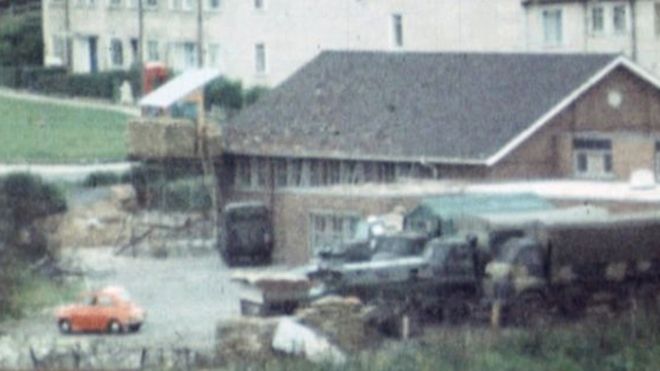
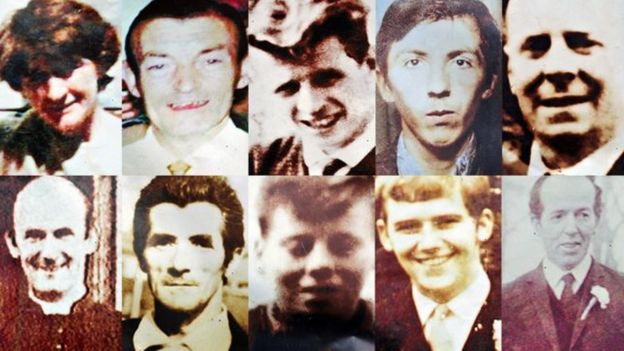
The inquest is looking into the shooting dead of 10 people in the Ballymurphy area of west Belfast in August 1971.
The shootings occurred amid disturbances sparked by the introduction of internment without trial in Northern Ireland.
M572 described shooting at the base coming from the surrounding area, beginning with a burst of four to five rounds from a Thompson submachine gun.
He said thought he saw smoke after that gunfire.
He said he thought Army sentries in sangars outside had returned fire at later shooting, and agreed that they would have been members of his platoon.
He was questioned at length why he did not remember the names of any of his fellow platoon members.
M572 said he had served several tours with many fellow soldiers, and had been new in the platoon at the time.
Later he was able to provide some extra names of soldiers he thought might have been present, to assist the coroner.
Image caption
Ten people were killed in the shootings at Ballymurphy in 1971
Later on 9 August 1971, he said, he went out alongside an armoured vehicle with about 10 soldiers on foot to recover the bodies of civilians lying in the manse area.
M572 said he was acting as lookout, and spent the time watching the surrounding area, without recovering any bodies himself.
He said that later, when back in the Henry Taggart base, he saw the body of a woman placed in a corridor to make room for casualties in the medical room.
‘Ashamed?’
Later M572 said he had suffered from PTSD after leaving the Army and had cut off all contacts with former colleagues and “tried to bury things”.
A barrister for the family of Joseph Murphy asked if the gaps in M572’s memory were because he was ashamed of what happened that night.
“I am not ashamed of anything, I’ve done nothing to be ashamed of,” M572 replied.
The barrister asked if he might be ashamed of what other paratroopers had done.
The former soldier said he did not believe they had, but added: “If they done anything reprehensible, then I would be ashamed.”
M572 added that he was anxious that his memories of several years of tours in Northern Ireland did not overlap and cause him to give false information to the inquest.
Jeffries Introduces Bipartisan Legislation Expediting Creation of Affordable Prescription Medication
The Stop Significant and Time-wasting Abuse Limiting Legitimate Innovation of New Generics (Stop STALLING) Act seeks to curb the abuse of the Food and Drug Administration’s (FDA) petition process while preserving the opportunity to submit legitimate claims raising public health concerns. WASHINGTON – This week, Representative Hakeem Jeffries (NY-08), Chairman of the House Democratic Caucus, Senator Amy Klobuchar (D-MN), Ranking Member of the Senate Judiciary Subcommittee on Antitrust, Competition Policy and Consumer Rights, Senator Chuck Grassley (R-IA), Chairman of the Senate Finance Committee, Representative Jerrold Nadler (NY-10), Chairman of the House Judiciary Committee, Representative Doug Collins (GA-09), Ranking Member of the House Judiciary Committee, Representative Jim Sensenbrenner (WI-05), Ranking Member of the House Judiciary Subcommittee on Antitrust, Commercial and Administrative Law and Representative Peter Welch (VT-01) introduced new bipartisan, bicameral legislation to curb the abuse of the FDA petition process and increase access to affordable prescription drugs. The Stop Significant and Time-wasting Abuse Limiting Legitimate Innovation of New Generics (Stop STALLING) Act would reduce the incentives for branded pharmaceutical companies to interfere with the regulatory approval of generics and biosimilars that would compete with their own products, a tactic that delays patient access to more affordable medications. The bill would also give the Federal Trade Commission (FTC) enhanced authority to take action against those who file sham petitions.
“No one should be forced to make the unthinkable choice between lifesaving prescription drugs and putting food on the table. The Stop STALLING Act aims to drive down the sky-high cost of medicine by expediting access to affordable generic drugs for everyday Americans,” said Jeffries. “Senators Klobuchar and Grassley, along with Representatives Sensenbrenner, Nadler, Collins and Welch should be commended for their leadership in this regard.”
Specifically, the Stop STALLING Act would:
Create an FTC cause of action against sham petitions as unfair methods of competition,
Create a rebuttable legal presumption of illegality for certain petitions referred from the FDA with a finding that they were submitted for the primary purpose of delaying the approval of a drug application, and
Grant the FTC the authority to seek civil penalties for violations.
Although interested parties may file petitions with the FDA in connection with its review of certain drugs, concerns have been raised that pharmaceutical companies file serial petitions or last-minute petitions in attempts to delay generic approval, while imposing significant and unnecessary review costs on the FDA.
U.S. Representative Hakeem Jeffries (NY-08) is the Chair of the House Democratic Caucus. He sits on the Judiciary and Budget Committees and proudly represents New York’s 8th Congressional District, including parts of Brooklyn and Queens in the House of Representatives.
Archive discovery implicates British General Frank Kitson in McGurk’s Bar Bombing cover-up: families demand immediate arrest and questioning.
The McGurk’s Bar families have demanded that an independent police force immediately question British General Sir Frank Kitson under caution following the discovery of a secret British Army Log, which they believe proves that Kitson colluded with the Royal Ulster Constabulary (RUC) and disseminated lies about the McGurk’s Bar victims around 4 hours after the attack.
Author and activist Ciarán MacAirt, a grandson of two of the McGurk’s Bar victims, discovered an entry in a high-level British Military 39 Brigade Operations Log recorded at 1am on 5th December 1971 (Serial 12) which stated:
“RUC have a line that the bomb in the pub was a bomb designed to be used elsewhere, left in the pub to be picked up by Provisional IRA. Bomb went off and was a mistake. RUC press office have a line on it – NI should deal with them”.
Archive proves General Sir Frank Kitson, Brigade Commander (Bde Comd) of Belfast in December 1971, colluded with RUC to disseminate the heinous disinformation about the McGurk’s Bar victims just hours after the attack. This fabricated lie became the pretext of the bombing in the RUC and British Military cover-up when reported to British Government Ministers and the media.
The archive, discovered by MacAirt at the British National Archives in Kew, London, records that the order originated from “Bde Comd” which is the British military abbreviation for “Brigade Commander”. The Brigade Commander of 39 Infantry Brigade at the time was General Sir Frank Kitson, or Brigadier Kitson as he was then.
General Sir Frank Kitson
General Sir Frank Kitson (retired) rose to become Commander-in-Chief United Kingdom Land Forces (1982 – 1985) and Aide-De-Camp General to the British Queen (1983 – 1985).
Kitson is a renowned military author and counter-insurgency expert who oversaw Britain’s deployment, during the conflict in the North of Ireland, of in-depth interrogation techniques (including torture), psychological operations, pseudo-gangs and covert Special Force units like the Military Reaction Force (MRF) which murdered civilians with impunity.
Kitson also overhauled and re-developed the British Army’s information units which managed British information policy, propaganda and disinformation across the North of Ireland.
“This is absolutely critical evidence relating to the genesis of the McGurk’s Bar lie which blamed our loved ones for the massacre and allowed mass-murderers to roam free and murder again. The secret British Army record appears to confirm that General Sir Frank Kitson himself, the architect of gangs and counter-gangs on our streets, colluded with the RUC and disseminated this lie throughout British Army Brigade and Headquarters. This heinous lie was then fed to British Government Ministers and was published in the media, becoming the pretext for the bombing in the RUC cover-up.”
“This archival evidence confirms our long-held suspicion that Kitson colluded with the RUC to cover-up the McGurk’s Bar massacre. We demand that General Sir Frank Kitson is arrested for questioning immediately by an independent police force as the PSNI has deliberately failed to investigate this high-level British Army and RUC conspiracy. The PSNI has proved yet again that it is more interested in covering up for a sectarian police force in the past rather than investigating the McGurk’s Bar Massacre fairly and upholding the basic human rights of citizens murdered, injured and bereaved in the attack.”
Niall Ó’Murchú of Kinnear & Co. Solicitors stated:
“We engaged the PSNI five weeks ago in order to ensure that independent investigators questioned Kitson under caution immediately but, so far, PSNI has failed completely to respond to any of our many requests to deal with this serious matter. Collusion in the aftermath of the McGurk’s Bar massacre has long been established by Ciarán MacAirt’s discovery of many secret British State archives; but this is the very first document which shows that Kitson was personally involved in the atrocity.”
“This new evidence has clearly passed the threshold required to justify Kitson’s immediate questioning under caution. Nevertheless, the PSNI should not be involved with this investigation for two reasons: firstly, as a matter of law, the PSNI is not independent when it comes to investigating legacy cases, following the recent Court of Appeal judgment in the McQuillan case; secondly, the PSNI’s treatment of these families in particular during the last 13 years has been utterly disgraceful and has done little except re-traumatise them and perpetuate the McGurk’s Bar cover-up.”
“We have initiated this legal process because the Chief Constable has thus far failed to refer this matter to independent investigators, or even respond to us in any way.”