An MI5 report on policing compiled at the height of the conflict in the early 1970s must remain secret, a British official has ruled.
The Morton Report, which examined operating practices of the RUC Special Branch police in 1973, is understood to contain details of illegal activities which were recommended for use by the RUC as a “counter-insurgency” strategy.
The decision appears to confirm the importance of MI5 officer Jack Morton and his report in laying the groundwork for the Special Branch’s Dirty War.
A year after the report was issued, loyalist paramilitaries acting in collusion with Special Branch and other British forces killed 33 people and an unborn child in a series of terror attacks against nationalist civilians across Dublin and Monaghan. It was the deadliest attack of the conflict.
Britain’s Information Commissioner said the report was instigated by the head of MI5, Michael Hanley, who suggested to then RUC Chief Constable Graham Shillington that a senior ‘Security Service’ officer conduct a review of Special Branch in June 1973.
The officer chosen was Jack Morton, once a former colonial police chief in India who eventually rose to become a high-ranking figure in British military intelligence.
Over 20 academics from Britain and Ireland have called for the Morton Report to be made available for their research, but to no avail. The Information Commissioner, Elizabeth Denham, declared the report should stay secret because it was supplied by MI5, without any further justification.
Reacting to the decision, Daniel Holder, deputy director of the Committee for the Administration of Jutice (CAJ) said: “It is difficult to conceive how the 1973 Morton report can’t be released by the PSNI for national security reasons when the PSNI did – eventually – release most of the 1980 Walker Report to CAJ in a similar case.
The Walker Report notoriously advised the RUC to maintain paid informers instead of prosecuting them for any offences they had committed, including murder.
“Both relate to the structures of RUC Special Branch, and both were authored by MI5 officers,” Mr Holder said, adding that such reports “reveal wrongdoing by the state.”
Mr Holder said that the public has a right to know about the past. “The application of blanket national security vetoes over historic information is not human rights compliant,” he warned. “Particularly when the documents in question may contain evidence of past security policies and practices that involved or facilitated human rights violations.”
He said the Morton report should be disclosed to prevent “a repetition of past practices that fuelled conflict.”
Sinn Féin’s European election candidate in the Six Counties, Martina Anderson, clashed with hardline unionist Jim Allister on live television as campaigning for the European elections to be held across Ireland reached a climax.
Ms Anderson appeared on UTV’s politics programme ‘The View from Stormont’ with five other European election candidates standing in the North: Diane Dodds (DUP), Naomi Long (Alliance Party), Danny Kennedy (UUP), Colum Eastwood (SDLP) and Jim Allister (TUV).
Ms Anderson reminded Allister, whose party lost half of its elected councillors in local elections earlier this month, that the North of Ireland voted clearly against Brexit in the 2016 referendum.
But Allister reacted angrily, waving his hand up towards Ms Anderson’s face. “Don’t you talk to me about democracy – you set out with the bomb and the bullet,” he said. “You are a vicious bomber.”
“I think Jim needs some manners,” said Ms Anderson, before raising her hand in a ‘body space’ gesture. “That’s twice Jim and I am going to ask Jim, who is sitting beside me, to please have a little bit of manners because you are in my face – no more!”
Thursday’s election to the European election will be closely watched to see how Brexit politics has altered the traditional nationalist/unionist split in the three-seat northern constituency.
A slight demographic shift since the last election in 2014 could improve the prospect of a historic change from two unionist seats to two nationalists. That could happen if Martina Anderson retains her seat and SDLP leader Colum Eastwood wins enough first preferences to avoid being eliminated before the moderate unionist (and anti-Brexit) Alliance Party, who are also competing for the third seat against the Ulster Unionist Party.
The stakes are high for both Irish unity and peace — the election of two nationalists to one unionist would make the demand for a border poll on reunification, a key element of the 1998 Good Friday Agreement, irrefutable. That in turn could potentially bring about an end to the armed actions of breakaway IRA groups.
Sinn Féin leader Mary Lou McDonald called for Martina Anderson to be given the number one preference, before transferring to “pro-remain, progressive candidates”.
“Brexit changes everything for all of us, and it’s for that reason that we identify this as maybe a unique and unifying moment of solidarity for people who want what is best for all of us right across Ireland,” she said.
The SDLP parked their ‘battle bus’ symbolically on the Derry/Donegal border on Wednesday as they launched their campaign to “take back [former SDLP leader] John Hume’s seat in the European Parliament and deliver a second pro-Europe MEP”.
Colum Eastwood was joined by Fianna Fáil TD, Charlie McConalogue, a sign that the two parties are still on course for a future coalition.
“This is a critical election,” said Eastwood. “For three years, the voice of the pro-Europe majority in northern Ireland has been silenced, sidelined and ignored. That ends here and it ends now. This campaign is an opportunity to reassert our demand to remain in the European Union.
“The European Union is proof that the simplest of ideas are always the most powerful. After centuries of division and conflict, people across Europe made a lasting choice. We decided that bridges work so much better than borders.”
Also contesting the Six County Euro election on Thursday May 23 are Claire Bailey of the Green party, Tory candidate Amandeep Singh Bhogal, UKIP’s Robert Hill, and Independents Jane Morrice and Neil McCann. European parliament elections also take place in the 26 Counties on the following day.
Coverage of these, as well as the 26 County local elections also being held on Friday, will begin here beginning on Thursday evening, with full news of all the results as they emerge over the weekend.
McGOVERN-THOMPSON LAUNCH GROUNDBREAKING BOOK ON BRITISH COLLUSION IN AMERICAN TOUR
A groundbreaking new book shows Britain armed, directed, paid and protected loyalist agents to carry out murders in Tyrone and Derry, then denied blame. Professor Mark McGovern, joined by Mark Thompson of Relatives for Justice, will begin a seven state American launch of COLLUSION COUNTERINSURGENCY in NORTHERN IRELAND, on June 2nd.They will present shocking new findings in public events and Congressional meetings in a tour organized by the Ancient Order of Hibernians and Relatives for Justice, but now supported by a growing list of Irish-American groups. AT STAKE A central claim used by British officials to justify their campaign during the Troubles is the statistic that crown forces were only responsible for 10% of the north’s killings. This figure, compiled decades ago, accounts for only those directly killed by British troopers or the Royal Ulster Constabulary. The number gets cited to claim the British played an impartial role in a sectarian war between nationalists and unionists. It is also used to claim that legacy investigations of killings should be artificially limited to a 10% fraction of conflict related inquiries.
Meanwhile nationalists in Tyrone, south Derry and across the north saw a pattern of murders committed with hallmarks of deep British state force collusion. Loyalist killers traveled freely in heavily patrolled areas where nationalists could not move without being stopped. Crown patrols often spiked hours before murders then vanished. Covert camera surveillance was disabled. Loyalists had precise intelligence of the sort only available to British forces, from searches of locations. HALLMARKS Mark McGovern, Professor of Sociology at Edge Hill University in England, studied dozens of these killings in Tyrone and South Derry, applying academic research standards. Helped by Mark Thompson and Relatives for Justice, Professor McGovern combined original eyewitness accounts, and unpublished materials, with court transcripts and British military studies to put together a shocking new look at British collusion. His findings raises questions on hundreds of murders that were attributed to loyalists, but may have been carried out as part of an overall British strategy.
Anyone familiar with any loyalist murders in Tyrone or South Derry during the late 1980s and early 1990s will find new facts detailed here. There is even new information about the murder of my own close friend, American citizen and Bronx resident Liam Ryan.
Professor McGovern and Mark Thompson will appear at a series of not to be missed events, that will include New York City, Philadelphia, Washington DC, Rutherford New Jersey, Boston, Newport, Rhode Island, Fairfield, Connecticut and Albany. They will reveal startling new facts and personally signed books will be available for purchase.
AOH Freedom for All Ireland Chair Martin Galvin added:
“The British deny using loyalist criminals to commit murders. Again and again victims’ families asked how else could low level loyalist killers get away with so many murders? How could criminals get through heavily patrolled areas undetected and undetectable? How did they turn off cameras, wipe tapes, and make British patrols vanish, unless these loyalist criminals were backed by planning, approval, and direction at a high level within the British military and constabulary? Victims’ families deserve to have the shocking truth told. The AOH is proud to help bring that truth to Americans who need to hear it.” SCHEDULE They will premiere in Philadelphia on Sunday June 2nd at the MacSwiney Club,510 Greenwood Avenue, Jenkintown Philadelphia, beginning at 1:30pm,organized by Gerry McHale and Pearse Kerr.(267-767-7854).This venue was specifically chosen in memory of Liam Ryan, the former Clan na Gael member, whose murder is one of those investigated in the book, and who attended events there . On Tuesday June 3rd. Professor McGovern and Mark Thompson will be in New York City for an event at O’Lunneys Time Square, 145 West 45th street starting at 7pm. They travel to Washington DC for a series of key Congressional briefings on Wednesday June 4th and Thursday June 5th and are arranging an event at the prestigious National Press Club. Malachy McAllister’s case will also be highlighted during these briefings. On Thursday June 6th,they will appear in Rutherford, New Jersey at an event now being organized by Malachy McAllister. Professor McGovern and Mark Thompson will speak on Friday ,June 7th at the Watertown AOH Hall, 151 Watertown Street, near Boston, organized by Jack Lahey-(603-560–8192)and starting at 7pm. They go to the Newport Rhode Island AOH Hall, from 1pm to 3pm on Saturday, June 9th organized by Kevin Doyle.(401-641-8183) On Sunday June 9th,Bridgeport AOH will hold an event at the Gaelic American Club, 74 Beech Road in Fairfield, Connecticut starting at 2pm. They will finish in Albany with a Monday evening June 10th event at the Irish American Heritage Museum,370 Broadway, at 7pm before meeting Irish American Legislators on Tuesday morning at the State Capitol.
Northern Ireland has “had a political process at the cost of a peace process”, believes Clare Bailey MLA, the leader of the Green Party in Northern Ireland. She is highly critical of the limited progress since the Good Friday Agreement 21 years ago and the lack of real social integration. She was speaking in the latest Forward Together podcast.
Clare questions who has benefited since the signing of the Good Friday Agreement. “Certainly within the working class and the most deprived areas in Northern Ireland and those communities – they certainly haven’t seen a pay-off,” she argues. Clare references the lack of government, squeezed budgets, welfare reform, “soaring levels of poverty” and “more people dying by suicide since the signing of the Good Friday agreement than were ever killed in the troubles. We have intergenerational trauma.”
She lists her frustrations with lack of progress. “We have more peace walls in Northern Ireland now than we did during the conflict. Our education system hasn’t moved on. Back in 1981, I was one of the first 28 pupils to attend Lagan [integrated] College when it first opened. There were protests at the door of the school. Our buses were smashed and we were identified by our uniforms…. But yet here we are almost 38 years later with only 65 of our schools both primary and post primary that are under the integrated banner…. Over the past 20 years I’ve seen little attempt at integration.”
Clare adds that it is wrong to believe that we should wait for politics and the economy to improve before civic society is strengthened. “We need to hear a civic voice,” she urges, adding that “citizens’ assemblies [are] an excellent model to start engaging with.”
She makes clear her frustration with elements of mainstream British and Northern Irish politics. “We have hardline Brexiteers who are pushing for a no deal Brexit and openly admitting that they’d never even read the Good Friday Agreement. And nationalist parties whose raison d’être has always been about a united Ireland, they’ve reached this point and [they are] still not willing to put their ideas on the table of what that is.”
This context, she suggests, is dangerous. “We are still a deeply traumatised society. It doesn’t take much to just scratch those open wounds. People are still living with fear and it’s getting worse because we’re not dealing with it.”
As far as Clare is concerned, the Assembly – when functioning – is itself an expression of sectarian division. “I have to designate myself as either a nationalist or a unionist. And if I don’t agree with either, or don’t identify as either, I’m automatically designated as ‘an other’. I designated myself as a feminist when I was first elected and the computer does not compute. So I am automatically an ‘other’. So therefore my ‘other’ vote in some Assembly debates is lesser than that of a nationalist or a unionist. And it’s in those types of situations I mean by saying sectarianism has been written into the heart of the institutions.”
For the future, the challenge of climate change is the most important issue. “If we want a united Ireland, we need to talk about transformation and we need to be in no doubt whatsoever that a new Ireland is coming. And she’s on her way and she’s called climate chaos. We’ve been given 12 years to the point of no return from the Intergovernmental Panel on Climate Change – when, if we do not radically change our lifestyles, our behaviours, then the damage that will be done will be irreparable. So we will be forced into renegotiating who we are on this island. How do we get along. What our relationships are. But more importantly, how we do business together. So I am in no doubt that a new Ireland is coming, but I don’t believe that it’s the one many people are thinking of.”
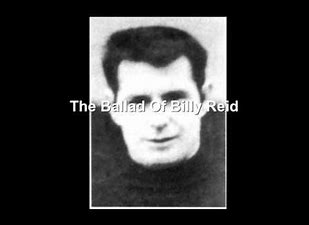
I’ll sing You a song of a terrible wrong When the flag it flew at half mast When a man he lay dead was riddled with led And he died on the streets of Belfast Oh, the Radio said was another shot dead And he died with a gun in his hand But they didn’t say why Billy Reid had to die For he died to free Ireland
It happend one day when the bold I.R.A. Went out to fight for their land With an old Thompson gun, put the troops on the run To return to their home was their plan Oh, the Radio said was another shot dead And he died with a gun in his hand But they didn’t say why Billy Reid had to die For he died to free Ireland
While retuning the guns Billy met British huns And when the fight was begun His poosition was dire and the gun wouldn’t fire And he died with that old Thompson gun Oh, the Radio said was another shot dead And he died with a gun in his hand But they didn’t say why Billy Reid had to die For he died to free Ireland
Although he lay dead he was kicked in the head By the heir they dragged him around But they still fear him yet the will never forget How brave Billy Reid stood his ground Oh, the Radio said was another shot dead And he died with a gun in his hand But they didn’t say why Billy Reid had to die For he died to free Ireland
If you think he was right come and join in the fight And help to free Belfast For the blood Billy shed although he lies dead In our hearts his memory will last Oh, the Radio said was another shot dead And he died with a gun in his hand But they didn’t say why Billy Reid had to die For he died to free Ireland Oh, the Radio said was another shot dead And he died with a gun in his hand But they didn’t say why Billy Reid had to die For he died to free Ireland