The following is a piece by Saoradh National Executive member Dee Fennell following an interview with BBC Spotlight. British Crown Forces have been proven complicit in the mass murder at Loughinisland after they attempted to silence two investigative journalists who exposed collusion between the RUC/PSNI and a Loyalist Death Squad, however there are those in the media who hang on their every press release as gospel and base their journalism on this basis without interrogating or investigating the Crown Force propaganda, Crown Forces are Britain’s hard power in Ireland but there are many manifestations of soft power and a complicit unquestioning media is one of those, in a way they are complicit in the RUC/PSNI attacks on the “freedom of the press” Last week I was interviewed by BBC’s Spotlight for a programme to be broadcast next week. In the course of that interview several serious allegations were made against myself, other Saoradh members and the party in general. This is water off a duck’s back of course, and we are thankful that we made our own full recording of the interview that is at our disposal, and can put any edited comments in their full context should that be required. However the rationale for much of these allegations was “the police believe”, “the police allege”, “the police have told us”, “the police have made a number of arrests”. The implication being that “the police” are trustworthy and to be believed. So ahead of that programme and the nonsense it will no doubt churn out, I would like to share this quote from Belfast High Court yesterday where, ironically, two journalistic colleagues of those working on Spotlight took a case against the PSNI/RUC. This was regarding their arrests and PSNI raids on their homes. This was after they exposed those responsible for the Loughinisland Massacre in a critically-acclaimed documentary. The militiaman responsible for their arrests explained that he did so because those named in the documentary had their lives “put in danger for merely having the misfortune of being involved in terrorist atrocities at whatever level”. It is worth noting that none of those named has been charged, or even arrested as the two journalists have been. That isn’t “legacy”. That isn’t “the bad old days”. That is yesterday. 2019. And it perfectly demonstrates the bias and attitude of an organisation that still seeks to protect loyalists responsible for sectarian slaughter, rather than assist families seeking the truth. After this, and recent revelations regarding their Ormeau Road Bookmakers “investigation” and refusal to disclose all information, how can anyone trust anything they say? Remember that when watching next week’s Spotlight. And have a big pinch of salt handy.
Several thousand people attended the west Belfast funeral of leading
republican socialist ‘Marty Mac’ Martin McElkerney on Wednesday. A
former PoW, Mr McElkerney was closely involved in the IRSP’s peace
strategy after being released from Long Kesh prison in 2000 under the
terms of the Good Friday Agreement.
On Monday evening a masked man fired two single shots, followed by a
volley, into the air from an automatic rifle as the remains of Mr
McElkerney were returned to his home in the Divis area of Belfast.
A guard of honour of up to 100 was also formed in the street outside his
home in an impressive display of solidarity by the Republican Socialist
Movement. The mark of respect for a fallen Volunteer was greeted by
cheers and applause by crowds in Ross Street in the Divis area of west
Belfast.
At the funeral a colour party flanked the cortège of the former leading
figure in the Irish National Liberation Army (INLA) as he was laid to
rest, some of whom were masked. After Requiem Mass the coffin, draped in
a starry plough flag with a beret and gloves on top and flanked by
former INLA comrades, it made its way the three miles from Albert Street
to Milltown cemetery.
The cortege stopped several times, including outside Costello House, the
Falls Road headquarters of the Irish Republican Socialist Party (IRSP)
with whom McElkerney played a senior role right up until his death.
Among the mourners were representatives of most republican political
groups. Sinn Féin’s Gerry Kelly, who is a brother-in-law of the
deceased, attended the funeral and was joined by party colleague Carál
Ní Chuilín.
The PSNI provocatively filmed the procession while a British military
spotter plane circled overhead throughout the funeral. As the cortege
reached Milltown a piper played music before members of the IRSP
gathered for a short oration at the INLA plot.
Among those to address the crowd was Strabane republican Willie
Gallagher. He criticised media coverage of his friend’s death, saying
that he was surrounded by family and friends. He also called for more
support for those struggling with post-traumatic disorder in a society
transitioning out of conflict.
He said McElkerney had been willing to take on any task and “despite
medical difficulties at that time, stepped forward and helped bring
closure to the Ruddy family – ending a sad chapter for us all”. He was
referring to the task of locating the remains of Seamus Ruddy, from
Newry, which were found in northern France in May 2017.
In a brief statement, the IRSM paid tribute to those who attended the
“final farewell” to Martin McElkerney. “‘You were the calm in the storm,
a person held in high esteem by all, a person of wisdom and reason, you
were a leader’. You will be forever missed. Farewell friend and
comrade.”
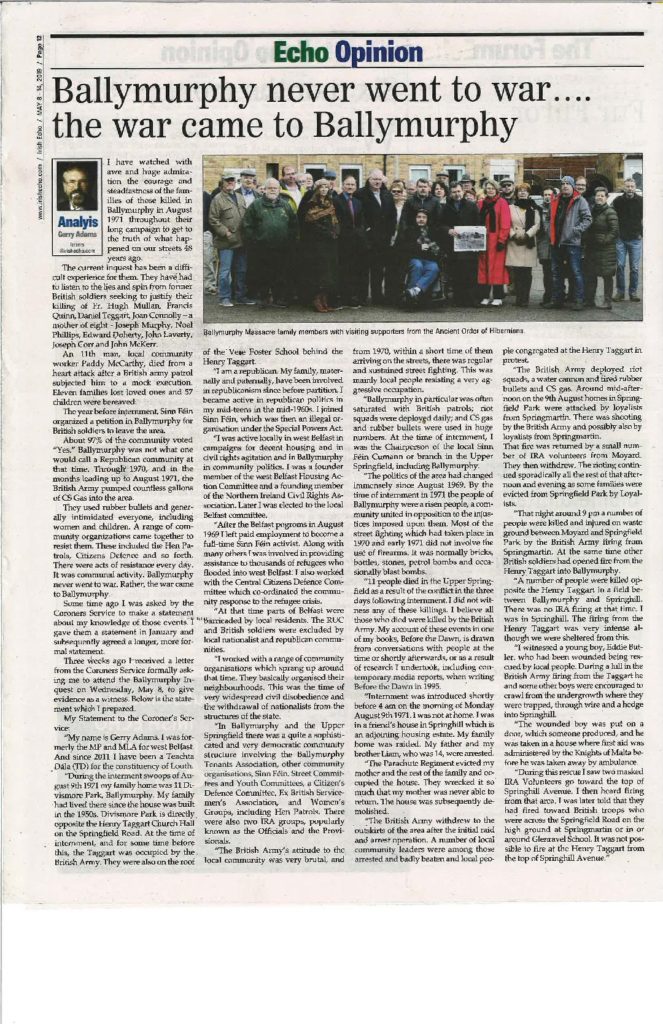
Roy Greenslade is both a supporter of Sinn Fein and writing in the Guardian, a fair minded and expert critic of his old profession. I mention this to anticipate an irrelevant smear. On the reporting of the Ballymurphy inquest, he’s absolutely right. A story that matches in horror the Birmingham pub bombs or the abuses in cause celebres such as Hillsborough or the murder of Stephen Lawrence is largely ignored because the initials “IRA” are involved. The old reflex is back at work ; they fear IRA propaganda. You think they would have learned something from the long saga of Bloody Sunday.
For the inquest into the deaths of 10 people shot by British paratroopers in 1971, later known as the “Ballymurphy massacre”, has been under-reported by London-based mainstream media since it began more than five months ago.
But the failure of newspapers and news broadcasters to report on what was said by two former soldiers who served in Northern Ireland at the time of the deaths, was a breathtaking omission
Contrast this failure to report with the space given to politicians, such as Tory MPs Penny Mordaunt and Johnny Mercer, and former army chiefs, such as Lord Dannatt and Sir Mike Jackson, when protesting against the historical prosecution of British servicemen. Their views were headlined while the Ballymurphy inquest evidence has been all but buried.
In fairness, as with all long-running inquiries, it is expensive to staff the press bench day after day. However, the Press Association has been providing a service, enabling editors to receive copy on a regular basis, and BBC online has reported all the key evidence.
The Irish News has carried almost 70 pages about the inquest and its editor, Noel Doran, argues that “significant new information has emerged over the course of the inquest.” He says: “Senior officers have spoken for the first time about the incidents, and they’ve been cross-examined, too. New facts have come to light.”
Sinn Féin leader Mary Lou McDonald has conceded that her party will
suffer some losses in the 26 County local elections, but she said: ‘Beidh lá eile
againn’ [We will have another day].
Arriving at the count centre in Dublin’s RDS this evening she said Sinn
Féin benefited from a surge in support in 2014, but that they will not
retain all of these. She said the surge this year had gone to the Green
Party.
“I am not sure where we are going to land but I know that we will have a
lot of counting and some long nights ahead of us,” she said.
But Ms McDonald added: “Sinn Féin aren’t cry babies, we dust ourselves
down and we get back at it because that’s what political activism is all
about.
“Some days the day is yours and the tide is in and some days are more
challenging and the challenge for any political organisation is to be
able to manage and to navigate your way through either scenario, you
have to have all-weather politics.”
Tallies are predicting that Sinn Féin – who tripled their numbers in the
last local elections – will lose a number of these seats.
In Dublin their party vote is roughly half of what they received in
2014, while the party could lose as many as half their seats on Cork
City Council. Much depends on the direction of transfers among the
left-wing candidates, who have all suffered as a result of the ‘Green’s
day’, as McDonald put it.
An exit poll for RTE published showed Sinn Féin will likely poll around
12%, some 3% down on five years ago. The largest decline has been in
urban areas, where a low turnout by working class voters has coincided
with a swing to the Greens.
The same exit poll indicated a significant increase in support for Irish
reunification in the 26 Counties, which should have benefited Sinn Féin.
But some decline in the Sinn Féin vote had been expected following
upheaval within the party over its approach to abortion. Aontú, a new
republican anti-abortion party which formed in the wake of the
controversy, is set to win at least two seats in its first 26 County
election according to early tallies, and possibly up to five.
Ms McDonald said: “I am disappointed for our people who ran and who
served for the last five years and who I know wanted to continue to
serve their communities.”
She said the huge surge in favour of the Greens worked against all
parties, including Sinn Féin but also warned of a disengagement in some
areas.
“There is an issue that we need to address politically in terms of
disengagement from politics generally, particularly in identifiable
parts of Dublin and beyond, so I think it’s a mixture of things,” said
Ms McDonald.
When asked if another poor election result could lead to question marks
over her leadership, she replied: “Leaders are charged with leadership
come what may. So it is easy to lead and be a political activist when
things go your way and the surge is on.
“Those are great days. But you also have to be ready . . . when
things are more challenging.”