August 2019 A chairde: FFAI ISSUES UPDATEA-Boris Johnson threatens Ireland and European Union with “no deal Brexit” unless new deal concessions -After becoming British Prime Minister without any general election, popular mandate or Westminster majority , Boris Johnson began by threatening a no deal Brexit disaster on October 31st, unless the EU renegotiates the Withdrawal Agreement to his liking. He is gambling that the EU will bow to threats and offer major concessions to stop Britain from crashing out of Europe and forcing a hard border across Ireland. Johnson in his first Westminster speech as Prime Minister promised a “golden age”, ushered in by an October 31st withdrawal ” no ifs, no buts”. He said the Withdrawal Agreement negotiated by the British government under Theresa May was something “no country that values its independence and indeed its self-respect could agree” and its terms for the Irish border, a “monstrosity” “unacceptable”, “anti-democratic.” Johnson boasted that his regime was “turbocharging” preparations for a no deal Brexit crash out, if Europe refused to abolish the backstop. He snubbed Irish Taoiseach Leo Varadkar, by not phoning him for six days.(Customarily incoming British Prime Ministers make a courtesy call to the head of the Irish government within a day of taking office).Johnson then clashed with Varadkar, saying the backstop must be abolished. Varadkar replied that the emergency measure was made necessary by British decisions. Ireland’s Tanaiste or Deputy Prime Minister Simon Coveney described Johnson’s strategy as “give me what I want or I will burn the house down for everybody.” He said if Johnson wants to “tear up” the existing Withdrawal Agreement with the EU “we are in trouble” and charged the British Prime Minister with deliberately putting Britain on a “collision course” with Ireland and the European Union. Johnson said he would not meet with French and German leaders unless they agree in advance to “abolish the backstop”. The “backstop” was agreed by Britain and the EU as part of the 599 page Withdrawal Agreement to avoid a disastrous hard border across Ireland. Brexit would make the six counties Europe’s land border with Britain, requiring customs, import and immigration checks. The EU invited the north to remain in the customs union, with customs, immigration controls etc beginning in the Irish sea, (meaning at entry points into England, Scotland or Wales). Brexiteers within the Tory Party, backed the DUP, to veto a “backstop” or safety net that would only begin if a full trade agreement was not reached by the end of 2020.Johnson took over for Theresa May after winning a contest within the Conservative Party. There was no general election and he needs 10 DUP votes for a majority in Westminster. Alliance Party head Naomi Long said “we need a statesman not a showman.” SDLP head Colum Eastwood said “Johnson coasted into Downing Street on a wave of Brexit bluff and bluster”. Michelle O’Neill said Sinn Fein would “engage Johnson on the fact that there is nothing good to come from Brexit”. B-New amnesty moves for British troopers meet Congressional challenge-In the closing days of the contest for Tory Party leadership, Boris Johnson vowed to end “unfair prosecutions” of British troopers for murders committed in the north between 1969-98 with a statute of limitations. (Read ‘unfair” as ‘any’ murder prosecutions of troopers). He quickly created a post of British Army veterans minister and named Johnny Mercer, the most vocal advocate of trooper amnesty at Westminster, to head it. The move would make a mockery of British claims that its troopers and constabulary were not “above the law” or did not act with impunity in the north. Only a handful of British troopers were ever imprisoned for murders like Ballymurphy or Bloody Sunday. There are growing British worries about prosecutions of former troopers, because proceedings like the Ballymurphy Massacre Inquest reveal how British troopers committed brutal murders which were white-washed by the crown. Six Members of Congress joined in a bipartisan letter to Deputy British Ambassador Michael Tatum, citing American concerns about state force amnesty in legacy killings and Britain’s failure to implement agreed legacy mechanisms. The bipartisan Congressional initiative, joined by Representatives Peter King, Eliot Engel, Chris Smith, Brian Fitzpatrick, Nita Lowey and Brendan Boyle. The initiative also follows a recent AOH sponsored tour by Mark Thompson of Relatives For Justice and Edge Hill University Professor Mark McGovern, author of Counterinsurgency and Collusion in Northern Ireland. The British government repeatedly claimed that it was opposed to amnesty for killings by British military, including in a formal letter by then Ambassador Kim Darroch to Members of Congress on May 18,2018.An amnesty in the form of statute of limitations was overwhelmingly opposed by those who responded to the British government Consultation on legacy, announced earlier this month. However this policy was summarily discarded by the new Tory leader. Legacy mechanisms were agreed and published by the British government as part of the Stormont House Agreement of 2014. These mechanisms, which include a Historical Investigations Unit into Troubles killings, have never been implemented. Many nationalists believe that the HIU would bring charges against crown forces for killings or collusion with loyalists in murders.C-Julian Smith, named six countysecretary snubs Derry nationalists-Julian Smith replaced Karen Bradley as Britain’s six county secretary. He was met by Bloody Sunday and Irish language protestors as he arrived in Derry for his first day in the new post. Smith who had been applauded on the stage as a “friend of the party” at the Democratic Unionist Party conference 2017, had been a key figure in keeping the DUP MPs propping up Theresa May. He visited a number of unionist landmarks, including the Apprentice Boys of Derry Siege Museum, the Apprentice Boys Walker’s Monument and the city walls. He avoided nearby nationalist sites such as the Bogside, Museum of Free Derry or Free Derry corner. Smith then said he would speak with all political parties in the north and treat them equally. However he is viewed as the DUP’s choice for the post, carrying out policies set by Boris Johnson who seems willing to sacrifice Irish interest for Westminster political gains. Meanwhile talks to restore the devolved Stormont Assembly, which has not sat since January 2017 continue. There is no agreement on key issues including an Irish Language Act, implementing legacy mechanisms, the Renewable Heat Initiative and social issues. Last year a DUP-Sinn Fein agreement fell apart on Valentine’s Day, when the DUP reneged on a compromise proposal allowing an Irish language Act along the lines of Scotland and Wales.D-Bonfire threats by loyalists force City Council retreat -July is not only marked by triumphal Orange parades across the north but also by hundreds of huge July 11th night bonfires. Many of these bonfires are topped off with posters of nationalists, KAT signs( meaning kill all Catholics), or Irish symbols which are publicly burned to cheers and sectarian songs as part of the celebrations. This year the most sinister example was a bonfire built in the parking lot of a Belfast City Council owned leisure center at Avoniel. When local residents called for the bonfire materials to be removed from the city owned property, a crowd connected to the loyalist Ulster Volunteer Force formed a barricade at the entrance to the parking lot. They made threats to staff and forced the facility to be closed. Belfast City Council made a formal complaint to the PSNI constabulary about “aggravated trespassing” and hired contractors to remove the bonfire materials. The names of the contractors were leaked to loyalists. Threatening graffiti naming the contractors was painted on the walls, with slogans like contractors “attack loyalism at your own risk!” Instead of enforcing the City’s right to remove the materials, constabulary warned there was a risk of “serious violence” using firearms if council workers made any attempt to dismantle the bonfire. Belfast City Council then gave up efforts to remove the bonfire.
AOH BUILDING CONGRESSIONAL SUPPORT FOR FFAI This past week anyone reading the daily papers in the north, the nationalist IRISH NEWS or the unionist BELFAST TELEGRAPH or anyone reading the Irish American papers, the IRISH ECHO and IRISH VOICE, read about AOH supporting victims’ families in the north by getting a major Congressional letter on legacy justice to the British Ambassador. We got many phone calls and email messages from Ireland, thanking the AOH, and telling us that American Congressional initiatives have a major impact on the British and are a morale boost for those fighting for justice. The AOH got word on Friday afternoon that Congressman Peter King agreed to take the lead. Over the weekend we were able to get five more co-signers, including important committee chairs.The AOH was able to accomplish this because AOH members in local districts have contacted representatives and said Irish Americans in their constituency wanted them to take a stand and support us on the key issue of legacy justice. We want to build up a network of Congressmen, who are aware of key FFAI issues and the importance of Irish issues to voters in their district. Brothers living in Congressional districts across the country, are a key part of building that network.
FFAI MONTHLY BULLETIN Please read the monthly FFAI Bulletin in the AOH national email blasts, or on the New York State and National AOH web sites. We want to give you monthly updates on key events in the north with short analysis and explanation. MGALVINESQ@AOL.COM.
“Great leaders don’t set out to be a leader. They set out to make the difference. It is never about the role – always about the goal.” Lisa Haisha
By Oleg Vishnepolsky
Weak leaders measure success by money, position and power.
Strong leaders measure success by the difference they made in other people’s lives.
The secret to the success of my own career was to hire good people, trust them to do their jobs, and bring out the best in them, not the stress in them.
Good people need little to no management. They need support, clarity and encouragement.
But most of all they need leaders who care.
If we don’t care about people, we don’t deserve to be leaders.
The new British government under Boris Johnson has already displayed its
contempt for the political process in Ireland by holding a private dinner with the DUP
ahead of meeting the other political parties, while new
Direct Ruler Julian Smith’s first message to the public was to express
his joy at seeing a picture of the English queen on his desk.
Johnson held more formal talks with Stormont’s main parties in Belfast
on Wednesday as he made his first visit to the Six Counties since
becoming British Prime Minister.
But his first action on Tuesday evening was to dine with DUP leader
Arlene Foster and DUP MPs Jeffrey Donaldson and Nigel Dodds after
arriving into Belfast.
The event showed Johnson’s focus is on renewing the Tories’ confidence
and supply deal with the hardline unionists who are keeping the minority
Tory government in power.
Following Sinn Féin’s meeting with Mr Johnson, party leader Mary Lou
McDonald said she told the British prime minister he had to stop being
the DUP’s “gopher”.
Ms McDonald said his stated claim of impartiality was “laughable”.
“He tells us he will act with absolute impartiality, we have told him
that nobody believes that,” she said. “Nobody believes that because
there are no grounds to believe there is any kind of impartiality, much
less strict impartiality.”
She said the confidence and supply deal at Westminster between the DUP
and the Tories had “poisoned the groundwater” at Stormont.
“He asked for our advice and we have strongly advised him that to make
progress here he needs to ensure that he is not the DUP’s gopher, he
needs to stop mollycoddling them, he needs to spell out the realities of
life to them and put pressure on his unionist colleagues to ensure we
can land on an equitable and sustainable agreement,” she said.
Johnson’s visits to Scotland, Wales and finally the north of Ireland
were greeted by jeering and booing crowds in Edinburgh and Cardiff and
by a mixed bag of protestors in Belfast. Demonstrators from the Bloody
Sunday Justice Campaign as well as activists in favour of same-sex
marriage, Irish language legislation and Harland & Wolff shipyard
shouted slogans as he arrived.
But Johnson, who was joined at Stormont by newly-appointed Direct Ruler
Julian Smith, merely reiterated his hardline Brexit-at-all-costs agenda,
despite claiming to “attach huge importance to the letter, spirit of the
Belfast Good Friday Agreement”.
It was a statement that rang hollow before he finished the sentence. He
had left it to his Foreign Secretary Dominic Raab to admit the Tories
plan to simply impose full Direct Rule from London in the event of a
no-deal Brexit, while his newly established ‘Office of Veterans Affairs’
snubbed victims of state violence and collusion by describing British
killer soldiers as ‘the pinnacle of British character’ who should be
protected by the government.
The hypocrisy was even clearer when Smith’s first message to his Irish
subjects was a colonial-style picture of the English queen. In a tweet,
he wrote: “Proud to have a picture of Her Majesty The Queen on the
mantle piece of my private office at Stormont. I was delighted to see it
there when I arrived last Friday.”
Smith was understood to be mocking a current controversy over employment
equality legislation which has seen compensation paid to a civil servant
required to walk a gauntlet of portraits of the English royal family.
The actions have confirmed the widely-held belief that as far as the
north of Ireland is concerned, the Tories only priority remains the same
as when Theresa May was in charge: a formula of clear and calculated
insults to nationalists in order to keep the DUP placated, because the
votes of its 10 MPs are vital for them to stay in power.
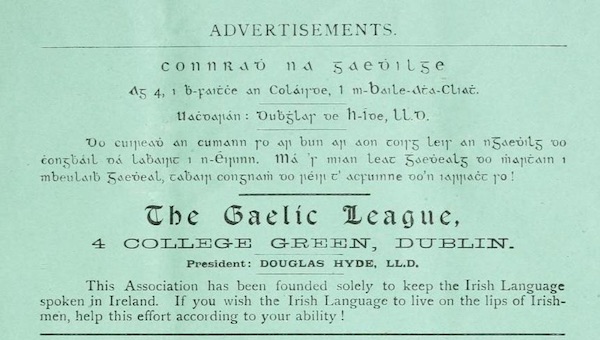
This week 126 years ago – 31 July 1893 – the Gaelic League (Conradh na Gaeilge) was founded. A look at the role it formed in the Easter Rising, by Brian Ó Conchubhair When the Irish Volunteers and the Citizen Army seized key buildings in Dublin City centre on Easter Monday, 24 April 1916, many, if not the majority, were believed to be members of Conradh na Gaeilge/The Gaelic League. When the self-declared Irish republic announced the Proclamation of Poblacht na hÉireann, six of the seven signatories were recognised members of Conradh na Gaeilge.
Of the 16 leaders to be executed, the majority were Gaelic League members and Irish speakers: Ceannt, Clarke, Mac Diarmada, MacDonagh, O’Hanrahan, P.H. Pearse, Willie Pearse, Plunkett, Casement, Heuston, Colbert, Daly and Kent. To further muddle the waters, Eoin MacNeill, in addition to being the co-founder of Conradh na Gaeilge/The Gaelic League in 1893 along with Douglas Hyde, was the president of the Irish Volunteers. One might be forgiven, therefore, for presuming that Conradh na Gaeilge/The Gaelic League was an ardent republican organisation, supportive of the IRB and military action rather than a non-political and non-sectarian association dedicated to the promotion of the Irish-language as a spoken language and the creation of a modern literature in Irish. The Establishment of Conradh na Gaeilge/The Gaelic League Douglas Hyde, following his late 1892 lecture on the need to de-anglicise the Irish nation and race, founded Conradh na Gaeilge/The Gaelic League in conjunction with Eoin MacNeill in 1893. With a focus on the vernacular form of language and modern literature, Conradh na Gaeilge/The Gaelic League distinguished itself from its rivals, The Society for the Preservation of the Irish Language, The Celtic Society and the Gaelic Union. Initially a small Dublin-based group, it gradually spread – geographically and socially – across Ireland and beyond as new branches affiliated: Galway (24 January 1894), Cork (22 April 1894), Derry (1894), New Ross, Wexford (May 1894), Eyries, Cork (December 1894) and London (October 1896). By 1896, 43 branches had registered with the Dublin head-branch, eight of which were abroad. The Rev. Peter C. Yorke’s controversial lecture on 6 September 1899, entitled ‘The Turning of the Tide’ marked a key moment in the League’s fortunes as membership in Dublin and its suburbs subsequently surged. By 1901 the capital boasted some 30 affiliated branches and two years later, in 1903, the League claimed 500 affiliated branches throughout the country. By 1904 Conradh na Gaeilge’s membership extended to some 50,000 members in 600 branches. The rapid growth in members continued the following year with reports of 100,000 members in 900 affiliated branches amongst the Irish diaspora across the globe: Scotland (Glasgow), England (London, Liverpool, Manchester, Porstmouth, Southampton, Rugby, Birmingham, Leicester, Wigan, Oldham, Salford, Coventry, Bolton); Wales (Cardiff); Argentina (Piedad; Buenos Aires), United States of America (Chicago; New York; Holyoke, NY; Rhode Island), New Zealand (Miltown; Balcluttra), South Africa (Capetown; Kimberley). Increased membership impacted revenue: while 1895 showed a mere £43 in membership fees that sum rose to £2,000 by 1900. Such funding allowed the employment of full-time staff and community organisers (timirí) who travelled rural Ireland, often on bicycles or motorbikes, organising lectures, forming night classes, establishing branches, exhorting native and heritage speakers to the value of their linguistic inheritance. The Conradh’s curriculum of events matched the seasons: in winter they focused on classes where members, young and old, mastered the fundamentals of reading and writing – a valuable educational opportunity for many. Social interactions included excursions, céilí/céilithe, dancing, recitations, lectures, musical concerts, plays. Spring and summer months suited fairs, feiseanna, excursions, and exhibitions where the vernacular arts and cultures learned in the winter classes was displayed and exhibited. Irish-Week and the Oireachtas festival were high-points in the cultural calendar. The Irish Volunteers: The Issue of Conradh na Gaeilge? Eoin MacNeill, Gaelic League co-founder 20 years earlier, penned an article ‘The North Began’ in Conradh na Gaeilge’s weekly Irish-language newspaper An Claidheamh Soluis on 1 November 1913 in response to the Ulster Volunteers’ formation. On 25 November, at the Rotunda’s ice rink, some 7,000 people allegedly attended the Irish Volunteers’ first meeting, with 3,000 registering that night. MacNeill, as author of the article, was duly elected president but by his side stood several men associated with Conradh na Gaeilge – notably P.H. Pearse, The O’Rahilly, Thomas MacDonagh, Piaras Béaslaí – while in the background lurked the Irish Republican Brotherhood. At a meeting in Galway to establish the Volunteers in the western region, MacNeill was flanked by Pearse and Casement, all closely associated with Conradh na Gaeilge. Yet the Volunteers, despite their title, Óglaigh na hÉireann, functioned and operated through the medium of English. The close overlap in membership between the two organisations proved detrimental to Conradh na Gaeilge’s activities, which slumped into a decline following the glory period of 1900-1910. Factions within the League considered its linguistic approach and policies too benign and called for more aggressive and confrontational gestures when promoting the language in the face of official intransience. The Great War, Suspense and Suspension When Great Britain entered World War I, the passing of the Suspensory Act (1914) ensured Home Rule’s postponement until the conflict’s conclusion. John Redmond, the Irish Parliamentary leader, urged the Volunteers to enlist in the army, and through their sacrifice ensure Home Rule for Ireland. This policy caused a split in the Volunteers with the majority following Redmond into the National Volunteers and the minority following MacNeill, Pearse, The O’Rahilly and Éamonn Ceannt into the Irish Volunteers. As a self-declared non-political and non-sectarian organisation, Conradh na Gaeilge and its official newspaper, An Claidheamh Soluis, adopted no official stance on the war. But if the movement remained intact, its members disagreed and differed considerably. Hyde’s neutral stance allowed the Gaelic League to remain a home to Irish-speaking Redmonites, and Irish-speaking ‘Sinn Féiners’, Irish-speaking recruiters and Irish-speaking objectors. William Gibson (2nd Baron Ashbourne) and Tomás Ó Domhnaill M.P., both noted Gaelic Leaguers, encouraged young men to enlist, while Irish speakers who spoke at recruitment meetings were arrested and jailed for sedition. If An Claidheamh Soluis attempted to ignore commenting on the war, the Irish-language paper Ná Bac Leis (Ignore It) ridiculed Irish involvement in the war. With Hyde’s shock resignation as President of Conradh na Gaeilge at the 1915 Ard Fheis in Dundalk, MacNeill stepped in temporarily to serve as President until Hyde would be coaxed back. He now, for all intents and purposes, controlled Conradh na Gaeilge and Óglaigh na hÉireann. The links between the two organisations seemed nearer than ever despite their divergent aims. Yet when the press reported the 1916 Rising, they titled it ‘the Sinn Féin Rebellion’ rather than ‘the Gaelic League rebellion’. MacNeill, as is well known, did not condone the rebellion, believing the Volunteers should wait for the war’s end and then seek the implementation of Home Rule as promised, but the IRB cared little for MacNeill once he had served his purpose of providing respectability and profile. By the time the 1916 Ard Fheis convened, most of Conradh na Gaeilge’s officials were in prison in England or Wales. While the links between the executed leaders and the Gaelic League bestowed no little honour on the organisation in the early years of the Free State and since, it spawned an enduring image of Conradh na Gaeilge less as a non-sectarian, non-political organisation but more one sympathetic to advanced republicanism. Such an understanding is far removed from that envisioned by Hyde. Many, if not most, of those who fought on the nationalist side in Easter week were Gaelic Leaguers, but they were also affiliated to numerous other friendly societies: the Gaelic Athletic Association, Cumann na mBan. If there is a tendency to overplay the role of the Gaelic League in the 1916 Rising, it is impossible to underestimate its role in its leaders’ intellectual development and in introducing debates and discussions into early 20th-century Ireland that steeled the public for independence. It was Conradh na Gaeilge during the fin de siècle that provided the intellectual, linguistic and cultural rationale for political independence. But as has been well noted, revolutions are made not by hurleys and footballs but by ideas and Conradh na Gaeilge was the main conduit for radical ideas for reinventing and reenergising Irish society in the period building up to 1916.
The juryless retrial of a man accused of IRA membership collapsed in
farcical scenes this week after a PSNI policewoman did not recognise a
vehicle licence plate from which she was supposed to have recovered DNA
evidence.
It was the second time Gardai police had attempted to imprison Dubliner
Darren Weldon based on so-called “belief evidence”. Token circumstantial
evidence was again presented in support of their allegation that Mr
Weldon was a member of the Real IRA.
The 47-year-old, from Kilbarrack in Dublin, had originally pleaded not
guilty to IRA membership in October 2014.
In the original trial, the prosecution’s case against the accused man
was mainly composed of “belief evidence”. This is a mere statement of a
senior member of the police that their target is guilty as charged.
At the Special Criminal Court, set up in 1939 to accelerate the
imprisonment of republicans and still in use today, such “evidence” is
normally enough to secure a conviction, especially if accompanied by a
plausible supporting argument.
In an initial trial in 2017, memorial photographs of Real IRA leader
Alan Ryan which police said they had found on Mr Weldon’s phone were
presented as corroboration. They also claimed to have found his DNA on a
swab taken from the licence plate of the vehicle used in the attack.
Mr Weldon was quickly found guilty and sentenced to five years
imprisonment. But he had his conviction quashed in 2018 and a retrial
ordered after the Court of Appeal found the Special Criminal Court had
made a “factually incorrect” finding in relation to a photo on Weldon’s
iPhone.
Without this evidence, there was a “substantial gap” in the Special
Criminal Court’s reasoning, causing the Court of Appeal to consider the
conviction “unsafe”. A retrial was ordered.
Last week, and again without a jury present, the alleged supporting
evidence in the form of DNA linking Mr Weldon with the registration
plate was found to be entirely bogus.
In an embarrassing revelation, PSNI policewoman Christine Lumsden
admitted to a panel of judges that the number plate produced to her was
not the same number plate recovered from the scene.
“She went on to state that the number plate looked upside-down and
different,” said the chief judge. He said he could not be satisfied that
“the integrity of the number plate” was “properly preserved”.
“Having found that the belief evidence is not supported by any
independent evidence, we must find the accused not guilty,” he
concluded.