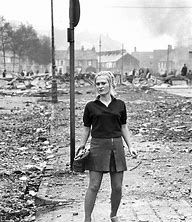
Following on from the Peoples Democracy march of 1st January 1969 from Belfast to Derry and the subsequent rioting in the Bogside and other towns in Northern Ireland, the Northern Ireland Civil Rights Association and its supporters were openly condemned by the Government of Northern Ireland as being manipulated by communists, republicans and socialists.
The sectarian police force
The government openly supported the so-called loyal institutions when they demanded the right to parade through towns and villages where the population was overwhelmingly Catholic whilst at the same time it ordered the Royal Ulster Constabulary to robustly put an end to demonstrations for civil rights and social reform. This sectarian police force needed no prompting and in April of 1969, some of its members entered the home of Derry man Sammy Devenny, trashing it and savagely beating Devenny and his daughters so badly that Devenny never recovered from his injuries and died on 17th July.
Again in July, the Orange Order decided to walk through the Catholic village of Dungiven and during the inevitable rioting the RUC brutally beat Francis McCloskey, a 67-year-old Catholic resident of the village so badly that he too died of his injuries. Francis would become the first Catholic civilian killed in Northern Ireland’s troubles. The people of Derry had had enough. They were not only in a different camp from the government; they also despised the local city council which was controlled by the unionists due to the worst case of gerrymandering of electoral wards ever experienced in the northern statelet.
The stand against sectarianism
A youth armed with Molotov cocktails keeps guard on top of a highrise flat in Derry.
The nationalist people were well aware of the fact that on 12th August, the Apprentice Boys of Derry, a loyal order, would demand and receive permission to walk through the city. Part of their route would take them along the western wall of the city directly overlooking the Catholic Bogside.
In anticipation of a confrontation taking place, local republicans decided to form the Derry Citizens Defence Association (DCDA) with the intention of maintaining peace and defending the Catholic areas of the city, particularly the Bogside which was the usual target of the RUC.
Many people and activist groups immediately joined the new association. The inevitable did happen when loyalists and nationalist youths exchanged insults and then stones at Waterloo Place. The RUC advanced with many loyalists coming behind them, pushing nationalists up William Street towards the Bogside. However, this time things were different.
The people of the Bogside, with their brothers and sisters from the rest of the city, and further afield, were there to stop them. The Catholics were armed with stones and petrol bombs, they raised barricades, the rooftops of the “high flats” were commandeered by the Bogside youths and from this advantage point, they rained petrol bombs and missiles upon the RUC invaders.
The poorly equipped police force
For their part, the RUC were using CS gas canisters which they used to flood the district but a soft wind would blow the gas back towards them. The police were poorly equipped with shields that were much too small and their uniforms were not flameproof causing many of them to suffer severe burns from the Molotov cocktails.
Police reinforcements were sent in from all over the north but to no avail. The ‘bogsiders’ would not yield an inch and fought them to exhaustion, all the time broadcasting to the world at large on Radio Free Derry.
Response from the Irish Republic
On the 13th of August, the Taoiseach of the Republic of Ireland, Jack Lynch sent Irish troops to the border areas to help provide medical aid and shelter for the wounded. This caused the nationalists to hope for, and the Unionists to fear, an incursion into the Bogside by Irish troops.
Response from the British North
The northern government next decided to bring in the notorious B-Specials to replenish the RUC. This was an act of pouring petrol on the fire. This force was hated by the nationalists of all hues. At the same time, the RUC had opened fire on a crowd of nationalists standing guard over St. Eugene’s Cathedral. Two men were wounded.
The violence spreads
By the 14th of August fighting was beginning to break out in other parts of the north as young nationalists tried to divert RUC reinforcements away from Derry. In Belfast, Orange pogromists attacked the Catholic Bombay Street district burning homes and displacing over 1,500 people. On the 14th August, James Chichester Clarke, the Northern Irish Prime Minister was forced to request the British Prime Minister to send in the British Army. Within hours a company of the Prince of Wales Own Regiment entered the city separating the warring sides. On the main, they were welcomed by the nationalists.
It is reckoned that approximately 350 RUC men were wounded to some extent during the riots, of the residents there are no figures as many went over the border for treatment.
In the rest of the 6 counties, Belfast suffered the most with many having lost their homes and 5 Catholics and 2 Protestants were killed. In the aftermath of the battle of the Bogside, the nationalist people would see the despised corporation fall, they would also take pride in themselves knowing that they had stood up against discrimination and deprivation.
Without doubt Boris Johnson holds the political initiative. Despite all their lambasting and lamentations, the opposition parties show no sign of getting an act to together to prevent No Deal or even save the Union. Rather the reverse.
Labour is insistent that any alternative government must have Mr Corbyn as its leader. There is no conceivable parliamentary majority for installing him at Number 10, even on a temporary basis. There are other things MPs can do if they have the will and the numbers, though none is easy and some would be political dynamite. They could take control of parliament’s agenda in order to declare a revocation of article 50. They could rush through changes to the relevant laws to ensure that an election happened before 31 October.
All possible solutions depend on there being sufficient Conservative MPs capable of remembering that Britain’s democratic fabric relies not so much on laws as assumptions that people will behave properly.
The word unprecedented is overused, but not in this case. If Britain crashes out of the EU in the middle of an election campaign deliberately delayed by a prime minister with no mandate, it won’t just be the constitution that will be plunged into the darkest crisis of our modern history.
He turns the anti Johnson case on its head. Rather than leading a minority of English nationalists that a parliamentary majority should easily defeat, McTernan sees the prime minister positioning himself to exploit the internal splits within Conservative and Labour and occupy the vacuum on the left and right created by years of broad consensus over austerity – the centre ground newly gone militant, if you like and ready for Boris . This is a recipe for political success.
The de Gaulle parallel ( a pretty tenuous one admittedly) comes in because the aloof Frenchman managed to appeal for national unity over the heads of a multiparty system that couldn’t form stable governments at a time when a military revolt was threatened over their inability to decide whether to pull out of Algeria or fight the rebels to the death. To win power, de Gaulle sounded the patriotic note but outraged the Right by promptly betraying them, going for independence and using his unique authority gained in second world war to face the coup attempt down.
The parallel then is not so close. And by the way Boris is no de Gaulle. He sees himself as Churchill. But is the Union Boris’s Algeria? Which will be betray; the Union or withdrawal, “no if, no buts?” McTernan warms to his provocative theme.
The most foolish of the Labour party’s attacks on Mr Johnson has been that he is a rabid rightwinger. The problem is that the new prime minister is not the narrow nationalist depicted by the Corbynites, he is a globalist.
A referendum smashes and then remakes political allegiances, uprooting old loyalties and making millions of voters available. Not just swing voters, but switchers too. Political flux creates opportunities but it needs new approaches. The failures, in the end, of Mr Johnson’s predecessor Theresa May and Jeremy Corbyn, the Labour leader, are almost identical — both saw the current political conjuncture as a chance to move their respective parties to the left and right poles.
Traditionally, this would have created a gap in the centre, but the failure of any new “centrist” party is telling. Times of unprecedented change can only be answered by unprecedented politics. Step forward, Mr Johnson.
Good politicians accumulate political capital, great ones spend it as well. Michael Gove is the best recent model. His unchallenged reputation as a rightwinger enabled him to be the most liberal justice secretary since the post was created. Mr Johnson has learnt well from this example and has placed Mr Gove at his right-hand side as chancellor of the Duchy of Lancaster — that opaquely named post which is really “secretary of state for the centre of government
By delivering Brexit, Mr Johnson will have the largest amount of political capital that a Tory leader has had with their right since Thatcher won the miners’ strike. This will give him almost total freedom. Already he has established message discipline, and the political discourse has shifted from “people’s vote vs Brexit”, where the government struggled, to “no deal vs no Brexit”, where the Tories are the champions of the voice of the people. The prime minister will use his freedom to marshal new constituencies. Not just the northern working class, but all patriots who worry about Mr Corbyn’s uncritical approach to Russian president Vladimir Putin. Expect a large increase in defence spending. The work of Mr Gove to “green” the image of the Conservatives will continue, with legislation on animal rights and agricultural subsidies for carbon-neutral means of production.
And don’t be surprised if the legalisation of cannabis moves closer — young people need a reason to vote Tory too. Intervention. Infrastructure. Optimism. Patriotism. A renewal of politics to rescue the nation. Soon we will hear the prime minister’s clarion call: “Anglaises, Anglais, aidez-moi!”
(De Gaulle in an dramatic TV address had appealed “ Francaises, Francais, aidez moi”, to bring out the masses on to the streets of Paris even as some rebel paratroops from Algiers were landing in France. We’re not quite there yet).
However concern over the Union is reaching panic stations. Scottish Independence fervour is massively boosted by English No Deal militancy. It’s a bad sign when the economics are almost entirely ignored. What strikes reasonable unionists is how so many don’t seem to care if the Union survives or not. This is at the heart of Gordon Brown’s theme below, and the commentator Alex Massie’s. He sees the unionist case going by default in both main UK parties.
Lord Ashcroft’s most recent poll found 52% of Scots favour independence now. Revealingly, just 30% of those Scots polled thought unionism would prevail in a second referendum if, or when, such a vote was held.
From which one thing seems obvious: unionism can only win this game by not playing this game. Ruth Davidson understands this. It’s a misfortune for unionism that the Labour Party does not. Just as the Tories are prepared to sacrifice the stability of the union on the altar of a no-deal Brexit, so Labour appears ready to offer the SNP a second independence referendum if that’s what it takes to put Corbyn into Downing Street.
As a result, viewed from Scotland, neither the English Conservative nor the English Labour Party can sensibly be considered unionist organisations.
Given the conviction in some parts of the left that Scotland was England’s first “colony” — a conviction both ignorant and depressing — it’s little surprise that the likes of McDonnell are so relaxed about Scottish independence. Yet it’s still startling to think that the people leading the Labour Party are so intensely relaxed about the dismemberment of the country they seek to lead. This is not the Labour Party of John Smith and nor is it that of Gordon Brown. That party no longer exists.
So these are lonely times for Scottish unionists. They peer south and do not much care for what they see. A Britain in which the choice lies between Boris Johnson and Jeremy Corbyn is not a cheerful place. No wonder they view the future with foreboding.
If their paranoia does not yet match that of their Ulster brethren, they still have an inkling that, should it be deemed necessary, they too will be sold out. That is one obvious interpretation of the recent polling, which reveals that, in England, “leave” voters think the break-up of the UK is a price worth paying for Brexit. And it is the obvious conclusion to be drawn from McDonnell’s decision to offer a referendum to the SNP too.
So these are lonely times for Scottish unionists. They peer south and do not much care for what they see. A Britain in which the choice lies between Boris Johnson and Jeremy Corbyn is not a cheerful place. No wonder they view the future with foreboding.
If their paranoia does not yet match that of their Ulster brethren, they still have an inkling that, should it be deemed necessary, they too will be sold out. That is one obvious interpretation of the recent polling, which reveals that, in England, “leave” voters think the break-up of the UK is a price worth paying for Brexit. And it is the obvious conclusion to be drawn from McDonnell’s decision to offer a referendum to the SNP too.
The first step to solving a problem is to see it clearly. And if we are to understand why we are facing not only our most serious constitutional crisis since the 17th century but an unprecedented economic calamity precipitated by a no-deal exit from the EU, we must recognise that nationalism is now driving British politics…
Johnson’s flying visits to all corners of the UK have done nothing to dispel the impression that under him the world’s most successful multinational state is devoid of a unifying purpose powerful enough to hold it together and to keep four nationalisms – Scottish, Irish, English and also a rising Welsh nationalism – at bay….
What is most worrying is not just that so many think the union will end but how at least for now so few appear to care. Only 30% of British Conservatives (and only 14% of Brexit party voters) would oppose Brexit if it meant the break-up of the union: 56% of Tories (and 78% of Brexit party voters) – in total 70% of Leavers – would go ahead regardless, even if the union collapsed….
Unionist parties in Northern Ireland should have been persuaded that their stated objectives – the integrity of the UK and an open border with the Irish Republic – could be best secured by continued membership of the customs union and single market…
As the Second World War ended, George Orwell made a distinction between patriots who instinctively love their country and the opposite, a political nationalism that he defined as “power hunger tempered by self-deception”. He noted its defining features: unreality about the country’s prospects; introversion bordering on the xenophobic; and hate-filled obsessiveness that treats people solely in terms of their loyalty and utility. Orwell argued passionately that the descent into a narrow, chauvinistic nationalism could be halted only by what he called “moral effort”.
In our times, this means we must rediscover the age-old virtues of empathy, solidarity across borders, reciprocity between nations and co-operation rather than conflict. These precious ideals – and a tolerant, inclusive and outward-looking Britishness – could not survive the divisiveness and chaos of a no-deal Brexit. To prevent the rise of dysfunctional nationalism, the first step is to stop no deal in its tracks.
But Gordon, how is this to be done? We’ve heard the lament before What’s the strategy?
August 10, 1969: San Clemente, California—President Richard Nixon accused his predecessor Lyndon Baines Johnson of complicity in the assassination of President John F. Kennedy. Speaking with reporters on the first day of a 10-day stay at his Pacific Ocean vacation home …
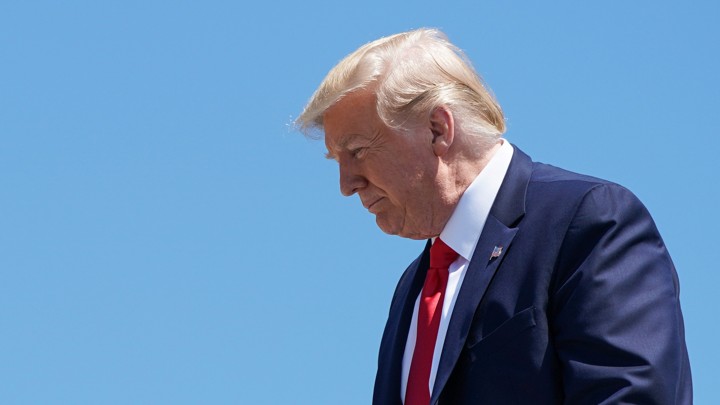
Of course, that never happened. Obviously. How could it; how dare it? But had it happened, such an accusation—by a president, against a former president—would have convulsed the United States and the world. Today, President Donald Trump accused his predecessor, Bill Clinton—or possibly his 2016 campaign opponent, the former first lady and Secretary of State Hillary Clinton—of complicity in the death of the accused sex trafficker Jeffrey Epstein.
Many seem to have responded with a startled shrug. What do you expect? It’s just Trump letting off steam on Twitter.
Reactions to actions by Trump are always filtered through the prism of the ever more widely accepted view—within his administration, within Congress, within the United States, and around the world—that the 45th president is a reckless buffoon; a conspiratorial, racist moron, whose weird comments should be disregarded by sensible people.
By now, Trump’s party in Congress, the members of his Cabinet, and even his White House entourage all tacitly agree that Trump’s occupancy of the office held by Washington, Lincoln, FDR, and Eisenhower must be a bizarre cosmic joke, not to be taken seriously. CNN’s Jake Tapper on August 2 quoted a “senior national security official” as saying: “Everyone at this point ignores what the president says and just does their job. The American people should take some measure of confidence in that.”
Everybody at this point ignores what the president says.
So even though Trump just retweeted the comedian Terrence K. Williams accusing the Clinton family of murder, the people who work for Trump may ignore that, too. They know that the president punching the retweet button like an addled retiree playing the slots through a fog of painkillers means nothing. The days of “taking Trump seriously, not literally” have long since passed. By this point, Trump is taken neither seriously nor literally. His words are as worthless as Trump Organization IOUs.
But cosmic joke or no cosmic joke, Donald Trump is the president of the United States. You may not like it. I don’t like it. Mike Pompeo doesn’t like it. Mitch McConnell doesn’t like it. Kevin McCarthy doesn’t like it. But it’s still a fact, and each succeeding outrage makes it no less a fact. Grinning and flashing a thumbs-up over an orphaned baby? Yes, still president. Tweeting that a third-tier dictator has threatened him with more missile tests unless he halts military exercises with a U.S. ally——and that he has surrendered to that blackmail? Shamefully, still president. Accusing a former U.S. president of murder? It’s incredible, it’s appalling, it’s humiliating … but, yes, he is the president all the same.
Trump’s circle probably expects the world to sputter for a while and then be distracted by some new despicable statement or act. That is how it has gone for nearly three years, and that is how it is likely still to go. Trump is steering the U.S. and the world into a trade war, and perhaps a financial crisis and recession along with it. He is wrecking the structure of U.S. alliances in Asia, and his rhetoric is inciting shooting rampages against minorities. Compared with that, mere slurs and insults perhaps weigh lighter in the crushing Dumpster-load of Trump’s output of unfitness for the office he holds.
But it shouldn’t be forgotten, either, in the onrush of events. The certainty that Trump will descend ever deeper into subbasements of “new lows” after this new low should not numb us to its newness and lowness.
Neither the practical impediments to impeachment and the Twenty-Fifth Amendment process, nor the foibles and failings of the candidates running to replace him, efface the fact that this presidency shames and disgraces the office every minute of every hour of every day. And even when it ends, however it ends, the shame will stain it still.
By AM
Saturday, August 10, 2019
Share
Tweet
Share
Share
EmailDes Dalton with the paper that formed the basis of his contribution to The Way Forward seminar held by Republican Sinn Féin in the Teacher’s Club in Dublin on Saturday July 27.
‘nationalism’ is a word that still signifies all sorts of undifferentiated things, but it serves me quite adequately to identify the mobilizing force that coalesced into resistance against an alien and occupying empire on the part of peoples processing a common history, religion, and language – Edward Said (Champion of Palestinian independence and anti-colonialist)
Today’s seminar has been stimulating as well as challenging, engaging with ideas about the future direction we believe that Ireland should take. I believe that we agree on far more than separates us. However, that is not to say that we can simply ignore certain first principles. I believe that to do so is dishonest and will never provide the basis for meaningful and ultimately fruitful engagement.
I think that we are now in a changed political landscape, I am not naïve enough to believe that Brexit and all the political upheaval and potential economic upheaval that accompanies it will somehow magic a New Ireland into being. But again, we should not be blind to the possibilities that it does present to Irish Republicanism. At a minimum it has shone a spotlight on the illogicality of partition and has begun the first serious discussion about the possibility of a free and united Ireland in over thirty years. In the Éire Nua programme we have something substantial to contribute to that discussion. Indeed, amid this current political upheaval in Anglo-Irish relations between Dublin and London I believe that as traditional Republicans we have a duty also to continue to articulate the aspiration for real All-Ireland democracy.
To begin I would like to establish a couple of first principles. Beginning with parameters and definition. Language is not inconsequential, as all with even a cursory interest in Irish politics or history will readily agree. Even how we refer to Ireland is loaded with meaning. Language frames the entire debate around defining the Irish nation. Over the past twenty years at least there has been an increasing usage of the term “the island” to refer to Ireland. It appears that even to refer to Ireland, or even All-Ireland is simply too much of an acknowledgment that such a thing as the Irish nation exists as a geographic entity, let alone a political or cultural one. During the current Brexit debate I have detected an even further shift, with many within the media and the Leinster House political class referring to the 26-County state as Ireland. Previously even the most died in the wool “Free Stater” would always refer to the “state” never to “the country” when referencing the 26-County state. This was a recognition that Ireland as a nation extended beyond the border. Now the air is laden with references to Ireland and “Northern Ireland”, with the underlying idea being of course that two countries exist on “the island”. This is where the importance of language comes in. Once we accept these labels, we accept the parameters of the debate as set by the partitionist political class. Having done so we abdicate the very idea of Ireland. We have essentially been defeated before we even start, we have conceded the very basis of Irish nationalism let alone Irish republicanism. Once this language enters everyday parlance it soon became a way to think of Ireland and so it goes on.
This no idle academic debate about terminology. This is key to our starting point, our first principles. Because the definition of the Irish nation ipso facto defines the unit of decision making which brings us back to the heart of the matter. Parameters and definition. The importance of the unit of decision making has never been lost on the British government. Tony Blair’s Chief of Staff Jonathan Powell hammers home this point in his memoir of the so-called “peace process” Great Hatred, Little Room: Making Peace in Northern Ireland.
One of Tony Blair’s attributes as a leader was his ability to go back to first principles (…) Tony had zeroed in on the fundamental principle: what was the unit that had the right to self-determination? Was it Northern Ireland (sic), the island of Ireland, or the islands together including Britain? He believed the key point to be that of the consent of the people being ruled, and that meant it had to be the people of Northern Ireland (sic) who should have the say. For the unionists this was of fundamental importance, unlike the issue of decommissioning, which was purely transient because, after all, any group that gave up its weapons could easily acquire new ones. The principle of consent, which had been accepted by the Irish government in progressively stronger terms in the Sunningdale Agreement of 1973, the Anglo-Irish Agreement of 1985 and in the Downing Street Declaration of 1993, would be the most difficult concession for Republicans to make.
To quote from the contribution of Sylvie Kleinman of the Department of Modern History, Trinity College, Dublin, to a volume entitled “Reinterpreting (Robert) Emmet” with particular reference to Emmet’s mission to France:
A common thread runs through the extensive manuscripts detailing official attitudes in France towards Ireland and the United Irishmen, namely that they were consistently described as representing une nation, un people, which to French perceptions could already claim its place among the nations of the earth.
Documents issuing from the Irish College in Louvain, in what is now Belgium, 400 years ago used terms “náisiún” regarding Ireland and “Éireannach” instead of “Gael” and “Gael-Ghael” in reference to an Irish person. We are not a revolted colony nor as Thomas Davis said, “a sandbank thrown up by caprice of wind and earth”, but an ancient people.
The British state is in the midst of an existential crisis as a result of Brexit. The fault lines that lie at the heart of the British state have been exposed by the whole debacle. The undemocratic nature of the so-called United Kingdom is exposed for all to see. The narrow jingoistic little England nationalism of the Eton and Oxbridge elite trumps the sovereignty of the people of Ireland, Scotland or Wales. None of this will come as any surprise to Irish Republicans, who have never been under any illusions about the true nature of English government’s relationship with the Irish people. But now it has been laid bare for all to see.
Once more the “Irish Question” has come back to bite the British establishment as they try to square the circle of British occupation of the Six Counties and its consequent denial of the inherent unity and sovereignty of the historic Irish nation. The call, by characters such as Jacob Rees Mogg etc, to protect the integrity of the so-called United Kingdom are breath taking in their lack of historical or political awareness. They do so, sure in the knowledge that their imperialistic bluster will go unchallenged. Where are the voices raised in defence of the territorial and political integrity of the Irish nation? The British Tory elite know only too well that even a basic Irish nationalist position was long ago abandoned by the Irish constitutional nationalist parties on both sides of the British imposed border under the terms of the 1998 Stormont Agreement.
The silence of the constitutional nationalist establishment on even the most basic tenets of Irish nationalism is damning. Not for the first time, it falls to traditional Irish Republicans to articulate the right of the people of Ireland to national independence. Unequivocally we take our stand on the principles of the 1916 Proclamation.
Brexit has also exposed the 1998 Stormont Agreement as an empty shell. It’s promised guarantees of enshrining Irish nationalists’ right to exercise Irish citizenship has been exposed as yet more empty rhetoric. Once more the nationalists of the Six Counties have been abandoned by so-called constitutional nationalism, including the 26-County state. In the Six Counties the Stormont Assembly has fallen into abeyance while the British government abandoned any pretence of neutrality on the issue of their continued occupation of north eastern Ireland by forming an unholy alliance with the DUP. Indeed, in recent weeks the historian Paul Bew, in a paper for the policy think tank Policy Exchange, argues that the incoming British Prime Minister must consistently make the case for the union between the Six Counties and Britain. Professor Bew contends that the preservation of the union should be the “absolute priority” of the next British Prime Minister. Paul Bew, as a key adviser to David Trimble, played a central role in the negotiation of the 1998 Stormont Agreement. That entire “peace process”, which culminated in the 1998 Stormont Agreement was predicated on the notion, as set out in the 1993 Downing St Declaration, that the British Government had: “no selfish strategic or economic interest in Northern Ireland.” Consequently, Paul Bew’s intervention is not insignificant. His candour and honesty are to be welcomed as it helps further to debunk the myth that the British Government is in any way neutral on the question of the constitutional position of the Six Counties.
Once more history repeats itself, this time as farce, as the British Tory elite cling to power by “playing the Orange card”. However, and again in a repeat of the past, the DUP have discovered already that their Tory “friends” are more than willing to abandon them whenever political expediency dictates. A Boris Johnson administration will have even less scruples in discarding them when they have outlived their usefulness. This has always been the attitude of the British ruling elite to unionism. That is why Irish Republicans have continually pointed to the New Ireland that is provided for in the Éire Nua programme. Here the sovereignty of all sections of the Irish people, Protestant, Catholic and Dissenter is enshrined. Those within the broader unionist community are invited to take their rightful place within the Irish nation, here their full participation in the exercise of democratic decision making will not be subject to the whims and caprice of a foreign parliament. A new Ireland can never emerge from either Stormont, Leinster House or Westminster.
In terms of the wider debate around Brexit and the EU, Irish Republicans have always recognised the EU for what it is. A club of former imperial powers whose primary purpose is the consolidation of their economic and political power. It is imperialism in a modern form. Republicans have consistently argued against Ireland’s participation in this project. In Ireland we have experienced both forms of imperialism and still do. In the Six Counties British military occupation represents the old imperialism while in the 26 Counties we have seen the social and economic ravages of the new imperialism of the EU.
The result of the British referendum on Brexit was of course welcomed by Irish Republicans on two levels. Firstly it exposed the inherent fissures that exist within the so-called United Kingdom. From our point of view, it will hopefully hasten its demise. We welcome the increased likelihood of a referendum on Scottish Independence. Secondly it strikes a blow against the EU project and gives encouragement to other progressive forces throughout Europe.
Unfortunately, the British right were allowed to frame the debate, there are of course very progressive arguments to be advanced against the EU, but they were lost in a cacophony of right-wing voices clamouring for position within the British Tory party. We are proud of our record of consistently opposing the construction of a militarised and undemocratic super state in every referendum held in the 26 Counties since 1972. This is the only position Irish Republicans can hold if we are serious about creating an independent Ireland based on the principles of the 1916 Proclamation. Talk of a United Ireland is meaningless, we have had unity under British Rule and indeed under the EU both parts of Ireland were largely under the same EU law. The sovereignty and independence of the Irish people is the goal of Irish Republicanism. There is no point in removing the shackles of British imperialism only to replace them with political and economic imperialism of the EU.
Éire Nua builds from the ground up. It is a model of real participatory democracy. Ensuring that the people are involved in the decision-making process from local or community level, through region and provincial, all the way up to national level. Éire Nua addresses the various partitions that have been inflicted on Ireland. Not simply the north south political partition imposed in 1920/21 but also the social and economic east/west partition that has existed since the foundation of the two partition states. Following the old British colonial model, all political and policymaking was centred in Dublin and ergo was in the main Dublin centred. Decisions on economic development, education, health, social services, the environment and employment were and are being made at a remove from the people most affected.
This has been further exacerbated by the further centralisation of power from Dublin to Brussels. The historian, political activist and biographer of James Connolly, C. Desmond Greaves regarded the nation state as the ‘locus of democracy’ arguing that it was only within national communities that people could exercise democracy in a meaningful way. It was the largest or optimal political unit within which rights of minorities could be protected. In building democracy from the ground up we must not, to paraphrase Parnell, set a boundary to the march of democracy. It is not enough merely to create democracy within nations, we must work for a real democracy between nations. A community of free nations as envisaged by Connolly, with cooperation in fair trade, protection of human rights and the environment. The First Dáil in its Message to the Free Nations of the World set freedom and justice as the “fundamental principles of international law,” and declared Ireland’s unshakable belief in “a frank co-operation between the peoples for equal rights against the vested privileges of ancient tyrannies.” This should remain as the basis of our internationalism.
Ireland is part of Europe and has been for tens of thousands of years. As Irish Republicans we draw on a political philosophy whose roots lie within the European Enlightenment of the 18th Century. This European culture of music, literature and philosophy predates and transcends the EU. A Europe that, in the words of Charles De Gaulle, stretches from the Atlantic to the Urals.
Far from looking inward we as Irish Republicans are looking outward and into the future. We have a vision of the type of Ireland we wish to create. We believe Éire Nua provides the framework within which such a new Ireland can be constructed by all sections of the Irish people.
We are entering a period of radical change which presents opportunities for those committed to fighting for real political and economic democracy not only within nations but between nations. Let a New and free Ireland take its rightful place within such a community of free nations.
The following is the full text of a speech delivered by Sinn Féin MEP Martina Anderson last
Sunday at the hunger strike commemoration organised by the party in Strabane, County Tyrone.
Those of you before me have come out today to honour and pay tribute to
the twelve hunger strikers of this phase of our struggle who died in
Parkhurst Prison, Wakefield Prison and the H-Blocks of Long Kesh.
Prisoners from Mayo, Derry, Tyrone, Armagh and County Antrim.
We also pay tribute to those many other women and men from across the
thirty-two counties who participated in and survived the hunger strikes
of 1972, 1973, 1974, 1977, 1980 and 1981, in Crumlin Road Jail, Brixton
Prison, Mountjoy Jail, Portlaoise, Armagh Jail and the H-Blocks.
To this day, I remain astonished at how our imprisoned comrades, among
them, Michael Gaughan and Frank Stagg, lonely and isolated, stood up to
the anti-Irish racism and brutality they suffered by warders in English
prisons, including force-feeding; and how, here in the North, over
seven, long months in 1981, ten men fearlessly demonstrated with their
lives their rejection of British rule and showed to the world that what
British rule represents in Ireland is eight hundred years of crime.
To this day, I am in awe of the families of the hunger strikers – some
of whom are with us today.
Your loyalty, your endurance, the pain you suffered day and night, and
sleepless nights, over sixty-six days, seventy-three days, or, in the
case of the Hurson family, young Martin after forty-six days.
There is a saying that you can judge how civilised a society is by the
way it treats its prisoners.
And by that yardstick Britain stands indicted before the world when you
think back to the torture of the hooded men, to the beatings in
Castlereagh, Strand Road and Gough Barracks, to the physical attacks on,
and mistreatment of, the women prisoners in Armagh Jail, Brixton prison
and Durham Jail, the strip-searching of the women, and the punishments
and indignities suffered, especially the women in Armagh who demanded
political status along with their comrades in the H-Blocks.
It comes as no surprise to Irish nationalists and republicans that what
Britain did in Ireland it did in North America, the Far East, on the
Indian sub-continent, and across Africa. Its forces tortured and
murdered people in South Africa, Palestine, Malaya, Kenya, in Cyprus, in
little villages and towns whose names and inhabitants never appeared in
the British press or made it into the history books.
Irish Republican and nationalist resistance was a response to the
violence of the B-Specials, the RUC, in a one-party state where
nationalist votes, nationalist opinion, nationalist culture, nationalist
suffering, counted for nought – a response to state pogroms and the
state killings of Sammy Devenney in his home of Derry, of nine-year-old
Patrick Rooney in his bed in Divis Flats, for which no one has ever been
held to account, and this was long before the IRA fired its first shot.
Right now British arms and munitions – flow into Saudi Arabia. Blood
money.
Trade and profits amounting to £4.7bn. That’s 4.7bn pound worth of death
and destruction.
Inflicting carnage on innocent children, women and men in Yemen. And
those in the Commons and in the Lords and in their board rooms and
drawing rooms don’t give a damn about the mass killings of innocent
people.
The hypocrisy.
I’m reminded of that amazing song resistance and sacrifice, ‘The Ballad
of Joe McDonnell’, especially today on his 38th anniversary, “And you
dare to call me a terrorist while you look down your gun.”
Joe McDonnell and his comrades were courageous volunteers. Men of
integrity. Irish republicans of indisputable courage, able to go without
food day after day after day because what sustained their spirit was the
love of their people, the love of freedom, the aim of peace and justice,
a land where the laughter of their children would ring in the air, an
Ireland free from English interference. England – ‘the never-failing
source of all our political evils.’
So, how was it, that the first time Joe McDonnell was in prison he had
political status but that the next time he was in prison he was stripped
naked and beaten and deprived of his human rights? Hunger strikers died
and scores more civilians, soldiers and prison officers died on the
streets, because the British government went back on its word. Political
status for sentenced prisoners was conceded by the British in 1972 after
a hunger strike in which no one died – no prisoners, no prison officers.
But four years later, Britain arbitrarily withdrew political status for
prisoners convicted after March 1976.
It was deliberately provocative.
Britain believed that if it could break and demoralise the prisoners
then the struggle on the outside would be demoralised and broken. Those
were the stakes. But it was bound to fail. When they had tried the same
tactic in 1917 a hunger strike resulted in the death of Thomas Ashe. So
it is not as if they didn’t know that republicans would resist.
Britain’s criminalisation policy caused great suffering – which is what
was intended – and, of course, it failed. Instead of demoralising the
republican struggle – it reinvigorated it.
Out of those deaths in the H-Blocks arose a more powerful movement.
Young people were inspired to join the struggle. Many centuries ago a
French cleric – coined a phrase and described England as ‘Perfidious
Albion’, a country that never keeps its word, a state that you can never
trust.
We know that to be so true – from Britain’s promise to the Irish
Parliamentary Party in 1914 to introduce Home Rule, before then
partitioning our country, to its reneging on political status in 1976
which led to so many deaths.
British politicians tell us they want to leave the EU on agreed terms
and that they don’t want to see a hard border in Ireland.
Do we believe them? Like hell we do.
For a start – they’ve even reneged on the Withdrawal Agreement
negotiated by former British Prime Minister Theresa May. At a time when
a ‘no-deal’ Brexit looks ever more likely it is vital to ensure that the
political consensus that has built up around Brexit is maintained and
not undermined.
That means making it clear that there is no harder border on the island
of Ireland, it means protecting our all-island economy and it means
defending the Good Friday Agreement.
I am, however, more than a little perplexed by the Fianna Fáil position
on all of this in recent days and weeks.
They appear to be saying that the Irish position – as endorsed by the
Dáil and by the majority of parties in the north – is too stringent and
rigid; yet they offer nothing by way of substance as an alternative.
It’s a position that is confusing, unhelpful and wrong.
The fact is that they can’t have it both ways – they either stand
against a hard Brexit, or they don’t.
That’s the bottom line.
All parties need to make it crystal clear that the Irish government and
the EU need to stick to their position – that the Withdrawal Agreement
is the only show in town and as part of that a ‘backstop’ is essential.
If Boris Johnston gets his way, he and, the DUP, will inflict on the
majority of the people here in the North a Brexit that will impact on
political progress, bankrupt small businesses and generally impoverish
many, many people.
I’ve a bit of advice for the DUP. Britain has no friends – it only has
interests.
It is currently indulging you because you serve Brexiteer interests in
the life of this British parliament.
But, do not get carried away. If circumstances change, if it suits the
British government, it will ditch you. You can be sure of that.
And when that happens, and when you are disabused of how important you
are to Boris Johnson and English nationalism, when you decide to come
back home, we in the nationalist republican community will be here to
work with you – As equals.
Finally, I have an Irish republican message for the British Prime
Minister.
It’s a message whose composition began with the Battle of the Bogside
which shaped young Patsy O’Hara and Micky Devine;
It’s a message written by the likes of Bobby Sands driven from his home
in Rathcoole; written in Bellaghy, in Cappagh, in Dungiven and in
Camlough; It was proclaimed in Wakefield and Parkhurst Prisons, in
Armagh Jail, in English Jails, in the H-Blocks, in the prison hospital –
Don’t think we have suffered your oppression, your state killings and
assassinations for decades;
don’t think we’ve come this far to fall foul of Britannic jingoism;
don’t think because you don’t like immigrants, don’t think that you can
make us collateral for your unsavoury, ‘Little Englander’ attitudes.
You will not be closing our roads.
You will not be blocking our bridges.
You will not be reinforcing partition by further dividing Down from
Louth, Armagh from Monaghan; Fermanagh from Cavan; Derry and Tyrone from
Donegal.
You will not divide the families of Strabane and Lifford from each
other.
When you say you don’t want a hard border, we don’t believe you.
Why don’t we believe you?
Because you’ve lied your way through every land and to every people
you’ve occupied and oppressed.
And you can lie all you want but we know the truth, and the truth is
that your days in Ireland are numbered.
As the prisoners, as the blanket men, as the protesting women, as the
hunger strikers proclaimed in the face of all that pointless British
brutality above which they rose with such dignity: