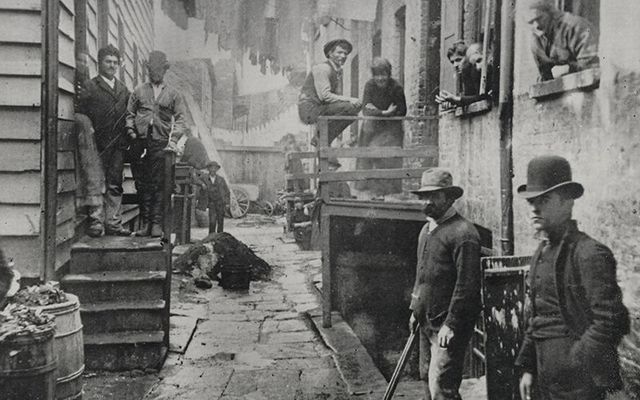
The famous Jacob Riis photo of residents of Five Points, in the Lower Eastside of New York City.Jacob Riis / NYC Library
Geez, darn, babe – proving that American slang has its roots in the Irish American urban experience
Just before he died, Daniel Cassidy released a pioneering book that begins to prove how American slang has a root in the Irish American urban experience.
As usual, snoots would rather fall on the side of error than to end the kibosh on ascribing Irish origins to any aspect of Anglo-American society.
Ireland has a native civilization older than England or France, and it has out-proportioned contributions to modernist culture, but it is more usually described as derivative rather than an originator of trends. Despite stubborn refusal, “jazz” and “poker”, “moolah” and “spunk” all derive from Irish Gaelic, which was used in New York by the Irish like Yiddish and Spanglish was used later-on in the city.
Some dismiss these theories without any real understanding of the Irish Gaelic language. They existentially must disallow the language had mixed with English – jerks without the knack to dig it. Others dismiss the theories in loyalty to academia’s wine and cheese status quo, and don’t wish to seem too maverick, or too “street,” like Cassidy who had an unabashed Brooklyn accent. There’s an element of snobbery involved in the outright refusal many swells have for this working stiff’s tome.
Cassidy was among those who have begun to case the hidden history, anyway, and show how gambling slang, underworld lingo, street gang terms, street-wise cant, merchant code and political jargon in New York City is teeming with Irish Gaelic that melted into American English.
Fellow politically-minded academics present English history and culture as being spic and span of Irish influence, and so ignore impulsively, both Irish American slang-smiths in the modern period and Irish Gaelic teachers who taught the early Medieval English how to read and write. They prefer to label Irish words in English as unknown, or originated in more swank cultures like Latin or French. It’s basic prejudice on the side of the common hegemony, rooted in ignorance.
This is a small taste compiled from Daniel Cassidy’s boss book, “How the Irish Invented Slang”, and from Niall Ó Donaill’s “Foclóir Gaeilge-Béarla”.
We don’t normally exclaim “Gee whiz” or “Gee whilikers” anymore. We associate such talk with a classic time in New York, when Irish Gaelic was the secret language of the slums, an Irish Gaelic word which means ‘s slom é, or “it’s bleak.” In the slums it was common to hear Irish people say Dia Thoilleachas, Gee Hillukus, which became Gee Whilikers, and means the “will of God.” “Gee” is the approximate pronunciation of Dia, or the Irish word for God. “Holy cow” means Holy Cathú or Holy Cahoo or Holy Grief. “Darn” is another Gaelic exclamation. In Irish you say daithairne ort, which means, “darn on you” or “misfortune on you.” Gee whiz comes from Dia Uas or Geeuh Woous which means “noble god.”
Irish love words were once all over pop songs pumped out from Tin Pan Alley. “Mother Macree”, or mother of my heart, was a huge hit from those early days of pop. A big name in early popular theater, was Irishman Dion Boucicault who wrote ‘The Streets of New York”, and included lots of Gaelic in the titles and dialogue of his blockbusters.
Irish pet names like peata, or pet, are still current, as is báb or bawb, which is babe today.
Love songs were published as sheet music for people to sing to at the piano, and it was commonplace to hear Irish pet names like Avourneen, Mavourneen, Acushla, Agrah and other lovely words like that
The Irish were pioneers in pop culture, and they littered American popular entertainment from Mother Macree to Huckleberry Finn with snippets of their language.
If you want to cully support, you’re calling on your cuallaí, or friends to help you. In modern Irish, collaí has the sense of being carnal or sexual.
If you want to gather people together you make a ballyhoo about the gathering, which in Irish is bailliú, and pronounced like ballyhoo. You might use a slogan in your ballyhoo to promote the gathering, as slogan comes from slua ghairm, the yell of a crowd or a battle-cry. Ballyhoo entered the language at the circus, where Irish people would use slogans to make ballyhoo about a new show everyone should come out and see. Buddy is another Irish Gaelic word, which comes from the Irish expression, a vuddy, or a bhodaigh, which means something like “pal.” The root of the word bhodaigh is strangely, bod, which is the Irish word for penis, and pronounced like bud.
Speaking of body parts, the Irish put their Gaelic mark all over the stiff, or corpse, which comes from the word staf or “big guy.” If someone has their snout in the air, they’re acting like snoots, which comes from the Irish expression snua aird or when someone appears to be on high and is acting like a swank swell with his nose in the air.
Swank is the Irish word somhaoineach or “valuable” in disguise. Swell is the word sóúil or “luxurious” dolled up to suit the English speaker. If you kick a rich guy in the can, you’re kicking him in his ceann which is the “extremity” of a thing, and also “head,” which is at the other end from the tail end.
Dogs comes from do chos your feet. The vulgar word for the vagina, pussy, isn’t so bad, it just means pus or pouty lips in Irish Gaelic. It’s a descriptive term, and not insulting. Mug, however, is insulting, and the common phrase “ugly mug” comes from the word muic, which means pig.
Irish Gaelic was a secret language in Éire, which was once an Ireland riddled with foreign spies, and so it was a language to keep the copper (the catcher, the thinker) from catching on. Cop comes from ceapaim, and means “I catch, think etc.” You try to keep the cop from figuring out your racket, or your reacaireacht, your “dealing, selling or gossiping.”
Just like the word bailiff came from the Gaelic word baille for bally or homevillage, the word in New York for the cop on the beat, was the ceap on the béad, the protector on ill-deeds.
Another kind of Big Shot is the racketeer, who can be a cop or a goon – glommers collecting grift – official or underworld. There’s little difference when you boil it down between official thieves and illegal ones, and the Irish knew this, observing the most organized acts of criminality enacted by a dolled up British state, exploiting and criminalizing their own civilization. Big Shot is the Irish word for chief in disguise: seoid, meaning “jewel” or figuratively, “chief.”
Racketeer is also related to the Irish word reachtaire which was the title for the money-taking administrator at a colonial big house or at a church office back in Ireland. On the streets of New York, the racketeer has translated the duties and strategies of the colonizer into street crime rackets for himself–the oppressed learn the methods of oppression better than anyone.
A word that should be brought back is “joint” for place or establishment or room. It’s a word that instantly conjures an entire world of old New York. It comes from the Irish word for protection or shelter, a place with a roof, such as in the root of the Irish word for penthouse, díonteach or jeent-ock.
If you want to ditch a joint, and skedaddle in a jiffy, because some dick has copped on to your whereabouts, you want to de áit a díonteach or de-place a joint, and sciord ar dólámh or make an all out slip in a deifir in a “hurry,” because some dearc or “eye” or PI, has ceaptha or thought or caught on to your whereabouts.
Eugene O’Neill was another huge name in early American pop culture. His plays were also high art, but riddled with Irish themes and language. His favorite word for money was jack, which is a straight-up glom from the Irish tiach, or money or purse. A guy with a jack-roll, was a guy with a wad of cash, spoondoolies or dollars, rolled up. Spoondoolie is one of those old slang words that got resurrected recently in video games, along with Simolions, the currency of Sim City, an urban planning computer fantasy. They’re weird English takes on Irish Gaelic expression for a big pile of money or suim oll amháin.
Not everyone is hip to the process where words in one language get misheard and pronounced differently in the new language. In Irish if you want make sure someone understands your meaning, you say, Diggin tú? It’s a normal phrase you hear at the end of sentences all the time. In America, An duigeann tú? Became Diggin you? or You dig? It takes a certain knack to understand how closely related the concepts and sounds of tuig and dig are to each other.
Most scholars go by their goofy hunch, that tells them that Irish Gaelic is some dead language no one ever spoke. In fact, it was the first language of most Irish Americans that came here in the big flood of Irish after the famine, when that famine adversely targeted Irish-speaking areas first and foremost, sending Irish speakers to America before anyone.
In the anti-Gaelic mind, Irish language is a queer idea, and way too vast a thing to even engage – easier to kill it than to incorporate it into an academic’s repertoire of reference. The academic makes this decision usually because he or she is already burdened with three centuries of censorious English state propaganda about the meaning and origin of Anglo-American civilization, which did not come about like their poets’ tell us it did.
Another reason Irish Gaelic is neglected as an original source for American slang, is because a lot of the street slang that the Irish made up, relates to a world of vice and crime, some Irish would prefer did not exist.
There is shame associated with the destruction of native Irish Gaelic civilization, because the Irish lost their literature and institutions with the victory of the British Empire over their native government. They were impoverished, and took up crime in some instances. The Irish share with Black people and Jews, an urban legacy in America that is not squeaky clean, but rather dirty, like life is dirty when you have no money.
Having street smarts is one way to look at the world realistically, and not be duped by those who would double-cross you to take your jag on the personal level or your natural resources on the imperial one. Those who first come to the city as hicks or boobs, come with the law of hospitality firmly entrenched in their hearts, only to awaken from such kindness by the cruelty of urban America. It’s dangerous to be a dork or ninny in the dog eat dog world. That’s why there are so many words for the person-preconditioning, the person before he develops the cop-on that accompanies an ambitious life post-nincompoop to make it in New York.
One way to wake up is to get slugged in the face and have your jag jacked. The Fighting Irish is a common aptronym that describes the occupation of many a brawler that had to whale on an opponent to survive or climb the ladder leading out of the rat race.
As an organized people, they were sparring with a much better-organized establishment. The Irish bickered with the WASP elite until the established order in New York broke down, reformed the sweatshop system of labor in Victorian Anglo-American society, and conceded to the unions and political machines the rights and benefits that created the middle class from the working class that the establishment would have been happy to see slaving away in sweatshops to this day. Instead, the Irish organized and fought for a conception of America that yielded working people an American Dream, a chance to climb out of the slum and into a middle-class job and lifestyle.
Lace curtain Irish is a term that describes the middle class Irish who climbed out of the slum into the spic and span homes of the American dream. They left behind a time in American cities when the Irish were smack dab in the middle of street life, theater, pop entertainment, and politics. The swells from the WASP tradition who owned the banks and institutions of American society tried everything to defame and prevent the Irish from joining their swank ranks, but that ended, or so the story goes, when JFK broke the barrier that separated the WASP from the Irish, and went from Harvard to the White House, key bastions of the establishment’s institutional power.
One of the ways the Irish got there was by giving up their jazzy speech for the snazzy touch that remade them into crackers and honkies. Although it’s commonplace to describe the Irish today as white establishment members, par excellence, they come from Irish Gaelic roots that put them in the middle of New York street life. We’re comfortable enough now where we can re-engage that original condition, and reclaim for ourselves a key position in the history of American pop entertainment, language and culture.
For the first time since Stormont’s collapse, there is now clear cross-community concern that health crisis means that lives are at stake
by Sam McBride
Monday, 16th December 2019, 6:03 pm Voters deserted Sinn Féin’s Elisha McCallion, pictured second right next to Michelle O’Neill, en masse during the election (Photo: PAUL FAITH/AFP/Getty)
Where there has been focus on Sinn Féin’s problems over the past few days, it has centred on Foyle – understandable because what had been Sinn Féin’s lead of 169 votes turned into a landslide majority of more than 17,000 for SDLP leader Colum Eastwood.
In a safe nationalist seat where the SDLP put up a credible candidate and nationalist voters could express their preference without any fear of a unionist victory, voters deserted Sinn Féin’s Elisha McCallion en masse.
Ms McCallion was widely regarded – even among some republicans – as simply not up to the job.Across Northern Ireland, Sinn Féin’s vote dropped by 6.6 percentage points, more than that of any other party. Pictured Mary Lou McDonald with Michelle O’Neill (Photo: Charles McQuillan/Getty)
Less than two months after Martin McGuinness’s death, and amid SDLP allegations in Parliament of vote fraud by Sinn Féin (which it denied), she had narrowly defeated the veteran Mark Durkan in 2017.
It was a measure of her inability to make an impact that in two and a half years one of the things that she was most known for was publicly complaining about the size of her London hotel room when she first flew to Westminster.
Her result was all the more humiliating because Sinn Féin had thrown everything at saving her seat – its Ard Fheis was held in Londonderry and she was repeatedly featured on the platform. Mary Lou McDonald, Michelle O’Neill and even Gerry Adams went to canvass for her. The party put enormous effort into promoting her on social media, only to see her vote collapse.
However, while the Foyle result will reverberate within republicanism for months, there is another surprising seat where on one metric Sinn Féin actually performed worse.
I was seated beside Mary Lou McDonald in RTÉ’s studio at the Belfast count centre as the West Belfast result was announced.
The Sinn Féin president professed herself pleased at a good result for the party and, in what is the most predictable seat in Northern Ireland, the rest of us were sufficiently distracted by the dramatic events elsewhere to fully grasp what the figures meant.
In fact, although Paul Maskey retained the seat at a canter, with a majority of more than 14,000, his share of the vote (53.8%) is now the lowest Sinn Féin has achieved in West Belfast in any election since 1996.
As well as his own vote falling because of voters not coming out, votes leached to the socialist People Before Profit and the new republican anti-abortion party Aontú as well as Alliance.The one unalloyed success for Sinn Féin was North Belfast in John Finucane’s victory against DUP’s Nigel Dodds (Photo: Charles McQuillan/Getty)
As recently as the 2010 general election, Sinn Féin was taking 71% of the votes in West Belfast. Lest Sinn Féin now try to claim that this was simply a personal vote for Gerry Adams, in the 2011 by-election after the then Sinn Féin president resigned his seat Mr Maskey was still taking more than 70% of the vote.
The one unalloyed success for Sinn Féin was North Belfast. But there John Finucane was not really standing as a typical Sinn Fein candidate, but on a single issue – Brexit – and was backed by the SDLP and Greens who stood aside in his favour.
On social media, Sinn Fein activists have been attempting to explain that away as a consequence of the party standing aside in three seats – South Belfast, East Belfast and North Down. That explanation doesn’t stand up under basic scrutiny.
Firstly, with the exception of Alliance, all other major other parties were also not standing in every seat.
Secondly, even assuming that Sinn Fein’s vote in those seats remained at 2017 levels it would mean only an additional 8,568 votes. That would equate to an improvement of about one percentage point, leaving the party’s vote still down more than that of the DUP.
The reasons for republicans moving away from Sinn Fein are likely disparate. For the first time since Stormont’s collapse, there is now clear cross-community concern that the health crisis means that lives are at stake.Some voters see politicians such as SDLP’s Colum Eastwood, centre, as far smarter, more articulate and less robotic than many Sinn Féin figures north of the border (Photo: Charles McQuillan/Getty)
Other voters now believe that Sinn Féin’s Westminster abstentionism is archaic and untenable in the face of Brexit.
Still others simply want competent representatives and see politicians such as Colum Eastwood as far smarter, more articulate and less robotic than many Sinn Féin figures north of the border.
Whatever the reason, this is the third northern election this year in which voters have given Sinn Féin’s leadership a warning.
Nationalist commentator Chris Donnelly, a critical if sympathetic observer of his former party, noted on Slugger O’Toole that “were these results to be repeated at Assembly level, a quarter of the party’s seats would be swept away.”
John O’Dowd’s recent challenge to Michelle O’Neill revealed major internal discontent at her performance.
Two weeks ago Gerry Adams announced in a press release that Ms O’Neill – rather than Mr O’Dowd or Conor Murphy – would be Sinn Féin’s nominee for deputy First Minister.
If Stormont is now to return, do Sinn Fein voters trust her to take on the role and keep watch on the DUP?
The British election of 12/12/19 can without hyperbole be described as a seismic event in the history of the United Kingdom, and its tremors will undoubtedly impact Ireland. Three items put the impact of last night into perspective:
The Tory party has won its biggest victory since Margaret Thatcher captured a third term in 1987
The Labour party has suffered its worst defeat since 1935.
For the first time since partition, Northern Ireland has returned more Nationalist than Union MPs to Westminster.
So, what does this mean? First, it means that barring some utterly unforeseen circumstance that Brexit from an Irish perspective is done. With a clear majority in the British parliament, Boris Johnson can now push through the Brexit deal agreed to with the European Union which puts Britain’s Brexit border at the Irish coast and respects the Good Friday Agreement. If Brexit is to happen, then this is the best outcome for Ireland. You Brothers made this possible by having your U.S. elected representatives make clear that a Brexit border along the six counties would take a post-Brexit U.S./U.K. trade deal off the table.
The election also means the Democratic Unionist Party (DUP) has lost its position as kingmakers in parliament and is now effectively a Westminster non-entity. The victory of John Finucane, the son of murdered solicitor Pat Finucane, over Nigel Dodds, the number two person in the DUP, by an overwhelming majority is a major blow for Arlene Foster and her party. The DUP will now be under pressure to restore the devolved government so they can have relevance. It is hard to see how having squandered the unique opportunity the DUP enjoyed in parliament for the past two years, not to mention her role in a still unresolved political scandal, Arlene Foster can survive in her leadership role. Given, as noted, that her number two Nigel Dodds has suffered a glaring defeat, the DUP will likely seek new leadership. The critical question is will they seek a new direction?
However, without wishing to vindicate Yeat’s observation, “Being Irish, he had an abiding sense of tragedy, which sustained him through temporary periods of joy,” we must be cautious. No sea change such as this comes without rough waters. Arlene Foster’s comment that “the pan-nationalist front has come to fruition again” may indicate that the DUP will retreat into its fundamental strategy of stoking fear and division rather than moving forward in engagement.
It is, therefore, imperative that we once again make the push for a U.S. Special Envoy to Northern Ireland to serve as an impartial, stabilizing influence during the dramatic changes which lie ahead. As a fair agent, a U.S. Envoy would mitigate the fears of Unionists and preclude their retreat into the divisive comfort zones of the past. Much of the Good Friday Agreement has yet to be implemented; until it and its vision of parity of esteem for all the people of the North is realized, then the ghost of violence remains at the table. It is time for the administration to appoint the Special Envoy which was promised and seal its historic legacy in the cause of peace which is the Good Friday Agreement.
Catholics currently make up about one third of the PSNI [which has 6, 832 members]BBC NI. Belfast. Sunday, December 15, 2019 The head of the Catholic Church in Ireland has called for a return to 50:50 recruitment in the Police Service of Northern Ireland (PSNI).
Archbishop Eamon Martin was writing in The Irish Catholic newspaper, following a meeting of church leaders with Chief Constable Simon Byrne.
Catholics currently make up about 32% of the PSNI [approximately 2,186 Catholics].
The archbishop said he had “concerns” about the future balance of community representation.
The PSNI replaced the Royal Ulster Constabulary in November 2001, and the 50-50 recruitment policy ran for its first 10 years until 2011.
It meant one Catholic recruit for every one person from a Protestant or other background.
Writing in the Irish Catholic, Archbishop Martin called for Catholics to consider the “noble vocation” and for communities to encourage and support them.
Archbishop Martin told The Irish Catholic: “Because Patten’s target of moving towards a police service that is representative of the society that it polices, I feel that in recent years it has reached a bit of a plateau and I would be concerned about that.”
Speaking about the current figures, the archbishop added: “It’s almost 20% short of the percentage of young Catholics who are out there.
“If you think of that age group of young people in Northern Ireland, almost 50% of those young people are Catholic and I think it should be a matter of concern, not just for Catholic communities, but indeed for the whole community.
“Because if we do not have a police service which is representative of the society that it polices, you immediately begin to run into accusations that the police service is not friendly to Catholic people, or you allow a vacuum to be created which allows others to exploit intimidation and fear in communities.”
Michael Kelly, the editor of the Irish Catholic newspaper, told BBC Radio Ulster’s Sunday Sequence programme: “If Catholics are substantially under represented by the people who police the community, then that is inevitably going to lead to a breach of trust.”
In August, the current chief constable said that he felt the PSNI was “not yet back at the point” where it needed to reintroduce the 50-50 recruitment process.
Mr Byrne has said he wants money to increase police numbers to the 7,500 suggested under Patten reforms two decades ago.
In September of this year, ex-PSNI Chief Constable Sir Hugh Orde said officer numbers were at a “dangerous” level in the face of increased dissident republican attacks.
He also said consideration should be given to re-introducing the hiring policy to address low numbers of Catholic recruits, adding that it was “a shame” Catholic recruitment is slowing down”.
In September 1999, the report of the Independent Commission on Policing for Northern Ireland, chaired by Lord Patten, signalled major reforms and the beginning of the end of the Royal Ulster Constabulary (RUC).
The Police Service of Northern Ireland replaced the RUC in November 2001.
A new PSNI recruitment drive is to be launched in January.
December 16, 2019 Dear Friends in the Lord, As we approach the great celebration of Christmas, the birth of our Savior, I wanted to take the opportunity to remind you that today, December 16, all parishes in the Archdiocese of New York and the Diocese of Brooklyn will offer the Sacrament of Confession from 4 p.m. to 8 p.m. for Reconciliation Monday! There is no better way to prepare to welcome Jesus than taking part in this wonderful opportunity for reconciliation. To find a parish near you in our archdiocese, you can use the parish finder on our website here. Has it been a while since you last went to Confession? Not sure what to do or say? Don’t worry. We’ve collected a few resources to help you prepare for confession at our website, here. Or, you can just ask the priest to guide you. He’ll be happy to help. May these final days of Advent be a time of prayerful preparation for you and your loved ones. Monsignor Joseph P. LaMorteVicar General and Moderator of the Curia