Although I have never read any of Lee Child’s ‘Jack Reacher’ novels, I have listened to lots of Elvis Costello over the years. Apart from the pair sharing an Irish background, the connection between them might appear tenuous. However, both were at Buckingham Palace recently to receive honours from the Queen. Perhaps incongruously given the setting, the two were also asked about their views on Irish unity. ‘I make no distinction between north and south and I really hope the island is unified soon,’ said Child, picking up a CBE for services to literature. ‘I hope that’s going to be the positive outcome of Brexit. It’s hundreds of years overdue.’ Irish unity was ‘an inevitability,’ according to Costello, picking up an OBE. ‘Maybe in my lifetime, in the lifetime of my children…’
During the dark decades of Northern Ireland’s troubles, voicing support for Irish unity, particularly as IRA bombs were going off, would have been a marginal pursuit, to put it mildly. But these are different times.
Neither man saw any contradiction between standing in front of the British Monarch to be honoured, while also supporting the peaceful reunification of the island of Ireland. A portent, perhaps, of how these countries, with their overlapping cultures, intertwined history and familial bonds will, in due course, make sense of a managed transfer of sovereignty over Northern Ireland. Priced in
That a process, of sorts, is underway to reunify the island of Ireland has now become received opinion. It must be in order to make it onto the front cover of The Economist. Back in February, the bulletin board of the international political and corporate elite claimed that:
‘Scottish independence has grabbed headlines since Brexit, but it is time to recognise the chances of a different secession from the United Kingdom. Sinn Féin’s success at the [Irish general] election is just the latest reason to think that a united Ireland within a decade or so is a real — and growing — possibility.’
It is not their style to offer endorsements; they speculate, intelligently, on what is likely to happen, explore whether it is feasible and then tell their readers if they should be concerned or not. An illustration, perhaps, that Irish unity is now being ‘priced in’ by policy makers and business leaders. We will continue to see animated discussions about the timeline, but the direction of travel is increasingly accepted. There is a magnetic effect pulling us towards a border poll — a referendum on Northern Ireland’s constitutional status — and an ever-widening body of opinion is becoming accustomed to that reality.
But if this is mood music then lets also consider hard power developments. Sinn Féin’s strong showing in the Irish General Election back in February — topping the poll and tying for top spot in terms of seats with Fianna Fail — is potentially game-changing. Even if the increasingly beleaguered Fianna Fail leader, Micheál Martin, manages to patch together a deal with Leo Varadkar’s Fine Gael to form a new government (FF has propped-up a FG minority government since 2016 in a confidence and supply arrangement), it will simply amount to a final twirl around the dancefloor for the south’s ancien régime.
Martin and Varadkar will hope the result of the election is a blip, a reaction to their tin-eared approach to domestic concerns around cost of living issues these past few years. But it feels more significant than that. Sinn Féin overcame the implacable hostility of Dublin’s political and media elite and still prevailed. So long the outsiders — marginalised and unrespectable as ‘the political wing of the IRA’ — it feels as though something structural has now changed.
A tilting of the field, certainly, towards the interests of younger voters and centre-left prescriptions. And, perhaps, a demystifying of Sinn Féin as something ‘other’ in southern politics. It helps that the party’s new leader, Mary-Lou McDonald is unconnected to her party’s militant past and brilliantly articulated the frustrations of ordinary families around the economic inequalities blighting modern Ireland. As a vignette, a video of her first speech in the Dail following the election garnered two million hits.
Anyway, how would a coalition of Fianna Fail and Fine Gael — rival civil war era parties that have dominated the past century in Irish politics — even work? The idea being floated of a rotating leadership, with Micheál Martin and Leo Varadkar taking turns at being Taoiseach, seems unfeasible and certainly unsustainable. (Not to mention it appears poor form to freeze out the actual winners of the election).
Meanwhile, the former Fianna Fail Taoiseach, Bertie Ahern, one of the key architects of the Good Friday Agreement, has said Irish unity in the next few years is — that word again — ‘inevitable.’ Given the plan to form a coalition with Varadkar is unpopular with much of Fianna Fail’s grassroots, might a successor to Martin change tack and throw their lot in with McDonald instead, if not immediately then at some stage over the next couple of years? The dilemma for Unionists
The overarching problem for unionists is that Northern Ireland was not built to last. The entity was only ever created in 1921 as cover for what would otherwise have been an even more humiliating exit from Ireland by the British state. (Even Churchill expected the six counties to reunite with the south, as Paul Bew makes clear in his recent book, ‘Churchill and Ireland’).
It was carefully constructed to maintain a Protestant-Unionist ascendancy that is fast-eroding as a poll on Irish unity looms into view. Moreover, there is a clear — and agreed — mechanism in the Good Friday Agreement to bring one about. Not to mention the demographic and electoral changes underway that will help assemble a majority vote for it in due course.
But what has fundamentally changed in recent years is that the argument for Irish unity has developed into an evidence-based proposition. There are clear benefits to governing Ireland as a single state — from economics to epidemiology — while Brexit has provided a powerful fillip, widening the constituency of people, who, if not wishing to see it on principle, can certainly accommodate themselves to the reality of it.
Particularly, as it involves automatic readmission to the European Union and the reacquiring of associated benefits that will be carelessly forfeited as Northern Ireland leaves with the rest of the UK. (Not least of which includes €600m a year in EU funding). As a minimum, the constitutional status quo requires the tacit support of the British state. But this is a different Britain from even a generation ago. There is little kinship for unionists to call upon. A poll last month from YouGov showed that:
‘…in principle, more Brits are supportive of a border poll taking place in Northern Ireland than against it by 36% to 25%. A further 39% responded that they didn’t know, showing a strong element of disinterest amongst the British public.’
Put simply, not enough Britons care about what happens to Northern Ireland. Do unionists understand this? The false dawn of the Democratic Unionist Party’s deal with Theresa May should have disabused them of any lingering illusions. The future’s bright, ‘the future’s orange’ quipped one of their MPs, Ian Paisley, when the arrangement to support the Conservatives was first agreed after the 2017 general election, seemingly unaware it was a defunct marketing slogan from a company that had ceased to exist. As a metaphor for the state of Unionism, it takes some beating. Out of time and place, reciting yesterday’s slogans.
After all, we are few months away from new Irish Sea border arrangements, following Boris Johnson’s decision to renege on commitments he had previously made to the DUP. He delighted their conference in 2018 by claiming that an Irish Sea border, with checks on goods moving between Northern Ireland and Great Britain, would amount to making Northern Ireland ‘an economic semi-colony of the EU and would be damaging to the fabric of the Union.’
Yet last December he agreed to just that. Northern Ireland will effectively be treated as part of a united Ireland by the British state for the import and export of agri-produce and manufactured goods. A small but highly symbolic step, courtesy of a Prime Minister representing the Conservative and Unionist Party.
An illustration, then, that the problems unionists face in maintaining their position are now systemic. Peter Robinson scolded the DUP about this as much a decade ago. The party’s former leader explicitly warned that they could not rely on having the numbers to maintain the Union by dint of a sectarian headcount. ‘Our task is not to defeat but to persuade,’ he told the DUP conference.
‘But when have we as unionists actually sought to persuade? And not just by words but by creating the kind of inviting society which everyone will want to be a part of.’ Robinson was remarkably sagacious, yet his successors have their fingers jammed in their ears, resolutely refusing to appeal to Catholic-Nationalists.
Latterly, he has likened engaging in debate about a future border poll to an insurance policy. ‘I don’t expect my own house to burn down but I still insure it because it could happen,’ he said in typically forthright fashion.
But he is not alone. Mike Nesbitt, the former Ulster Unionist leader has spoken of Brexit being unionism’s ‘biggest own goal’ and potentially paving the way for Irish unity. He has said that he knows people ‘of a unionist background who are now ‘thinking the unthinkable’ and asking, ‘would I be worse off?’
Even Billy Hutchinson, leader of the loyalist Progressive Unionist Party, has said unionism must not ‘bury its head in the sand like an ostrich’ as the debate around Irish unity intensifies.
Of course, Unionists signed up for a border poll as part of the Good Friday Agreement. The Union and the very existence of Northern Ireland has been entirely conditional — and time-limited — from that point onwards. The British Government will eventually honour a referendum — and stay well clear when it is held.
To prolong the status quo, unionists need to be able to project their appeal across the aisle. Does the DUP have the temperament to do so? Perhaps, in all honesty, they simply do not want to. It speaks to their insularity and inherent lack of confidence, which is replaced by a bravado which, invariably, manifests itself as tribal drum beating, which, ironically, further erodes the political ground beneath their feet.
The dilemma, then, is whether they can break the habit of a lifetime and make an offer to nationalists that can sustain Northern Ireland, along the lines that Peter Robinson urged in 2011. Either that, or they give serious consideration to their bargaining position in the growing conversation about a new all-Ireland/island settlement. Either option is toxic to many of their supporters. But change is now unstoppable. The problem for United Irelanders
None of which is to claim that it is all plain sailing for those who want to achieve Irish reunification in the next few years. They have, in part, lost control of the narrative over the last year or so, allowing critics to characterise their position as ‘border poll now’ rather than ‘have-the-necessary-dialogue-about-an-eventual-border-poll.’ The difference is significant.
The confusion about whether there ought to be a border poll as an immediate response to Brexit (as some campaigners want) allows southern politicians to say: ‘It’s not the right time.’ So, they need to be clearer about the time frame they envisage. Mary-Lou McDonald says a poll is potentially five years away. This would allow adequate space for discussion about what new Ireland would emerge, while reflecting the impacts of Brexit as well as the growing levels of support for reunification.
Is five years long enough? If Irish history tells us anything, it that a lot can change in half a decade. (The period from the Easter Rising in 1916 to the partition of the country in 1921 shows that). It is also worth bearing in mind where we were in 2015. David Cameron had just won the British general election with a comfortable majority, while no-one had even heard the term ‘Brexit.’ Two prime ministers later and four years on from the referendum vote, its outworking has still to be concluded. Northern Ireland has not yet felt the bow waves from that decision, but they will shake its economy to its shallow foundations. By, say, 2023, opinion in favour of a border poll may be beyond doubt.
There are, then, three main challenges for those supporting Irish unity. The first is to push for greater clarity around the mechanism for securing the poll. The Good Friday Agreement was always meant to be a blueprint for bringing about Irish unity through exclusively peaceful and democratic means. It contains the provision for a vote on Irish reunification, ‘if at any time it appears likely to [the Secretary of State] that a majority of those voting would express a wish that Northern Ireland should cease to be part of the United Kingdom and form part of a united Ireland.’
It’s an elusively-worded phrase, but its meaning is crystal clear: There will be a vote called when there is sufficient prospect of a majority of voters in Northern Ireland — and through a parallel referendum in the south — voting for one. Developing a shared and objective assumption around the metrics and processes that take us to and through a border poll is now urgently required. (Especially as a legal challenge attempting to codify the process was rejected only last month).
The former Northern Ireland Office official, Alan Whysall, writing a paper last year on the prospects of a border poll for The Constitution Unit at University College London, made the point that although the exact trigger for a poll in the Good Friday Agreement remains opaque, there are several criteria that offer a reasonable justification for calling one.
He cites a ‘clear majority in a succession of reliable opinion polls;’ a ‘Catholic majority in a census;’ a ‘majority of members in the Northern Ireland Assembly, or the general election, from nationalist parties;’ and ‘a vote by a majority in the Assembly in favour of a poll.’ As he points out ‘none of them [are] straightforward.’ However, most of these are already in prospect.
Numerous opinion polls have shown support is evening out between those who want a united Ireland those who do not. Tick.
Using data from the census and quarterly labour-force survey, The Economist calculates that ‘Catholics are now the single biggest confessional grouping in Northern Ireland…’ Tick.
The gap between pro-Irish unity and anti-Irish unity parties at the last assembly election in 2017 was just 30,000 votes, while the former now has a majority of Northern Ireland’s 18 Westminster seats. Partial tick.
Whysall’s analysis may provide a glimpse of the final recommendations that will come back from The Constitution Unit’s review into how a border poll would work in practice. They may recommend elongating the process, with the equivalent of an ‘Article 50’ process, where after a vote to leave the UK takes place, there is then a time lag to negotiate the finer details, with this package being put back to the voters in a confirmatory ballot.
Such a recommendation would be implacably rejected by United Irelanders, who have the fortuitous precedent of the British Government’s own Brexit referendum, carried, famously (or infamously depending on taste), by just 52/48 per cent. It provides a powerful legal basis for honouring a straightforward 50 per cent +1 result.
But no-one wants such a close call. So, the second priority must be to maintain the outreach work with unionists and all those who do not instinctively prefer Irish unity. Much good work is already going on in this space, with a genuine attempt by United Irelanders to engage with unionists’ concerns.
The reality is that many unionists will not want to know. To be fair, there is not much point in being a unionist if you meekly acquiesce in the end of Northern Ireland. What is needed, then, is a rapport. Some predictability. A protracted public discussion over the next few years where the issues are clearly and openly discussed. It needs to continue to focus on making a positive case for change, outlining the benefits and opportunities that unity would bring and creating space for unionists to join the discussion. Even if they do not participate, they will at least know what to expect.
Unencumbered by the electoral ramifications, it is much easier for ‘civic’ unionism rather than ‘political’ unionism to occupy a seat at the table. Especially rural voices and parts of the business community, given they will be among the hardest hit by Brexit. The conversation should be open and wide-ranging; without infantilising unionists or the discussion getting lost in the weeds of identity politics.
There are only two stipulations. First, there is no unionist veto. Non-engagement must not limit the legitimate aspirations of United Irelanders. Second, it is reasonable to expect unionists to abide by the result of a border poll. The principle of consent, upon which the Good Friday Agreement is built, is a weathervane. When it finally points south, unionists must honour the decision.
The third priority is allied to this. United Irelanders need to develop ‘proof of concept.’ How will a new Ireland work? What are the benefits? What are the assurances for unionists and others? There needs to be, for instance, a detailed discussion about what institutions a new all-Ireland settlement requires.
There will be a temptation to assume that Stormont should be kept. But is a devolved body, just 100 miles from Ireland’s capital, representing nearly a third of the population of the island, the right model? It would be horribly asymmetrical and lead to all manner of confusion and parallel influence. It would be better to bolster local government across the whole of Ireland, perhaps adopting the British model of ‘metro-mayors’ in major conurbations, providing clustered unionist communities in the north with the realistic prospect of local executive office. (Quite rightly, the Northern Ireland Executive is already inching towards a city-region economic model).
Next, there is a need to agree priorities around the economy, key infrastructure and the harmonisation of public services and entitlements. Integrating the less productive northern economy into the rest of the country by implementing the more dynamic policy model of the south is the straightforward bit. As is ensuring better rail and digital connectivity around Ireland’s principal cities. Again, there is much for unionists to contribute here. Is Ireland to have an equivalent of the NHS, for instance? What comes next?
If Sinn Féin is frozen out by Fianna Fail and Fine Gael in coming days, as seems likely, the debate around Irish reunification will still catalyse. Sinn Féin will then dominate the opposition benches in Leinster House and Fianna Fail’s every instinct, mindful of being superseded by the Shinners, will be to keep them at bay, leading to a general ‘greening’ of the government’s approach to the North. Eventually, we will reach a tipping point and find that everyone in Dublin has been in favour of the reunification of the island all along.
Turning 100 miles north, and the process of normalisation continues. Reunification permeates every discussion. For republicans it becomes the solution to every issue. (To my eternal bemusement, unionist commentators appear to write about little else). All eyes will be on next year’s Census. Will it finally show that Catholics now outnumber Protestants and, if so, what does it now mean in the fast-secularising north? Next year is also Northern Ireland’s centenary. How will unionists, who saw the state carved out in their image respond to the loss of their hegemony?
The following year sees elections to the assembly (although there is a call to push them back to 2023, after a three-year hiatus with the assembly). The effects of Brexit will certainly have been felt by then and so the stakes have never been higher. If unionists can maintain top spot and a plurality of the vote, they will be able to repel calls for a border poll. If Sinn Féin manages to push the DUP into second place (it was just 1,000 votes behind in 2017), then the talk will be of little else.
Given I have written a book predicting the ‘inevitability’ of the reunification of the island of Ireland, I have not left myself much wiggle-room. However, in the full consideration of unfolding events, I would contend that I do not need it.
Kevin Meagher is the author of ‘A United Ireland: Why unification is inevitable’, available here.
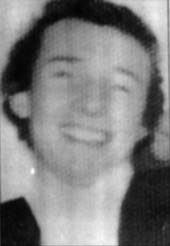
Raymond Peter McCreesh, the seventh in a family of eight children, was born in St. Malachy’s Park, Camlough (So Armagh) on 25 February 1957.He was born into a strong nationalist family, and was active in the Republican movement since age 16.He attended the local primary school, St Malachy’s, and later attended St Colman’s College where he met Danny McGuinness.Raymond first joined na Fianna Éireann in 1973, and later that year he joined the Irish Republican Army’s 1st Battalion, South Armagh. The operation which led to the capture of Raymond, his boyhood friend, Danny McGuiness, and Patrick Quinn, took place on June 25th, 1976.
An active service unit comprising these three and a fourth Volunteer arrived in a commandeered car at a farmyard in the town land of Sturgan a mile from Camlough – at about 9.25 p.m.
Their objective was to ambush a covert Brit observation post which they had located opposite the Mountain House Inn, on the main Newry – Newtonhamilton Road, half-a-mile away. They were not aware, however, that another covert British observation post, on a steep hillside half-a-mile away, had already spotted the four masked, uniformed and armed Volunteers, clearly visible below them, and that radioed helicopter reinforcements were already closing in.
As the fourth Volunteer drove the commandeered car down the road to the agreed ambush point, to act as a lure for the Brits, the other three moved down the hedgeline of the fields, into position. The fourth Volunteer, however, as he returned, as arranged, to rejoin his comrades, spotted the British Paratroopers on the hillside closing in on his unsuspecting friends and, although armed only with a short range Stengun, opened fire to warn the others.
Immediately, the Brits opened fire with SLRs and light machine-guns, churning up the ground around the Volunteers with hundreds of rounds, firing indiscriminately into the nearby farmhouse and two vehicles parked outside, and killing a grazing cow!
The fourth Volunteer was struck by three bullets, in the leg, arm and chest, but managed to crawl away and to elude the massive follow up search, escaping safely – though seriously injured – the following day.
Raymond and Paddy Quinn ran zig-zag across open fields to a nearby house, under fire all this time, intending to commandeer a car. Unfortunately, the car belonging to the occupants of the house was parked at a neighbour’s house several hundred yards away. Even then the pair might have escaped but that they delayed several minutes waiting for their comrade, Danny McGuinness, who however had got separated from them and had taken cover in a disused quarry outhouse (where he was captured in a follow-up operation the next day).
The house in which Raymond and Paddy took cover was immediately besieged by berserk Paratroopers who riddled the house with bullets. Even when the two Volunteers surrendered, after the arrival of a local priest, and came out through the front door with their hands up, the Paras opened fire again and the Pair were forced to retreat back into the house.
On the arrival of the RUC, the two Volunteers again surrendered and were taken to Bessbrook barracks where they were questioned and beaten for three days before being charged.
On 2 March 1977, McCreesh and Paddy Quinn were convicted and sentenced to fourteen years in prison for attempted murder, possession of a rifle and ammunition and a further five year for IRA membership.In the H-Blocks he immediately joined the blanket protest, and so determined was his resistance to criminalisation that he refused to take his monthly visits for four years, right up until he informed his family of his decision to go on hunger strike. Raymond’s resolve to hunger strike to the death, to secure the prisoners’ five demands was indicated in a smuggled-out letter written by Paddy Quinn, an H-Block blanket man – who was later to embark on hunger strike himself – who was captured along with Raymond and who received the same fourteen year sentence: “I wrote Raymie a couple of letters before he went to the prison hospital. He wrote back and according to the letter he was in great spirits and very determined. A sign of that determination was the way he finished off by saying: Ta seans ann go mbeidh me abhaile rombat a chara’ which means: There is a chance that I’ll be home before you, my friend!” Raymond died at 2.11 a.m. on Thursday May 21st, 1981, after 61 days on hunger strike.
Died May 21st, 1981 A determined and courageous Derryman
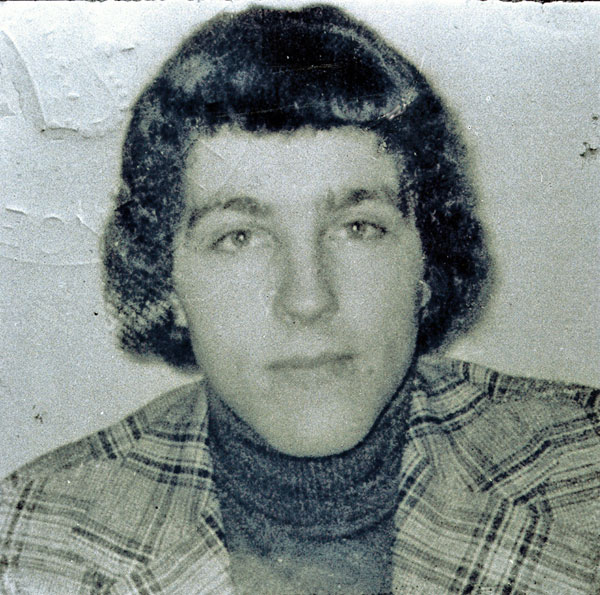
Twenty-three-year-old Patsy O’Hara from Derry city, was the former leader of the Irish National Liberation Army prisoners in the H-Blocks, and joined IRA Volunteer Raymond McCreesh on hunger strike on March 22nd, three weeks after Bobby Sands and one week after Francis Hughes.
Patsy O’Hara was born on July 11th, 1957 at Bishop Street in Derry city.
His parents owned a small public house and grocery shop above which the family lived. His eldest brother, Sean Seamus, was interned in Long Kesh for almost four years. The second eldest in the family, Tony, was imprisoned in the H-Blocks – throughout Patsy’s hunger strike – for five years before being released in August of this year, having served his full five-year sentence with no remission.
The youngest in the O’Hara family is twenty-one-year-old Elizabeth.
Before ‘the troubles’ destroyed the family life of the O’Haras, and the overwhelming influence of being an oppressed youth concerned about his country drove Patsy to militant republicanism, there is the interesting history of his near antecedents which must have produced delight in Patsy’s young heart.
GRANDFATHER
Patsy’s maternal grandfather, James McCluskey, joined the British army as a young man and went off to fight in the First World War. He received nine shrapnel wounds at Ypres and was retired on a full pension.
However, on returning to Ireland his patriotism was set alight by Irish resistance and the terror of British rule. He duly threw out his pension book, did not draw any more money and joined the Republican Movement. He transported men and weapons along the Foyle into Derry in the ‘twenties.
He inherited a public house and bookmakers, in Foyle Street, and was a great friend of Derry republican Sean Keenan’s father, also named Sean.
Mrs. Peggy O’Hara can recall ‘old’ Sean Keenan being arrested just before the out break of the Second World War. Her father’s serious illness resulted in him escaping internment and he died shortly afterwards in 1939.
Mrs. O’Hara’s aunt was married to John Mulhern, a Roscommon man, who was in the RIC up until its disbandment in 1921.
“When my father died in 1939 – says Mrs O’Hara, – “John Mulhern, who was living in Bishop Street, and owned a bar and a grocery shop, took us in to look after us. I remember him telling us that he didn’t just go and join the RIC, but it was because there were so many in the family and times were hard.
“My father was a known IRA man and my uncle reared me, and I was often slagged about this. Patsy used to hear this as a child, but Patsy was a very, very straight young fellow and he was a wee bit bigoted about my uncle being a policeman.
“But a number of years ago Patsy came in to me after speaking to an old republican from Corrigans in Donegal, and Patsy says to me, ‘You’ve nothing to be ashamed of, your uncle being a policeman, because that man was telling me that even though he was an RIC man, he was very, very helpful to the IRA!”
FAMILY
The trait of courage which Patsy was to show in later years was in him from the start, says Mr. O’Hara. “No matter who got into trouble in the street outside, Patsy was the boy to go out and do all the fighting for him. He was the fighting man about the area and didn’t care how big they were. He would tackle them. I even saw him fighting men, and in no way could they stop him. He would keep at them. He was like a wee bull terrier!”
Apparently, up until he was about twelve years of age, Patsy was fat and small, “a wee barrel” says his mother. Then suddenly he shot up to grow to over six foot two inches.
Elizabeth, his sister, recalls Patsy: “He was a mad hatter. When we were young he used to always play tricks on me, mother and father. We used to play a game of cards and whoever lost had to do all the things that everybody told them.
“We all won a card game once and made Patsy crawl up the stairs and ‘miaow’ like a cat at my mother’s bedroom door. She woke up the next day and said, ‘am I going mad? I think I heard a cat last night’ and we all started to laugh.”
The O’Haras’ house was open to all their children’s friends, and again to scores of the volunteers who descended on Derry from all corners of Ireland when the RUC invaded in 1969. But before that transformation in people’s politics came, Mrs. O’Hara still lived for her family alone.
She was especially proud of her eldest son, Sean Seamus who had passed his eleven plus and went to college.
PROTESTS
When Sean was in his early teens he joined the housing action group, around 1967, Mrs. O’Hara’s conception of which was Sean helping to get people homes.
“But one day, someone came into me when I was working in the bar, and said, ‘Your son is down in the Guildhall marching up and down with a placard!
“I went down and stood and looked and Finbarr O’Doherty was standing at the side and wee fellows were going up and down. I went over to Sean and said, ‘Who gave you that? He said, Finbarr!’ I took the placard off Sean and went over to Finbarr, put it in his hand, and hit him with my umbrella.’
Mrs. O’Hara laughs when she recalls this incident, as shortly afterwards she was to have her eyes opened.
“After that, I went to protests wherever Sean was, thinking that I could protect him! I remember the October 1968 march because my husband’s brother, Sean, had just been buried.
“We went to the peaceful march over at the Waterside station and saw the people being beaten into the ground. That was the first time that I ever saw water cannons, they were like something from outer space.
“We thought we had to watch Sean, but to my astonishment Patsy and Tony had slipped away, and Patsy was astonished and startled by what he saw.”
INCIDENT
Later, Patsy was to write about this incident: “The mood of the crowd was one of solidarity. People believed they were right and that a great injustice had been done to them. The crowds came in their thousands from every part of the city and as they moved down Duke Street chanting slogans, ‘One man, one vote’ and singing ‘We shall overcome’ I had the feeling that a people united and on the move, were unstoppable.”
IRSP
Shortly after his release in April 1975, Patsy joined the ranks of the fledgling Irish Republican Socialist Party, which the ‘Sticks’, using murder, had attempted to strangle at birth. He was free only about two months when he was stopped at the permanent check-point on the Letterkenny Road whilst driving his father’s car from Buncrana in County Donegal.
The Brits planted a stick of gelignite in the car (such practice was commonplace) and he was charged with possession of explosives. He was remanded in custody for six months, the first trial being stopped due to unusual RUC ineptitude at framing him. At the end of the second trial he was acquitted and released after spending six months in jail.
In 1976, Patsy had to stay out of the house for fear of constant arrest. That year, also, his brother, Tony, was charged with an armed raid, and on the sole evidence of an alleged verbal statement was sentenced to five years in the H-Blocks.
Despite being ‘on the run’ Patsy was still fond of his creature comforts!
His father recalls: “Sean Seamus came in late one night and though the whole place was in darkness he didn’t put the lights on. He went to sit down and fell on the floor. He ran up the stairs and said: ‘I went to sit down and there was nothing there’
“Patsy had taken the sofa on top of a red Rover down to his billet in the Brandywell. Then before we would get up in the morning he would have it back up again. When we saw it sitting there in the morning we said to Sean: ‘Are you going off your head or what? and he was really puzzled.”
IMPRISONED
In September 1976, he was again arrested in the North and along with four others charged with possession of a weapon. During the remand hearings he protested against the withdrawal of political status.
The charge was withdrawn after four months, indicating how the law is twisted to intern people by remanding them in custody and dropping the charges before the case comes to trial.
In June 1977, he was imprisoned for the fourth time. On this occasion, after a seven-day detention in Dublin’s Bridewell, he was charged with holding a garda at gunpoint. He was released on bail six weeks later and was eventually acquitted In January 1978.
Whilst living in the Free State, Patsy was elected to the ard chomhairle of the IRSP, was active in the Bray area, and campaigned against the special courts.
In January 1979, he moved back to Derry but was arrested on May 14th, 1979 and was charged with possessing a hand-grenade.
In January 1980, he was sentenced to eight years in jail and went on the blanket.
HUNGER STRIKE
What were Mrs. O’Hara’s feelings when Patsy told her he was going on hunger strike?
“My feelings at the start, when he went on hunger strike, were that I thought that they would get their just demands, because it is not very much that they are asking for. There is no use in saying that I was very vexed and all the rest of it. There is no use me sitting back in the wings and letting someone else’s son go. Someone’s sons have to go on it and I just happen to be the mother of that son.”
PRINCIPLES
Writing shortly before the hunger strike began, Patsy O’Hara grimly declared: “We stand for the freedom of the Irish nation so that future generations will enjoy the prosperity they rightly deserve, free from foreign interference, oppression and exploitation. The real criminals are the British imperialists who have thrived on the blood and sweat of generations of Irish men.
“They have maintained control of Ireland through force of arms and there is only one way to end it. I would rather die than rot in this concrete tomb for years to come.
Patsy witnessed the baton charges and said: “The people were sandwiched in another street and with the Specials coming from both sides, swinging their truncheons at anything that moved. It was a terrifying experience and one which I shall always remember.”
Mr. and Mrs. O’Hara believe that it was this incident when Patsy was aged eleven, followed by the riots in January 1969 and the ‘Battle of the Bogside’ in August 1969 that aroused passionate feelings of nationalism, and then republicanism, in their son. “Every day he saw something different happening,” says his father. “People getting beaten up, raids and coffins coming out. This was his environment.”
JOINED
In 1970, Patsy joined na Fianna Eireann, drilled and trained in Celtic Park.
Early in 1971, and though he was very young, he joined the Patrick Pearse Sinn Fein cumann in the Bogside, selling Easter lilies and newspapers. Internment, introduced in August 1971, hit the O’Hara family particularly severely with the arrest of Sean Seamus in October. “We never had a proper Christmas since then” says Elizabeth. “When Sean Seamus was interned we never put up decorations and our family has been split-up ever since then.”
Shortly after Sean’s arrest Patsy, one night, went over to a friend’s house in Southway where there were barricades. But coming out of the house, British soldiers opened fire, for no apparent reason, and shot Patsy in the leg. He was only fourteen years of age and spent several weeks in hospital and then several more weeks on crutches.
BLOODY SUNDAY
On January 30th, 1972, his father took him to watch the big anti-internment march as it wound its way down from the Creggan. “I struggled across a banking but was unable to go any further. I watched the march go up into the Brandywell. I could see that it was massive. The rest of my friends went to meet it but I could only go back to my mother’s house and listen to it on the radio,” said Patsy.
Asked about her feelings over Patsy be coming involved in the struggle, Mrs. O’Hara said: “After October 1968, I thought that that was the right thing to do. I am proud of him, proud of them all”.
Mr O’Hara said: “Personally speaking, I knew he would get involved. It was in his nature. He hated bullies al his life, and he saw big bullies in uniform and he would tackle them as well.
Shortly after Bloody Sunday, Patsy joined the ‘Republican Clubs’ and was active until 1973, “when it became apparent that they were firmly on the path to reformism and had abandoned the national question”.
INTERNED
From this time onwards he was continually harassed, taken in for interrogation and assaulted.
One day, he and a friend were arrested on the Briemoor Road. Two saracens screeched to a halt beside them. Patsy later described this arrest: “We were thrown onto the floor and as they were bringing us to the arrest centre, we were given a beating with their batons and rifles. When we arrived and were getting out of the vehicles we were tripped and fell on our faces”.
Three months later, after his seventeenth birthday, he was taken to the notorious interrogation centre at Ballykelly. He was interrogated for three days and then interned with three others who had been held for nine days.
“Long Kesh had been burned the week previously” said Patsy, “and as we flew above the camp in a British army helicopter we could see the complete devastation. When we arrived, we were given two blankets and mattresses and put into one of the cages.
“For the next two months we were on a starvation diet, no facilities of any” kind, and most men lying out open to the elements…
“That December a ceasefire was announced, then internment was phased out.” Merlyn Rees also announced at the same time that special category status would be withdrawn on March 1st, 1976. I did not know then how much that change of policy would effect me in less than three years”.
Patsy O’Hara died at 11.29 p.m. on Thursday, May 21st – on the same day as Raymond McCreesh with whom he had embarked on the hunger-strike sixty-one days earlier.
Even in death his torturers would not let him rest. When the O’Hara family been broken and his corpse bore several burn marks inflicted after his death.
• Fearless and tenacious guerrilla fighter Volunteer Francis Hughes
» Special Correspondent
THE DEATH of Francis Hughes at the age of
25 on hunger strike in the H-Blocks of Long Kesh saw not the end of a legend
but a new chapter in what was, by any measure, the story of one of the most
fearless and tenacious guerrilla fighters of the 20th Century and of the Irish
Republican Army.
Born in Bellaghy, South Derry, on 28
February 1956, Francis was once described
by the British authorities as “the most wanted man” in the North of Ireland – a
telling indication of his effectiveness as a guerrilla fighter against enemy
forces in his native terrain.
He was arrested on 16 March 1978 following
a gun battle in which an undercover British soldier was killed. Francis was
seriously wounded during the exchange and was captured in a follow-up search of
the area. He received a life sentence in February 1980.
Francis Hughes died on 12 May 1981 after 59
days on hunger strike.
Legendary Volunteer dies on Hunger Strike
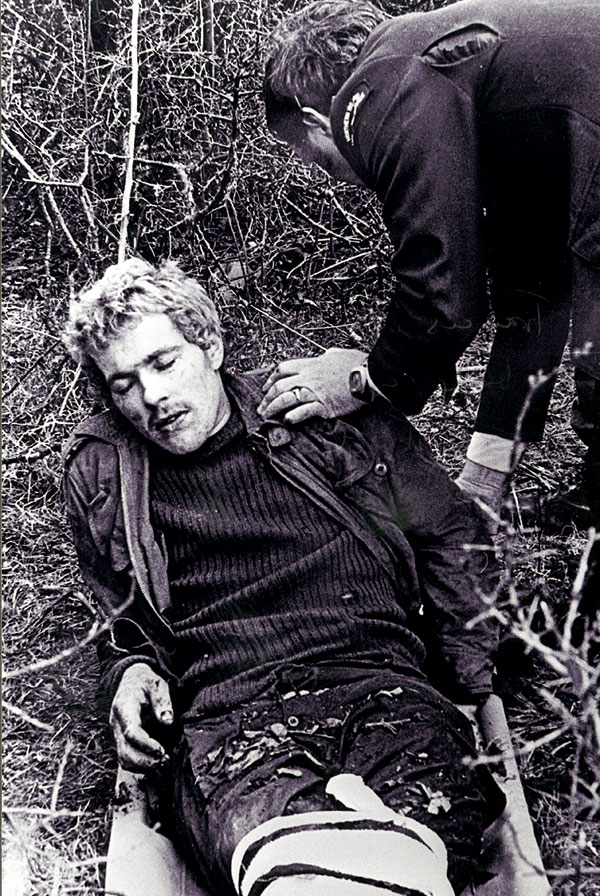
• Legendary freedom fighter Francis
Hughes, pictured during his capture by crown forces. Hughes lies badly injured
following a gun battle. He wears combat clothing and his hair has been dyed to
disguise his identity
ON 12 May 1981, at 5:43 pm, just seven days
after the death of Bobby Sands, Hunger Striker Francis Hughes died. The South
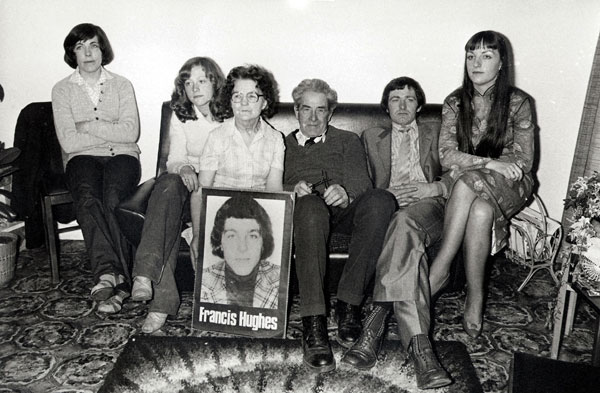
Derry man had endured 59 days on hunger strike. His sisters Noreen, Maria and
Vera and brother Roger were by his bedside when he passed away.
Paying tribute to Hughes, the IRA said he
was one of the bravest soldiers of the armed struggle against British rule.
Sinn Féin’s Gerry Adams called on British
Premier Margaret Thatcher to accept that her efforts to stare down the Hunger
Strike had failed, and for Taoiseach Charles Haughey to end his silence, which
Adams said encouraged British intransigence.
Cardinal Tomás Ó Fiaich implored of
Thatcher:
“How many more Irishmen must go to their
graves inside and outside before
intransigence gives way to a constructive effort to find a solution?”
In the United States, Senator Edward
Kennedy decried Thatcher’s intransigence whilst Boston City Council renamed the
street on which the British Consulate is located as Francis Hughes Street.
Speaking to An Phoblacht on the day before
his son’s death, Francis Hughes’s father told of his last visit to his dying
son:
“It’s a terrible thing to see a young lad
dying but amazingly he was in great spirits. His face was just yellow with eyes
sunken. Just the same as a corpse lying there. I said: ‘Do you see me,
Francis?’ He said: ‘I see the shape of you but I can’t see your face.’
“When he had gotten a wee sleep he chatted
away and caught my hand and held it tight. I said to him, ‘You’re not too bad,’
and he said, ‘Ah, now, tomorrow or Wednesday will see the end of it.’”
• The Hughes family
Reaction on the streets
The evening of Francis Hughes’s death saw
an upsurge in attacks by the IRA with the British Army and RUC coming under
fire across Belfast. Riots, which had been raging since the death of Bobby
Sands, intensified with nationalist youths across the Six Counties engaging
British crown forces with bricks and petrol bombs.
In Dublin, the most serious rioting since
the 1972 burning of the British Embassy in the aftermath of the Bloody Sunday
massacre of civil rights marchers by British paratroopers occurred. Gardaí
attacked a march going from the GPO to the British Embassy in Ballsbridge with
an indiscriminate baton charge.
Sinn Féin President Ruairí Ó Brádaigh
castigated Taoiseach Charles Haughey on his inaction.
On the same evening, in a sickening and
deliberate act of murder, 14-year-old Julie Livingston was killed by a British
Army plastic bullet in Lenadoon, west Belfast. Francis Hughes’s death was the
impetus for an increased use of lethal plastic bullets and injuries received
from them rose dramatically across the Six Counties after 12 May.
Legendary figure
Francis Hughes had been captured by the
British on 16 March 1978 following a gun battle that killed an SAS soldier and
left Hughes wounded in the leg.
He had been branded the North’s most wanted
man by the RUC and was a legendary figure in his native south Derry and beyond.
He had become involved in the armed struggle after witnessing the brutality of
crown forces and experiencing it first-hand with harassment and beatings.
He had participated in the 1980 Hunger
Strike and in 1981 he volunteered again and was accepted. In an open letter he
wrote to the people of south Derry about his decision to go on hunger strike:
“I have no prouder boast than to say I am
Irish and have been privileged to fight for the Irish people and for Ireland.
If I have a duty I will perform it to the full with the unshakeable belief that
we are a noble race and that chains and bonds have no part in us.”
He was a cousin of Thomas McElwee who would
also die on the 1981 Hunger Strike.
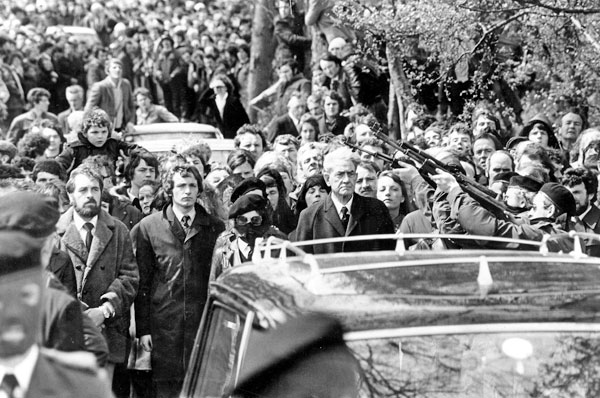
• Volunteers of Óglaigh na hÉireann
fire a volley in salute to their deceased comrade
Funeral
In death, the legendary south Derry
volunteer instilled as much fear amongst crown forces as he had in life. The
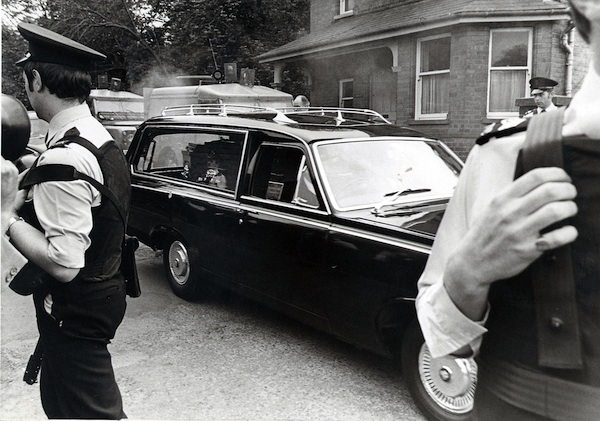
RUC hijacked his funeral cortege to prevent it passing through west Belfast on
its sad return to County Derry. An RUC man was observed spitting on the coffin.
At the funeral, there were poignant scenes
as Francis Hughes’s father, Joseph, approached an RUC cordon barring access to
Bellaghy. His appeal to be allowed bring his son to St Mary’s Church fell on
deaf ears and the cortege was forced to take a circuitous route. Earlier, the
IRA had bid farewell to their comrade with a volley of shots over his
Tricolour-draped coffin outside the Hughes family home.
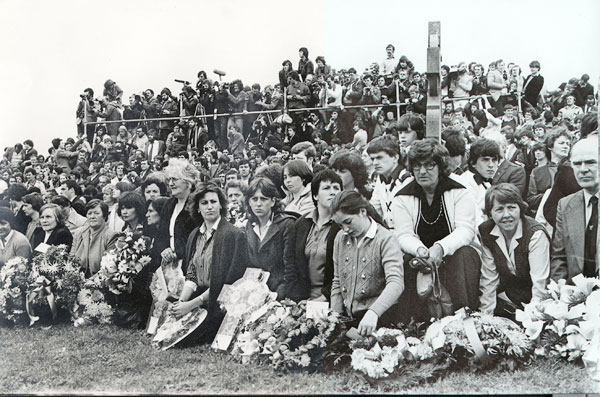
The funeral was marked by a day of mourning
with businesses in nationalist areas shutting down and vigils and rallies
occurring the length and breadth of the country. There were also numerous
rallies abroad.
Chairing the graveside ceremony was south
Derry republican John Davey, a friend of Francis Hughes, who was later murdered
by a pro-British death squad. The graveside oration was delivered by Martin
McGuinness.
Addressing a crowd of thousands, McGuinness
paid tribute to the bravery of Francis Hughes, both as an active IRA Volunteer
and as a political prisoner and a hunger striker. Outlining the history of the
Blanket Protest and its escalation into the hunger strikes he rejected British
propaganda that sought to portray republicans as sectarian and the IRA as
criminals. McGuinness went on to say that the Hunger Strike had challenged the
political and religious leadership of the country and they had been found
wanting. John Hume and Charles Haughey had been whipped into line by British
Prime Minister Margaret Thatcher, he said.
Concluding with a moving tribute to Francis
Hughes, Martin McGuinness said:
“His body lies here beside us but he lives
in the little streets of Belfast; he lives in the Bogside; he lives in East
Tyrone; he lives in Crossmaglen. He will always live in the hearts and minds of
unconquerable Irish republicans in all these places. They could not break him.
They will not break us.”
• A crowd of thousands at the funeral
heard Martin McGuinness declare of Francis Hughes: ‘They could not break him.
They will not break us’
New York Archbishop, Cardinal Timothy Dolan, has come in for considerable criticism over a recent conference call he and other leading Catholic prelates had with President Trump.
Much of the criticism has come from within the church itself.
But the cardinal, whose political leanings are generally seen as being conservative, is being defended by New York attorney Brian O’Dwyer, whose political leanings are very much to the contrary.
An example of the criticism directed at Cardinal Dolan came in a letter published in the St. Louis Post Dispatch newspaper on behalf of a number of priests based in next door southern Illinois. The priests argued that Dolan had allowed himself to be “played by Trump.”
Cardinal Dolan is a native of St. Louis.
Trump had made a pitch during the call for Catholic votes in November.
On his website, and in a May 5 posting referring to his podcast,Cardinal Dolan stated: “I talked about my recent call with my brother bishops and President Trump. We discussed the needs and challenges of our Catholic schools. I am grateful for his (Trump’s) support on this.”
The online Catholic publication CRUX, reported that President Trump had, during the call, dubbed himself the “best [president] in the history of the Church” and said that the issues at stake in the upcoming presidential election have “never been more important for the Church.”
Added the report: “Following the call, some Catholics criticized Church leaders for not challenging the president on immigration and rising white nationalism and for using what was meant to be a working call with Catholic leaders for campaign purposes. In particular, Dolan has been singled out for his praise of the president, both during the call and in a subsequent appearance on Fox News.”
A commentary in America Magazine, the nation’s main Jesuit publication, reported on the conference call thus: “On Saturday, April 25, Cardinal Timothy Dolan, the archbishop of New York, was one of the principal voices on a conference call between President Trump and hundreds of Catholic leaders, appealing for financial support for Catholic schools; audio of that call leaked and was reported shortly after it concluded.
“Cardinal Dolan then gave a special welcome to the president during the live stream of last Sunday’s Mass from St. Patrick’s Cathedral, which Mr. Trump said he planned to watch. The next morning, the cardinal made an appearance on ‘Fox & Friends’ in which he praised the president for his sensitivity ‘to the feelings of the religious community.’
“These interviews highlighted a pastoral failure to recognize the actual pain and fear that many Catholics are suffering.
“Many Catholics were outraged, some because they oppose any support given to Mr. Trump under any circumstances, but many more because the bishops did not challenge the president or voice reservations about his policies. Their response – their grief and frustration and anger at what they see as the misuse of the faith they love – was entirely foreseeable.
“That the bishops did not take into account the predictable response of many in their flock represents a pastoral failure, the effects of which may outlast any good done in securing federal support for Catholic schools on the conference call.”
Being archbishop of New York is, arguably, one of the most high profile demanding jobs in the Catholic Church.
Politics is never far outside the doors of St. Patrick’s Cathedral, and avoiding political entanglement is something that every archbishop has to concern himself with.
Doing so is not always possible, says Brian O’Dwyer, who marched past those imposing from doors as Grand Marshal of the 2019 New York St. Patrick’s Day Parade.
“I completely disagree with the criticism of Cardinal Dolan,” O’Dwyer, who is the current flag bearer for a family with a standout Democratic Party lineage, said.
“In recent days both Governor Andrew Cuomo and Governor Phil Murphy met with Donald Trump to plead their cases for their respective states,” said O’Dwyer.
“The unfortunate reality is that Donald Trump is the president of the United States and it’s the cardinal’s duty to deal with him on behalf of his flock.
“He has been a consistent advocate for the Irish community and in particular our immigrants. I credit him with reversing Malachy McAllister’s deportation, and I applaud him for his consistent and courageous stands on behalf of all immigrants. All of us should be thank for his advocacy on our behalf.”
As it happens, Cardinal Dolan’s intercession will be required again in the coming days as McAllister’s six month reprieve from deportation will run out of time at the end of May.
That could well mean the cardinal once again getting on the phone with President Trump as he did, along with GOP congressman Peter King, last November.