Trevor Ringland touts a ‘competing narrative’ where “families whose loved ones were brutally murdered at Loughinisland” stop questioning collusion because victims’ families and constabulary “both wanted the same outcome” (July 1).How could constabulary arresting the journalists who named alleged killers be the same outcome as arresting the suspected loyalist killers themselves? The legacy crisis exists because families want facts not British fairytale narratives about the murder of their loved ones.Mr Ringland mischaracterises the issue as a dispute between those who think ‘violence outside the law was justified’ and their opponents. He implies families of nationalist victims do not go to British crown courts, ombudsmen or investigatory bodies seeking justice for murdered loved ones, but want some sort of justification for republican armed struggle between 1968-98.He seems unable or unwilling to face the real question at the heart of the crisis.Did violence within British law, mean British troopers, constabulary and loyalist agents were permitted to carry out or collude in murders, which the state legal machinery then justified, or simply would not prosecute the murderers?Mr Ringland cites Loughinisland. The film No Stone Unturned named and filmed suspects and revealed that besides DNA evidence available from the recovered car, weapons and clothing, the wife of one of the suspected loyalist gunmen telephoned and wrote, confessing her role and naming the alleged gunmen.No-one was charged except the filmmakers. Why should these families not suspect collusion or conclude that no prosecutions despite so much evidence, meant the loyalist killers were being protected by crown forces?The legacy backlog worsens, 22 years post Good Friday Agreement, because nationalist victims’ families must fight to get truth from inquest courts (Ballymurphy) ombudsmen (Loughinisland), or historical investigations (Glenanne). It exists because British officials deny and delay the quest for truth with legal roadblocks, apparently hoping, that relatives will be frustrated, die off or give up.Today, instead of truth mechanisms they agreed five years ago at Stormont House, the British plan to create an ‘independent body’ which many fear will be used as a magic wand to make hundreds of cases disappear, by repeating the words “no new compelling evidence and realistic prospect of prosecution”.If Britain did not fear legacy truth why do they go to such lengths to bury it?
Jim Loscalzo/CNP/ZumaFor indispensable reporting on the coronavirus crisis and more, subscribe to Mother Jones’ newsletters.
Last July, Secretary of State Mike Pompeo launched an advisory panel to help the US practice “a moral foreign policy … grounded in [a] conception of human rights.” Crucially, its mission, Pompeo explained, would include reining in a dangerous proliferation of “new” human rights. “Unalienable rights are by nature universal. Not everything good, or everything granted by a government, can be a universal right,” he wrote in a Wall Street Journal op-ed explaining the formation of this Commission on Unalienable Rights. “Loose talk of ‘rights’ unmoors us from the principles of liberal democracy.”
It didn’t take long for human rights experts to read between the lines. Pompeo, whose leadership of the State Department has become in many ways an experiment in how quickly he can orient American foreign policy toward his evangelical Christian faith, stocked the commission with academics and diplomats best known for defending religious freedom while opposing reproductive rights and LGBTQ equality.
Pompeo, whose leadership has become in many ways an experiment in how quickly he can orient American foreign policy toward his evangelical Christian faith, stocked the commission with academics and diplomats best known for defending religious freedom.
On Thursday, the commission finally unveiled a draft of its long-anticipated report, finding—surprise, surprise—just what Pompeo suggested in his initial op-ed: not all rights are created equal. Describing a human rights landscape “in crisis,” the report focuses mainly on the Declaration of Independence and Universal Declaration of Human Rights and mostly ignores the binding treaties establishing a framework for international human rights law. The problem, as the commissioners see it, is that a proliferation of new rights include many in competition with one another, which has eroded the international consensus around human rights. The solution, then, is to boost protections of certain rights, particularly religious freedom, while diminishing others.
“As anticipated, the report elevates religious freedom as an unalienable right, while dismissing abortion and same-sex marriages as not rights but instead ‘divisive social and political controversies,’” Jayne Huckerby, director of the International Human Rights Clinic at Duke Law School, tells me. She notes that the report “recognizes that legally there should be no hierarchy between different types of rights,” but “still calls for US foreign policy to de-emphasize economic and social rights compared with civil and political ones.”
In practice, that has already started to happen. With Pompeo leading from Foggy Bottom, the United States has renounced its role as a leader in promoting LGBTQ equality and reproductive rights abroad, most prominently in Trump’s expansion of the so-called global gag rule, which restricts which nongovernmental organizations can receive US aid based on whether they perform any abortion-related activities. US diplomats have teamed up with countries with abominable records on these issues—Saudi Arabia and Brazil among them—to oppose international agreements aimed at preserving those rights. When Trump appeared at the United Nations General Assembly last year, he chose to host an event focused on religious freedom. And, while his administration regularly attempts to cut back on international aid, the president still recently signed an executive order giving $50 million to support international religious freedom.
“This administration practices consistent and continued erasure of LGBTQ people and refuses to acknowledge that access to reproductive health care is essential for survival,” says Molly Bangs, director of reproductive rights advocacy group Equity Forward. “LGBTQ people face threats to their health, safety, and civil rights here at home and around the globe and this report makes zero mention of protecting their rights.”
Since the commission’s formation, Pompeo has been a public cheerleader of its work, taking care to note that the group is not crafting policy, but simply elaborating “the principles through which we can ground America’s commitment to championing human rights in our enduring dedication to unalienable rights and our tradition of constitutional self-government,” as he wrote in the Washington Post this week. For the past several days, he’s been tweeting in anticipation of the release of its draft report, pairing quotes from Elizabeth Cady Stanton, Frederick Douglass, and Martin Luther King Jr. with the hashtag “UnalienableRights.” Still, his support for the panel has often been nakedly political and, of course, does not exactly honor the legacy of the very individuals he’s held up as symbols of these unalienable rights. Pompeo traveled to Philadelphia on Thursday, ignoring concerns about the safety of himself, his team, and others during the coronavirus pandemic, to give a speech at the National Constitutional Center. In his remarks, he took time to criticize “rioters” for “desecrating monuments to those who fought for unalienable rights” and suggested that the New York Times‘ 1619 Project, which examines the legacy of slavery in the United States, was “a disturbed reading of history” and “a slander on our great people.” Pompeo took time to criticize “rioters” for “desecrating monuments to those who fought for unalienable rights” and suggested that the New York Times‘ 1619 Project, which examines the legacy of slavery in the United States, was “a slander on our great people.”
Rob Berschinski, a former State Department official who is now senior vice president for policy at Human Rights First, said Pompeo’s remarks “loosely clothed a foray into the culture wars under the seal of the US State Department. It should rightfully be seen as a political speech unbecoming of a Secretary of State.”
The speech, though, is just the culmination of a year’s worth of work that, while abstract in its consideration of the historical and philosophical roots of human rights, is intensely political. Across its five public meetings, which Huckerby and her colleagues at Duke Law analyzed in an article for Just Security, “religious freedom was clearly intended to be a core focus of the commission” and was “frequently discussed” by the commissioners, including in the context of when it clashes with the right to have an abortion.
There’s also the simple matter of who Pompeo chose to serve as commissioners, including chair Mary Ann Glendon, a former US ambassador to the Vatican who once said awarding the Pulitzer Prize to the Boston Globe for its coverage of sexual abuse by Catholic priests “would be like giving the Nobel Peace Prize to Osama bin Laden.” (Pompeo, in his remarks on Thursday, noted that he once worked as Glendon’s research assistant, calling the experience “one of my life’s greatest gifts.”) The commissioners’ selection is also one reason several human rights advocacy organizations, including Robert F. Kennedy Human Rights, sued Pompeo in March, alleging that the Commission on Unalienable Rights violates federal law requiring advisory bodies be independent and “fairly balanced among competing points of view.”
“There is reason to believe the Secretary carefully selected the Commission members to yield a pre-determined result: constraining the understanding of ‘unalienable’ human rights to the narrow set of rights allegedly grounded in theories of natural law,” the lawsuit states.
This, though, was of course the point. Just look at the reaction among Pompeo’s core group of supporters, the evangelical right, to see what was expected of this panel when it was announced last year. Back then, Tony Perkins, president of the right-wing Family Research Council, praised the newly-formed panel for “ensuring that the protection of these fundamental rights—the most foundational of which is freedom of religion or belief—is a core element of strategic policy discussions.”
NEAR THE END OF THE 19th century, New Yorkers out for a drink partook in one of the more unusual rituals in the annals of hospitality. When they ordered an ale or whisky, the waiter or bartender would bring it out with a sandwich. Generally speaking, the sandwich was not edible. It was “an old desiccated ruin of dust-laden bread and mummified ham or cheese,” wrote the playwright Eugene O’Neill. Other times it was made of rubber. Bar staff would commonly take the sandwich back seconds after it had arrived, pair it with the next beverage order, and whisk it over to another patron’s table. Some sandwiches were kept in circulation for a week or more.
Bar owners insisted on this bizarre charade to avoiding breaking the law—specifically, the excise law of 1896, which restricted how and when drinks could be served in New York State. The so-called Raines Law was a combination of good intentions, unstated prejudices, and unforeseen consequences, among them the comically unsavory Raines sandwich.
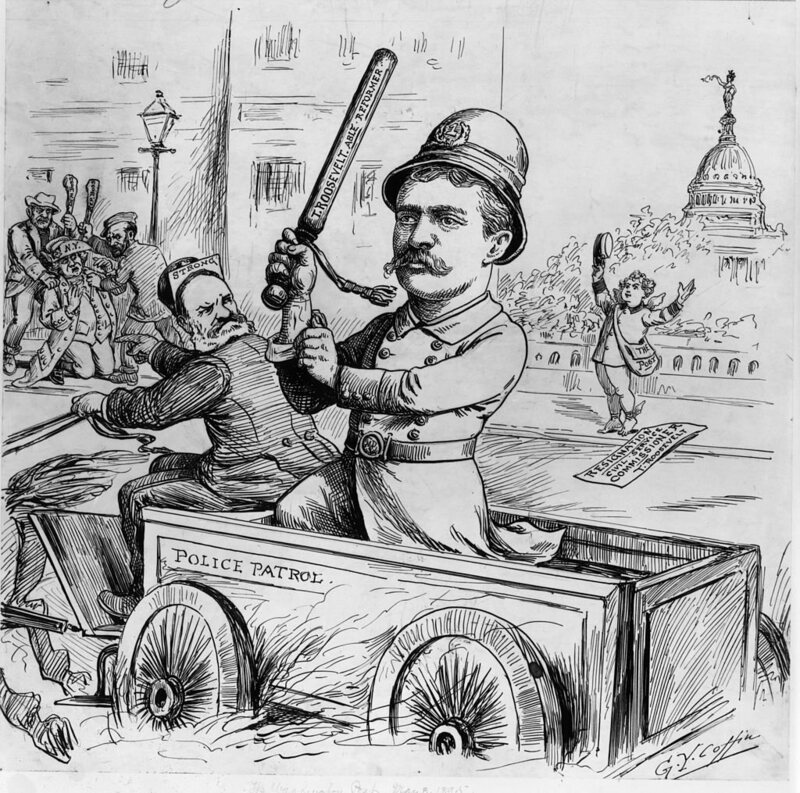
The new law did not come out of nowhere. Republican reformers, many of them based far upstate in Albany, had been trying for years to curb public drunkenness. They were also frustrated about New York City’s lax enforcement of so-called Sabbath laws, which included a ban on Sunday boozing. New York Republicans spoke for a constituency largely comprised of rural and small-town churchgoers. But the party had also gained a foothold in Democratic New York City, where a 37-year-old firebrand named Theodore Roosevelt had been pushing a law-and-order agenda as president of the city’s newly organized police commission. Roosevelt, a supporter of the Raines Law, predicted that it would “solve whatever remained of the problem of Sunday closing.”
In his crackdown on vice in New York, Theodore Roosevelt supported the Raines Law. MPI/GETTY IMAGES
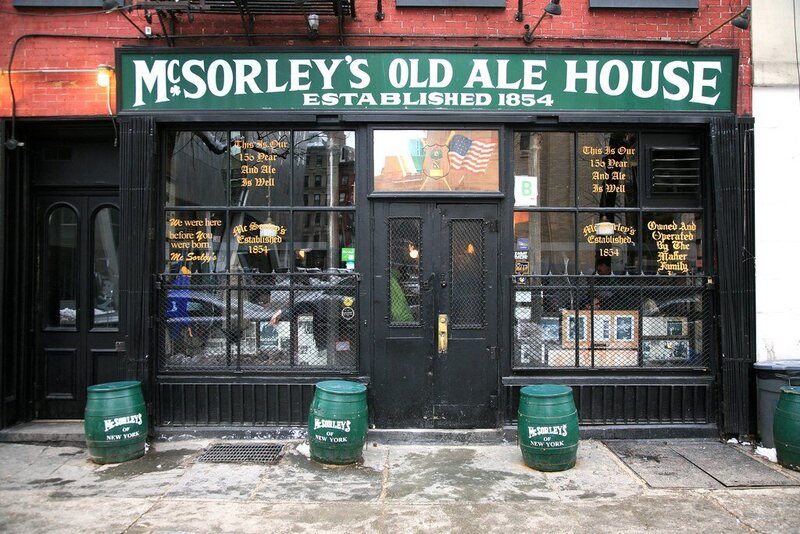
The 1896 Raines Law was designed to put dreary watering holes like these out of business. It raised the cost of an annual liquor license to $800, three times what it had cost before and a tenfold increase for beer-only taverns. It stipulated that saloons could not open within 200 feet of a school or church, and raised the drinking age from 16 to 18. In addition, it banned one of the late 19th-century saloon’s most potent enticements: the free lunch. At McSorley’s, for example, cheese, soda bread, and raw onions were on the house. (The 160-year-old bar still sells a tongue-in-cheek version of this today.) Most controversial of all was the law’s renewed assault on Sunday drinking. Its author, Finger Lakes region senator John W. Raines, eliminated the “golden hour” grace period that followed the stroke of midnight on Saturday. His law also forced saloon owners to keep their curtains open on Sunday, making it considerably harder for patrolmen to turn a blind eye.
The Raines Law took effect on April 1, 1896. Progressives scored its first weekend in action a bone-dry success. Bars closed Saturday at midnight; the liquor flow on Sunday slowed to a trickle. RAINES MAKES A THIRST, a New York World headline quipped. But while the teetotalers celebrated over lemonade, plenty of booze-deprived New Yorkers were fuming.
It’s no longer free, but McSorley’s still serves its famed meal of cheese, crackers, and raw onion. ENDYMION120/CC BY 2.0
Behind this lifestyle tug-of-war lay a cultural conflict of national proportions. Those in favor of the Sunday ban, generally middle-class and Protestant, saw it as a cornerstone of social improvement. For those against, including the city’s tide of German and Irish immigrants, it was an act of repression—an especially spiteful one because it limited how the average laborer could enjoy himself on his one day off. The Sunday ban was not popular, to say the least, among the city’s Jews, who’d already observed their Sabbath the day before.
Opponents pointed out that existing Sabbath drinking laws were hypocritical anyway. An explicit loophole had been written into the law itself: it allowed lodging houses with ten rooms or more to serve guests drinks with meals seven days a week. Not incidentally, wealthy New Yorkers tended to dine out at the city’s ritzy hotel restaurants on Sundays, the usual day off for live-in servants.
Intentionally or not, the Raines Law left wiggle room for the rich. But a loophole was a loophole, and Sunday was many a proprietor’s most profitable day of business. By the following weekend, a vanguard of downtown saloon-owners were gleefully testing the law’s limits. A suspicious number of private “clubs” were founded that April, and saloons started handing out membership cards to their regulars. Meanwhile, proprietors converted basements and attic spaces into “rooms,” cut hasty deals with neighboring lodging-houses, and threw tablecloths over pool tables. They also started dishing up the easiest, cheapest, most reusable meal they could get away with: the Raines sandwich.
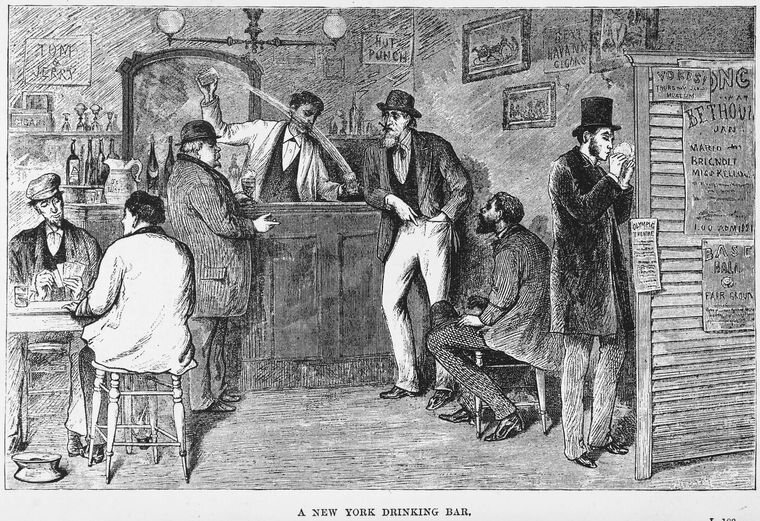
An idyllic scene of a New York bar, pre-Raines law. PUBLIC DOMAIN
Law enforcement declared itself satisfied. “I would not say that a cracker is a complete meal in itself, but a sandwich is,” an assistant D.A. in Brooklyn told an assembly of police captains as the first Raines hotels sprouted up. Remarkably, the courts upheld these definitions of “meal” and “guest.” Reformers were understandably flabbergasted. The law itself was sound, Raines complained. It was the police and the courts that had made it laughable. He and his progressive allies had seriously underestimated just how far New Yorkers would go for a drink.
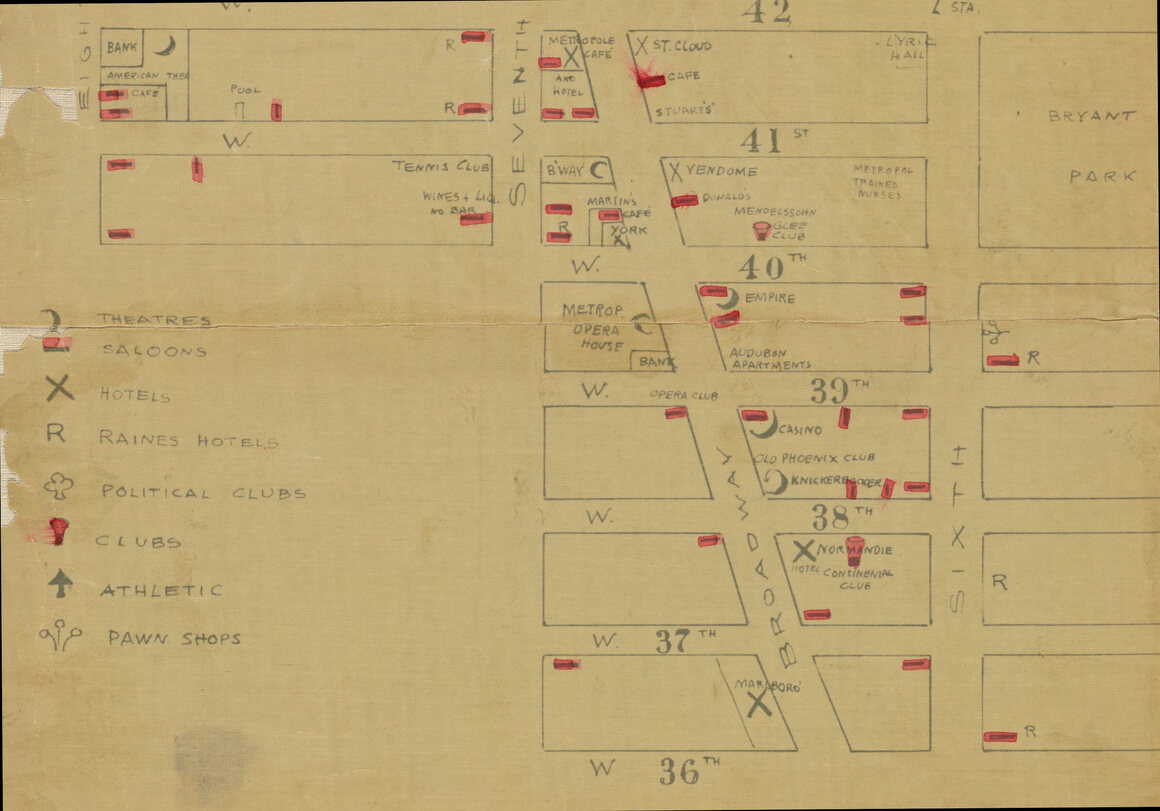
The court decisions were a turning point. With summer approaching, “Raines hotels” sprang up everywhere. By the next year’s election season, there were more than 1,500 of them in New York. Brooklyn, still a separate municipality at this point, went from 13 registered hotels to 800 in six months, and its tally of social clubs grew tenfold.
For the libertines of New York City, Zacks writes, the second half of 1896 was “too good to be true, a drunken daydream.” The hotel carve-out allowed drinks to flow at all hours. There was no obligatory last call, and the city’s liveliest drinking spots now offered cheap beds mere steps away. For Raines and the law’s other architects, this was the most alarming unintended consequence: their efforts to make New Yorkers virtuous had caused a spike in casual sex and prostitution.
On this 1899 map of Broadway, Raines hotels are marked with an “R.” PUBLIC DOMAIN
The state government ratified a set of clarifying amendments a year later. The free-for-all atmosphere faded, albeit slowly. Still, for years following the passage of the Raines Law, a general state of confusion and case-by-case dealings reigned. Following a wave of enforcement in 1902, hotel proprietors arrived at a creative solution: charging a premium for the obligatory sandwich. The Waldorf-Astoria went the classy route, offering unwanted meat patties instead, but the result was the same: a 50- or 100-percent markup to each drink ordered. The police seem to have appreciated the clarity of this arrangement. As long as Sunday drinking remained “an expensive luxury,” the Times suggested, its excesses would be tolerated by the average upstanding citizen. And for many a Sunday drinker, even some of the poorer ones, the inflated tab was preferable to risking arrest in an illicit backroom. Raines himself saw this as “the only compromise that is possible in New York.”
The Raines Law tussle continued well into the 20th century. The New York Supreme Court ruled in 1907 that a Sunday meal must be ordered and delivered in “good faith” for the accompanying drinks to be legal. Under pressure, brewers started refusing to supply Raines hotels. A new state excise law in 1917 contained a minimum-room requirement that effectively prevented the opening of new ones.
But the Raines Law debacle was merely a prelude for what was to come. New York reformers had long allied themselves with the Anti-Saloon League, a civilian organization with Midwestern origins that would morph into one of the most powerful pressure groups in U.S. history. By 1919, the efforts of the ASL made nationwide Prohibition the law of the land, putting an end to such quaint half-measures as the Raines sandwich and replacing the Raines hotel with the speakeasy.

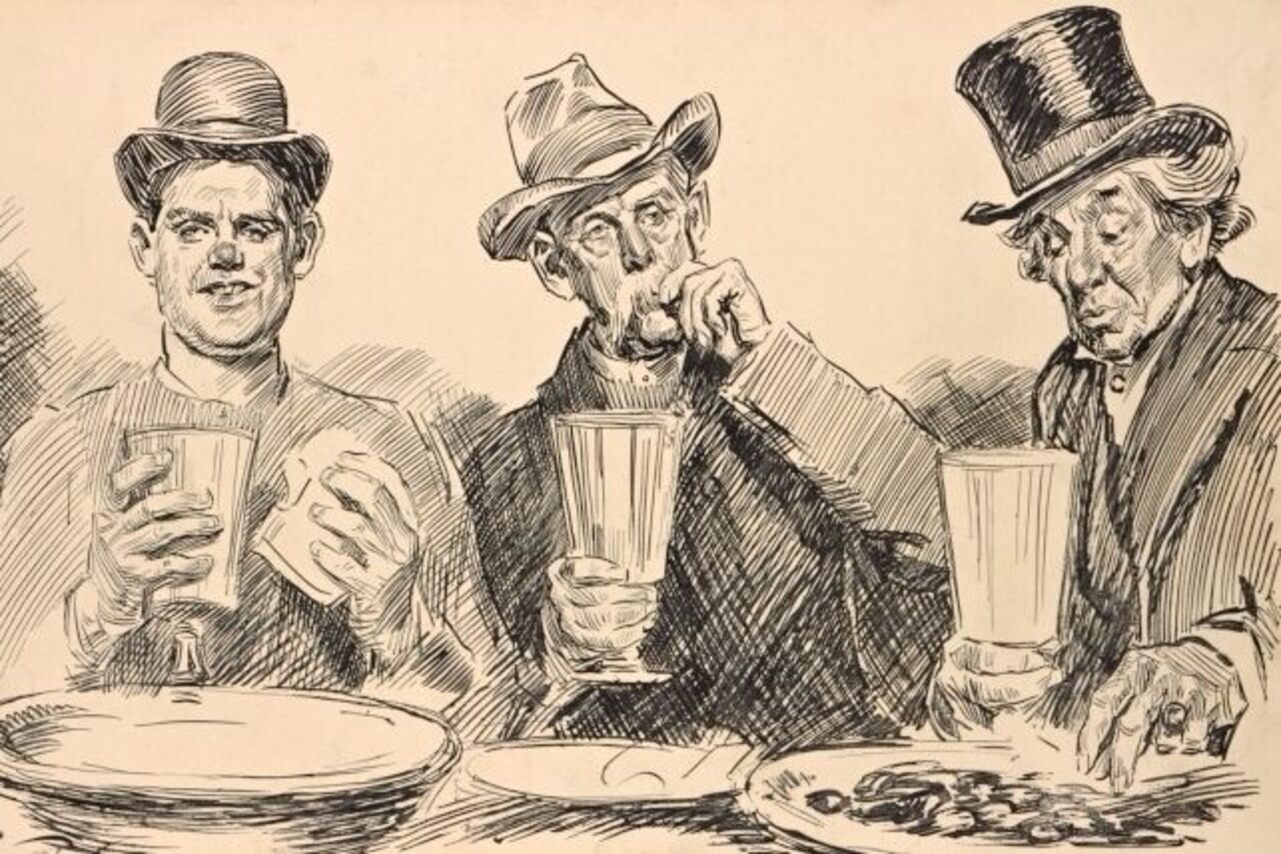 Three men feast on free lunch in this drawing by Charles Dana Gibson.