Ireland international soccer star James McClean wrote this article on his reasons for supporting Irish Unity for nationalist lobby group ‘Think 32’ and the Derry News.I have had the honour of representing my country on the football pitch.
Captaining Ireland was among the proudest moments in my life because I am an Irishman to the core.
But despite being able to do these things, I have always been conscious of the fact that some rights are still denied to me because I happen to have been born in the North.
I can captain my country, but I still can’t vote for my country’s President.
I can represent the FAI (Football Association of Ireland) at home and abroad, but I can’t have any democratic say in the make up of the government that funds it.
Partition is rife with such failures and contradictions.
To me, it simply doesn’t make sense to have two ‘national’ football teams on an island this size never mind two health systems, two education systems and two governments.
As an Irish man and an Irish citizen, I want the island of Ireland to be reunified under a government for all our people.
I don’t want to have any technicalities, caveats or doubts questioning my nationality.
And I strongly believe that everyone who lives on this island should be entitled to the same rights as each other.
The best way to achieve all of that is through the reunification of our island and the creation of a new all-Ireland administration that governs in the best interests of the people.
I am certainly not alone in that belief.
Every day, more and more people are coming to the same conclusion when they look at what is happening with Brexit, austerity and the handling of the pandemic.
And at the end of the day, all we are asking for is the right to choose our own future through a referendum on Irish unity.
That’s democracy and what has anyone got to be afraid of in that?
I want my children to grow up in a better country than the one I and generations before me, grew up in.
Surely that is what all parents want.
I am convinced that a better Ireland is possible through reunification.
In the dock: Winston Churchill Rea (aka Winkie Rea), at the opening of his trial at Belfast Crown Court on Monday
Michael Donnelly
November 25 2020 07:27 PM
Innocent Catholics were considered legitimate targets by roving loyalist gunmen because they had supposedly contributed to the coffers of the IRA, a loyalist paramilitary leader allegedly confessed on tape.
The tape, one of seven, was allegedly made by one-time Red Hand Commando head Winston Churchill Rea, for the so-called ‘Belfast Project’.
The project saw former loyalist and republicans allowing themselves to be interviewed by the Boston College about their terrorist past.
At one stage the 69-year-old also allegedly claimed there was a time when “buck-shee” Army privates handed over their SLR weapons to loyalist gunmen to fire into Catholic estates, as long as they provided their own ammunition.
The tapes, which were supposedly to remain confidential until his death, form the backbone of the prosecution case against the pensioner and the 19 offences he faces, allegedly committed between 1973 and 1996, including involvement in murder.ADVERTISING
The prosecution at his Belfast Crown Court Diplock-style, non-jury trial claim that Mr Rea, who alluded on tape to his identity as “Winston Winkie Rea”, is the person designated as “Interviewee L” and who confessed to the terrorist crimes he denies.
On Wednesday, during one tape section, ‘L’ was asked about the strategies of the RHC in the opening days of the Troubles between 1971 and 1972, to which he replied it was “his belief, if there hadn’t been a Protestant/loyalist backlash”, they would have been “driven into a United Ireland”.
He said “back in them days” the RHC, who were “prepared to enter enemy territory”, regarded ordinary Catholics as legitimate targets because they were seen almost every day, putting money into the “wooden collection boxes” of the IRA at the chapel gates as they left Mass.
Loyalists felt those monies were used to buy guns and bullets and the “Red Hand viewed those people contributing … were just as guilty as those who pulled the trigger”.
‘L’ went on to explain that while they much preferred to target and kill actual republicans because of the publicity from their IRA televised funerals, which provided “a moral-boost”, to the RHC leadership “the killing of ordinary Catholics was very much viewed as still part of the strategy”.
And with regard to the loyalist community, to ‘L’, they were “very much 100% behind us … no doubt about that”. The speaker said that doors in loyalist areas were always “left open for you”, and that “without the support of the community, you didn’t stand a chance”.
Later in that first interview, ‘L’ confided that when troops were initially deployed, “obviously the soldiers would have been favourable to loyalists”. He further claimed “so much so” soldiers had “no hesitation” in handing over their SLR weapons to loyalist gunmen to fire into Catholic housing estates.
The soldiers, who had to account for their ammunition, only handed over their rifles if the gunman could provide the correct ammo and ‘L’ even claimed to have witnessed it with his “own eyes”.
However, the speaker said this happened only between individual soldiers and loyalist gunmen, and that it was “just something” that came from privates themselves, “from the buck-shee privates”, it was “nothing orchestrated, it was just something, not from the top”.
Things changed, however, when that particular unnamed regiment was moved to be replaced by 2nd Para, and while there was still “a bit of a relationship” it was not the same.
‘L’ explained that 2nd Para operated a more “neutral” policy whereby “if loyalist broke the law they would come down hard on them and if republicans broke the law they would come down hard on them”.
The trail, of Mr Rea, AKA ‘Winkie Rea’, from the Springwell Road, in Groomsport, Co Down, continues.
The charges he denies include aiding and abetting, and conspiring to murder Catholic men John Devine in July 1989 and John O’Hara in April 1991.
Membership of the Red Hand Commando, aiding, abetting and conspiring to murder Catholics and conspiring to threaten to kill LVF leader Billy Wright in August 1996.
He has also pleaded not guilty to attempted murder and other terror-related charges, including conspiring to possess firearms secured from the Ulster Resistance paramilitary group on dates between November 1986 and October 1994.
London’s ‘deliberate decision’ not to launch independent inquiry ‘is a public breach of faith,’ says congressman.
Britain’s Secretary of State for Northern Ireland Brandon Lewis is due to make a decision on whether to launch an inquiry into Finucane’s murder by the end of the month | Andy Rain/EFE via EPA
U.S. lawmakers called on the U.K. to establish an independent inquiry into the 1989 murder of human rights lawyer Patrick Finucane, in a letter sent to Prime Minister Boris Johnson.
“The British government’s deliberate decision not to proceed with an independent, judicial inquiry into the Finucane murder — an unfulfilled commitment of the peace process — is a public breach of faith,” said Republican Congressman Chris Smith in a statement that accompanied the letter, signed by 24 bipartisan members of Congress.
Finucane, a Catholic solicitor, was murdered during the Troubles, the three decades of violence that left more than 3,500 dead. Finucane’s clients included suspected Irish Republican Army members, and there have long been allegations that some in the U.K. security forces colluded in the killing.ADVERTISEMENT FROM EVERBRIDGEabout:blankSCROLL TO CONTINUE WITH CONTENT
According to recent reports, Britain’s Secretary of State for Northern Ireland Brandon Lewis is due to make a decision on whether to launch an inquiry into Finucane’s murder by the end of the month.
The letter states: “U.S. legislation urging your government to recognize the overwhelming public interest in a ‘true,’ independent, judicial inquiry has been enacted and/or passed the House of Representatives on four separate occasions … Several years after former Prime Minister David Cameron acknowledged ‘shocking levels of collusion’ — and issued an apology to the Finucane family — we remain astounded that the British government has refused to live up to its responsibility, and is violating its commitments to establish the inquiry.”
Democratic Representative Richard Neal, another of the signatories of the letter, said in a statement: “I continue to believe the Finucane family has a right to truth and justice … They deserve to know what happened in February of 1989 and the level of state collusion into the murder of their husband and father. This letter is calling on the British government to be accountable.”
The letter comes amid mounting pressure for an inquiry. Wednesday, Amnesty International U.K. wrote to Lewis to ask him to open an independent investigation. Micheál Martin, the Irish prime minister, said on Tuesday that the British government “should and must” conduct a public inquiry.
To support the empowerment of the bereaved and injured of the conflict to realise improved health and wellbeing, and full and equal participation at every level of our post-conflict society
Relatives for Justice Mission
Building and providing access to safe, integrated and professional services and programmes of support for the bereaved and injured of the conflict
Contributing to the health and wellbeing of victims and survivors
Realising empowerment through building skills, confidence and self-awareness
Encouraging the bereaved and injured to realise their role in peace building and processes designed to deal with the past
Investing in Relatives for Justice through training and sustainable partnerships
Relatives for Justice Aims
To provide a safe space for the bereaved and injured of the conflict
To provide professional, appropriate and development based individual, family and group support for the bereaved and injured in an holistic, integrated fashion
To develop and deliver said support in partnership with other professional organisations where appropriate
To support the bereaved and injured to tell their story and document their experiences
To build awareness and foster an understanding of the specific experiences and needs of the bereaved and injured of the conflict in a transitional context
To contribute to the search for truth, highlight injustice and contribute to a culture of human rights
To support families engaging with relevant processes to deal with the past including legal processes
To liaise with domestic and international human rights NGOs, government bodies and other international organisations in the furtherance of the realisation of the rights of victims and survivors of the conflict
Relatives for Justice Core Values
An active commitment to universal human rights and social justice
The promotion of equality and respect for the background, diversity and experience of all those bereaved and injured by the conflict
The application and development of the highest standards of professional support programmes for victims and survivors of the conflict
The promotion of recognition and remedy for the specific gender harms and experiences of the bereaved and injured of the conflict
Eligibility
Relatives for Justice only supports victims and survivors of the conflict in its work. Eligibility for services is determined at initial contact and evidence retained.The Work of Relatives For JusticeRelatives for Justice (RFJ) was founded in April 1991 when a number of bereaved families affected by the conflict came together to support one another. Instrumental in the formation of the organization were key figures that had, on a voluntary basis, been active for the previous 2 decades such as Monsignor Raymond Murray, Clara Reilly, Peter Madden, the law practice partner of the late Pat Finucane, and the late human rights lawyer Rosemary Nelson both subsequently murdered. RFJ is one of only a few organizations operating on a regional basis across the North and on an all island basis.Relatives for Justice is a world recognised NGO working with and providing support to relatives of people bereaved, and injured, by the conflict across the North of Ireland including border regions in the 26 counties.We assist and support families coping with the effects of bereavement through violence and the resulting trauma. We have offices in Belfast, Dungannon and 5 regional outreach centres.RFJ identifies and attempts to address the needs of those who have suffered loss and injury; this is achieved through one to one contacts, self-help, group support, outreach and befriending, counselling support and therapy work, welfare and legal advocacy.As relatives and survivors we all need to have our experiences heard and valued. In terms of conflict resolution this will also allow those most marginalised to realise the pivotal role and vital contribution that they bring to the creation of a new society based upon equality, respect and above all where human rights are secured.This work highlights and attempts to address outstanding human rights abuses. Our primary objective in this area of work is to assist in the bringing about of a more human rights-based culture in order to safeguard and protect human rights for all.
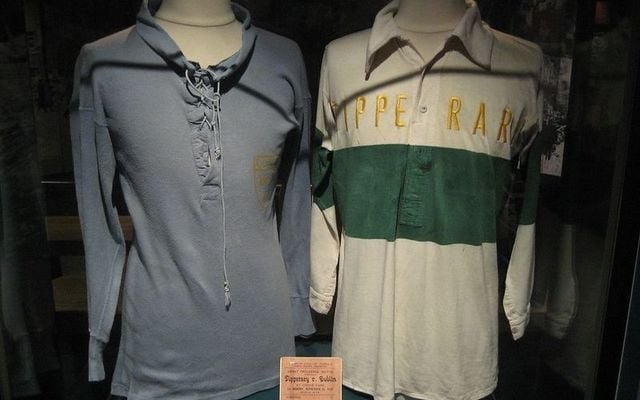
Tipperary will wear replicas of the original green and white jerseys worn on November 21, 1920, when British forces opened fire during a challenge match between Dublin and Tipperary.
Shane O’Brien@shamob96 Nov 09, 2020Orignal jersey worn by Tipperary (right) on Bloody Sunday, 1920.
Tipperary’s Gaelic footballers will wear special commemorative jerseys marking the centenary of Bloody Sunday in their Munster final clash with Cork on November 22.
The Tipperary County Board confirmed that Tipperary’s footballers will wear a special replica of the original green and white jersey worn on November 21, 1920, when British forces opened fire during an exhibition match between Dublin and Tipperary, fatally wounding Tipperary player Michael Hogan and 13 others.
The Tipperary County Board had initially planned to use the jerseys in a special commemorative match between Dublin and Tipperary that would only last 48 minutes and start from the 12th minute; when the shooting started on that fateful day.
However, the COVID-19 pandemic halted the GAA calendar, meaning that games that would normally take place over summer were rescheduled for winter and Tipperary will now instead mark the 100th anniversary of Bloody Sunday in a Munster football final.
In a statement, the Tipperary County Board said: “It is only fitting that the Tipperary team will wear the official replica green and white jersey as worn by Tipperary on that eventful day as a mark of respect to all of the fallen.”
The statement added: “The Tipperary players and management of 2020 are honoured to wear the official replica green and white jersey in this year’s Munster Final and play their part in marking this historic anniversary event.”
Teneo, the county’s shirt sponsors, has agreed to forego their name on the front of the commemorative jersey to add authenticity, while the replica jerseys will also feature an image of Michael Hogan along the sleeve.
Teneo Chairman and CEO Declan Kelly said that he was honored that his company was associated with the Tipperary Senior Football team as it marks the centenary of one of the darkest days in Irish history.
Kelly also said that he was proud of the Tipperary team for making their first Munster final since 2016.
The Premier County narrowly beat Clare and Limerick to book a place in the provincial decider later this month, where they will attempt to clinch their first Munster title since 1935.


 Orignal jersey worn by Tipperary (right) on Bloody Sunday, 1920.