Patrick Murphy: Watch out, we’re keeping an eye on you, Mr Putin.
If young Irish men and women die face-down in the Donbas mud, they will know they died to the applause of the main parties in Leinster House.
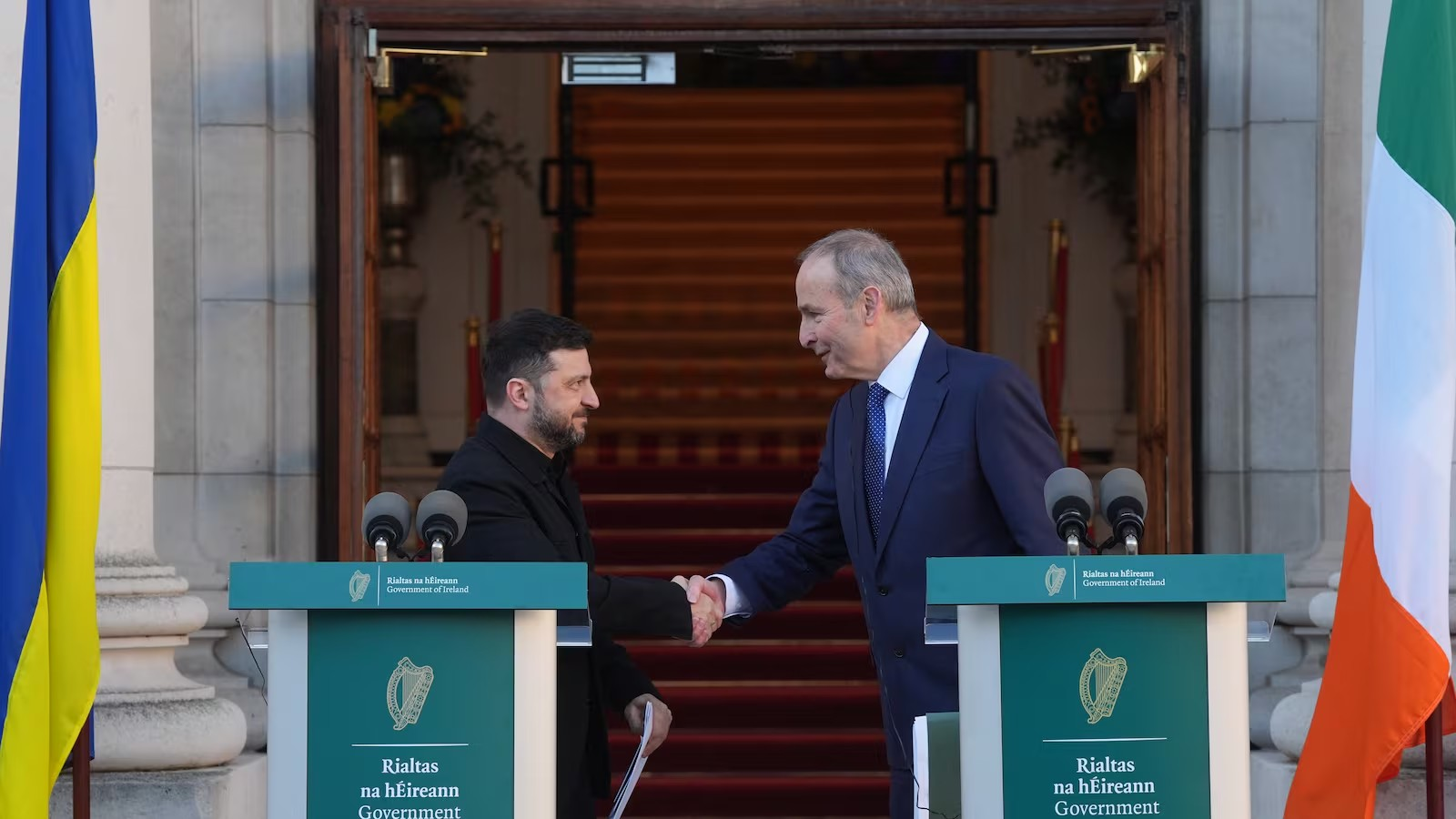
Ukrainian President Volodymyr Zelensky and Taoiseach Micheal Martin shake hands during a press conference at Government Buildings in Dublin
By Patrick Murphy
December 06, 2025 at 6:00am GMT
IN 1899, a Cork newspaper, The Skibbereen Eagle, famously stated in an editorial that it was keeping an eye on the Czar of Russia.
It is not clear if Czar Nicholas II changed Russian foreign policy as a result, but maybe the threat from West Cork made him a bit more cautious.
This week another product of Cork, Taoiseach Micheál Martin, adopted a similar approach to the current Russian leader, when he said during President Zelenskyy’s visit to the Dáil that Russia has to be held accountable.
We are not sure what he meant, but President Putin’s response was to say that if Europe wanted war, Russia was ready to fight. It looks like Russia is now keeping an eye on Ireland.
The Dáil’s main parties rightly condemned Russia’s invasion of Ukraine, but their standing ovation for Zelenskyy carried just a hint of 1914, when John Redmond argued that it was the “moral duty” of Irishmen to defend “brave little Belgium”.
Ceann Comhairle Verona Murphy echoed that sentiment, saying that Ireland “is not morally neutral in the face of atrocity”.
All very morally commendable, but where does Ireland go from here?
It might begin by remembering what Pope Francis said in 2022. He remarked that Moscow’s invasion of Ukraine was “perhaps somehow either provoked, or not prevented”.
He said an unnamed but “wise” head of state told him that NATO was “barking at the gates of Russia”.
The man responsible for that barking was honorary Irish nationalist Joe Biden, who was applauded in the Dáil two years ago. (The Dáil enjoys applauding.)
In 2019, Zelenskyy and Putin agreed a ceasefire in the Donbas region over the long-simmering conflict in Crimea.
However, when Biden became president in 2020, he argued for Ukraine to join NATO, which would have meant US missiles on Russia’s border. Putin reacted by illegally invading Ukraine in 2022.
An estimated 400,000 Ukrainian soldiers have died in an avoidable war for Joe Biden’s flawed foreign policy. No-one in the Dáil mentioned Biden – or Pope Francis.
Donald Trump’s attitude is different from Biden’s. He disowned Ukraine, not because he dislikes violence (as evidenced by his attacks on Venezuela), but because he sees more business opportunities in peace than in war.
By abandoning Ukraine, Trump has sidelined Europe, telling it to stand alone.
The obvious EU response would have been to seek an end to the war by sending Zelenskyy to Moscow to make a deal with Putin.
Rubbish, you say, Putin’s army should be beaten back into Russia and Ukraine should regain all its territory. That’s a fair point, but without US support, how exactly might that be achieved?
Should the EU take America’s place as Ukraine’s arms supplier? That is what NATO is advocating. If so, should Ireland be part of that?
It is heading that way. This weekend Irish Defence Forces are being trained by NATO in cyber-defence.
According to the US-based Defense News, the EU will spend £334 billion on military and related equipment this year. That is one and a half times China’s spend and more than three times Russia’s military budget.
Meanwhile, France and Germany are reintroducing military service, bringing to seven the number of European countries which have reintroduced conscription or military service since 2014.
Europe is gearing up for war, which is why Putin said Russia is ready to fight.
However, is the Ukrainian government worth dying for?
In 2015 the Guardian newspaper described Ukraine as “the most corrupt nation in Europe”. Its energy and justice ministers resigned last month amid allegations of a £76 million embezzlement scheme.
The BBC has referred to corruption in Ukraine as “endemic”. The London Independent claimed that “money for war has been stolen by a group of powerful people”.
Zelenskyy’s chief negotiator with the US resigned last week following an anti-corruption raid on his home.
The war in Ukraine is all over bar the shooting (and fine words in the Dáil).
Ireland’s support for Zelenskyy has aligned it with the EU’s military expansion. So will we see Irish soldiers march off to war, as in 1914, this time morally fighting for a corrupt state, as described in the British media?
The reassuring news is that if young Irish men and women die face-down in the Donbas mud, they will know they died to the applause of the main parties in Leinster House.
The Skibbereen Eagle may have long gone, but the current Irish media might like to keep an eye not only on Russia, but on events in the Dáil.
If you have an opinion on the issues raised in this article and would like to submit a Letter to the Editor to be considered for publication
Welcoming the closure of internment without trial, the paper condemns the years of arbitrary detention, psychological torment and injustice suffered by Long Kesh detainees since 1971
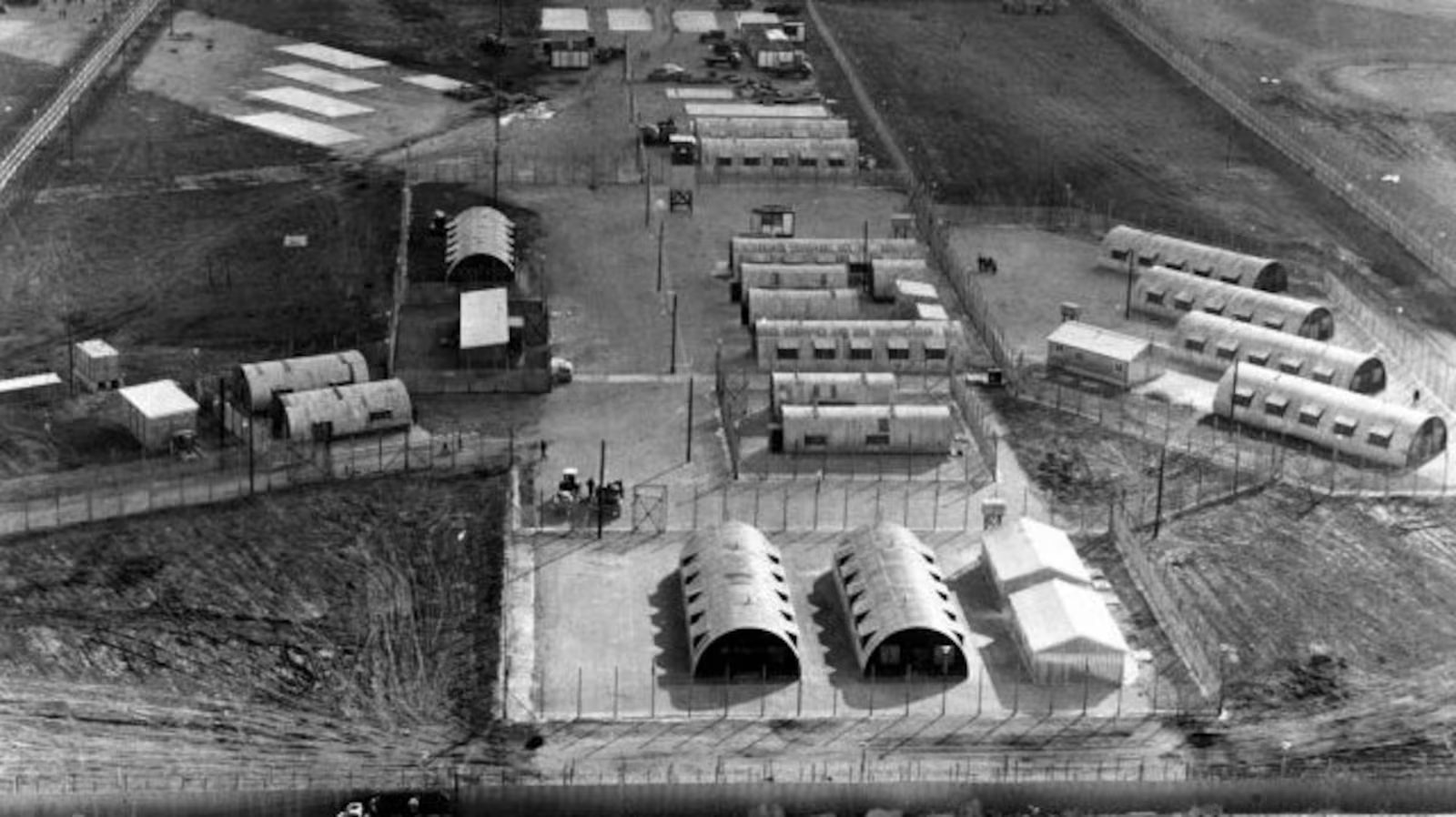
The Long Kesh internment camp
By Cormac Moore
December 06, 2025 at 6:00am GMT
December 6 1975
Doubtless heading the dictates of prudence (because Britain is believed to have been found guilty by the European Human Rights Commission of torture or internees as well as the discriminatory use of internment) if not of charity towards the internees in Long Kesh, Mr [Merlyn] Rees has finally laid to rest this evil which has provoked so much hostility and caused so much human suffering.
Yesterday’s decision will be widely welcomed. It is a long overdue move which could push us a little nearer to normality.
Internment without trial has been the great abomination in the eyes of those whose menfolk were its victims because it was exercised in so arbitrary a fashion. It has aroused disgust and protest on all sides. Anger over it has constantly provoked more than verbal protest.
It is now generally agreed that internment (or the less abrasive “detention”) has been counter-productive and that we should not move forward until it was ended.
There has always been uneasiness about the mental anguish of men arrested and detained without trial, and the demoralising effects of inactivity in a place providing few physical or mental facilities; over the herding together in compounds and the cheek-by-jowl existence of men and youths of varying social and intellectual capacities.
However Mr [Brian] Faulkner may have argued for it at the time of its introduction, internment without trial remains an essentially and hopelessly immoral exercise and those interned the victims of a wanton and unjustifiable act of aggression against their liberty.
Its history since 1971 and the subsequent arrival of British ministers, has been marred by a reluctance to face up to its realities except when protest became disturbing. Only then did Mr [William] Whitelaw make an effort to disengage from the Faulkner policy by ordering the release of several hundred men who had been so unjustifiably interned.
Even a subsequent system of enquiry by commissioners did not appear to operate in the best traditions of British justice and in too many cases Long Kesh inmates had to submit to the charade of hearing “evidence” from unseen “informers” before knowing whether they would be released or continue to be interned.
Long Kesh was opened in 1971 to provide for Mr Faulkner’s self-confessed “detestable instrument” of internment. Despite efforts to improve conditions there it has remained a squalid place harbouring men without hope.
Irish News editorial, while welcoming the ending of internment, condemned the policy in the first place and the more than four years of its enforcement.
The ancient race who ruled Ireland and their magic harp.
Before humans ruled the earth, the Tuatha Dé held the power of the Uaithne, a precious weapon.
Sean Reid
@bostoncrabthe
Dec 05, 2025
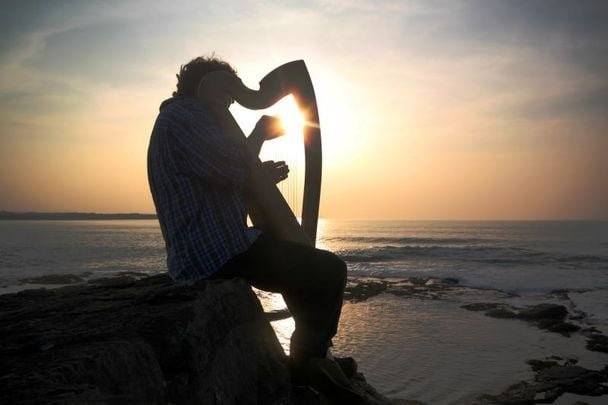
Before humans ruled the earth the Tuatha Dé held the power of the Uaithne, a precious weapon.Before humans ruled the earth the Tuatha Dé held the power of the Uaithne, a precious weapon. Getty
According to our folklore, Ireland wasn’t always ruled by humans. Many different races were said to call Ireland once their home. Easily, one of the most important of these is a group known as the Tuatha Dé Danann.
While human in their appearance, many stories tell of their fantastic powers and the epic battles that raged while they were in control of Ireland. To talk about them in great detail would take up half of this website’s memory, so I thought I’d share a tale about one particularly important member of the Tuatha Dé, known as The Dagda.
The Dagda was the high priest of the Tuatha Dé. He was very powerful and fought many battles, ensuring that the Tuatha Dé emerged victorious against their enemies. He could also control the four seasons using a magic harp called Uaithne. When he wished, he would play a particular chord on this harp, and the season would change from one to the next.
It was made of oak and was a visually powerful tool, helping to make the harp such a well-known image around Ireland. He would also bring Uaithne out to battle with him, as its chords would bring guidance and strength to The Dagda’s men and ensure victory would come to them.
Of course, this power was not a secret, and the mortal enemies of The Tuatha Dé Danann, The Formor, began to make plans to steal Uaithne away from The Dagda. They would learn its secrets and bring it out to battle themselves, hoping to defeat the Tuatha Dé and rule Ireland themselves. They launched an attack against The Dagda, and during the battle, they broke into his lair and stole Uaithne away from him.
When the Fomorians got the harp back to their home, they had great difficulty getting the harp to play any music. Any time they rang their fingers against its strings, nothing was to be heard except for silence. They wasted their time trying to work out the problem, as The Dagda and Uaithne were linked, with The Dagda able to call it back to himself at any time and prevent others from playing it.
When he noticed it missing, he gathered a group of men, and they made their way to the Fomorians. The Fomor spotted them but didn’t have much time to react. The Dagda called out to Uaithne, and it sprang to life and flew through the air towards The Dagda, killing nine Fomorians. He grabbed Uaithne and played three chords. The first made all the Fomorians burst into tears and collapse in despair. The second made them erupt into laughter and toss their weapons aside. The final chord sent them all into a slumber, allowing The Dagda and his men to escape unharmed.
The harp is one of our most well-known national symbols, and it is stories such as these that ensure that its legacy stays strong in Irelan
Celtic Woman’s New York 2026 tickets available now!
A thrilling new chapter in the iconic group’s 21-year journey brings “Celtic Woman – A New Era” to the United Palace in NYC for one night only.
IrishCentral Staff
@IrishCentral
Dec 03, 2025
Grammy-nominated Celtic Woman will perform at United Palace in New York City on Friday, March 20, 2026.Grammy-nominated Celtic Woman will perform at United Palace in New York City on Friday, March 20, 2026.
Grammy-nominated Celtic Woman will perform at United Palace in New York City on Friday, March 20, 2026. Tickets are now available.
The new production, “Celtic Woman – A New Era,” features Mairéad Carlin, Muirgen O Mahony, Ciara Ní Mhurchú, and newcomer Caitríona Sherlock performing a program that blends the ensemble’s signature harmonies with fresh orchestrations and contemporary staging.
Audiences should expect Irish dancers, a full ensemble, and traditional instruments, including bagpipes, bodhran, whistles, and Uilleann pipes, brought to life through modern storytelling and energetic arrangements.
“Celtic Woman – A New Era” will traverse a repertoire from Irish classics and contemporary favorites to classical pieces and original songs that reflect the vibrancy of modern Ireland while honoring centuries of musical heritage. The show is described as a spellbinding tribute to the enduring power of Irish music and the extraordinary talents of the performers, and promises memorable vocal performances and instrumental virtuosity.
Celtic Woman
Since their debut in 2004, Celtic Woman has become the most successful all-female Irish group in history, with more than three billion global streams, 5.3 million US sales, and 12.5 million global equivalent sales. The group draws nearly one million monthly listeners on Spotify and has amassed 900 million US streams to date, making them a familiar presence for Irish American audiences across the country.
Mairéad Carlin hails from Derry and is a Grammy-nominated singer who has appeared with the New York Philharmonic and Boston Pops. She first joined Celtic Woman in 2013.
Muirgen O Mahony is a classically trained vocalist from County Cork with education from the Cork School of Music and the Royal Academy of Music in London, and experience performing at venues such as the Royal Albert Hall.
Ciara Ní Mhurchú is a Dublin-born dancer and musician who has toured with Riverdance and Lord of the Dance and is a two-time All-Ireland Fleadh gold medalist.
Caitríona Sherlock comes from County Monaghan and is a multiple All-Ireland Fleadh Cheoil champion who has performed at Carnegie Hall and Croke Park, and has toured internationally.
United Palace
United Palace opened in 1930 as one of Loew’s Wonder Theatres and is known for its outrageously ornate architecture, designed by Thomas Lamb, and its decorative work by Harold Rambusch. The venue seats nearly 3,400 people and is Manhattan’s fourth-largest theater, hosting concerts, TV and film shoots, movie premieres, and a range of cultural events while blending historic opulence with state-of-the-art production facilities.
Irish president greets Volodymyr Zelensky as he begins official visit to Dublin.
The Irish Government has announced 100 million euro in non-lethal aid for Ukraine.
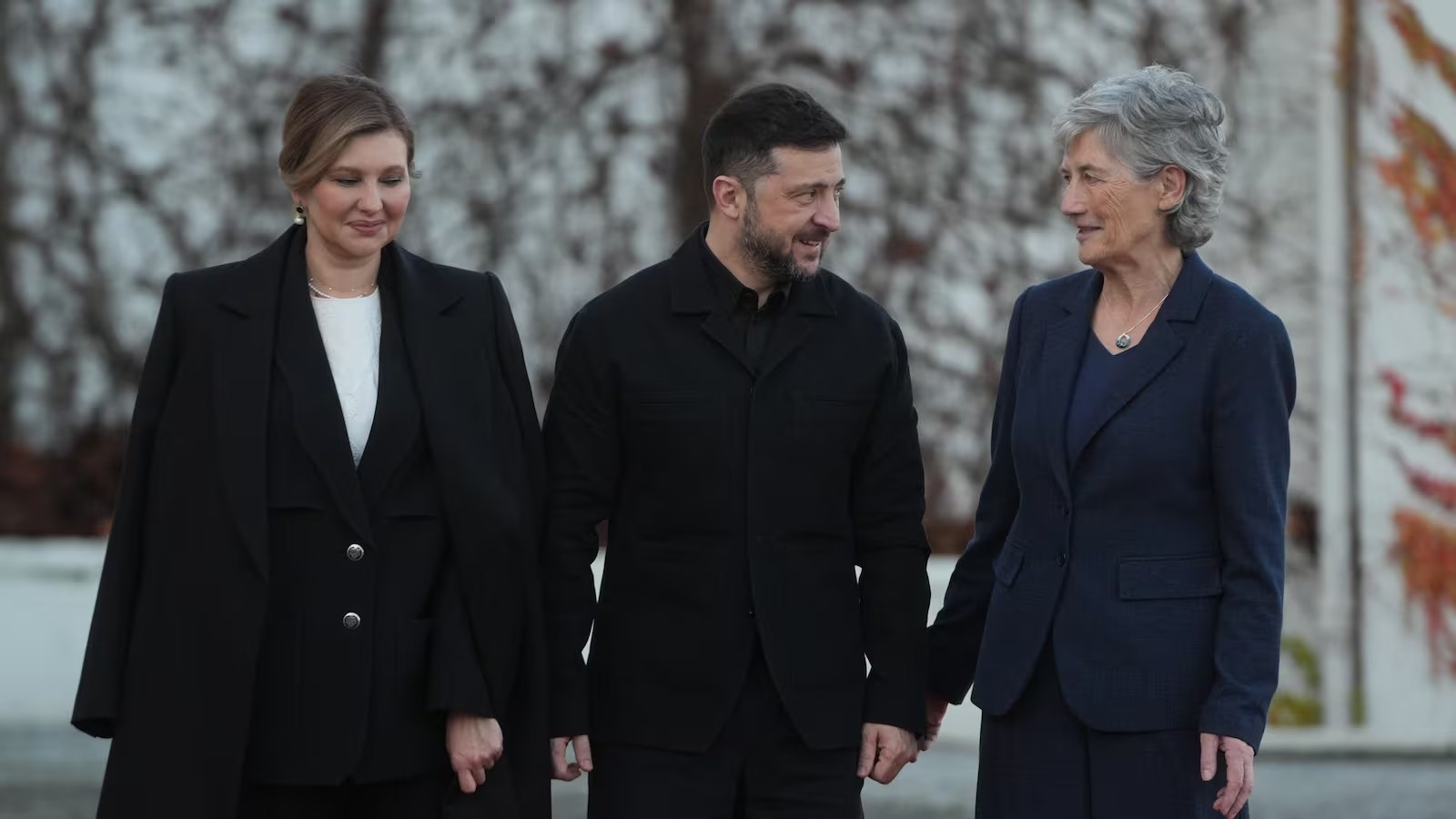
Ukrainian President Volodymyr Zelensky and his wife Olena Zelenska were welcomed by Irish President Catherine Connolly at Aras an Uachtarain.
By Gráinne Ní Aodha, Rebecca Black and Bairbre Holmes, Press Association
December 02, 2025 at 12:22pm GMT
Volodymyr Zelensky was greeted by Ireland’s president in Dublin as the Irish Government announced 100 million euro in non-lethal aid for Ukraine.
The additional funding brings to 200 million euro the total non-lethal military aid given to Ukraine this year.
The funding is part of a new Ireland-Ukraine partnership to be signed by Mr Zelensky and Irish premier Micheal Martin on Tuesday afternoon, which builds on an agreement signed in Kyiv last year.
The 2030 Roadmap on Ukraine-Ireland Partnership sets out Ireland’s immediate commitments to Ukraine, including 25 million euro to support the restoration and protection of Ukrainian energy infrastructure and a scheme to support training and other efforts as part of Ukraine’s path to EU accession.
Mr Zelensky’s visit is the first official visit of a Ukrainian president to Ireland.
He began the Dublin trip with a courtesy call to Ireland’s newly inaugurated president Catherine Connolly.
Mr Zelensky and First Lady Olena Zelenska arrived at Aras An Uachtarain, the official residence of the president, where Ms Connolly warmly welcomed them at a red carpet laid at the front door.
He is to hold a bilateral meeting with Mr Martin at Government Buildings, where a guard of honour will be held for him with flags dipped in military salute.
He will also give an address to parliamentarians at Leinster House after being introduced by the Ceann Comhairle, or Irish speaker of the house, Verona Murphy.
Mr Zelensky is also due to attend the inauguration of the Ireland-Ukraine Economic Forum with Irish deputy premier Simon Harris and Foreign Affairs Minister Helen McEntee.
Ms McEntee and Ukrainian Foreign Minister Andrii Sybiha are due to hold the first meeting of the Ukraine–Ireland Strategic Dialogue, which will also be established as part of the roadmap.
The visit comes a day after the Ukrainian president met French counterpart Emmanuel Macron in Paris as part of discussions on ending the largest armed conflict in Europe since the Second World War.
Mr Martin said he looks forward to “reiterating Ireland’s unswerving commitment to standing with the people of Ukraine for as long as it takes” as part of the visit.
The Taoiseach greeted Mr Zelensky on the tarmac after his plane landed in Dublin on Monday night.
In April 2022, Mr Zelensky made a historic address to the Irish Parliament by video link, in which he said Ireland had not been neutral to the “disaster” Russia had brought to Ukraine.
Welcoming the visit, Mr. Martin said Mr Zelensky’s arrival in Dublin comes at a “critical time” for Ukraine.
He said Zelensky’s “immense bravery” and the resilience of the Ukrainian people “are examples to us all”.
Ukrainian and US officials have worked to revise the proposed US-authored peace plan, which was developed in negotiations between Washington and Moscow but criticized as being too weighted towards Russian demands.
Mr. Zelensky said in Paris on Monday that the peace plan “looks better” but the issue of Ukraine’s control over its territories is “the most complicated” topic being discussed.