The legacy of Project Children
Posted by Jim on July 22, 2026
THE IRISH NEWS:
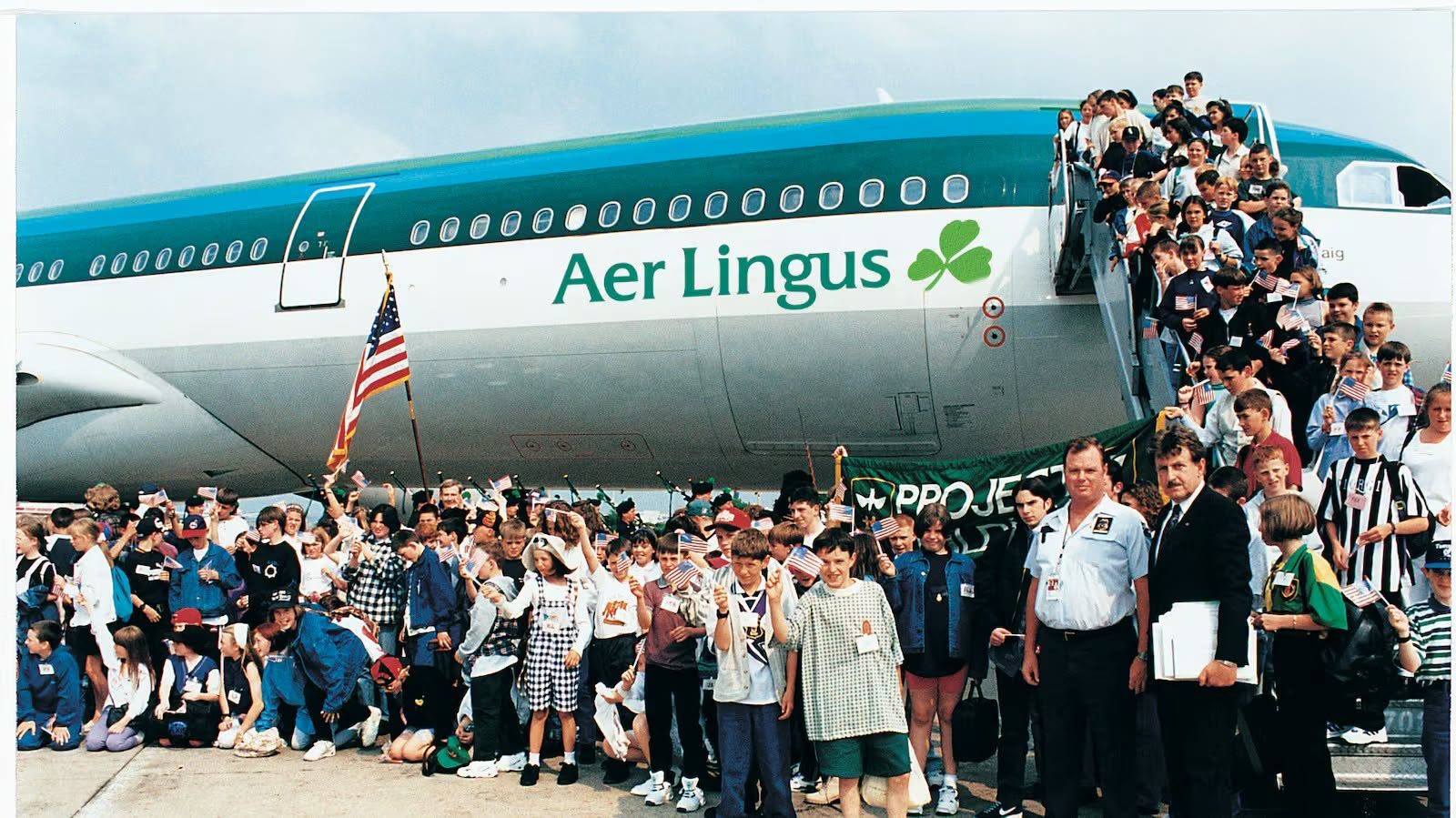
‘I’ll come back and marry you’: The legacy of Project Children which took thousands of Northern Ireland kids away from the Troubles.
Two-time Nobel Peace Prize nominee Denis Mulcahy and the success of Project Children are explored in a new documentary
Arrival day and kids on tarmac at JFK. The lasting legacy of Nobel Peace Prize nominee Denis Mulcahy’s peace mission revealed in new documentary.
By Amy Donohoe
July 21, 2026 at 6:00am BST
As an 11-year-old leaving his American host family at the end of a summer away from the Troubles, one Northern Irish boy turned to their daughter and said: “I know I’m going to come back and marry you.”
Years later, he did. Today, they have three children – a living legacy of a programme that began with just six children in 1975.
Two-time Nobel Peace Prize nominee Denis Mulcahy, a native of Rockchapel, County Cork, emigrated to the United States in 1962. He is responsible for changing the lives of many children of the north.
He joined the New York City Police Department in 1969 where he served with the Tactical Patrol Force, Street Crime Unit, and the 28th Precinct Detective Squad before joining the elite Bomb Squad in 1983. He retired in 2002 as a First Grade Detective after 33 years of dedicated service to the NYPD.
He also spent a lifetime proving that peace can begin with something as simple as opening a family home, helping thousands of children from Troubles-hit communities spend their summers in safety across America.
“Back in 1975, every time you put on the television here, the news was all about Northern Ireland,” Mr Mulcahy told the Irish News.
“It’d show the kids on the street, throwing bricks at the security people and the army, them shooting plastic bullets and kids getting killed. It really did get a huge amount of coverage here. It was non-stop.
“There are so many Irish and second-generation Irish here, so it was really big news at the time.
“It was a hopeless kind of situation because you ask yourself, ‘what can I do to help?’ And to be quite honest, there was very little you could do.”
But Project Children, a summer programme started by Mr Mulcahy, helped thousands of children escape the Troubles and build friendships across sectarian divides.
“We came up with this idea that maybe during the summer, during the marching seasons, we would just bring the kids out here for their safety. That’s when all the kids were getting hurt,” he added.
“It really was so small at the start, we brought six kids the first year and of course a big decision had to be made also, whether we did Catholic or Protestant. A lot of people felt there was a greater need to bring Catholic kids out of there but when you do something like that, you have to be fair and do it 50-50.
“I think it was a very good decision to have made because as time went on, a lot of Protestant kids came out of tough, poor areas too.
“There was a need to bring both. That was back in 1975. Any monies we raised went on airfare and insurance. Everybody volunteered their time and host families weren’t reimbursed in any way, they took the kids in for six weeks, they treated them like their own kids, they covered whatever expenses they had.”
Project Children continued to grow throughout the years, it went from six children, then onto 21, then 54 and eventually it was close to 1000 kids each summer.
“It was amazing for the kids who came from poor backgrounds. They tended to stay in their neighbourhoods, get married at a young age and repeat what their parents and grandparents had done. They were on welfare and there was really no future.
“One thing American families brought across to them was without a good education, you’re not going anywhere, so you have to stay in school. A lot of Americans brought kids back to go to school, not that the schools weren’t as good in Ireland but there was a better opportunity for them here.
“When you think about it, you say how could a mother have put a 10 year old child on a plane to travel 3000 miles for the summer. The reason they did it was their safety.
“People always said at least we knew they were safe for the six weeks so we didn’t hesitate to do it. A lot of credit has to go to the mothers. A lot of the fathers were in prison and the person raising their family was the mother. Really, an awful lot of credit has to go to the mothers of Northern Ireland.
“The word spread and we were able to book 468 seats on a 747 plane and we eventually did two 747s, so we were bringing close to a thousand kids a year. You couldn’t do it today, they were different times.”
Even though there’s not a need for the project to continue on such a large-scale, the story of Project Children continues.
“I had a call recently from a young lady, she’s doing her college paper on the programme – so I asked how she knew about it and she said that granny was out several years ago.
“We have generations of kids who keep passing on the positive stories.”
He adds: “There was a young guy years ago that I sent up to the Syracuse area. When he was leaving, he was about 11 years old, he turned to the host’s family’s daughter and said ‘I know I’m going to come back and marry you,’ and he did – now they’ve got three beautiful kids living in Upstate New York in an old mansion that he remodelled.”
Mulcahy never believed the Troubles would be solved in his lifetime, but he pays thanks to many people, including his good friend Bill Clinton. Today, a lot of the people who were in Project Children, have gone on to do great things.
“I would say, what a hopeless situation and this is not going to be solved in my lifetime but little did I know. A lot of the credit has to go on to my good friend Bill Clinton who I travelled to Ireland with on two of his visits. He did a lot at that time for Ireland because he issued the visas, he helped the kids get out of the situation.
“Once they were out of it they realised that we’re all the same. We would bring the kids, put them into neighbourhoods, they would meet each other and as soon as they heard that accent, they knew they’d a friend from home. It would be weeks later that they’d realise ‘oh that kid was Protestant or that kid was Catholic.’ It didn’t make any difference, they did have a lot in common, they had the same language, same accents, same ages.
“It’s different times now and it’s great because it’ll never go back to the way it was. However, there is still work to be done. People have to realise they have to live together. We have again come a long way along.”
The documentary How to Defuse a Bomb: The Project Children Story shows how the Project Children charity worked to bring Irish children to live in the US for a six-week summer respite from the everyday violence and strife of The Troubles.
Over the next 40 years, Project Children would go on to impact the lives of over 23,000 catholic and protestant children, showing them that a non-violent life was possible and how tolerance, understanding and communication can lead to life-long friendships.
“The documentary is very powerful and it’s all put together with local people, there’s no acting in it, it’s all factual,” Denis added.
Now in partnership with the Monaghan County Council, the Peace Campus has 50 years’ worth of contents from the programme – ranging from Mulcahy’s bomb squad suit and more.
“Heather Humphreys got the funding for that peace center and it’s amazing. The timing, everything is perfect. I couldn’t think of a better location to have it than right there on the border.”
Monaghan Cathaoirleach, Aidan Campbell, will also be in attendance at the documentary screening in both Washington and Boston.
“It’s important to us because Monaghan County Council started to travel over to the US a number of years ago. We started engaging and as a result of that, they were put in touch with Project Children and the Mulcahy family.
“Project Children was 50 years old last year so they were looking for a home for all the archives. Monaghan County Council and Project Children came together with the Peace Campus. Monaghan has been the home for it all.
“Monaghan is right on the border and we were close to the Troubles. Monaghan is an example of how different communities get on together, all cross-party, cross-religion and cross culture, we all get.
“That’s where the genesis of Project Children comes from, Protestants and Catholics working together and making a better life. The Peace Campus in Monaghan is a symbol of peace and it’s a fantastic building, it just complements Project Children what it’s all about.
“The exhibition was opened last year. The response to the story has been very strong from all generations, particularly people who experience first-hand the troubles, the dark times and our recent history in the north.
“Since the exhibition opened, there have been over 25,000 visitors through the museum.”