‘Ireland was seen as a bit like heaven on earth’
Posted by Jim on March 15, 2026
Northern Ireland
‘Ireland was seen as a bit like heaven on earth’ – The hidden link between St Patrick’s Purgatory and a pioneering medieval French writer.
Marie de France’s translation of the legend behind the pilgrimage site in Co Donegal is considered one of the most famous and complete versions of the tale.
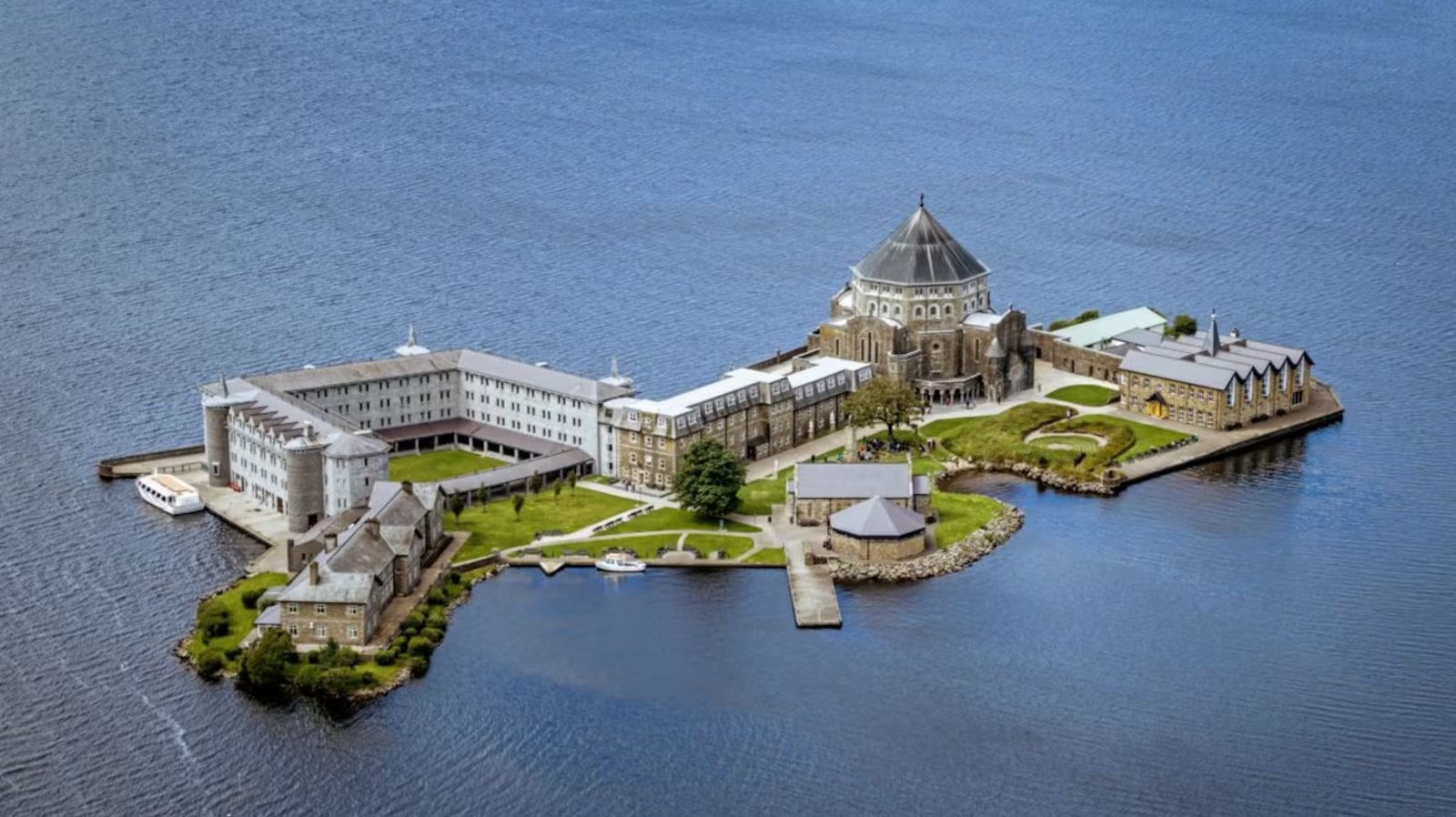
St Patrick’s Purgatory in Co Donegal has been a pilgrimage site since the fifth century, and the legend behind it was a popular tale across medieval Europe.
By Mark Robinson
March 15, 2026 at 6:00am GMT
An academic has told of the hidden link between the Purgatory of St Patrick in Co Donegal and one of France’s foremost medieval writers.
The ancient pilgrimage site on Lough Derg has long been associated with Ireland’s patron saint, where it is said that an entrance to purgatory was revealed as a means to help him evangelize the local people.
In the 12th century, the legend would feature in a Latin text written by a monk and was widely circulated across Europe.
It centers on the story of an Irish knight who travels to the site seeking penance. After entering purgatory, he is faced with a number of torments, which he overcomes, and tells other about upon his return.
Speaking to The Irish News, Myriam White-Le Goff, a medieval literature lecturer at the University of Artois in northern France, said that the legend circulating came at a time when Ireland was viewed as being more advanced than the rest of the continent.
“At the start of the Middle Ages, Ireland is a place that continental Europe strongly admired,” she said.
“It was the area of Europe that was considered the most refined, both artistically and intellectually.
“It’s true that continental Europe was far behind; we held a bit of a golden image of Ireland. It was a bit like heaven on earth.”
She added that Ireland was sometimes synonymous with “the other world” and that the idea that a door to another world existed inside a cave would not have been “completely crazy” to people in the Middle Ages.
“It’s a land which is as much geographic as it is symbolic. Saying ‘Ireland’ doesn’t necessarily mean that the people thought of Ireland the place. It can mean ‘elsewhere’; this exotic place,” she said.
As the legend of St Patrick’s Purgatory spread around Europe, she said that one of the most notable translations is believed to have been written by Marie de France – one of the Francophone world’s most prominent medieval writers.
“She was one of the first to re-write it,” she said.
“It is often said that she is the first female writer to have written in French,” she said.
“It’s possible that there are others who wrote before her and we don’t have any records of it. But in any case, that’s what a lot of literary historians would say.
“Even if we don’t know who she was or where exactly she came from, we do know that she is someone important who left her mark on history.”
Ms. White Le-Goff noted that, as in her other works, the author tells her audience that she is writing in order to preserve the story, at a time where oral tales were common and, in this instance, so that more people can read it.
However, she also makes some key changes, including the insinuation that even if the reader isn’t religious, they can get to heaven. She noted that this was important at a time when there was much “anxiety” surrounding salvation.
“She places value on the fact that the hero, Owein, is a knight, and that he can save himself and enter salvation, even though he is not religious,” she said.
“In the Latin legend, when he returns to the world of men, he asks the king, ‘What should I do? Should I continue being a knight? Or should I become a monk? Do I need to become religious in order to enter salvation?’.
“The king doesn’t respond. We don’t know his response and so every reader comes to their own conclusion.
“Marie de France makes the king respond. And the king says, ‘No, you can remain a knight because you can enter salvation as a knight’.
“That’s interesting in terms of the validation of the non-religious and it’s also important in the political and literary context of the time.”