Secret IRA plan to defend Garvaghy Road if Orange Order parade forced through
Posted by Jim on July 9, 2025
Jim Sullivan
THE IRISH NEWS:
Revealed: Secret IRA plan to defend Garvaghy Road if Orange Order parade forced through
Details have emerged on 30th anniversary of bitter stand-off in Portadown
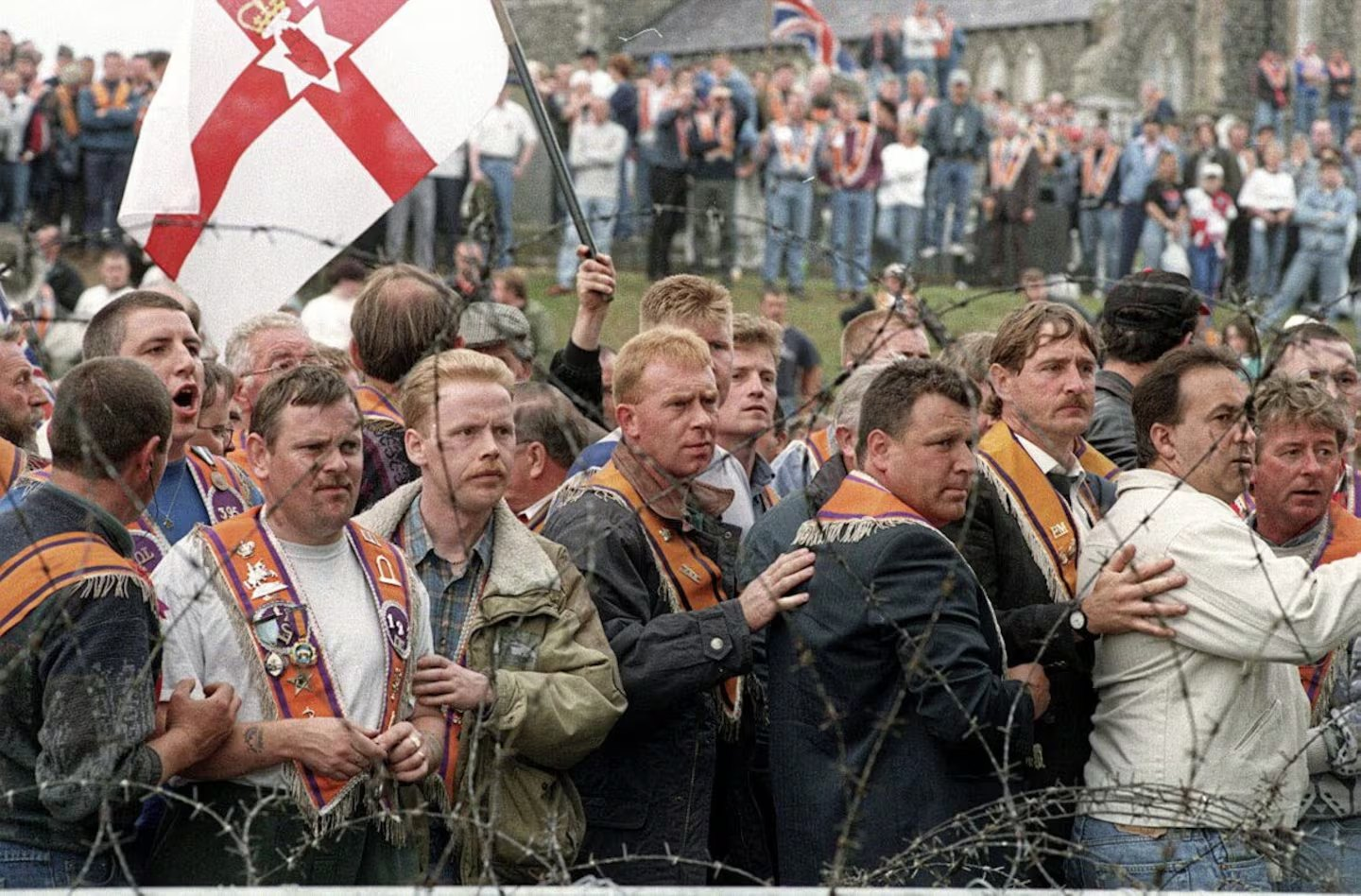
Most people will have considered the Drumcree parade dispute in Portadown – pictured here in July 1998, the first year it was banned – a relic of the past.
Orangemen pictured behind a British army barricade at Drumcree in July 1998
By Connla Young, Crime and Security Correspondent
July 09, 2025 at 6:00am BST
The IRA had a secret plan to defend Portadown’s Garvaghy Road if authorities forced through a controversial Orange Order parade almost 30 years ago.
The “doomsday” blueprint was drawn up by republican leaders after a march was allowed through the mainly nationalist district in 1997.
Details have emerged on the 30th anniversary of the start of the Drumcree dispute on July 9 1995.
Sources say the ‘defensive plan’ was devised against the backdrop of sectarian murders linked to the parade stand-off and heavy-handed RUC operations targeting nationalist protesters.
At the time, the IRA was on ceasefire and the Good Friday Agreement had been signed earlier that year.
But sources with knowledge of the plan now believe it may have been part of a “double bluff” by IRA leaders to force the British into holding firm against the Orange Order by banning it from the mainly Catholic district.
It is also suggested the IRA was aware that information about the blueprint, which included proposals to arm hundreds of local people with home-made guns, would be passed to the British by informers.
Informed sources say self-confessed agent Denis Donaldson was present when details of the plan were revealed to local IRA leaders.
It is understood Garvaghy Road residents were not aware of the IRA’s plans.
The bitter parading impasse began in the summer of 1995 when Garvaghy Road residents objected to an Orange Order march passing through the mainly nationalist district as it made its way from Drumcree Church into Portadown.
The following year, the parade was banned but after violent clashes, the decision was reversed. Nationalist protesters were forcibly removed from the Garvaghy Road to make way for the march.
At the height of the 1996 dispute, Catholic taxi driver Michael McGoldrick (31) was shot dead by renegade members of the UVF outside Lurgan.
The UVF, under the command of suspected British agent Billy Wright, also brought an armoured loading shovel to Drumcree, which was to be used to smash through RUC lines.
In 1997, the Orange Order was again allowed to march along the Garvaghy Road after the area was flooded with police in the early hours of Drumcree Sunday.
Pictures of nationalist residents hemmed into side streets by heavily armed RUC members sparked a furious backlash from nationalists across the north.
Catholic residents of the Garvaghy Road were also blocked from attending Mass, resulting in local people and priests praying in the open-air at British army lines.
Within days the IRA restored a ceasefire, which had ended in February 1996.
In 1998 the Orange Order was stopped from marching through the nationalist district, sparking several days of loyalist violence.
In the early hours of July 12, a sectarian arson attack carried out by the UVF claimed the lives of Catholic schoolboys Richard (10), Mark (9) and Jason Quinn ( in Ballymoney, Co Antrim.
The murders sent shockwaves across Ireland and made global headlines.
After the tragedy, some Orangemen continued on with their protest while others went home, resulting in the Drumcree dispute effectively coming to an end.
Well-placed sources suggest that despite being on ceasefire, IRA members regularly met to discuss the dispute in the years after it began in 1995.
Both Denis Donaldson, who it is claimed was a representative of the IRA’s ‘general headquarters’, and another veteran republican attended many of the meetings.
Sources suggest that Mr Donaldson was present at a meeting of high-ranking IRA members when the full blueprint to defend the Garvaghy Road was revealed by the veteran republican, who has since died.
It is suggested the secret IRA plan was specifically drawn up to defend the nationalist district in the event the Orange Order was once again forced through in 1998.
Sources say that in the months leading up to the annual dispute, a meeting was held involving representatives from three IRA ‘brigade’ areas, including north Armagh, south Armagh and east Tyrone.
It is said that after the events of 1997 “serious plans were made”.
Significantly, it is suggested that a large array of home-made weapons and other materials were moved into north Armagh for use in any defensive action that was to be launched.
“Preparations were being made to defend the area,” it is claimed.
Hundreds of home-made firearms known as Zip guns were manufactured and transported to various locations across north Armagh, and surrounding areas, in the months prior to the stand-off.
The single-shot weapons were designed to be used by people with no experience of handling firearms.
It is claimed the weapons, which fired shotgun cartridges, were to be handed out to local people and republican sympathisers in the event of a defensive scenario arising.
It is also claimed that the IRA moved “conventional” weapons into the area for use by its own members, who had experience of handling firearms.
Republican “back-up teams” were also going to be organized, which would attempt to move into the Garvaghy Road from several different directions in the event of conflict breaking out.
Sources believe that while the plan was being set out to those republicans attending the briefing meetings, the IRA leadership may in fact have been involved in a game of “double bluff” with the British.
It is claimed that several senior IRA members who were briefed about the plan were sceptical that it would ever be given the go-ahead.
It has also been suggested the IRA was aware that information about the plan was being passed to British intelligence.
This, it is believed, was intended to put pressure on the British government to take a hard stand against allowing Orangemen through the area in 1998.
Denis Donaldson was a familiar face on the Garvaghy Road during the years of the Drumcree dispute.
He is said to have encouraged the defensive plan when it was being discussed at IRA meetings.
Mr Donaldson was publicly exposed as an informer in 2005.
In April 2006, he was shot dead at a cottage near Glenties, Co Donegal.
The now defunct Real IRA claimed it was responsible three years later.