Man who was face of IRA in US
Posted by Jim on July 2, 2025
THE BELFAST TELEGRAPH:
Man who was face of IRA in US on escaping arrest from RUC, ‘traitor’ Denis Donaldson and why he had to ‘stand aside’
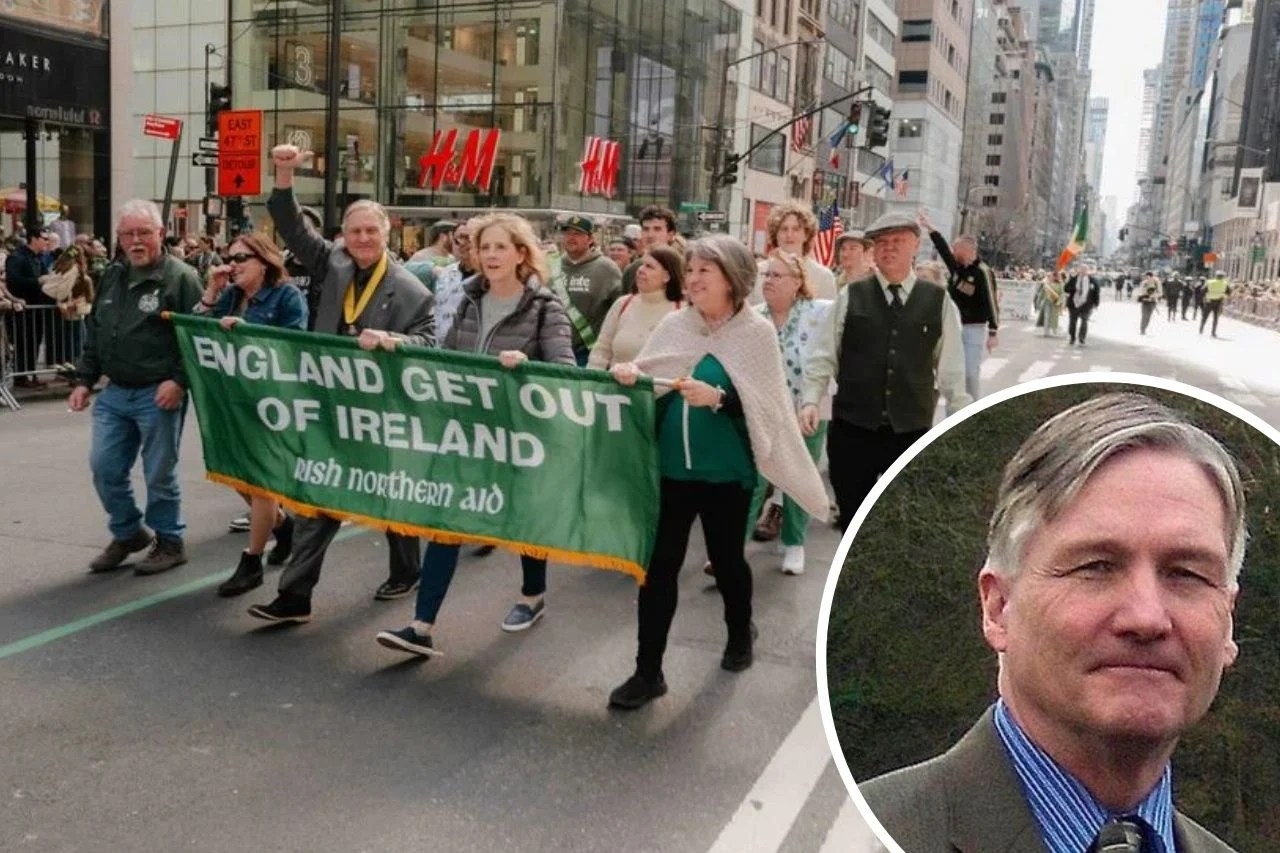
Ahead of a new RTE documentary, the Belfast Telegraph looks at the role played by Irish Americans during the Troubles
Martin Galvin, the former director of Noraid, which is believed to have provided millions in funding to Sinn Fein over the course of the Troubles
Martin Galvin (arm raised and in inset) takes part in a St Patrick’s Day parade in the US.
Suzanne Breen
Today at 01:21
For almost two decades, he was the public face of the IRA in the US. New York lawyer Martin Galvin was regarded as so dangerous by the authorities here that he was prohibited from entering the UK.
In August 1984 he defied the ban to appear at an anti-internment rally in west Belfast.
“I was brought across the Donegal-Derry border by republicans,” he says. “We walked miles through woodland. It was summer, but it was a cold, rainy night.”
Galvin never got to address the thousands gathered outside Connolly House in Andersonstown.
Gerry Adams introduced him on stage. As the lawyer took the microphone, the RUC moved forward, firing plastic bullets, in an attempt to arrest him. Twenty-two-year-old Sean Downes was killed. Galvin jumped off the platform.
As the RUC entered Connolly House, he was able to escape. “I’d a black coat on underneath the white one I was wearing. I put on a cap and glasses that were in my pockets,” he recalls.
“A young woman grabbed my hand and took me to a nearby house. It was only when in the attic there that I’d time to be afraid.”
Martin Galvin, the former director of Noraid, which is believed to have provided millions in funding to Sinn Fein over the course of the Troubles
Galvin is speaking to the Belfast Telegraph ahead of a two-part RTE documentary, Noraid: Irish America and the IRA. It tells the story of the US citizens who raised millions of dollars for the republican movement.
The lawyer, who was Noraid’s publicity director, knew he’d have to escape after addressing the rally, but nobody had anticipated the RUC would forcefully storm the crowd, he says.
He claims that just one republican present didn’t seem surprised at the turn of events. “The only person who didn’t look stunned was Denis Donaldson,” Galvin says. “He was chief steward at the rally. He was present for discussions leading up to my appearance. I’m convinced he’d told his handlers everything.”
In 2005 Donaldson admitted to being a British agent since the 1980s. A few years after the anti-internment rally the republican movement sent him to work in New York. He hated Galvin. “I’d clear evidence he was a traitor,” the lawyer says.
“I presented it and expected him to be investigated. However, I was told that his credentials were impeccable, that he was beyond reproach and had the full confidence of the Sinn Fein leadership.”
The RTE documentary interviews Noraid members in their homes and workplaces. They give their account of involvement in an organisation which was loathed by the British and Irish governments, and the White House.
In his yellow cab, taxi driver John McDonagh says: “New York City has always been the cockpit of Irish republicanism, and it was a great honour when they read the Proclamation at the GPO. It said ‘the exiled children in America’ — and you’re looking at them.
“Irish Americans have been part of the conflict from the 1800s. With the split of 1969, New York went with the Provisionals.”
Galvin says Sinn Fein knew Noraid members were “their friends in America — the people they could count on”.
Millions of dollars went to Ireland. Every American visitor could legally take over up to $10,000. The money would be brought to the Dublin office of IRA prisoners’ support group An Cumann Cabrach.
Noraid held fundraisers across the US. Limerick-born priest Fr Patrick Moloney, who worked with underprivileged youth in New York, sold raffle tickets at dinner dances.
In the documentary he jokes about wearing a big sleeved robe. If someone bought two tickets and handed him $50, he’d say “I won’t insult you by giving change.” A painting of the Last Supper by republican prisoners in Portlaoise hangs in his home.
During the 1981 hunger strike Noraid held daily protests in New York. Children banged bin lids on the streets, and effigies of Margaret Thatcher were burned.
Michael Shanley grew up at protests: “There was never a card-carrying membership. You showed up, you went to meetings, you participated.”
He sold pro-IRA bumper stickers, posters and badges. “We couldn’t sell that stuff fast enough,” he explains.
Noraid’s Irish People newspaper, which Galvin edited, had subscriptions “in every state of the Union with the exception of Hawaii”, Shanley recalls. Brigid Brannigan says activists “changed careers to be sure they’d enough time to give to the cause”.
Galvin, whose grandfather came from Co Offaly, visited Ireland as a law student. He joined Noraid in 1976.
“Queen Elizabeth visited as the US celebrated 200 years of independence. I saw the hypocrisy of that as Ireland was denied freedom,” he says.
“I was an assistant district attorney. I was doing really well. I won a lot of cases. At some point I was hoping to become a criminal court judge. Becoming involved in Irish Northern Aid put a halt to that.”
Galvin flew to Ireland regularly to discuss political and media strategies with Adams and other senior republicans.
Former Sinn Fein national publicity director Danny Morrison tells the documentary that Galvin once sent over a journalist from Playboy to interview republicans. “A lot of women in the movement weren’t pleased, but it got massive publicity,” he explains.
Galvin defends his decision. “It got the Irish republican message to people far beyond the traditional audience. Playboy had a huge reach,” he says.
“It wasn’t regarded as badly then as it is now. It did VIP interviews including ones with President Carter, Yasser Arafat and Lech Walesa.”
In 1983 McDonagh rented illuminated billboards in Times Square to send Christmas messages to IRA prisoners, which flashed across the screens every 12 minutes.
He tells the documentary he’d said he was a member of an Irish Catholic charity when booking the advertising. “They never asked me what type of charity,” he recalls. “I said I wanted to send season’s greetings to the Irish people. They never asked what type of Irish people. I didn’t offer what type.”
The messages ended with UTP — Up The Provos. The company had thought it meant Up The Pope.
Hours after Bobby Sands died on hunger strike in 1981, Noraid had organised a march with demonstrators carrying a coffin from the British consulate to UN headquarters. Weeks later a protest was held at the Metropolitan Opera House as Prince Charles attended a gala performance of the Royal Ballet’s Sleeping Beauty.
Four hunger strikers’ families addressed the rally. New York Mayor Ed Koch batted off complaints about the protest.
Complaints about NYPD officers’ support for republicans similarly fell on deaf ears. Chris Byrne joined the force in 1983 and played in its pipe band, which visited Ireland the following year.
When playing at the Rose of Tralee contest in Kerry, the band decided to also join a Sinn Fein hunger strike commemoration in Bundoran. Byrne recalls his bosses and Mayor Koch paying no heed to gardai complaints.
The band’s participation challenged the negative stereotype of US-born Irish republican supporters, he argues. “Next thing you have a contingent of Kojaks coming down the road, it was very hard to write that off,” he says.
The Rev Ian Paisley’s claim that there was “an active service unit in the NYPD” was “preposterous”, the former policeman says. He views the band’s Bundoran visit as “a great moment altogether” and perhaps its “proudest”.
Noraid always rejected claims the money it raised really went to the IRA. Former Provisionals interviewed in the documentary support that denial. Gabriel Megahey was jailed for arms smuggling. “The FBI said I was the officer commanding US and Canada,” he says.
“We didn’t need Irish Northern Aid money. There were people here, contractors. If I needed money I’d go to them and get it.”
Megahey discloses how IRA members took weapons over on the QE2. “You’d be walking out the dock gate and the next thing the seams of your trousers would be busted (with) the barrels sticking out. How we got away with it,” he adds.
John Crawley, a US Marine from Chicago who joined the IRA, says going near Noraid would have been “suicide” as its open membership meant undercover FBI agents could join.
Yet some members of the organisation were involved in gun smuggling. Its founder, 79-year-old Michael Flannery, was charged with arms offences with four other men in 1982. They were found not guilty.
Bernadette Devlin, who appeared as a defence witness, tells the documentary “nobody in the courtroom wanted to convict this geriatric mob sitting in front of them”.
Byrne recalls the acquittal celebrations that night at a Woodside ballroom. “A couple of jurors came up on the stage and were saluted by the crowd. They were pumping their fists in the air, and we were all together,” he says.
From 1983 Noraid organised “fact-finding” tours to Northern Ireland. People were “billeted” with local families. Kathleen Savage was on one trip. She was delighted to have her picture taken with Adams.
The documentary shows footage of Sinn Fein’s Tom Hartley warning the visitors the RUC could arrest and hold them for up to seven days.
“If they ask you for the name of a solicitor, you must ask for Pat Finucane,” he says. “Having suitably frightened you all, I’ll tell you about the torture too!” Hartley quips.
A masked IRA man can be seen boarding one of the Noraid buses to cheers. Savage recalls that at Derry’s Rossville Flats “the lads were in full gear. I asked them could I take a photo. They said: ‘Oh sure, snap away’”.
Morrison describes the Noraid visitors as “more principled about what was happening (here) than successive Irish governments”.
He argues that Irish America generally played a significant role. “They were the sons and daughters, or grandsons and granddaughters, of people who had suffered as a result of British policy in Ireland,” he says.
“Those people send money back, some of those people sent weapons back. It was a case of chickens coming home to roost.”
Before the 1992 New York Democratic presidential primary, Galvin quizzed Bill Clinton about a visa for Adams. Clinton pledged to support granting one — which he did when president — and Adams flew over in 1994.
The party’s direct access to the US spelt the beginning of the end for Noraid. Friends of Sinn Fein was set up in Washington with “business people and human rights lawyers” brought in who had no connection with the past struggle.
The party could reach into “a whole new set of money” with $10,000-a-head dinner tables in corporate America.
Galvin says: “I was told I had the wrong image. They saw me as too closely associated with support for the IRA. They wanted to change their image. They wanted to leave Irish Northern Aid behind. I had to just accept it and stand aside.”
Megahey tells the documentary: “I always stayed friends with Martin. Martin defended me many times. He was always there. He was always at my back. I think he was treated disgracefully.”
Morrison believes Noraid had “a fundamentalist point of view”, and Sinn Fein was moving into a “pragmatic phase” which “not everybody was suited to… not everybody agreed with”. He adds: “It can’t be a position of the tail wagging the dog.”
McDonagh says there was “no big bang moment”, the organisation “just fizzled out… we moved on with our lives”.
Galvin remains active in Irish American politics. He is now Freedom for All-Ireland chair in the Ancient Order of Hibernians.
But how does he feel about his Noraid past and the group’s decommissioning? He says: “I’m an Irish republican hardliner, I’m proud of that. I’ve no regrets, except that we haven’t achieved a united Ireland.”
Noraid: Irish America and the IRA, RTÉ One, July 9 and 16 at 9.35pm