‘Once you put your head above the parapet, there comes a cost’
Posted by Jim on February 15, 2026
THE IRISH NEWS:
Northern Ireland
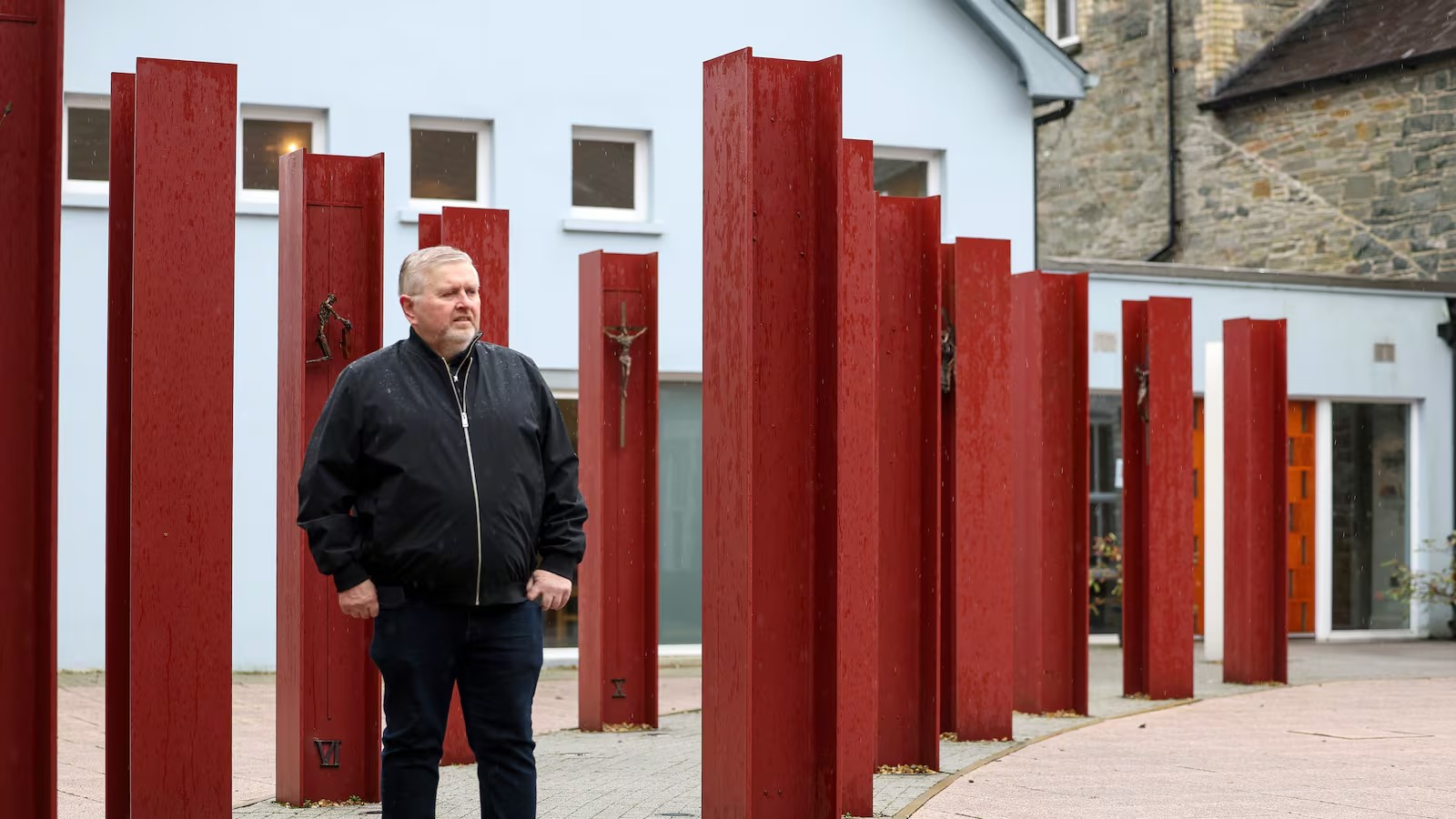
Fr Gary Donegan: ‘Once you put your head above the parapet, there comes a cost’.
A quarter of a century after first arriving in north Belfast, Fr Gary Donegan tells Denzil McDaniel about walking a ‘crooked line’ through troubled times.
Fr Gary Donegan pictured at the Passionist Monastery at Tobar Mhuire in Crossgar, Co Down.
February 15, 2026 at 6:00am GMT
WHEN Father Gary Donegan first felt the calling to be a priest as a Fermanagh teenager, he had a blunt reply for God: “Forget it, big lad.”
“There were girls in my class who had a better chance than me of becoming a priest,” he recalls with his familiar sense of humour, as he sits in his office in the grounds of Mercy Primary School on Belfast’s Crumlin Road.
The Passionist priest admits that his younger self struggled with resentment towards God over a series of tragedies in his deeply religious Fermanagh home.
“God took a battering. I would go down to the chapel and fight with God about some of the things that had happened.”
Providence dictated that his fight was only beginning, except that the man a documentary once dubbed “the priest in the jeans” would battle for rather than against his faith, and bravely stand to lead others through dark times.
It’s 25 years last month since Donegan arrived in Ardoyne, just 80 miles from his upbringing in Newtownbutler but a world away from his “idyllic childhood”.
He’s the second of five siblings, there were 13 in his father’s family, and in the wide, close-knit circle “there was never a cross word”.
Despite the conflict in the border area, there were great relationships between Protestants and Catholics and the large Donegan family got on well with everybody.
He recalls a Belfast woman accusing him of hating Protestants and shocking her into silence by telling her about his Protestant relatives.
“I was very blessed,” he says.
For a self-confessed “culchie”, it was a major change finding himself on the streets of north Belfast.
“I was sent here in 2001, and I use the term ‘sent’ deliberately because I didn’t want to come to the city. I saw the raw sectarianism, it was a shock.”
But he soon found the real people of the area.
“Ardoyne people are the salt of the earth, there’s nobody like them. You hear the term they’d give you the bit out of their mouth,” he says, talking in the heartland of Ardoyne in an office where he commutes to most days despite being based in Crossgar, Co Down.
For a quarter of a century, Donegan has literally walked the walk for the people he so admires.
Despite death threats, he and Father Aidan Troy led the Holy Cross children past loyalist protesters to school day after day in 2001, bearing the brunt of “vitriolic abuse”.
He was also on the streets every night for three years to help defuse tension during the Twaddell Avenue protests when Orange parades were denied a return along the Crumlin Road; and he faced down republican dissidents opposed to an eventual deal.
There’s a famous scene where he’s being verbally attacked by them and he steps forward, points the finger and comes out with the line: “I’ve been here every night for three years, where were you?”
On another occasion, he spoke out publicly as the scourge of illegal drugs resulted in suicides among the area’s youth, encouraging local people to also find their voice.
It wasn’t easy, and he recalls incidents such as being spat at in a restaurant and being hit by water cannon while helping to stop rioting.
“When you’re a peacemaker, you walk a very fine line at times. Once you put your head above the parapet, there comes a cost,” he says.
But he jokes that a mental toughness was already developed on the Gaelic football field: you couldn’t afford to take a backward step against St Pat’s of Donagh, the neighbouring parish to Newtownbutler First Fermanaghs, he says.
Donegan approached it all with a mixture of courage, a desire to break down barriers, humour, and empathy for others.
His resilience was forged in the fire of loss during his youth.
He recalls in 1979 a horrendous accident near his home in Fermanagh when seven people were killed in a car crash, including four members of the O’Harte family, with whom he was close.
His closest friend, Fergal O’Harte, survived because he was in Clones selling programs at the Ulster football final.
But it was merely a reprieve for the 15-year-old.
Donegan recalls with clarity the day he and Fergal were helping out with farm work and sat down by the stump of a tree.
“Fergal says ‘I don’t feel well, I’m really tired’ and he pointed to this thing on his neck. I said ‘It’ll not kill you’. I remember saying that line. Little did I realise that that Fergal developed a rare form of cancer.”
Despite a widely-publicised mercy mission when an RAF helicopter landed at the isolated border farmhouse to bring the boy to Glasgow for a revolutionary treatment called Interferon, Gary’s young friend died.
“I used to go to Fergal’s grave and talk to him,” says Donegan. “I’d say to God how could you, as a God, allow a family to be wiped out and and this widow left with a special needs daughter and a 90-year-old granny. How could you let that happen?
“At the same time Mammy’s sister, Tess, was dying of cancer. I think she was 39. One night Father William from the Graan came in to visit and her whole countenance changed.
“And this feeling came over me. This is what God wants me to do.”
Initially he resisted. “I just wanted to box for Ulster, play for Fermanagh. I want the wife, the five snottery children, an Audi 80 and a nice bungalow. I didn’t want much,” he jokes.
“But the more I would fight it, the more it was happening.”
So, Gary Donegan entered the priesthood at the Graan, the Passionist Retreat near Enniskillen, in October 1983, not yet 20 years old.
Why the Passionists?
”The Passionists’ first vow is to preach Christ crucified, taken from St Paul’s scripture. So, our first vow is to be with the modern-day crucified. I saw the guys in the Graan and I saw their empathy with the suffering.”
Donegan’s background in Fermanagh was key to the inner strength he showed in the turmoil of Ardoyne’s troubles, and he says his faith is underpinned by liberation theology and “the church of the street”.
The documentary “The Priest with the Jeans” was about him hearing as many confessions down entries or along the street, when he was joined by Brian McKee, his “wing man”.
He points to a photo of the two of them, and jokes: “You wouldn’t buy a used car off that boy!”
Donegan has rightly gained respect and plaudits for his peace and reconciliation work. He’s travelled far and wide, working with British, Irish and Amercan governments, in addition to being in places such as Estonia and South Africa.
In his office there’s photo of him speaking at the United Nations.
Often he travels with his good friend Bill Shaw, the Presbyterian minister he met during interface trouble, and he’s travelled to Dublin with loyalist leaders.
He works across communities with numerous people trying to make a difference.
All the above just scratch the surface of the work which has gained him honorary doctorates at Ulster University and Queen’s University, awards such as Community Relations Council person of the year, Aisling Centre man of the year, recognition in America and more.
At its heart, though, is the work he’s done among his own people, and it may seem remarkable that an area which has suffered so much becomes the inspiration for peace and reconciliation.
“Ardoyne was the epicentre of loss,” he says. “It had the largest loss of life of any parish in what we euphemistically call the Troubles. To put it into context, the 99 lives lost is the equivalent of 50,000 people dying in LA or 4.2 million dying in the United States.”
A book called “Ardoyne: The Untold Truth” was published in 2002 by a local project, which Donegan says “tells the stories of the 99 souls in a non-hierarchal way”.
The book details accounts of people killed by loyalist paramilitaries, state forces and republicans.
“I am on record as having condemned any form of violence. But what you had to do when you came here was to try to understand why somebody would take on a cause or defend a cause that would give up their liberty, give up faith, give up what drove them.
“You’re trying to get inside the mindset of why would someone actually do that on both sides,” he says, and points out that a lot of republican paramilitaries were Marxists and “hated the church and priests with a passion”.
He remembers during work he was doing with loyalists and republicans when “the republican prisoner was giving it to me in the neck and the loyalist guy couldn’t get over this and said ‘we were brought up thinking you were out to get us for Rome’.”
“I said ‘Would you take a look at that boy there; we have difficulty hold on to the ones we have!’”
Being a peacemaker can mean ploughing a lonely furrow, or as Father Gary Donegan puts it, “walking a crooked line”.
Essentially, if he was on any side it was that of the hard-pressed people caught in the middle of the conflict.
“You have to work with your own community before you can reach out. You have to win their trust,” he says, and ironically the role he and Father Aidan Troy played in standing up for the Holy Cross children gave them a credibility that years of traditional church work would never have done.
He recalls a vigil for Michael McGibbon, shot dead in church grounds, and the 1986 killing by the UVF of Raymond Mooney, murdered as he was leaving after chairing a meeting of the Holy Cross “living church” group.
The decision was taken to name the centre the Raymond Mooney Peace and Reconciliation office.
Peacemaking in troubled times was often subject to intimidation, such as constant blowing of car horns as he spoke at vigils or public meetings.
He recalls at one point standing up and saying to local people: “This is your area. I’m willing to give my life for you but I’m a blow-in. I love this place, but it’s your home. You need to take charge of this.”
Today, Ardoyne is a much better place but while the war is over, the efforts for peace and reconciliation go on at the Houben Centre, named after Father Charles Houben, a Dutch Passionist who returned to Ireland in his healing ministry.
Later he would be canonised as St Charles of Mount Argus.
Gary Donegan continues his peace efforts, despite personal setbacks in recent times.
Now aged 61, his health issues include significant loss of vision in one eye, and in January last year the passing of his beloved mother, Christina, hit him hard.
He was incredibly close to her, so close he felt unable to speak at her funeral. During our interview, he becomes emotional and quiet for a time as he recalls her memory, including the day she saved his brother’s life when fire engulfed their Newtown butler home.
“She was hanging out the clothes, and she heard the screams of Mark. She raced down; in those days women wore aprons and she threw the apron over her face and ran through the flames and pulled him out to save him.”
The story was covered in the press and media, describing her as “Ireland’s national heroine”.
Mark survived but would later develop MS and has been in a wheelchair most of his adult life.
“He’s my hero, he’s as happy as Larry and an inspiration to everybody,” says Donegan.
It seems to pass him by that his life of service also makes him a hero and inspiration to many in Ardoyne, across Ireland and further afield.