All hail Ireland’s patron saint of female power.
Posted by Jim on February 3, 2026
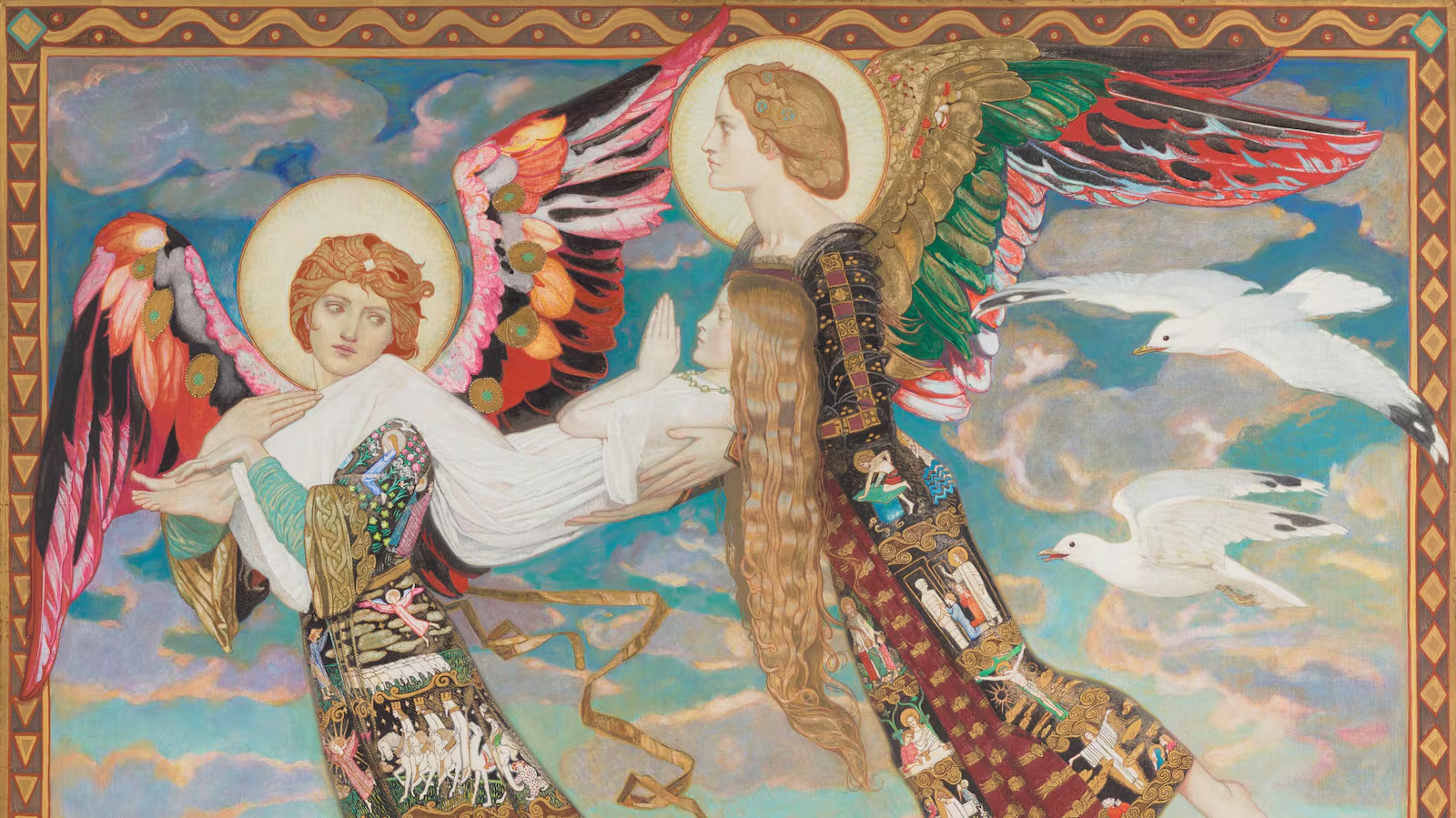
Alongside Patrick and Columba, Brigid is one of the most important Irish saints. Yet you would be hard-pressed to know it.
John Duncan’s Saint Bride hangs in the National Galleries of Scotland
By Tom Collins
February 03, 2026 at 6:00am GMT
ONE of my favourite paintings is by the Scottish artist John Duncan.
Painted just a century ago, Duncan drew on ancient artistic techniques that would have been familiar to monks working on ancient illuminated manuscripts.
Tempera uses that most basic of natural materials, the yolk of an egg. Mixed with pigments, it produces colours of stunning luminosity which retain their potency across centuries.
Duncan’s choice of tempera, oil and gold leaf, fitted his subject perfectly. It depicts St Bride – Brigid – being carried by angels to Bethlehem from the holy island of Iona in the Inner Hebrides.
It is said that St Brigid attended the birth of Jesus, some feat given she lived 500 years after that event. But who am I to doubt it? There is much in this world I do not understand.
Her feast day was Sunday. February 1 marks the beginning of the Irish spring (Spring? With the cold and rain it’s as difficult to believe as Brigid’s attendance at the Nativity, I know).
Alongside Patrick and Columba, she is one of the most important Irish saints. Yet you would be hard-pressed to know it.
Alongside Patrick and Columba, Brigid is one of the most important Irish saints. Yet you would be hard-pressed to know it
Hands up everyone who saw her feast day pass without notice? Compared with Patrick, Brigid is neglected.
Once again, our civilisation finds a way of writing the woman out of the story. Yet this ‘mother saint’ of Ireland has much to say to us today.
While Patrick was hobnobbing with chieftains and using his mystical powers to rid Ireland of snakes, Brigid was feeding the poor and healing the sick.
It was her concern with ordinary people’s lives that made her so revered in the centuries after her death; and her association with spring, and the turning of the seasons, gave hope to our ancestors that out of the darkness would come light, renewal and hope for the future.
In his poem St Brigid’s Girdle, Seamus Heaney writes about a St Brigid’s Day in County Wicklow where the first snowdrops are growing: “… and this a Brigid’s Girdle I’m plaiting for you, an airy fairy hoop (like one of those old crinolines they’d trindle), twisted straw that lifted in a circle to handsel and to heal, a rite of spring”.
Handsel is an archaic word for gift. I learned it from my father who carried on the practice of gifting us a coin on the first Monday of every new year, with the promise that if we kept it safe we would never be penniless.
Passing through the girdle secures a gift of sorts from St Brigid: her blessing which bestows protection and brings with it health and fertility.
The girdle links us to another important facet of St Brigid’s being – the way she links us through to the ancients who peopled this land before Christianity made its mark. She does so in a way Patrick and Columba cannot.
It’s said her father was an Irish chieftain, but her cult has also been linked to a Celtic goddess of the same name, and her feast day falls on the ancient pagan festival of Imbolc, said to be linked to the lambing season.
While our species has benefitted enormously from the march of civilization, it is increasingly clear that one of the things we have lost is our connection with the natural world – a world our ancestors, the worshippers of Brigid the Goddess and Brigid the Saint, were very much aware of, not least because their lives depended on it.
As is becoming increasingly clear, nature, so long neglected, is beginning to reassert itself. Climate change is its response to our desecration of the land and the plundering of our planet for fossil fuels, minerals, and over-production of food.
In just over a month’s time, we will be celebrating our Irishness by turning rivers green, decking ourselves in greens, whites and oranges. We will be donning leprechaun hats and drinking green Guinness, and our leaders will be paying homage to the Orange Man-Baby at the Court of King Donald in the White House.
That excess of ‘oirishry’ is not a fair reflection of Ireland today, nor will it meet its needs.
Let us take refuge instead in the folds of St Brigid’s cloak, pass through her girdle and contemplate her simple cross of woven reeds.
Let this embodiment of our Christian and pagan heritage mediate with our ancient ancestors lying beneath dolmens or buried in ancient mounds, and let us channel her love of learning, her spirit of creativity, and her compassion for those who really need our help.
Above all else let us celebrate the fact that this island would be nothing but for women like Brigid, women who have held life together while Ireland’s men have been doing all they can to tear things apart.
Letters to the Editor are invited on any subject. They should be authenticated with a full name