Chris Donnelly: Irish unity offers the best route to reconciliation and stability
Posted by Jim on November 17, 2025
Opinion
Chris Donnelly: Irish unity offers the best route to reconciliation and stability.
By any objective analysis, it is the conduct of unionism’s political leadership which continues to cause the greatest source of political and community upheaval.
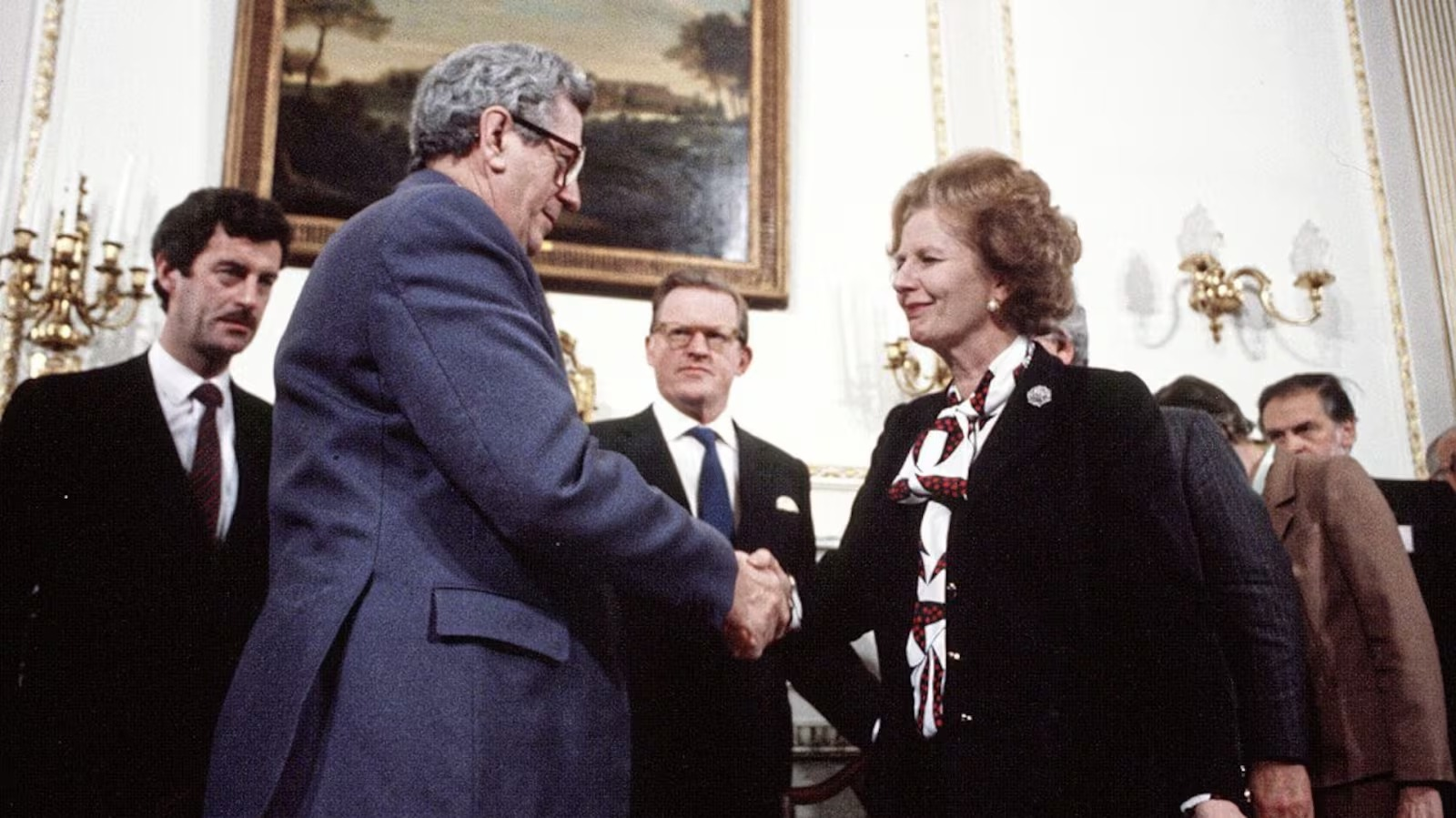
Tánaiste Dick Spring and Secretary of State Tom King (centre) look on as Margaret Thatcher and Garrett Fitzgerald sign the Anglo-Irish Agreement 40 years ago in November 1985
By Chris Donnelly
November 17, 2025 at 6:00am GMT
During her inauguration speech last week, the new Uachtarán na hÉireann, Catherine Connolly, appropriately referenced Article 3 of the Irish Constitution and its explicit commitment on behalf of the Irish people to work towards a united Ireland, consistent with the principle of consent as enshrined in the Good Friday Agreement.
As conversations continue and indeed expand on the prospect of Irish unification, it has become obvious that we need a cold, hard public discussion on how media framing, north and south, continues to betray a residual bias in favour of the unionist position, in spite of the change that has dropped slowly yet decisively over the past 30 years.
As I outlined in my last column, it is apparent in the manner in which the permanent veto against a Catholic ever becoming the British head of state is not deemed an issue worthy of discussion – and certainly of no significance regarding the constitutional position – yet sectarian comments attributed to online trolls during the Irish presidential campaign were elevated to a matter which allegedly indicated how unionists would not be welcome in a united Ireland.
At no point during coverage of the decision by the DUP to not attend the presidential inauguration in Dublin were senior DUP politicians challenged about what message their non-attendance sent to ordinary nationalists regarding respect for their identity and community whilst continuing to live in the United Kingdom today.
It is apparent in the oft-cited expectation that Irish unity must lead to a change of the national flag and national anthem, yet no such measures would even be countenanced regarding the union flag and God Save The King in order to maintain the union at present.
That is not to say such changes are not without merit and serious consideration by nationalists, but rather as an act of generosity as opposed to an expectation rooted in an unwarranted sense of entitlement.
It is apparent in the fact that no nationalist would consider compelling a unionist TD to swear an oath of loyalty to the Irish Republic in order to simply attend the Dáil in a united Ireland, yet nationalist MPs wishing to attend Westminster today continue to be publicly humiliated by swearing an oath of loyalty to the British monarch, without ever meriting discussion on the message that is sent to the Irish nationalist population in this place.
In an exchange with the presenter during the most recent episode of the BBC NI Borderlands podcast series, an interviewee commented regarding the prospect of a united Ireland that “you need to unite Belfast first”.
That is, of course, utter nonsense.
The city’s sectarian divisions have been evident and resulted in sporadic episodes of violence for more than 150 years. At no point has the fact that these have always happened whilst the city was under British jurisdiction meant that the existing constitutional status of the north of Ireland has been deemed null and void.
The very fact the continuation of the north of Ireland as a part of the United Kingdom has abjectly failed to both decisively address matters of reconciliation and to provide a stable political environment only adds credence to the belief that only Irish unity can provide a framework within which communities can better be reconciled and political stability achieved over time.
By any objective analysis, it is the conduct of unionism’s political leadership which continues to cause the greatest source of political and community upheaval.
The former tánaiste Dick Spring foolishly commented in 1993 that unionists should have the freedom to “withhold their consent” from constitutional change “unless and until they are persuaded by democratic means only”.
The context of his speech was amidst a particularly dreadful spate of killings across the north of Ireland and as background talks were clearly intensifying to clear a path to ceasefires that would come the following summer.
But it was careless talk nonetheless as it supported the undemocratic notion that unionism in itself had a veto on constitutional change, an affirmation (even if unintentional) of the Orange card manufactured and sustained by British brute force throughout centuries of Irish history to the detriment of all calling this place home.
As if to prove that some people never learn, the one-time Labour Party leader resurfaced last week to declare that Ireland was not “ready” for a unification referendum.
Instead, Mr Spring suggested it would be better for the north to simply “develop relationships with the south, economic relationships in particular”.
As the DUP’s non-attendance at Catherine Connolly’s inauguration illustrates, opposing partnership and greater co-operation is a central tenet of political unionism’s strategy.
It is also why Emma Little-Pengelly had the temerity to believe she should vocally oppose the notion of Irish citizens in the north being able to vote in future Irish presidential elections.
Only those blinded by ignorance, naivete or a lack of genuine experience of northern affairs would maintain that propping up a unionist veto or setting wildly unrealistic demands as a condition for Irish unity are appropriate at this time.
The problems besetting this society will not disappear in advance of Irish unity.
Enduring reconciliation and political stability will best be served by constitutional change. The sooner that is realised, the better.
If you have an opinion on the issues raised in this article and would like to submit a Letter to the Editor to be considered for publication