New insights into family’s long pursuit of justice
Posted by Jim on July 3, 2025

New insights into family’s long pursuit of justice
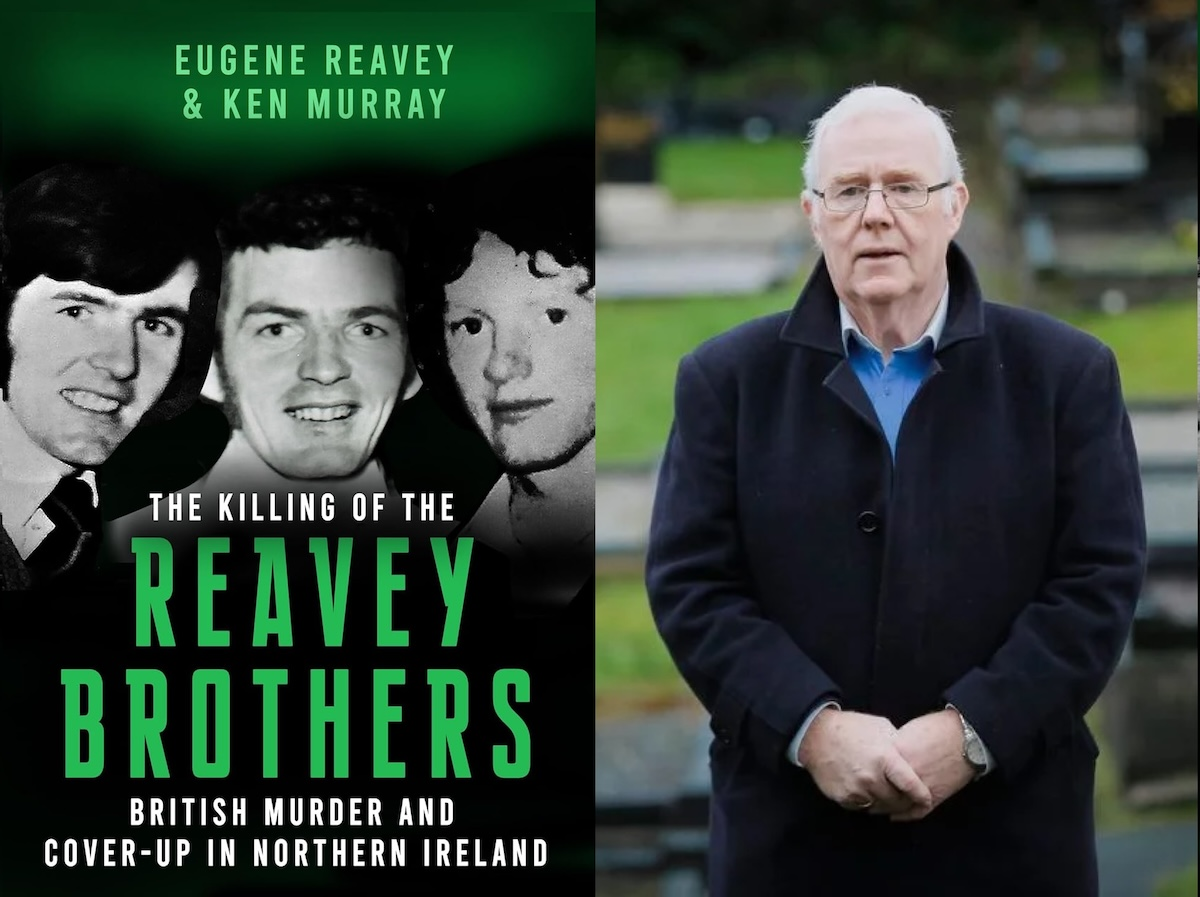
The brutal murder of three innocent Catholic brothers in south Armagh in 1976 remains one of the darkest chapters in a conflict scarred by British state collusion with loyalist paramilitaries. Nearly 50 years later, Eugene Reavey—whose three brothers were gunned down in their home—has published a powerful new book that names many of those allegedly involved in the Glenanne Gang, a sectarian death squad composed of members of the RUC, UDR, UVF, and other British-backed units.
Titled ‘The Killing of the Reavey Brothers: British Murder and Cover Up in Northern Ireland’, the book lays bare the depth of the British state’s involvement in loyalist terrorism. Drawing on decades of personal investigation and state-submitted evidence, Reavey names 35 suspects, with 23 confirmed as members of British Crown forces – specifically, the RUC, UDR, and Territorial Army – responsible for a reign of sectarian terror that claimed around 120 lives.
Among the names featured is Robin “The Jackal” Jackson, a notorious UVF commander widely believed to have been a British agent, as well as UDR member Bertie Frazer, who was killed by the IRA in 1975. In an extraordinary revelation, the book also claims that Frazer’s son, Willie Frazer, later a high-profile loyalist activist, acted as a getaway driver during the murder of the Reavey brothers, John Martin (24), Brian (22), and Anthony (17).
According to Mr Reavey, Protestant locals later told his family that Frazer had boasted about being the getaway driver.
“At the time we didn’t know whether to believe this or not as Willie was a notorious liar and fantasist,” Reavey writes. “He was also 15 at the time.” However, new evidence uncovered in documentation linked to the Hillcrest Bar bombing has since reinforced the claim, stating that “a Mr Frazer” was involved in the Reavey murders.
The Glenanne Gang’s atrocities formed a key part of Britain’s covert war against the nationalist community. Just minutes after the Reavey brothers were murdered in their home in Whitecross, the same gang struck again, slaughtering three members of the O’Dowd family in Ballydougan. The following day, the sectarian Kingsmill massacre took place, a likely retaliation for the previous night’s killings. Ian Paisley, then leader of the DUP, attempted to smear Eugene as driving one of the attackers to the scene of Kingsmill.
Eugene Reavey wrote: “The same allegation was repeated verbatim by Willie’s friend, Ian Paisley senior, in the House of Commons, which left us in no doubt about its source.”
These attempts to smear the Reavey family underline the extent to which the British establishment shielded their loyalist proxies while seeking to delegitimise nationalist victims and campaigners.
The unchecked collusion and corruption that defined loyalist operations didn’t end with the Glenanne Gang. Reavey’s book also exposes how he and his family’s construction firm were extorted by UDA godfather James Craig during the 1980s, forced to pay £1.35 million in “protection money.”
Craig – who was later shot dead by his own organisation – ensured UDA control over state-funded Housing Executive contracts and even arranged for Reavey to meet his republican counterpart to negotiate extortion terms on Belfast sites.
“Here was a prominent member of the UDA offering to introduce me to a member of the republican movement who he worked closely with,” Reavey writes. This chilling anecdote illustrates the cynical criminal enterprise that underpinned the Troubles for many within loyalism—propped up and enabled by the British intelligence services.
One of the book’s most shocking revelations relates to the murder of Protestant teenager Adam Lambert in 1987. It had long been claimed that the UDA gunned down the 19-year-old in retaliation for the IRA’s Enniskillen bombing. However, Reavey reveals that Lambert was murdered because two UDA thugs had been humiliated and ejected from a building site by a south Armagh worker. Mistaking Lambert for a Catholic because of where he was working, they shot him dead.
“Thinking he was a Catholic the two young UDA upstarts looking for a ‘Taig’ shot Adam Lambert dead having wrongly assumed he worked for Reavey Brothers,” the book says.
The killing was yet another example of how sectarian bloodlust, often facilitated by British forces, destroyed innocent lives—Catholic and Protestant alike.
John Stevens’ investigation later found the murder of Adam Lambert, along with that of defence lawyer Pat Finucane, could have been prevented, and confirmed there had been collusion in both. William Stobie, a UDA man who acted as the driver in Lambert’s murder and later an RUC Special Branch agent, was himself killed by his own organisation.
In this powerful and deeply personal book, Eugene Reavey once again makes clear what the nationalist and republican community have long known: that the British state was not a neutral player in the North’s conflict, but an active participant in the campaign of terror waged against the Catholic population. His unflinching account challenges the official narrative of the conflict and demands accountability, truth, and justice—not just for his brothers, but for all those whose lives were torn apart by the British state’s dirty war in Ireland.
* ‘The Killing of the Reavey Brothers: British Murder and Cover Up in Northern Ireland’, by Eugene Reavey with Ken Murray and published by Mercier Press, is available now.