Unity or the Union?
Posted by Jim on July 1, 2025
THE BELFAST TELEGRAPH:
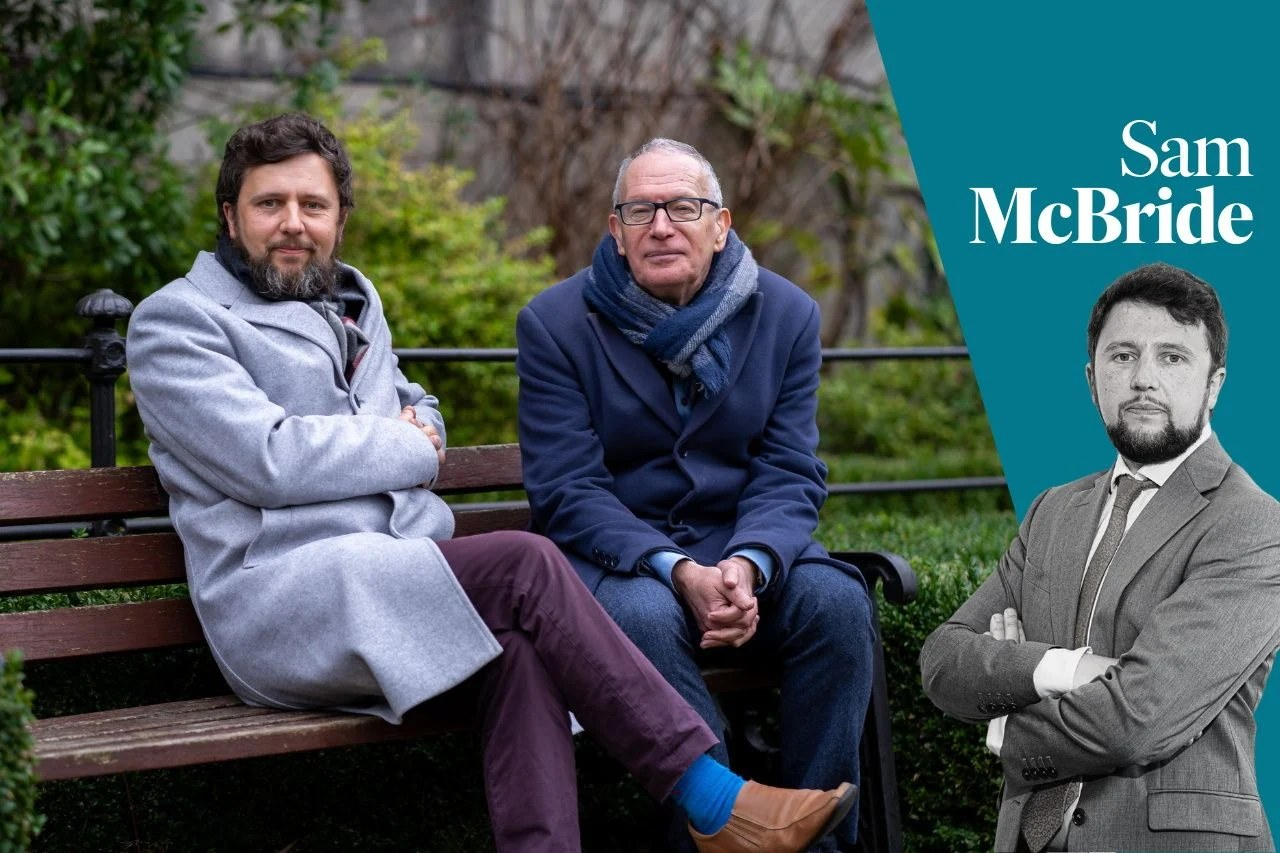
Unity or the Union? Both sides have a good argument, but rarely is it made in a sensible way.
Either case should be based on facts, not tribal thinking… our future depends on it.
The two authors each argue for, and then against, removing the Irish border
The two authors each argue for, and then against, removing the Irish border
Sam McBride
Today at 01:30
Ireland has many divides. The border might be the most controversial, but there are divisions which predated partition and have the potential to outlast it even if the border was to be removed.
Yet beyond differences of religion, of constitutional preference, of class — and even newer points of difference such as ethnicity and language — lies what is now perhaps the most important division: the split between those who want to win a border poll at all costs, and those whose respect for their neighbours outweighs their desire to get everything they want.
There is a fragility in all things. What we now have — booming prosperity (in both global and historical terms, even if we don’t think we’re rich), settled peace, and warm relations across the island and with Britain — is not normal.
Even after the turmoil of the post-Brexit years, we exist in an unusually settled period. This is both a blessing and an opportunity.
It is a chance to consider the future of the island calmly and rationally.
There’s no ticking clock against which we’re racing to make up our minds.
There’s no pike or gun pointed in our faces. There’s no pressing urgency to overcome religious discrimination or intolerable conditions.
It wasn’t always thus. Many of our ancestors lived in periods of terror and squalor.
We don’t often think of our situation in this way. Taking a longer view back to the past and ahead to the future gives context to the present.
Last year, I was approached with an idea: The Royal Irish Academy wanted to publish a book which set out the best arguments for a united Ireland, and the best arguments against a united Ireland.
Initially, the idea was that there would be two complementary books — I would write the one on Northern Ireland, and Fintan O’Toole would write the one on the Republic.
Eventually, it was decided to combine both in a single edition on the basis that while someone in Cork might not think they need to consider the same issues as someone in Coleraine, this decision inevitably impacts both.
Fintan and I each set out with equal clarity the cases for and against unity. Neither section was difficult to write because there are many strong and reasonable arguments for both sides. Yet many of them are rarely made.
The Troubles — and more recently Brexit — demonstrated how major developments on one side of the border inevitably affect the other jurisdiction.
What attracted me to the idea was that it was resolutely nonpartisan. This isn’t an attempt to tell readers what to think about a united Ireland. Rather, it is an attempt to get them to think about it in a different way.
Fintan and I each set out with equal clarity the cases for and against unity. Neither section was difficult to write because there are many strong and reasonable arguments for both sides. Yet many of them are rarely made.
For an issue which defines Northern Ireland’s politics, it is remarkable that unionist and nationalist parties spend so little time espousing the practical benefits of their ideological preference.
I’ve never had any interest in journalism which proselytises for one or other side. Readers deserve the best possible version of the truth we can establish, not the inevitable suppression of some awkward discovery because it doesn’t suit a particular cause.
At various points in my career I’ve been shunned by the DUP, Sinn Féin, and Government ministers for asking questions or reporting truths they’d rather were concealed. Not once has this caused me the slightest concern.
If the price of access to power is silence on important issues, then that access is pointless.
I accepted the invitation to write this book in the knowledge that I’d inevitably be accused of bias and that inevitably those claims would, absurdly, come from both sides.
Seeking to assuage the prejudices of such zealots is impossible, but there are a great many fair-minded people who want to be better informed about this decision, and it is those people for whom this book has been written.
It’s also for my children who are smarter than me and of whom I am immensely proud. I rarely write about them because they have the right to privacy and to be judged for who they are, rather than on my behalf.
But yesterday my daughter had her final assembly in primary school where she and her classmates were exhorted to embrace the boundless possibility before them.
Her generation, and that of her brother, will be able to judge this question freed from some of the shackles of history. But they also need to know some of the pitfalls into which past generations fell so that they can avoid repeating our mistakes and those of our ancestors.
For and Against a United Ireland is published by an academic publisher, meaning it has gone through fact-checking and peer review. But it’s not an academic book. We are journalists writing in plain language for normal people.
The book is part of the Arins project — Analysing and Researching Ireland, North and South, a joint initiative between the Royal Irish Academy and the University of Notre Dame. However, this is far too important a debate to stay within the academy. The way in which this question is decided will impact our lives and the futures of generations still unborn.
It’s not a decision to be taken flippantly or arrogantly or based on sectarian tribalism. We’ve had enough of that, and we know where it got us.
It’s not stupid to desire Irish unity or the Union’s continuation. The UK and the Republic are among the most advanced countries in the history of humanity — places where we can live comfortable lives, where there’s good medical care, and where difference is respected.
This is not an equation where the facts can be entered into a computer which can tell us how to vote. Voters will prioritise different factors and have differing tolerance of risk.
For many people, their sense of belonging is more important than simply which outcome would make them richer.
Those whose core identity is Irish or British are not inherently tribal or sectarian. National identity is wholly legitimate, and often healthy.
But what this book allows the reader to do is to not only have their own preference reinforced, but to understand and appreciate the counter-argument.
It’s not stupid to desire Irish unity or the Union’s continuation. The UK and the Republic are among the most advanced countries in the history of humanity — places where we can live comfortable lives, where there’s good medical care, and where difference is respected.
The poet John Hewitt once wrote of “this mad island crammed with bloody ghosts/And moaning memories of forgotten coasts/Our fathers steered from”. But in the lines which precede those words, he wrote: “I derive/ Sufficient joy from being here alive…”
His satisfaction at living in Northern Ireland was in an age when life was much harder and more dangerous, when sectarianism was rawer, and when for many people the world of today was unimaginable.
Some old certainties relied upon by our ancestors are now outdated. If we are to take a decision which could reshape this island for centuries to come, we need to base that decision on robust analysis of facts, not flabby tribal thinking.
In an era of disinformation, of manipulative artificial intelligence, and deceitful algorithms, a border poll is laden with peril if it is bungled.
There will be efforts to distort and deceive, and there will be those seeking to stir up murderous wrath.
Whatever our view on how this question should be answered, and whatever our view on when this question should ever be put to voters, now is the time to calmly consider the future we want for ourselves, and for our offspring.