THE IRISH NEWS:
Posted by Jim on June 30, 2025
Politics
Noel Doran: A quarter of a century on, the PSNI risks losing what made it work.
Scrapping 50/50 recruitment was a mistake that still haunts the PSNI
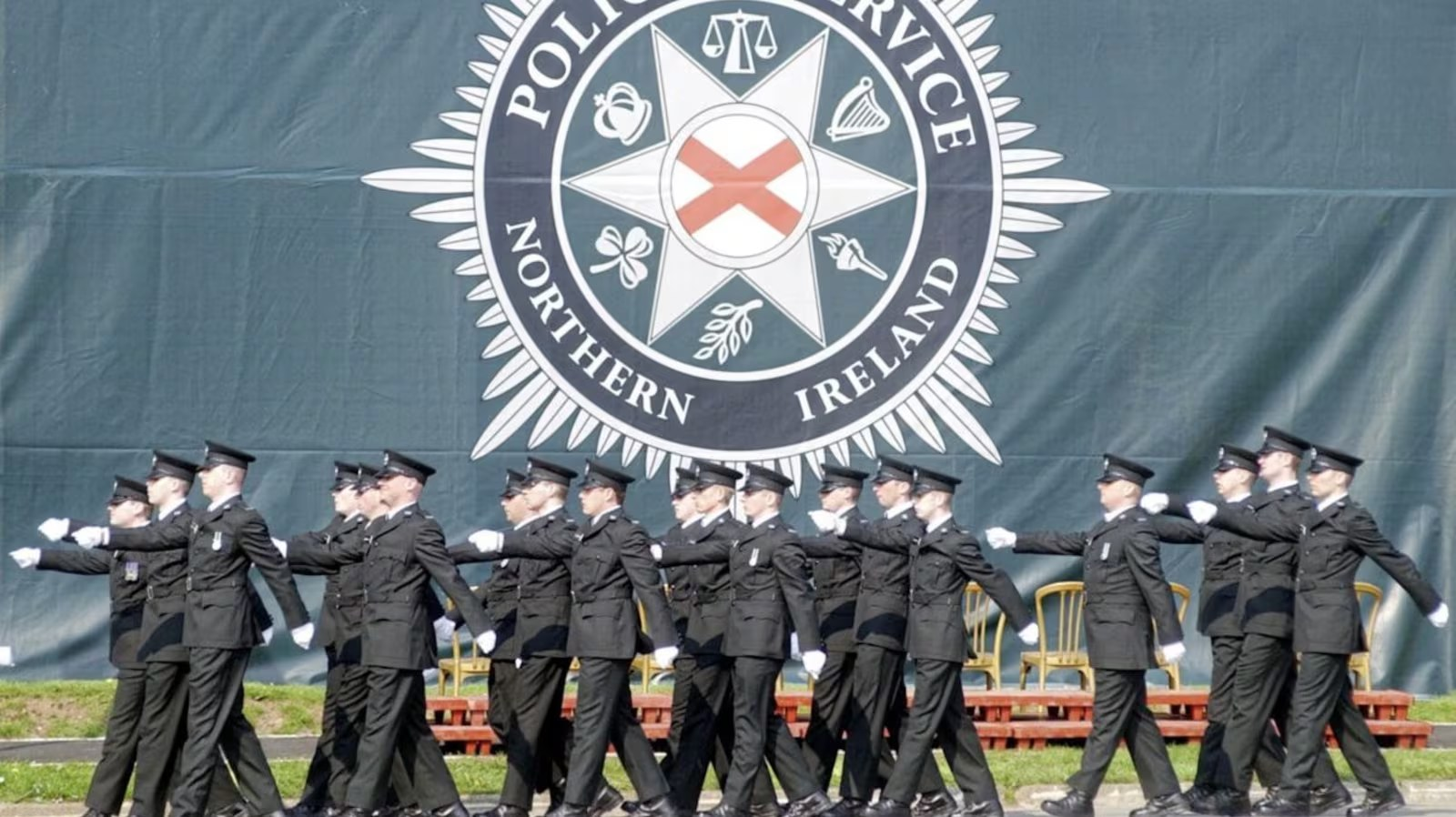
New recruits of the Police Service of Northern Ireland march past the new PSNI logo during the first ever graduation ceremony in Belfast.
By Noel Doran
June 30, 2025 at 6:00am BST
It is hugely disappointing that the PSNI, instead of preparing to celebrate the 25th anniversary of its launch next year as a heartening success story, is having to address fundamental questions about its religious balance.
Past and present flawed political interventions mean that developments which are entirely contrary to the spirit of the new era so painstakingly constructed a quarter of a century ago are growing in seriousness.
It was always envisaged that the PSNI would eventually contain as close to an even number of perceived Catholics and Protestants as possible, with those from other or no faith backgrounds equally welcome.
There were plainly a number of reasons for the fact that its predecessor, the RUC, was overwhelmingly Protestant, but it was agreed on all sides that change must follow as part of the breakthroughs associated with the 1998 Good Friday Agreement.
The GFA established the Patten Commission on policing under the direction of the former British cabinet minister Chris Patten, and, as soon as Maurice Hayes was named as one of its members, I was sure that its work would be transformational.
I had known him since I was a child, as he was a good friend of my late father, and I do not think that I ever met a more accomplished figure who had a sharper insight into all aspects of Irish life, north and south.
Hayes, who died in 2017, and his colleagues produced their visionary report in 1999, recommending the establishment of the PSNI, under the supervision of policing boards and an ombudsman, with a new code of ethics and crucially a policy of 50/50 recruitment for Catholics and Protestants remaining for at least a decade.
It also proposed an emphasis on community policing and normalisation which would include the removal of the GAA’s Rule 21, preventing northern police officers and British soldiers from joining the association.
The attitude of Catholics and nationalists to policing needed to change if a lasting new dispensation was to be achieved, and, as previously noted in this column, The Irish News found itself increasingly close to the sharp end of the debate.
Our initial suggestion that the time had come for the two main nationalist parties to take their seats on the policing boards caused something of a stir, while our repeated calls on the GAA to finally drop Rule 21 were probably even more contentious.
It led to threats of a boycott of the paper from some quarters, but it transpired that both the PSNI arrival and the GAA’s ban departed with much less upheaval than might have been anticipated in the course of November, 2001.
The number of Catholics in the new service rose dramatically from eight per cent at its inception up to almost 30 per cent within less than 10 years, and was heading steadily toward a figure which fairly represented our divided population.
Unfortunately, the then Conservative secretary of state Owen Paterson, who was only in his post for just over two years and shortly afterwards left the British cabinet to become a Brexit campaigner, caved in to unionist pressure and made the disastrous decision to end the 50/50 recruitment policy in 2011.
The most recent figures indicate that the number of Catholic officers who were born in the north, as opposed to moving from across the border or Britain, is roughly 26 per cent, or barely one in four.
It is even more alarming that, according to the result of a Freedom of Information request by this paper last week, Catholics made up just 17.1 per cent of new hires to the PSNI in 2024, representing an unmistakeably negative trend.
While the dreadful attempts to intimidate and target Catholic officers by small but aggressive republican splinter groups are very much a factor, the perception that the PSNI is becoming an institution which is increasingly and disproportionately linked to the Protestant tradition is deeply unhelpful.
The reality that there have always been more applications to the service from Protestants than Catholics means that a 50/50 recruitment policy does not provide equality of opportunity, but wider considerations are involved.
Although the multiple scandals surrounding the investigation into the 1997 murder of the GAA official Sean Brown were initially down to shocking conduct on the part of the RUC, the refusal by the present Labour secretary of state Hilary Benn to allow the public inquiry which the courts have ruled as a necessity has inflicted further reputational damage on the PSNI.
Mr Benn can undo at least some of the harm which this and other cases have caused to the image of policing through starting a review process which would allow the return of 50/50 selection in the short term.